
Testing Architecture for Scalable Systems: Design for Quality
Quick answer
Testing architecture is the structural design of an organization's testing system — how tests are organized, executed, supported by infrastructure, and gated for quality. Scalable systems need a five-layer model (in-process, service contract, integration, system, production validation) built on federated test ownership, ephemeral environments, and distributed execution. Organizations with deliberate testing architecture deploy 4.7x more frequently with 3.1x lower change failure rates.
Reviewed by Sushant Joshi

Testing architecture is the structural design of an organization's testing system. It defines the layers of testing, how tests are organized and executed, what infrastructure supports test execution, how test results flow into quality decisions, and how quality gates enforce standards across CI/CD pipelines. A well-designed testing architecture scales linearly with the system it tests, while a poorly designed one becomes a bottleneck that slows delivery and erodes quality.
Your application architecture and your testing architecture are deeply coupled. A microservices architecture requires a testing architecture that handles hundreds of independently deployable services. A monolithic architecture requires a testing architecture that handles a single, large codebase efficiently. When the testing architecture does not match the application architecture, teams experience slow pipelines, flaky tests, environment contention, and defects escaping through untested integration points.
Most organizations do not design their testing architecture. It emerges organically as teams add tests, adopt tools, and configure pipelines independently. The result is accidental architecture—a collection of disconnected test suites, inconsistent frameworks, duplicated infrastructure, and quality gates that enforce different standards across different teams.
Accidental testing architecture works for small systems. When you have five services and ten developers, ad hoc coordination is sufficient. When you grow to fifty services and a hundred developers, the accidental architecture collapses. Test suites take 90 minutes. Environment contention blocks multiple teams simultaneously. Flaky tests from shared test data create pipeline failures unrelated to code changes. The testing system becomes the primary constraint on delivery velocity.
Organizations that treat testing architecture as a deliberate engineering discipline scale quality alongside delivery. They invest in shared test infrastructure, define clear layer boundaries, automate environment provisioning, and measure testing system performance as rigorously as application performance. The 2025 State of DevOps report found that organizations with deliberate testing architecture deploy 4.7 times more frequently with 3.1 times lower change failure rates.
This guide provides a framework for designing testing architecture that scales with your system. It is intended for test architects, platform engineers, and engineering leaders who need to build testing infrastructure that supports hundreds of services and thousands of tests without becoming a bottleneck. If you have already defined your software testing strategy, this guide shows you how to implement it architecturally.
In this guide
- What Is Testing Architecture?
- Why Testing Architecture Matters for Scalable Systems
- Key Components of a Scalable Testing Architecture
- Layered Testing Architecture Model
- Tools for Scalable Testing Architecture
- Testing architecture in practice: a worked example
- Testing architecture challenges and how to solve them
- Testing architecture best practices
- Testing Architecture Checklist
- Test infrastructure that scales with the number of services
- Testing architecture FAQ
What Is Testing Architecture?
Testing architecture encompasses four interconnected systems:
Test Organization System: How tests are structured, categorized, and mapped to application components. This includes naming conventions, directory structures, test tagging schemes, and the mapping between tests and the risks they mitigate.
Test Execution System: How tests are run, parallelized, and scheduled. This includes CI/CD pipeline design, test runner configuration, resource allocation, and execution ordering. The execution system determines how fast you get feedback.
Test Infrastructure System: The computing resources, environments, tools, and services that support test execution. This includes test clusters, ephemeral environments, service virtualization, test data services, and artifact caching. The infrastructure system determines how much testing you can run concurrently.
Test Intelligence System: The analytics, reporting, and decision-making layer. This includes test result aggregation, flaky test detection, test impact analysis, coverage tracking, and quality gate enforcement. The intelligence system determines how effectively you use test results to make release decisions.
A complete testing architecture integrates all four systems into a cohesive platform that teams consume through standard interfaces. Teams interact with the architecture through CI/CD templates, CLI tools, and dashboards—not by managing infrastructure directly.
The architecture builds on DevOps testing principles and extends them with the structural rigor needed for systems at scale. For teams implementing test automation frameworks, the testing architecture provides the execution and infrastructure context those frameworks operate within.
Multi-tenant products add a failure mode nothing else on this list has — testing strategy for SaaS platforms covers the tenancy boundary tests.
For the tool comparison behind this — Prism, WireMock, Microcks, MockServer and the rest — see the best API mocking and service virtualization tools.
The data layer under all of this has its own failure modes — database testing strategies for DevOps teams covers migrations, isolation and rollback.
Running the suite inside the cluster it is testing is covered in testing strategy for cloud-native applications.
Functions need a different split between local, emulated and deployed tests — see testing strategy for serverless architectures.
For where each test level starts and stops, see unit vs integration vs system testing.
If the service runs on Kubernetes, running the suite in-cluster removes a whole class of false confidence — see API testing in Kubernetes.
Why Testing Architecture Matters for Scalable Systems
Test Execution Time Grows Nonlinearly
As the number of services and tests grows, execution time increases nonlinearly unless the architecture actively manages it. A test suite that takes 5 minutes for 10 services might take 90 minutes for 50 services if tests run sequentially, environments are shared, and there is no test impact analysis. The architecture must ensure that feedback time remains constant as the system scales.
Environment Contention Blocks Multiple Teams
Shared test environments become bottlenecks when multiple teams need them simultaneously. One team's failed deployment corrupts the shared staging environment and blocks five other teams from testing. Without architectural solutions—ephemeral environments, service virtualization, namespace isolation—environment contention scales linearly with team count.
Test Data Conflicts Cause Flaky Tests
Shared test databases are the single largest source of flaky tests in distributed systems. When multiple test suites write to the same database simultaneously, tests interfere with each other unpredictably. The testing architecture must provide isolated test data for each test execution.
Quality Standards Diverge Across Teams
Without architectural enforcement, quality standards become suggestions rather than requirements. One team enforces 80% code coverage while another has none. The testing architecture must embed quality gates in shared infrastructure so that standards are enforced automatically rather than culturally.
Key Components of a Scalable Testing Architecture
Federated Test Ownership
Each service team owns the tests for their service. Tests live in the same repository as the service code, run in the service's CI/CD pipeline, and are maintained by the service's developers. This is the foundational organizational principle of scalable testing architecture.
Cross-service tests—integration and end-to-end—are owned by platform teams, quality engineering teams, or shared between the provider and consumer teams through contract testing agreements.
Ready to shift left with your API testing?
Try our no-code API test automation platform free. Generate tests from OpenAPI, run in CI/CD, and scale quality.
Distributed Test Execution
Test execution must be distributed across many parallel runners to maintain fast feedback. Use container-based test runners (Kubernetes Jobs, GitHub Actions runners, GitLab runners) that scale horizontally based on demand. Allocate dedicated compute resources for test execution rather than sharing with other workloads.
Implement test sharding—splitting test suites across multiple runners—so that a suite of 1,000 tests runs in 10 parallel shards of 100 tests each. This reduces feedback time from 30 minutes to 3 minutes without changing the tests themselves.
Ephemeral Environment Provisioning
Every integration and system test should run in a freshly provisioned environment that is torn down after the tests complete. This eliminates environment contention, ensures clean baselines, and prevents test data pollution. Use Kubernetes namespaces, Docker Compose environments, or cloud sandboxes depending on your infrastructure.
The provisioning system should be self-service: teams request an environment through a pipeline template or CLI command, and the platform provisions it within minutes. Shift-Left API integrates with ephemeral environments to run automated API tests against freshly deployed services.
Service Virtualization Layer
Not every dependency needs to be real during testing. Service virtualization provides realistic simulations of external services, third-party APIs, and slow internal dependencies. This reduces environment complexity, improves test reliability, and enables teams to test against dependencies that are expensive or unavailable.
The virtualization layer sits between the service under test and its dependencies, intercepting API calls and returning configured responses. It can simulate latency, errors, and edge cases that are difficult to reproduce with real services.
Test Intelligence Platform
Build a centralized platform that col
lects and analyzes test results from all teams:
- Flaky test detection: Automatically identify tests that fail intermittently and quarantine them.
- Test impact analysis: Determine which tests are affected by a code change and run only those tests for fast feedback.
- Coverage aggregation: Compute organization-wide test coverage across all services and test layers.
- Quality gate enforcement: Automatically block deployments that do not meet quality thresholds.
- Trend analysis: Track testing metrics over time to identify degrading quality or improving maturity.
API Testing Layer
In distributed architectures, the API layer is the most cost-effective point for catching defects. An automated API testing layer using Shift-Left API generates tests from OpenAPI specifications, runs them on every deployment, and validates that contracts between services are honored. This layer sits between unit tests and full integration tests, catching the defects that are too integration-specific for unit tests and too numerous for end-to-end tests.
Layered Testing Architecture Model
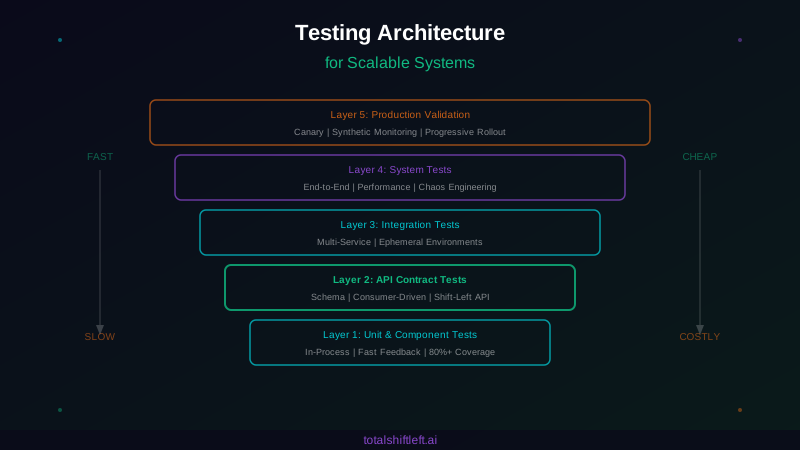
The scalable testing architecture follows a five-layer model, mirroring the application architecture:
Layer 1: In-Process Tests — Unit and component tests that run within the service's build process. No external dependencies. Target: 80%+ code coverage, under 2 minutes execution. Owned by the service team.
Layer 2: Service Contract Tests — API schema validation, consumer-driven contract tests, and automated API tests generated from OpenAPI specs. Validates that each service's interface conforms to its published contract. Target: all public API endpoints covered, under 3 minutes execution. Owned by the service team with Shift-Left API automation.
Layer 3: Integration Tests — Tests that deploy the service under test with its real dependencies in an ephemeral environment. Validates data flow, error propagation, and eventual consistency behavior. Target: all critical integration paths covered, under 10 minutes execution. Owned by the service team.
Layer 4: System Tests — End-to-end tests that exercise complete user journeys across the full system in a staging environment. Target: 10-20 critical business journeys, under 20 minutes execution. Owned by a quality engineering or platform team.
Layer 5: Production Validation — Canary deployments, synthetic monitoring, and progressive rollouts in production. Not traditional testing but a quality assurance mechanism that catches environment-specific issues. Owned by the platform and SRE teams.
The architecture enforces a key principle: each layer catches a different class of defects, and defects should be caught at the lowest (cheapest, fastest) layer possible. Teams that invest heavily in Layer 2 (API contract testing) consistently have the lowest defect escape rates because they catch integration defects without the cost of full environment deployment. Generating that layer through schema-aware test generation from each service's OpenAPI spec is what lets the contract-test layer keep pace as the number of services grows.
Tools for Scalable Testing Architecture
| Tool | Type | Best For | Open Source |
|---|---|---|---|
| Shift-Left API | API Testing | Automated API test generation and contract validation | No |
| Testcontainers | Integration Testing | Running dependencies in containers for isolated testing | Yes |
| Playwright | E2E Testing | Parallel cross-browser end-to-end test execution | Yes |
| k6 | Performance Testing | Distributed load testing at scale | Yes |
| Pact Broker | Contract Testing | Centralized contract management and verification | Yes |
| BuildKit | Build Infrastructure | Distributed container builds with caching | Yes |
| Allure TestOps | Test Reporting | Centralized test analytics and intelligence | No |
| Launchable | Test Intelligence | ML-powered test impact analysis and selection | No |
| WireMock Cloud | Service Virtualization | API mocking and service simulation at scale | No |
| Grafana + Prometheus | Observability | Test infrastructure monitoring and dashboards | Yes |
| Argo Workflows | Test Orchestration | Kubernetes-native test pipeline orchestration | Yes |
| MinIO | Artifact Storage | S3-compatible test artifact caching | Yes |
Testing architecture in practice: a worked example
Problem: A SaaS platform with 80 microservices experienced a testing crisis. The CI/CD pipeline took 75 minutes end-to-end. Teams waited an average of 3 hours for shared staging environments. Flaky tests accounted for 30% of pipeline failures. End-to-end test suites took 45 minutes and tested scenarios that overlapped extensively with unit and API tests. The testing bottleneck reduced deployment frequency from the target of daily to once per week.
Solution: They redesigned their testing architecture around the five-layer model:
- Standardized unit test frameworks across all services with 80% coverage gates enforced in Layer 1.
- Implemented Shift-Left API at Layer 2 to generate API contract tests for all 80 services automatically, replacing 60% of their end-to-end test scenarios.
- Built an ephemeral environment platform using Kubernetes namespaces, eliminating the shared staging bottleneck. Each PR got its own namespace with the changed service and its direct dependencies.
- Deployed test sharding across 20 parallel runners, reducing Layer 3 integration test execution from 30 minutes to 4 minutes.
- Reduced end-to-end scenarios from 300 to 40 critical business journeys at Layer 4.
- Built a test intelligence platform that tracked flakiness, enforced quality gates, and provided test impact analysis.
Results: Pipeline execution dropped from 75 minutes to 12 minutes. Environment wait time dropped from 3 hours to 0 (ephemeral environments provisioned per PR). Flaky test rate dropped from 30% to 3% through quarantine and fix sprints. Defect escape rate to production decreased by 55%. Deployment frequency increased from weekly to 8 times per day. The testing architecture became a competitive advantage rather than a bottleneck.
Free Guided worksheet
Build Your Testing Strategy in 30 Minutes
A structured worksheet that walks you through defining your testing strategy in 30 minutes. Cover architecture, tools, layers, and team responsibilities.
Download FreeTesting architecture challenges and how to solve them
Challenge: Infrastructure Cost of Ephemeral Environments
Provisioning a full environment for every PR is expensive when you have many services and frequent PRs.
Solution: Deploy only the changed service and its direct dependencies, not the entire system. Use resource quotas to limit compute allocation per namespace. Implement automatic TTLs that destroy namespaces after inactivity. Use spot instances for test infrastructure. Monitor and optimize costs weekly.
Challenge: Test Intelligence Requires Historical Data
Test impact analysis and flaky test detection require weeks or months of historical data before they become useful.
Solution: Start collecting test execution data immediately, even before implementing intelligence features. Use simple heuristics initially (run tests that map to changed files) and graduate to ML-based analysis as data accumulates. Most organizations see useful flaky test detection within two weeks of data collection.
Challenge: Migrating from Monolithic Test Suites
Many organizations have large, monolithic test suites that cannot be easily decomposed into layers.
Solution: Identify the highest-value tests for migration first—typically API-level tests that verify business logic without UI dependencies. Use test automation strategy principles to refactor tests into the appropriate layers progressively. Do not attempt a big-bang migration; move tests layer by layer over multiple sprints.
Challenge: Cross-Team Standards Adoption
Teams resist adopting shared test infrastructure because their existing approach works for their team, even if it does not work at scale.
Solution: Make the shared platform the path of least resistance. Provide pre-built pipeline templates that are easier to use than building a custom pipeline. Demonstrate the value through metrics: faster feedback, fewer flaky tests, no environment contention. Involve team leads in platform design so they have ownership over the solution.
Challenge: Service Virtualization Accuracy
Mock services that do not accurately reflect real service behavior can mask defects or create false failures.
Solution: Generate service virtualizations from real API traffic recordings. Keep virtualizations synchronized with service contracts using Shift-Left API and OpenAPI specifications. Run periodic validation tests that compare virtualization responses with real service responses. Alert when drift is detected.
Testing architecture best practices
- Design testing architecture deliberately rather than letting it emerge organically—accidental architecture does not scale
- Follow the five-layer model: in-process, contract, integration, system, production validation
- Invest most heavily in Layer 2 (API contract testing) for distributed systems—it provides the best defect detection ROI
- Use ephemeral environments for all integration and system testing to eliminate contention and data pollution
- Implement test sharding and parallel execution to maintain fast feedback as test suites grow
- Build a test intelligence platform that detects flaky tests, performs impact analysis, and enforces quality gates
- Federate test ownership—the team that owns the service owns its tests at Layers 1-3
- Standardize test frameworks across the organization to reduce maintenance burden and enable cross-team contribution
- Monitor testing architecture performance metrics: execution time, flaky rate, environment provisioning time, cost per test run
- Use Shift-Left API to automate the API testing layer and ensure contract compliance across all services
- Treat testing infrastructure as a product—with a roadmap, SLAs, and dedicated engineering capacity
- Review and evolve the testing architecture quarterly as the application architecture changes
Testing Architecture Checklist
- ✔ Document the testing architecture with clear layer definitions and ownership
- ✔ Implement federated test ownership with service teams owning Layers 1-3
- ✔ Deploy distributed test execution with parallel runners and test sharding
- ✔ Build ephemeral environment provisioning for integration and system testing
- ✔ Implement service virtualization for external and expensive dependencies
- ✔ Deploy automated API contract testing at Layer 2 using Shift-Left API
- ✔ Build a test intelligence platform with flaky detection and impact analysis
- ✔ Enforce quality gates automatically in CI/CD pipelines
- ✔ Standardize test frameworks and pipeline templates across teams
- ✔ Configure test result aggregation and centralized reporting dashboards
- ✔ Set execution time budgets for each testing layer
- ✔ Implement test infrastructure cost monitoring and optimization
- ✔ Schedule quarterly testing architecture reviews
- ✔ Maintain documentation on test infrastructure SLAs and capabilities
Test infrastructure that scales with the number of services
The architecture question is where the shared pieces live. Per-service containers scale linearly; a shared staging environment does not. This is the pattern that holds at 50 services:
# platform/testing/harness.py — one package, imported by every service repo
import pytest
from testcontainers.compose import DockerCompose

@pytest.fixture(scope="session")
def stack(request):
    """
    Each service brings up only its own direct dependencies.
    Everything further out is a spec-driven mock, not a real deployment —
    which is what keeps startup time flat as the estate grows.
    """
    compose_file = request.config.getoption("--stack", default="test-stack.yml")
    with DockerCompose(".", compose_file_name=compose_file, pull=True) as c:
        c.wait_for("http://localhost:8080/health")
        yield c
The stack file makes the boundary explicit — real for what you own, mocked from the contract for what you do not:
# test-stack.yml
services:
  orders-api:                     # the service under test — real
    build: .
    ports: ['8080:8080']
    environment:
      DATABASE_URL: postgresql://postgres:test@db/postgres
      INVENTORY_URL: http://inventory-mock:4010
      BILLING_URL: http://billing-mock:4011

  db:                             # direct dependency — real
    image: postgres:16-alpine
    environment: { POSTGRES_PASSWORD: test }

  inventory-mock:                 # someone else's service — mocked from its spec
    image: stoplight/prism:4
    command: mock -h 0.0.0.0 /specs/inventory.yaml --dynamic
    volumes: ['./specs:/specs:ro']

  billing-mock:
    image: stoplight/prism:4
    command: mock -h 0.0.0.0 -p 4011 /specs/billing.yaml --dynamic
    volumes: ['./specs:/specs:ro']
Testing architecture FAQ
What is testing architecture?
Testing architecture is the structural design of an organization's testing system. It defines the layers of testing, how tests are organized and executed, what infrastructure supports test execution, how test results are collected and analyzed, and how quality gates are enforced in CI/CD pipelines.
How do you design a testing architecture for microservices?
Design testing architecture for microservices by implementing five layers: in-process testing (unit and component), service interface testing (API contracts), integration testing (multi-service), system testing (end-to-end), and production validation (monitoring and canary). Each service owns its first two layers while shared infrastructure supports the upper layers.
What is the test pyramid and how does it apply to scalable systems?
The test pyramid is a model that recommends many fast unit tests at the base, fewer integration tests in the middle, and minimal end-to-end tests at the top. For scalable systems, the pyramid is extended with an API contract testing layer between unit and integration, which is the most cost-effective layer for catching defects in distributed architectures.
How do you scale test execution across many services?
Scale test execution using distributed test runners, parallel execution across containers, test impact analysis to run only affected tests, shared test infrastructure provisioned on-demand, and centralized test result aggregation. The goal is to maintain fast feedback loops even as the number of services and tests grows.
What infrastructure do you need for testing at scale?
Testing at scale requires container-based test execution clusters, ephemeral environment provisioning, service virtualization for dependency isolation, test data management services, centralized test reporting, and distributed caching for test artifacts. Build this as a platform that teams consume through APIs and CLI tools.
Sources and further reading
- Martin Fowler — The Practical Test Pyramid — the reference argument for test-layer proportions.
- Testcontainers — throwaway real dependencies for integration tests.
- Kubernetes documentation — the platform primitives cloud-native tests run on.
Key takeaways
- Testing architecture is the hidden infrastructure that determines whether your testing strategy succeeds or fails at scale.
- You can have the best testing strategy on paper, but without the execution system, environment provisioning, test intelligence, and infrastructure to support it, the strategy remains theoretical.
- Design your testing architecture deliberately. Implement the five-layer model.
- Invest in ephemeral environments and distributed execution. Build test intelligence that makes quality decisions automatic.
- And invest most heavily in the API contract testing layer—it delivers the highest return on investment for distributed systems.
If you are ready to automate the API contract testing layer of your testing architecture, start your free trial of Shift-Left API and generate comprehensive API tests for all your services from OpenAPI specifications.
Related: DevOps Testing Complete Guide | Software Testing Strategy for Modern Applications | Enterprise Testing Strategy Guide | Test Automation Strategy | How to Build a Test Automation Framework | Automated Testing in CI/CD
Ready to shift left with your API testing?
Try our no-code API test automation platform free.