
Software Testing Strategy for Modern Applications (2026)
Quick answer
A software testing strategy is a documented plan defining what to test, when, how, and who's responsible across the SDLC — covering test levels, tools, environments, and quality gates. For modern applications it maps to a five-layer architecture: in-process unit tests, API/contract tests, integration tests, system-level E2E tests, and production validation (canary, synthetic monitoring). Teams with an architecture-aware strategy resolve defects 67% faster and release 2.4x more often than those without one.
Reviewed by Sushant Joshi

A software testing strategy is a comprehensive plan that defines the approach, scope, tools, and responsibilities for testing across the entire software development lifecycle. It aligns test activities with application architecture, team structure, and delivery velocity to ensure quality at every stage from code commit to production deployment.
Modern applications are not the monoliths of a decade ago. They are distributed systems of microservices, APIs, event-driven workflows, cloud-native deployments, and increasingly, AI-powered features. A testing strategy built for a simpler era will not protect you in this environment. Teams that test modern applications with outdated approaches spend 40% more time on bug fixes post-release and experience three times more production incidents than those with strategies designed for distributed architectures.
The complexity of modern software has outpaced the testing practices most organizations rely on. Applications that once ran as single deployable units now consist of dozens or hundreds of microservices, each with its own release cycle, data store, and API surface. Cloud-native infrastructure adds ephemeral compute, container orchestration, and multi-region deployment to the mix. AI features introduce probabilistic behavior that traditional deterministic tests cannot verify.
According to the 2025 State of Testing report, organizations with a documented, architecture-aware testing strategy resolve production defects 67% faster and release 2.4 times more frequently than those without one. The strategy is not a bureaucratic exercise—it is the operational blueprint that makes continuous delivery possible without continuous failure.
This guide provides a complete framework for building a software testing strategy that addresses the realities of modern application development in 2026. It covers what to test, how to structure your test architecture, which tools to deploy at each layer, and how platforms like Shift-Left API automate the API testing layer that sits at the center of every distributed system. If you are building on shift-left testing principles, this guide shows you how to operationalize them across your entire stack.
In this guide
- What Is a Software Testing Strategy?
- Why Modern Applications Need a New Testing Approach
- Key Components of a Modern Testing Strategy
- Testing Architecture for Modern Stacks
- Tools for Modern Application Testing
- Software testing strategy in practice: a worked example
- Software testing strategy challenges and how to solve them
- Software testing strategy best practices
- Software Testing Strategy Checklist
- Write the strategy as configuration the pipeline reads
- Software testing strategy FAQ
At the API layer a strategy becomes three concrete artifacts: the nine types of API testing to decide what to cover, how to write API test cases for the template, naming and boundary examples, and the API testing checklist to confirm nothing was skipped before a release.
What Is a Software Testing Strategy?
A software testing strategy is a documented framework that defines the organization's approach to quality assurance across the software development lifecycle. Unlike a test plan—which details specific test cases for a single release—a testing strategy establishes the overarching principles, structures, and standards that guide all testing activities.
A well-defined testing strategy answers five fundamental questions:
- What to test: Which layers of the application require automated tests, manual exploration, or both?
- When to test: At which stages of the pipeline do different test types execute?
- How to test: What frameworks, tools, and patterns will the team use?
- Who tests: Are developers, QA engineers, or platform teams responsible for each test type?
- What defines quality: What metrics, coverage targets, and quality gates must be met before release?
The strategy acts as a contract between engineering, QA, product, and operations. It ensures that everyone agrees on the definition of "tested" and that the pipeline enforces that definition automatically. For teams operating in a DevOps testing model, the strategy also specifies how testing integrates with CI/CD pipelines and deployment automation.
Modern testing strategies are living documents. They evolve as the application architecture changes, as new services are added, and as the team learns from production incidents. A strategy that was adequate for a three-service application will not scale to thirty services without deliberate revision.
Multi-tenant products add a failure mode nothing else on this list has — testing strategy for SaaS platforms covers the tenancy boundary tests.
Running the suite inside the cluster it is testing is covered in testing strategy for cloud-native applications.
Functions need a different split between local, emulated and deployed tests — see testing strategy for serverless architectures.
If the layer boundaries are the open question, unit vs integration vs system testing covers them with examples.
Why Modern Applications Need a New Testing Approach
Distributed Architecture Breaks Traditional Testing
Monolithic applications had a single deployment unit and a predictable execution path. You could run end-to-end tests against a fully assembled system and have reasonable confidence in the result. Modern microservices architectures shatter this model. Each service is independently deployed, versioned, and scaled. Testing a single service in isolation tells you nothing about how it behaves when integrated with the twenty other services it depends on.
API contract testing, service virtualization, and consumer-driven contracts are now essential—not optional. Your testing strategy must explicitly account for the interfaces between services, not just the logic within them. This is where API testing strategy for microservices becomes foundational.
Cloud-Native Infrastructure Introduces New Failure Modes
Containers, Kubernetes orchestration, serverless functions, and managed services add infrastructure-level failure modes that traditional application testing never considered. A service that passes all unit and integration tests can still fail in production because of resource limits, network policies, DNS resolution timing, or cold start latency.
Your testing strategy must include infrastructure validation: Helm chart testing, Terraform plan verification, resource limit validation, and chaos engineering experiments that prove the system recovers from infrastructure failures.
AI Features Demand Probabilistic Testing
AI-powered features—recommendation engines, natural language processing, computer vision, generative AI—produce outputs that vary across invocations. Traditional assertion-based testing that expects exact outputs cannot validate these features. Your strategy needs statistical validation, output distribution testing, bias detection, and human-in-the-loop evaluation for AI components.
Release Velocity Requires Automated Confidence
Teams deploying multiple times per day cannot rely on manual regression testing. Every test in the critical path must be automated, fast, and reliable. Flaky tests that pass 95% of the time are not acceptable when you deploy 20 times daily—that means one false failure per day blocking your pipeline. A modern testing strategy prioritizes test reliability as aggressively as test coverage.
Ready to shift left with your API testing?
Try our no-code API test automation platform free. Generate tests from OpenAPI, run in CI/CD, and scale quality.
Key Components of a Modern Testing Strategy
Test Level Definition
Define which test levels your organization uses and what each level is responsible for verifying. Most modern strategies include:
- Unit tests: Verify individual functions and classes in isolation. Target 80%+ code coverage for business logic.
- Component tests: Validate a single service end-to-end using mocked dependencies. Verify API contracts, database interactions, and error handling.
- Integration tests: Confirm that two or more services communicate correctly through real interfaces. Focus on contract compliance and data consistency.
- End-to-end tests: Validate critical user journeys across the full system. Keep these minimal—10 to 15 scenarios covering the most important business flows.
- Non-functional tests: Cover performance, security, accessibility, and reliability. These run on a schedule or as quality gates for major releases.
Test Automation Framework Selection
Choose frameworks that align with your technology stack and team skills. Standardize on a small number of tools rather than allowing each team to choose independently. Framework sprawl creates maintenance burden and knowledge silos. For guidance on framework selection, see How to Build a Test Automation Framework.
CI/CD Pipeline Integration
Every test level must have a designated stage in the pipeline. Unit and component tests run on every commit. Integration tests run on pull request merges. End-to-end and performance tests run on staging deployments. Define clear pass/fail criteria for each stage and ensure the pipeline halts on failure. Teams building automated testing in CI/CD pipelines need explicit gate definitions.
Environment Strategy
Define how test environments are provisioned, managed, and torn down. Modern strategies use ephemeral environments that spin up on demand for integration testing and tear down after the pipeline completes. This eliminates environme
nt contention and ensures tests run against a known baseline.
Test Data Management
Establish how test data is created, maintained, and cleaned. Shared test databases are a primary source of flaky tests. Use factories, fixtures, or synthetic data generation to ensure each test run starts from a predictable state. For API testing, tools like Shift-Left API can generate realistic test data from OpenAPI specifications automatically.
Quality Metrics and Reporting
Define the metrics that indicate testing health: code coverage by service, test pass rates, mean time to detect defects, flaky test rates, and defect escape rates to production. Publish these metrics on a shared dashboard and review them in sprint retrospectives.
Testing Architecture for Modern Stacks
The testing architecture for a modern application mirrors the application architecture itself. In a microservices-based system, each service has its own test suite running in its own pipeline, while cross-service tests run in a shared integration pipeline.
The architecture follows a layered model:
Layer 1: In-Process Testing — Unit and component tests run within the service's build process. These tests use in-memory databases, mocked external dependencies, and the service's own test harness. Execution time target: under 2 minutes.
Layer 2: Service Interface Testing — API contract tests and consumer-driven contract tests validate that each service's API conforms to the expected schema and behavior. Tools like Pact, Schemathesis, or Shift-Left API automate this layer through schema-aware test generation that derives tests directly from API specifications. This is the most cost-effective testing layer for distributed systems.
Layer 3: Integration Testing — Tests that deploy two or more real services in a controlled environment and validate their interaction. These tests focus on data flow, error propagation, and eventual consistency behavior. Execution time target: under 10 minutes.
Layer 4: System Testing — End-to-end tests that exercise complete user journeys across the full system. These tests run against a staging environment that mirrors production. Execution time target: under 20 minutes for the full suite.
Layer 5: Production Validation — Synthetic monitoring, canary deployments, and feature flag-controlled rollouts that validate behavior in the production environment. This is not traditional testing but a quality validation layer that catches environment-specific defects.
This layered architecture ensures that the majority of defects are caught at the cheapest, fastest layers (1 and 2) while still providing confidence at the system level (layers 4 and 5). For a deeper dive into designing test architectures, see the companion article on testing architecture for scalable systems.
Tools for Modern Application Testing
| Tool | Type | Best For | Open Source |
|---|---|---|---|
| Jest / Vitest | Unit Testing | JavaScript/TypeScript applications | Yes |
| pytest | Unit Testing | Python services and data pipelines | Yes |
| JUnit 5 | Unit Testing | Java and Kotlin microservices | Yes |
| Shift-Left API | API Testing | Automated API test generation from OpenAPI specs | No |
| Pact | Contract Testing | Consumer-driven contract validation | Yes |
| Playwright | E2E Testing | Cross-browser UI testing with API interception | Yes |
| k6 | Performance Testing | Load testing with JavaScript scripting | Yes |
| OWASP ZAP | Security Testing | API and web application security scanning | Yes |
| Testcontainers | Integration Testing | Spinning up real dependencies in containers | Yes |
| Cypress | E2E Testing | Component and integration testing for web apps | Yes |
| Schemathesis | API Testing | Property-based testing from OpenAPI schemas | Yes |
| Terraform Test | Infrastructure Testing | Validating infrastructure-as-code changes | Yes |
The tool selection must align with your team's skills and your architecture's requirements. Avoid adopting tools that require specialized expertise your team does not have. The best tool is the one your team will actually use consistently.
Software testing strategy in practice: a worked example
Problem: A fintech company with 45 microservices was experiencing an average of 12 production incidents per month. Their testing strategy was a holdover from their monolithic era: extensive manual regression testing before monthly releases, minimal API testing, and no contract validation between services. When they moved to continuous deployment, the manual testing bottleneck forced them to either skip testing or delay releases.
Solution: They implemented a layered testing strategy aligned with their microservices architecture:
- Each service received a comprehensive unit test suite with 85% coverage targets enforced in CI.
- They adopted Shift-Left API to auto-generate API tests from their OpenAPI specifications, covering all 45 services' API surfaces without manual test authoring.
- Consumer-driven contracts were established between critical service pairs using Pact.
- End-to-end tests were reduced from 500 scenarios to 25 critical business journeys.
- Performance tests ran nightly against staging with automated alerts for regression.
- Canary deployments with automated rollback provided production validation.
Results: Production incidents dropped from 12 per month to 2 within three months. Deployment frequency increased from monthly to 15 times per week. Mean time to detect defects fell from 4 days to 35 minutes. The team eliminated the manual QA bottleneck entirely and redeployed QA engineers as quality coaches embedded in development teams.
Free Guided worksheet
Build Your Testing Strategy in 30 Minutes
A structured worksheet that walks you through defining your testing strategy in 30 minutes. Cover architecture, tools, layers, and team responsibilities.
Download FreeSoftware testing strategy challenges and how to solve them
Challenge: Test Flakiness Undermines Confidence
Flaky tests that intermittently fail without code changes erode team trust in the test suite. Developers begin ignoring failures, and the safety net dissolves.
Solution: Track flaky test rates as a first-class metric. Quarantine flaky tests immediately—move them to a non-blocking suite and fix them within one sprint. Invest in deterministic test infrastructure: isolated environments, controlled time, stable test data, and retry-aware assertions for eventually consistent systems.
Challenge: Slow Test Suites Block Deployment
When test suites take 45 minutes or more, developers context-switch away from the code under test. Feedback loops lengthen and defects accumulate.
Solution: Enforce execution time budgets at each test level. Parallelize test execution across containers. Use test impact analysis to run only the tests affected by the changed code. Push slow tests to asynchronous pipelines that run in parallel with deployment to staging.
Challenge: Microservice Integration Gaps
Teams test their services in isolation but miss defects that emerge when services interact. Schema changes in one service break consumers silently.
Solution: Implement contract testing between all service pairs that communicate directly. Use schema registries to version API contracts. Run integration tests in ephemeral environments that deploy the changed service alongside its direct dependencies.
Challenge: Environment Parity Issues
Tests pass in CI but fail in staging or production because environments differ in configuration, data, or infrastructure.
Solution: Use infrastructure-as-code to ensure all environments are provisioned identically. Containerize test dependencies. Maintain a production-like dataset for staging that is refreshed weekly. Validate environment parity as part of the deployment pipeline.
Challenge: Test Ownership Ambiguity
When no one owns the tests, no one fixes them. Shared test suites decay as teams add tests without maintaining existing ones.
Solution: Assign clear ownership for each test suite to a specific team. The team that owns the service owns its tests. Cross-service integration tests are owned by a platform quality team or shared between the consuming and providing teams with explicit agreements.
Software testing strategy best practices
- Treat your testing strategy as a living document—review and update it quarterly as your architecture evolves
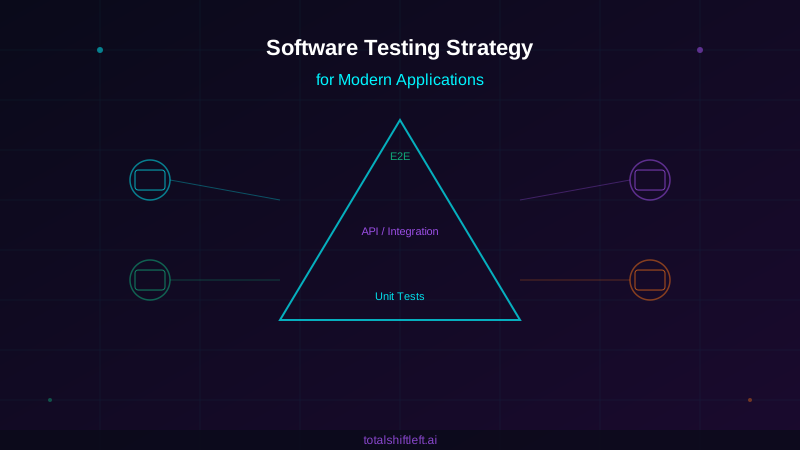
- Adopt the test pyramid as a structural principle: many fast unit tests, fewer integration tests, minimal end-to-end tests
- Automate every test that runs more than once; manual testing should be reserved for exploratory testing and usability evaluation
- Enforce quality gates in CI/CD that block deployments when tests fail—no exceptions, no manual overrides
- Invest in test automation strategy tooling that generates tests from specifications to eliminate the coverage gap between API changes and test updates
- Measure test effectiveness by defect escape rate, not just code coverage percentage
- Use feature flags to decouple deployment from release, enabling testing in production without user exposure
- Run performance tests on every staging deployment, not just before major releases
- Implement chaos engineering practices to validate resilience assumptions in your testing strategy
- Standardize test frameworks across teams to reduce maintenance burden and enable cross-team contribution
- Keep end-to-end test suites under 30 minutes—if they take longer, you are testing too much at the wrong level
- Build observability into your testing: log test execution metrics, failure patterns, and flakiness trends
Software Testing Strategy Checklist
- ✔ Document the testing strategy and share it with all engineering teams
- ✔ Define test levels aligned with your application architecture
- ✔ Assign clear ownership for each test suite to a specific team
- ✔ Standardize test frameworks and tooling across the organization
- ✔ Integrate all automated tests into CI/CD pipelines with quality gates
- ✔ Implement API contract testing for all service interfaces
- ✔ Establish test data management practices that ensure deterministic results
- ✔ Set up ephemeral test environments for integration testing
- ✔ Configure test execution time budgets for each pipeline stage
- ✔ Track and publish testing metrics on a shared dashboard
- ✔ Quarantine and fix flaky tests within one sprint of detection
- ✔ Run performance and security tests on a regular schedule
- ✔ Review and update the strategy quarterly
- ✔ Conduct chaos engineering experiments monthly in staging
Write the strategy as configuration the pipeline reads
A strategy document is read once. The same decisions as a policy file are read on every build — and can be reviewed, versioned and diffed like anything else:
# testing-strategy.yaml
version: 1
principles:
  - "Every test lives at the cheapest layer that can prove the property."
  - "A test that cannot fail the build is documentation, not a test."
layers:
  unit:
    scope: "Pure logic, no I/O."
    target_share: 0.70
    max_duration_seconds: 120
    gate: { coverage_min: 80 }
  integration:
    scope: "One service plus its real dependencies, via containers."
    target_share: 0.20
    max_duration_seconds: 600
  contract:
    scope: "Provider and consumer expectations, verified independently."
    target_share: 0.08
    gate: { breaking_changes: block }
  e2e:
    scope: "Revenue-critical journeys only."
    target_share: 0.02
    max_cases: 15                 # a hard cap, deliberately
non_functional:
  performance: { p99_ms: 500, run_on: [pull_request] }
  security:    { scanner: zap, findings: { critical: block, high: block } }
  accessibility: { run_on: [nightly] }
Then assert the shape is real. A pyramid that inverts quietly is the most common way a strategy stops being true:
# scripts/check_test_shape.py
import yaml, subprocess, json

policy = yaml.safe_load(open("testing-strategy.yaml"))["layers"]
counts = {layer: int(subprocess.run(
    ["pytest", f"tests/{layer}", "--collect-only", "-q"],
    capture_output=True, text=True).stdout.strip().split()[-2])
    for layer in policy}

total = sum(counts.values())
for layer, cfg in policy.items():
    share = counts[layer] / total
    target = cfg["target_share"]
    flag = "" if abs(share - target) <= 0.10 else "  <-- drifted"
    print(f"{layer:<12} {counts[layer]:>5} tests  {share:6.1%} (target {target:.0%}){flag}")
Software testing strategy FAQ
What is a software testing strategy?
A software testing strategy is a systematic plan that defines what to test, when to test, how to test, and who is responsible for testing across the software development lifecycle. It covers test levels, types, tools, environments, and quality gates to ensure applications meet functional, performance, and security requirements.
How do you create a testing strategy for modern applications?
Start by mapping your application architecture to test levels: unit tests for individual services, API contract tests for service interfaces, integration tests for workflows, and end-to-end tests for critical paths. Layer in non-functional testing for performance and security, automate everything in CI/CD, and use shift-left practices to catch defects early.
What is the difference between a test plan and a testing strategy?
A testing strategy is a high-level document that defines the overall approach to testing across the organization or product. A test plan is a detailed document for a specific release or feature that specifies test cases, schedules, resources, and exit criteria within the framework the strategy establishes.
Why is API testing critical in a modern testing strategy?
Modern applications are built as distributed services communicating through APIs. API testing validates business logic, data contracts, and integration points without the fragility of UI tests, making it the most efficient layer for catching defects in microservices and cloud-native architectures.
How does shift-left testing improve a software testing strategy?
Shift-left testing moves quality assurance earlier in the development process—into design, coding, and code review phases. This catches defects when they are cheapest to fix, reduces rework by up to 80%, and ensures that testing is a continuous activity rather than a late-stage bottleneck.
Sources and further reading
- Martin Fowler — The Practical Test Pyramid — the reference argument for test-layer proportions.
- ISTQB Glossary — the standard vocabulary for test terms.
- DORA State of DevOps research — the multi-year dataset behind the four delivery metrics.
Key takeaways
- A software testing strategy for modern applications is not a document you write once and file away.
- It is the operational framework that determines whether your team can deliver rapidly without sacrificing quality.
- The complexity of distributed architectures, cloud-native infrastructure, and AI-powered features demands a strategy that is as sophisticated as the applications it protects.
- Start by mapping your architecture to test levels. Automate the API testing layer first—it delivers the highest return on investment for distributed systems.
- Build quality gates into every stage of your pipeline. Measure what matters: defect escape rates, test execution times, and flakiness trends.
If you are ready to automate the API testing layer of your strategy, start your free trial of Shift-Left API and generate comprehensive API tests from your OpenAPI specifications in minutes—no manual test authoring required.
Related: DevOps Testing Complete Guide | Enterprise Testing Strategy Guide | Testing Architecture for Scalable Systems | What Is Shift Left Testing? | Test Automation Strategy | How to Build a Test Automation Framework
Ready to shift left with your API testing?
Try our no-code API test automation platform free.