
DevOps Testing: The Complete Guide (2026)
Quick answer
DevOps testing is the practice of embedding quality validation throughout the entire software delivery lifecycle — from pre-commit hooks through production monitoring — replacing the traditional dev-to-QA handoff with continuous, automated testing at every pipeline stage. It spans unit, integration, API/contract, security, performance, and end-to-end tests distributed across six pipeline stages; one FinTech case study cut release cycles from 6 weeks to daily deploys and reduced production defects 89%.
Reviewed by Parveen Kumari
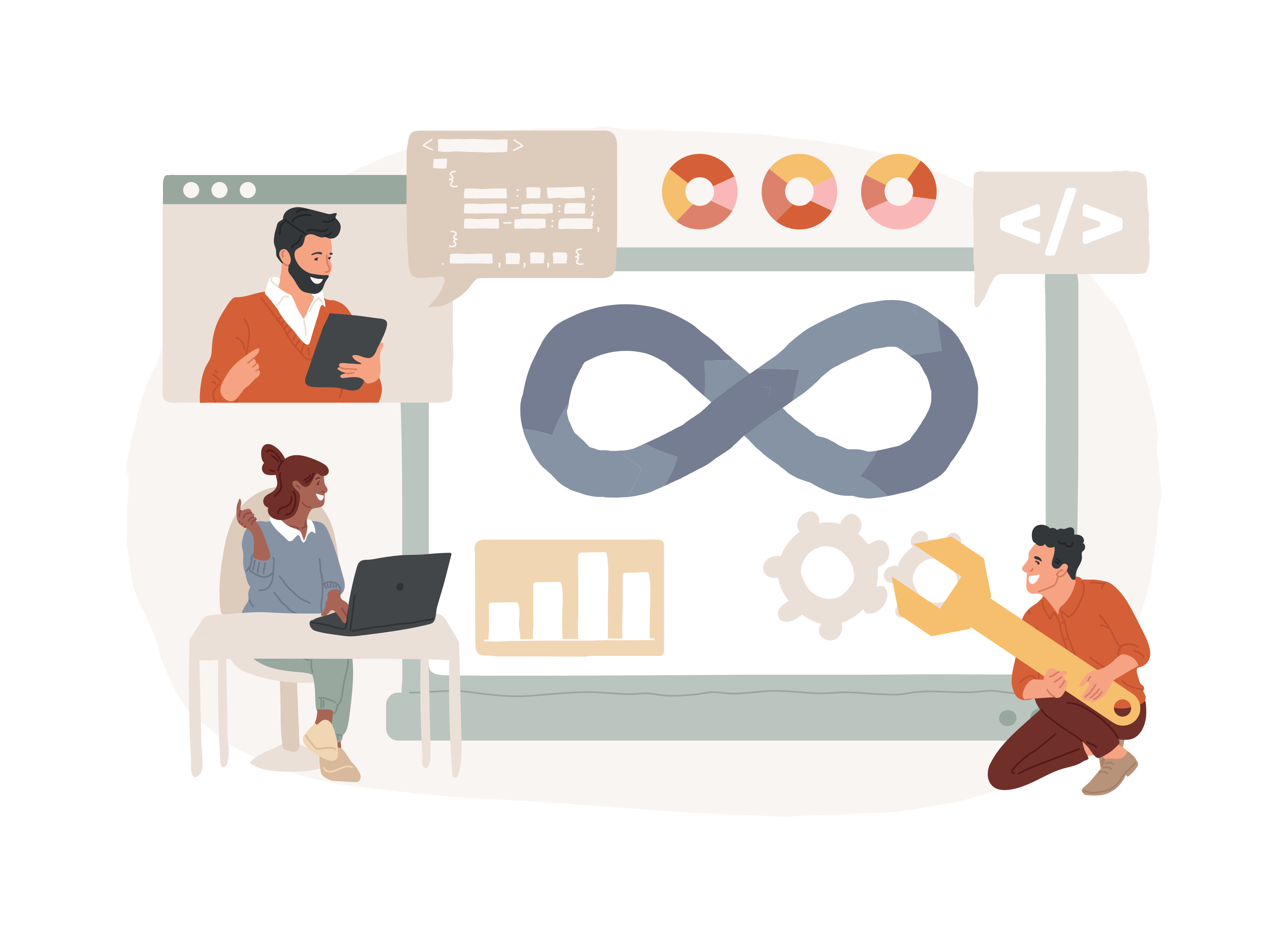
DevOps testing is the practice of embedding quality validation throughout the entire software delivery lifecycle — from code commit to production monitoring — replacing traditional phase-gate QA with continuous, automated testing at every pipeline stage.
Software teams ship faster than ever. The 2025 DORA State of DevOps Report found that elite performers deploy on demand, with lead times measured in hours, not months. But velocity without quality is just shipping bugs faster. The teams that sustain rapid delivery are the ones that weave testing into every stage of their pipeline rather than bolting it on at the end.
That is the core premise of DevOps testing: quality is not a phase. It is a continuous activity, owned by everyone, enforced by automation, and measured alongside throughput. When organizations treat testing as a shared responsibility embedded in the delivery pipeline, they simultaneously increase deployment frequency and decrease change failure rates.
This guide provides the complete picture. Whether you are a developer writing your first pipeline tests, a QA engineer transitioning from manual to automated workflows, or a test architect designing a DevOps testing strategy for an enterprise, you will find the frameworks, tools, and practices you need. We will cover what DevOps testing means, why it matters, how to architect it, which tools support it, and how to build a culture that sustains it.
If you are also exploring how to push quality even earlier in the lifecycle, our guide on shift-left testing complements this pillar page and provides the conceptual foundation that DevOps testing builds upon.
In this guide
- What Is DevOps Testing?
- Why DevOps Testing Is Important
- Key Components of DevOps Testing
- DevOps Testing Architecture
- DevOps Testing Tools Comparison
- Real-World Example: FinTech Platform Transformation
- Common Challenges in DevOps Testing
- DevOps Testing Best Practices
- DevOps Testing Checklist
- A complete pipeline, stage by stage
- DevOps testing FAQ
What Is DevOps Testing?
DevOps testing is a quality engineering discipline that integrates testing activities into every phase of the software delivery lifecycle. Rather than treating testing as a separate stage that occurs after development and before release, DevOps testing distributes quality validation across planning, coding, building, deploying, and operating software.
In a traditional model, developers write code, throw it over the wall to QA, and wait days or weeks for feedback. Bugs found late are expensive to fix, context is lost, and releases slow to a crawl. DevOps testing eliminates this handoff by making testing a continuous, automated, and collaborative process.
The defining characteristics of DevOps testing include:
- Continuous execution — Tests run on every commit, every build, and every deployment, not in batched test cycles
- Automation-first — Manual testing is reserved for exploratory and usability scenarios; everything repeatable is automated
- Pipeline-integrated — Tests are quality gates in the CI/CD pipeline, not standalone activities
- Shared ownership — Developers, testers, SREs, and product owners all contribute to and are accountable for quality
- Production-aware — Testing does not end at deployment; observability, synthetic monitoring, and canary releases provide ongoing quality signals
- Fast feedback — Test results are available within minutes, enabling developers to fix issues while context is fresh
DevOps testing encompasses the full spectrum of test types: unit tests, integration tests, API testing, contract tests, security scans, performance tests, accessibility checks, and production monitoring. The key differentiator is not what you test but when, where, and how testing happens within the delivery flow.
Continuous Testing vs Traditional QA
Traditional QA operates as a phase. Code freezes happen, test environments are provisioned, test plans are executed manually, and defects are logged in tracking tools. This approach worked when releases were quarterly. It fails when teams deploy daily.
Continuous testing, the engine of DevOps testing, runs automated tests at every pipeline stage without human intervention. Pre-commit hooks catch formatting and lint errors. Unit tests validate logic on every push. Integration tests verify service interactions on every build. Security scans inspect dependencies on every pull request. Performance baselines are checked before every deployment. Smoke tests confirm critical paths after every release. And synthetic monitors validate production behavior around the clock.
The shift from traditional QA to continuous testing is not just a tooling change — it is an organizational transformation. It requires developers to write testable code, testers to become automation engineers, and leadership to invest in pipeline infrastructure.
On Microsoft tooling the equivalent is the Azure DevOps API testing pipeline guide, including the publish-test-results task most teams miss.
If the gap is tooling rather than process, start with continuous integration testing tools and its comparison matrix.
Why DevOps Testing Is Important
1. Speed Demands Embedded Quality
When teams deploy once a quarter, a two-week manual test cycle is feasible. When teams deploy ten times a day, it is impossible. DevOps testing removes the bottleneck by automating quality checks so they run in parallel with the delivery flow rather than blocking it.
2. Cost of Late Defects Is Exponential
Research from the Systems Sciences Institute at IBM found that the cost of fixing a defect increases by 6x when found during testing and up to 100x when found in production. DevOps testing catches defects at the earliest possible stage — ideally at the moment the developer introduces them — when fixes are cheapest and fastest.
3. Customer Expectations Have Changed
Users expect zero-downtime deployments, instant rollbacks, and flawless experiences. A single production incident can erode trust built over years. DevOps testing provides the safety net: automated regression suites prevent known bugs from recurring, canary releases limit blast radius, and monitoring catches anomalies before users report them.
4. Regulatory and Security Compliance
Industries from finance to healthcare require auditable quality processes. DevOps testing provides automated, traceable evidence of testing at every stage — which tests ran, what they validated, and whether they passed — making compliance reporting a byproduct of the pipeline rather than a separate burden.
5. Team Morale and Retention
Engineers do not want to spend weekends firefighting production incidents caused by untested code. A strong DevOps testing culture gives developers confidence that their changes are validated, reduces on-call fatigue, and creates an environment where teams ship with pride rather than anxiety.
Key Components of DevOps Testing
Unit Testing
Unit tests validate individual functions, methods, and classes in isolation. They are the fastest tests in the pipeline, executing in milliseconds, and the most numerous. In DevOps, unit tests run on every commit as the first automated gate. A failure here prevents code from progressing further, providing the fastest possible feedback.
Effective unit testing in DevOps requires testable code architecture — dependency injection, interface-based design, and separation of concerns. Teams targeting 80% or higher code coverage for critical paths find the best balance between confidence and maintenance cost.
Integration Testing
Integration tests verify that components work correctly together — that your service can read from the database, call an external API, or publish to a message queue. In DevOps pipelines, integration tests typically run after unit tests and require test infrastructure such as containerized databases or mock services.
The rise of containerization has transformed integration testing. Tools like Docker Compose and Testcontainers allow teams to spin up realistic dependency stacks in seconds, run integration tests, and tear them down. This eliminates the shared test environment bottleneck that plagued traditional QA.
API and Contract Testing
In microservices architectures, APIs are the contracts between services. API testing validates that endpoints return correct responses, handle errors gracefully, and meet performance thresholds. Contract testing goes further by verifying that producers and consumers agree on the interface, preventing the integration failures that plague distributed systems.
For teams building or consuming APIs, embedding API tests in the CI/CD testing pipeline is non-negotiable. Wiring those checks into GitHub Actions, GitLab, Jenkins, or Azure DevOps means every commit validates that API contracts are honored before the change reaches production.
Security Testing
DevSecOps integrates security testing into the pipeline rather than treating it as a final audit. This includes static application security testing (SAST) to scan source code, software composition analysis (SCA) to check dependencies for known vulnerabilities, dynamic application security testing (DAST) to probe running applications, and secret scanning to prevent credential leaks.
Automated security gates catch common vulnerabilities on every commit. They do not replace penetration testing or threat modeling, but they eliminate the low-hanging fruit that accounts for the majority of security incidents.
Performance Testing
Performance testing in DevOps moves beyond the traditional model of annual load tests before major releases. Instead, teams establish performance baselines and validate them on every build. Automated performance tests compare response times, throughput, and resource utilization against known thresholds, flagging regressions before they reach production.
Tools like k6, Gatling, and Locust integrate directly with CI/CD pipelines, enabling performance validation as a standard quality gate rather than a periodic exercise.
End-to-End and Smoke Testing
End-to-end tests validate critical user journeys across the full stack. In DevOps, these tests run against staging environments or canary deployments to confirm that the entire system works as expected. Smoke tests — a lightweight subset of end-to-end tests — run immediately after deployment to verify that core functionality is operational.
Ready to shift left with your API testing?
Try our no-code API test automation platform free. Generate tests from OpenAPI, run in CI/CD, and scale quality.
The key is selectivity. Running a full end-to-end suite on every commit is slow and fragile. Running targeted smoke tests on every deployment is fast and essential.
DevOps Testing Architecture
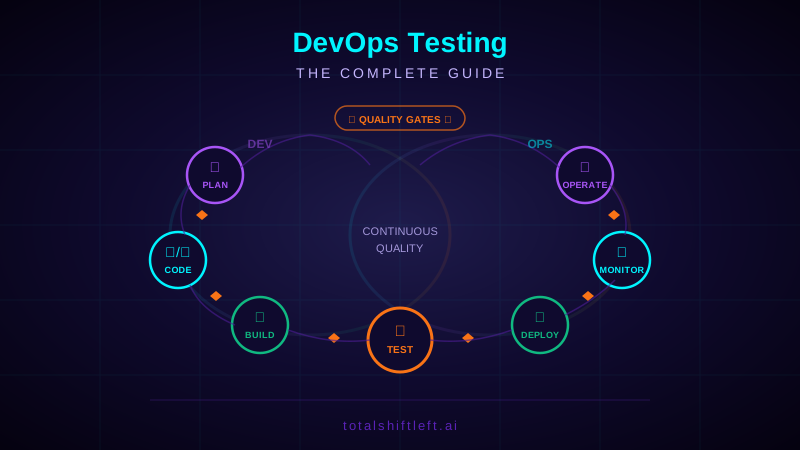
A well-designed DevOps testing architecture distributes tests across pipeline stages to maximize feedback speed while maintaining thorough coverage. The following architecture aligns test types to pipeline stages:
Stage 1: Pre-Commit (Developer Workstation)
- Linting and formatting checks
- Unit tests for changed files
- Pre-commit hooks enforcing standards
Stage 2: Commit / Pull Request (CI Server)
- Full unit test suite
- Static code analysis (SAST)
- Dependency vulnerability scan (SCA)
- Code coverage enforcement
- Contract test validation
Stage 3: Build / Integration (CI Server)
- Integration tests with containerized dependencies
- API functional tests
- Database migration tests
- Performance baseline checks
Stage 4: Staging / Pre-Production
- End-to-end tests on critical paths
- Security dynamic scanning (DAST)
- Load and stress testing
- Accessibility compliance checks
- Visual regression testing
Stage 5: Production Deployment
- Canary or blue-green deployment
- Automated smoke tests
- Feature flag validation
- Rollback triggers on failure thresholds
Stage 6: Post-Deployment / Operations
- Synthetic monitoring
- Real user monitoring (RUM)
- Error rate alerting
- Performance anomaly detection
- Chaos engineering experiments
This architecture follows the testing pyramid principle: many fast, cheap tests at the base (unit), fewer slower tests in the middle (integration, API), and a small number of expensive tests at the top (end-to-end). The pyramid ensures that most defects are caught early, where feedback is fastest and fixes are cheapest.
For teams building this pipeline from scratch, our detailed guide on how to build a CI/CD testing pipeline walks through the implementation step by step.
DevOps Testing Tools Comparison
Selecting the right tools is critical to building an effective DevOps testing pipeline. The following table compares leading tools across key testing categories:
| Category | Tool | Best For | Pipeline Integration | Learning Curve |
|---|---|---|---|---|
| Unit Testing | Jest | JavaScript/TypeScript apps | Excellent CI/CD support | Low |
| Unit Testing | JUnit 5 | Java/Kotlin apps | Native Maven/Gradle | Low |
| Unit Testing | pytest | Python apps | Excellent CI/CD support | Low |
| API Testing | Total Shift Left | No-code API test automation | Native CI/CD integration | Very Low |
| API Testing | Postman/Newman | Manual + automated API tests | CLI-based CI/CD | Low-Medium |
| API Testing | REST Assured | Java-based API testing | Native Maven/Gradle | Medium |
| Contract Testing | Pact | Consumer-driven contracts | Pact Broker + CI/C |
D | Medium | | Performance | k6 | Developer-friendly load testing | Excellent CI/CD support | Low-Medium | | Performance | Gatling | High-scale performance testing | Maven/Gradle/CLI | Medium | | Security (SAST) | SonarQube | Static analysis + quality gates | Native CI/CD plugins | Low-Medium | | Security (SCA) | Snyk | Dependency vulnerability scanning | Excellent CI/CD support | Low | | Security (DAST) | OWASP ZAP | Dynamic security scanning | Docker-based CI/CD | Medium | | E2E Testing | Playwright | Cross-browser E2E tests | Excellent CI/CD support | Medium | | E2E Testing | Cypress | Component + E2E testing | Dashboard + CI/CD | Low-Medium | | Monitoring | Datadog | Full-stack observability | API + agent-based | Medium | | Monitoring | Grafana + Prometheus | Open-source monitoring stack | Kubernetes-native | Medium-High |
When evaluating tools, prioritize those that integrate natively with your CI/CD platform, support parallel execution, provide clear reporting, and scale with your team size. A no-code platform like Total Shift Left can accelerate API testing adoption for teams that want fast results without writing test scripts.
Real-World Example: FinTech Platform Transformation
The Problem
A mid-size FinTech company processing 2 million transactions daily was struggling with a legacy testing approach. Their release cycle looked like this:
- Developers coded for 3 weeks in feature branches
- A dedicated QA team spent 2 weeks manually testing in a shared staging environment
- Environment conflicts caused 30% of test time to be wasted on configuration issues
- Average release cycle: 6 weeks
- Production defect rate: 12 critical bugs per release
- Mean time to recovery (MTTR) from production incidents: 4.2 hours
The QA team of 8 engineers was overwhelmed, and developers had no visibility into test results until weeks after writing the code. Context switching to fix old bugs was destroying productivity.
The Solution
The team implemented a comprehensive DevOps testing strategy over 4 months:
Month 1: Foundation. Adopted trunk-based development with short-lived feature branches. Added pre-commit hooks for linting and unit test execution. Established a minimum 75% unit test coverage policy for all new code. Integrated SonarQube for static analysis on every pull request.
Month 2: Pipeline automation. Built a multi-stage CI/CD pipeline with automated quality gates. Containerized all test dependencies using Docker Compose. Implemented API contract testing using Pact for their 23 microservices. Added automated security scanning with Snyk and OWASP ZAP.
Month 3: Performance and monitoring. Established performance baselines for critical transaction paths. Added k6 load tests running on every merge to main. Deployed synthetic monitoring for the top 10 user journeys. Implemented canary deployments with automated rollback triggers.
Month 4: Culture shift. Retrained QA engineers as quality coaches embedded in development squads. Established blameless post-mortems for every production incident. Created a testing dashboard visible to the entire engineering organization. Introduced quality metrics into sprint retrospectives.
The Results
After 6 months of operating with the new DevOps testing approach:
- Release cycle: 6 weeks reduced to daily deployments (42x improvement)
- Production defects: 12 per release reduced to 1.3 per month (89% reduction)
- MTTR: 4.2 hours reduced to 18 minutes (93% reduction)
- Test execution time: 2 weeks manual reduced to 22 minutes automated
- Deployment frequency: Monthly to 8-12 deploys per day
- Developer satisfaction: NPS increased from 22 to 71
The QA team transitioned from gatekeepers to enablers, spending their time on exploratory testing, test strategy, and coaching developers rather than executing repetitive manual test cases.
Common Challenges in DevOps Testing
Challenge 1: Flaky Tests Erode Pipeline Trust
Flaky tests — tests that pass and fail intermittently without code changes — are the number one killer of DevOps testing effectiveness. When pipelines fail randomly, developers learn to ignore failures, retry until green, or disable tests entirely. Trust evaporates, and the quality safety net develops holes.
Solution: Quarantine flaky tests immediately by moving them to a non-blocking test suite. Track flake rates as a team metric. Invest in root cause analysis: most flakiness stems from test interdependencies, shared state, timing assumptions, or unreliable test infrastructure. Allocate dedicated time each sprint for test reliability improvements.
Challenge 2: Slow Pipelines Kill Developer Productivity
If your pipeline takes 45 minutes to provide feedback, developers context-switch to other work and lose flow state. When the build finally completes, they have moved on mentally. Slow pipelines also create merge bottlenecks, especially on active teams where multiple developers push changes simultaneously.
Solution: Parallelize test execution across multiple agents. Implement test impact analysis to run only the tests affected by the change. Use tiered pipelines: fast checks (lint, unit tests) gate the PR, while slower tests (integration, E2E) run post-merge. Cache dependencies and Docker layers aggressively. Set a pipeline SLA — for example, PR feedback within 10 minutes.
Challenge 3: Test Environment Bottlenecks
Shared test environments create contention. When three teams need the staging environment simultaneously, one team tests while the others wait. Environment drift — where staging does not match production — causes tests to pass in staging and fail in production.
Solution: Adopt ephemeral environments that are created on demand for each pull request and destroyed after merge. Container orchestration platforms like Kubernetes make this feasible. Each PR gets its own isolated environment with realistic data, eliminating contention and drift. Tools like Argo CD, Terraform, and Crossplane can automate environment provisioning.
Challenge 4: Legacy Code Lacks Testability
Many organizations have large codebases written without testability in mind — monolithic architectures, tight coupling, no dependency injection, and global state. Writing tests for this code is painful, and teams avoid it.
Solution: Apply the strangler fig pattern: do not attempt to retroactively test the entire codebase. Instead, write tests for every new feature and every bug fix. Over time, the tested surface area grows organically. For critical legacy paths, invest in characterization tests that document current behavior before refactoring. Follow test automation best practices to build maintainable suites from day one.
Challenge 5: Cultural Resistance to Shared Quality Ownership
In many organizations, quality is still seen as the QA team's job. Developers write code and move on. Operations teams handle production issues. This siloed mindset is incompatible with DevOps testing, where everyone must own quality.
Solution: Start with leadership alignment. Quality metrics (defect escape rate, MTTR, test coverage) should be team metrics, not QA metrics. Embed testers in development squads rather than in a separate department. Celebrate quality wins in the same way you celebrate feature launches. Make writing tests a first-class part of the definition of done, not an afterthought.
DevOps Testing Best Practices
Following DevOps testing best practices consistently is what separates teams that sustain quality from those that only talk about it. Here are the practices that deliver the highest impact:
Free YAML templates + guide
CI/CD Testing Pipeline Templates
Production-ready CI/CD pipeline templates for GitHub Actions and GitLab CI. Includes API testing, contract testing, and performance testing stages.
Download Free- Automate everything repeatable. If a test can be scripted, it should be. Reserve manual testing for exploratory sessions, usability testing, and edge cases that require human judgment. Automation is the backbone of automated testing in CI/CD.
- Fail fast, fix fast. Design your pipeline so that the cheapest and fastest tests run first. A lint error should block the build in seconds, not after 20 minutes of integration tests. Fast feedback keeps developers in flow.
- Treat tests as production code. Tests deserve the same code review, refactoring, and maintenance as application code. Poorly written tests become a liability — they are slow, fragile, and misleading. Apply DRY principles, meaningful naming, and clear assertions.
- Version test data and configurations. Test data should be deterministic, version-controlled, and environment-independent. Avoid relying on shared databases that can be modified by other tests or teams. Use factories, fixtures, or synthetic data generation.
- Implement quality gates, not quality hopes. Every pipeline stage should have explicit pass/fail criteria. Code coverage below 75% fails the build. Security vulnerabilities above a severity threshold block deployment. Performance regression beyond 10% triggers an alert. Automate enforcement so humans do not have to remember.
- Monitor production as a testing activity. Deployment is not the finish line. Synthetic monitors, error rate alerts, and real user monitoring provide continuous quality signals that complement pre-production testing. Production observability catches the bugs that pre-production tests miss.
- Measure and visualize quality metrics. What gets measured gets improved. Display test pass rates, coverage trends, flake rates, defect escape rates, and MTTR on a team dashboard. Review these metrics in sprint retrospectives and use them to prioritize testing investments.
- Invest in test infrastructure. Fast, reliable test infrastructure pays dividends across the entire engineering organization. Slow CI servers, unreliable test environments, and inadequate tooling create friction that discourages testing. Treat test infrastructure as a product with its own roadmap.
- Practice shift-left and shift-right. Shift-left testing moves testing earlier in the lifecycle. Shift-right testing extends it into production. The best DevOps teams do both, catching defects before deployment and detecting anomalies after deployment.
- Continuously improve. Run blameless post-mortems after every production incident. Ask what test could have caught this and add that test to the suite. Over time, the test suite becomes a living document of every lesson the team has learned.
DevOps Testing Checklist
Use this checklist to assess and improve your DevOps testing maturity:
Pipeline Foundation
- ✔ CI/CD pipeline runs automated tests on every commit
- ✔ Pipeline stages are ordered fastest-to-slowest (unit → integration → E2E)
- ✔ Quality gates enforce pass/fail criteria at each stage
- ✔ Pipeline provides feedback within 10 minutes for PR checks
- ✔ Build artifacts are immutable and promoted through environments
Test Coverage
- ✔ Unit tests cover 80% or more of critical business logic
- ✔ Integration tests validate all service-to-service interactions
- ✔ API contract tests exist for every microservice interface
- ✔ Security scanning (SAST + SCA) runs on every pull request
- ✔ Performance baselines are validated on every merge to main
- ✔ Smoke tests run after every production deployment
Infrastructure
- ✔ Test environments are ephemeral and provisioned on demand
- ✔ Test data is synthetic, deterministic, and version-controlled
- ✔ Tests run in parallel across multiple agents
- ✔ Docker containers provide consistent dependency management
- ✔ Test infrastructure scales with team and codebase growth
Culture and Process
- ✔ Quality is a shared team metric, not a QA-only responsibility
- ✔ Tests are part of the definition of done for every user story
- ✔ Blameless post-mortems follow every production incident
- ✔ Flaky tests are quarantined and tracked as technical debt
- ✔ Quality metrics are reviewed in sprint retrospectives
Production Quality
- ✔ Synthetic monitoring validates critical paths 24/7
- ✔ Error rate alerts trigger on anomalies within minutes
- ✔ Canary or blue-green deployments limit blast radius
- ✔ Automated rollback triggers exist for deployment failures
- ✔ Real user monitoring provides ongoing quality feedback
See also: contract testing in our learn hub for the underlying concept.
A complete pipeline, stage by stage
This is the shape almost every DevOps testing pipeline converges on: cheap checks first, expensive checks on a deployed artifact, and nothing promoted past a failed gate.
# .github/workflows/pipeline.yml
name: Build, test, deploy
on: [push, pull_request]

jobs:
  static:                       # seconds — lint, types, spec
    runs-on: ubuntu-latest
    steps:
      - uses: actions/checkout@v4
      - run: ruff check . && mypy app
      - run: npx @stoplight/spectral-cli lint openapi.yaml --fail-severity error

  unit:                         # a minute — no I/O
    needs: static
    runs-on: ubuntu-latest
    steps:
      - uses: actions/checkout@v4
      - run: pytest tests/unit -q --cov=app --cov-fail-under=80

  integration:                  # minutes — real dependencies, thrown away after
    needs: unit
    runs-on: ubuntu-latest
    services:
      postgres: { image: postgres:16-alpine, env: { POSTGRES_PASSWORD: test },
                  options: --health-cmd pg_isready --health-interval 5s }
    steps:
      - uses: actions/checkout@v4
      - run: pytest tests/integration -q
        env: { DATABASE_URL: 'postgresql://postgres:test@localhost/postgres' }

  api-contract:                 # against a deployed preview
    needs: integration
    runs-on: ubuntu-latest
    steps:
      - uses: actions/checkout@v4
      - run: ./scripts/deploy-preview.sh
      - run: schemathesis run openapi.yaml --url "$PREVIEW_URL" --checks all

  deploy:
    needs: api-contract
    if: github.ref == 'refs/heads/main'
    runs-on: ubuntu-latest
    steps: [{ run: ./scripts/deploy.sh production }]
DevOps testing FAQ
What is DevOps testing?
DevOps testing is the practice of embedding quality validation throughout the entire software delivery lifecycle, from code commit to production monitoring. It replaces the traditional handoff between development and QA with continuous, automated testing at every pipeline stage. Instead of testing being a phase that happens after development, DevOps testing makes quality a continuous activity woven into planning, coding, building, deploying, and operating software.
How does testing change in a DevOps environment?
In DevOps, testing shifts from a phase-gate activity to a continuous process. Developers write tests alongside code, automation replaces manual testing, pipelines enforce quality gates, and production monitoring provides real-time quality feedback. Everyone owns quality, not just the QA team. The most significant cultural change is that testing becomes proactive (preventing defects) rather than reactive (finding defects after they exist).
What metrics should DevOps teams track for testing?
Key DevOps testing metrics include deployment frequency, change failure rate, mean time to recovery (MTTR), test coverage, test execution time, flake rate, defect escape rate, and pipeline pass rate. The DORA metrics provide a widely adopted framework for measuring delivery performance alongside quality. Teams should also track test reliability (flake rates), automation coverage (percentage of tests automated), and mean time to feedback (how quickly developers learn about failures).
What is continuous testing in DevOps?
Continuous testing runs automated tests at every stage of the CI/CD pipeline — from pre-commit hooks and unit tests to integration tests, security scans, performance checks, and post-deployment smoke tests. It provides immediate feedback on code quality without human intervention. The goal is to create a quality feedback loop that is as fast and reliable as the delivery pipeline itself, so no code change reaches production without automated validation.
How do you build a DevOps testing culture?
Building a DevOps testing culture requires shared ownership of quality across dev and ops, investment in test automation, blameless post-mortems, testing as a first-class citizen in sprint planning, and measuring quality metrics alongside delivery metrics. Start by embedding testers in development squads, making quality metrics visible to the entire organization, and celebrating quality improvements alongside feature launches. Leadership must explicitly communicate that quality is everyone's responsibility.
Sources and further reading
- DORA State of DevOps research — the multi-year dataset behind the four delivery metrics.
- Martin Fowler — Continuous Integration — the original definition of the practice CI tooling implements.
- GitHub Actions documentation — workflow syntax, caching and matrix builds.
Key takeaways
- DevOps testing is not a tool or a technique — it is a philosophy of continuous quality that transforms how software teams deliver value.
- The organizations that get this right deploy faster, fail less, recover quicker, and build products their users trust.
- The path forward is clear. Start with your pipeline: automate the tests you have, add quality gates that enforce standards, and measure the results.
- Then expand outward: embed security and performance testing, invest in test infrastructure, and build a culture where quality is everyone's responsibility.
- Whether you are just beginning your DevOps testing journey or optimizing a mature pipeline, the principles in this guide provide the framework for sustainable quality at speed.
- The tooling exists, the practices are proven, and the business case is overwhelming.
Ready to accelerate your DevOps testing? Total Shift Left provides no-code API test automation that integrates directly into your CI/CD pipeline, giving your team automated quality gates without the scripting overhead. Start your free trial and experience continuous API testing in minutes.
DevOps & Testing Culture Cluster
- DevOps Testing Culture Explained
- QA in DevOps: The Evolving Role of Test Engineers
- Continuous Quality in DevOps
- Quality Engineering vs Traditional QA
- Testing Ownership in DevOps Teams
- How DevOps Teams Build Testing Pipelines
- DevOps Metrics for Software Quality
- DevOps Testing Maturity Model
- Building a Testing Center of Excellence
Test Data Management Cluster
- Test Data Management for Modern Applications
- Synthetic Test Data vs Production Data
- Best Practices for Test Data Management
- Test Data Generation Tools for API Testing
- Data Masking for Testing Environments
- Managing Test Data in Microservices
- Database Testing Strategies for DevOps
- Test Data Automation in CI/CD Pipelines
- How to Generate Test Data for API Testing
- Test Data Challenges in Distributed Systems
Testing Strategy & Architecture Cluster
- Software Testing Strategy for Modern Applications
- Enterprise Testing Strategy Guide
- Risk-Based Testing Strategy Explained
- Testing Strategy for Cloud Native Applications
- Testing Architecture for Scalable Systems
- Testing Strategy for Platform Engineering Teams
- Testing Strategy for SaaS Platforms
- Testing Strategy for AI-Powered Applications
- Testing Strategy for Serverless Architectures
- Future of Software Testing in AI-Driven Development
DevOps Testing Strategy | DevOps Testing Best Practices | CI/CD Testing Pipeline | Shift-Left Testing Guide | API Testing Guide | Test Automation Best Practices | Microservices Testing Guide
Ready to shift left with your API testing?
Try our no-code API test automation platform free.