
OAuth 2.0 API Testing: Flows, Negative Cases & Tools (2026)
Quick answer
OAuth API testing validates that authorization flows, token issuance, scope enforcement, and refresh and revocation all behave correctly across the authorization server, resource server, and client. The nine practices most teams skip — PKCE enforcement, redirect_uri exact-match, state-parameter CSRF checks, scope downgrade testing, and refresh-token rotation — catch the majority of OAuth bugs that reach production.
Reviewed by Sushant Joshi

OAuth API testing is the practice of validating that an API's OAuth 2.0 authorization implementation correctly enforces authorization flows, issues and validates access tokens, enforces scope boundaries, handles token refresh and revocation, and prevents common OAuth attack patterns including open redirects, authorization code theft, and scope escalation.
OAuth 2.0 is the authorization framework that powers virtually every API ecosystem in 2026. When you "Sign in with Google," connect a third-party app to your GitHub account, or authorize a Slack integration, OAuth is orchestrating the permission flow. Its ubiquity makes it a high-value target — and a common source of security vulnerabilities.
A 2025 analysis of OAuth implementations across 500 production applications found that 41% had at least one exploitable vulnerability: open redirects on authorization endpoints, missing PKCE for public clients, reusable authorization codes, or insufficient scope validation. These are not edge cases — they are systematic failures in how OAuth flows are implemented and tested.
The root cause is complexity. OAuth 2.0 involves multiple parties (authorization server, resource server, client application), multiple grant types (authorization code, client credentials, device code), and multiple security mechanisms (PKCE, state parameter, token binding) that must all work correctly together. Testing each component in isolation misses the interaction bugs where real vulnerabilities hide. This guide covers how to test OAuth implementations comprehensively — from individual flow validation to full integration security testing as part of your API security testing program.
In this guide
- What Is OAuth API Testing?
- Why OAuth Testing Matters
- Key Components of OAuth Testing
- How OAuth Testing Works
- Test Examples: Authorization Code + PKCE, Client Credentials, Scopes
- Tools for OAuth API Testing
- OAuth 2.0 API testing in practice: a worked example
- OAuth 2.0 API testing challenges and how to solve them
- OAuth 2.0 API testing best practices
- OAuth Testing Checklist
- OAuth 2.0 API testing FAQ
What Is OAuth API Testing?
OAuth API testing validates the complete OAuth 2.0 authorization lifecycle across all participating components: the authorization server that issues tokens, the resource server that validates tokens and enforces access, and the client application that obtains and uses tokens.
The OAuth 2.0 framework defines several grant types, each with distinct testing requirements:
-
Authorization Code Grant: The standard flow for web and mobile applications. The user authorizes access through a browser, receives an authorization code, which the client exchanges for access and refresh tokens. This is the most complex flow to test because it involves redirects, state management, and PKCE.
-
Client Credentials Grant: Used for machine-to-machine communication where no user interaction is involved. The client authenticates directly with the authorization server using its client ID and secret to obtain an access token. Testing focuses on credential security and scope enforcement.
-
Device Code Grant: Used for devices with limited input capability (smart TVs, IoT devices). The device displays a code that the user enters on a separate device to authorize access. Testing validates the polling mechanism, code expiration, and rate limiting.
-
Refresh Token Grant: Used to obtain new access tokens without re-authorization. Testing focuses on refresh token rotation, expiration, revocation, and scope downgrade prevention.
Each grant type has specific attack patterns that testing must cover: open redirect exploitation, authorization code interception, token leakage through browser history and referrer headers, scope escalation, and cross-site request forgery against the authorization endpoint.
Getting test credentials without leaving a static token in the pipeline is its own problem — SSO and secret management for API testing covers the OIDC-to-vault pattern.
For the scanner landscape behind this, see API security testing tools compared on OSS, pricing and CI integration.
Why OAuth Testing Matters
OAuth Vulnerabilities Enable Account Takeover
Open redirect vulnerabilities on the authorization endpoint allow attackers to intercept authorization codes and exchange them for access tokens, effectively taking over the user's session. This attack pattern — documented extensively in OWASP API Security resources — requires only that the attacker can trick a user into clicking a crafted authorization URL.
Scope Mismanagement Leads to Over-Privileged Access
OAuth scopes define what an access token is authorized to do. When resource servers do not validate scopes rigorously, a token intended for reading user profiles may also work for modifying payment information. Scope enforcement failures violate the principle of least privilege and create unnecessarily broad attack surfaces.
Token Lifecycle Issues Create Persistent Access
Poorly implemented token refresh and revocation allows attackers who obtain a refresh token to maintain access indefinitely, even after the user changes their password or revokes the application's access. If refresh tokens are not rotated on use, a stolen refresh token provides permanent access that the legitimate user cannot revoke.
Third-Party Integrations Multiply Risk
OAuth is the mechanism by which third-party applications access your API on behalf of users. Every OAuth client represents a trust relationship that must be validated. A compromised or malicious OAuth client can exfiltrate user data, perform unauthorized actions, or serve as a pivot point for broader attacks against your API ecosystem.
Key Components of OAuth Testing
Authorization Endpoint Testing
The authorization endpoint is the entry point for user-facing OAuth flows. Test that it validates the redirect_uri exactly (not just prefix matching), that it requires and validates the state parameter to prevent CSRF, that it requires PKCE code_challenge for public clients, that it rejects unregistered client IDs, and that error responses do not leak sensitive information.
Token Endpoint Testing
The token endpoint exchanges authorization codes or credentials for access tokens. Test that authorization codes are single-use (replaying a code fails), that codes expire within a short window (typically 10 minutes), that PKCE code_verifier is validated against the stored code_challenge, that client authentication is required for confidential clients, and that token responses include appropriate cache-control headers.
Scope Validation Testing
Scopes define the boundaries of what an access token can do. Test that the authorization server only grants scopes the client is registered for, that the resource server rejects requests when the token lacks the required scope, that scope escalation through the refresh flow is impossible (refreshed tokens cannot have broader scopes), and that scope consent is presented to the user clearly and accurately.
Token Refresh Testing
Refresh token handling is critical for long-lived access. Test that refresh tokens rotate on use (the old refresh token is invalidated when a new one is issued), that refresh tokens have maximum lifetimes, that refresh tokens are invalidated on logout and password change, and that refresh requests from revoked clients are rejected. This complements JWT token security testing when JWTs are used as access tokens.
Redirect URI Validation Testing
Open redirect on the authorization endpoint is one of the most frequently exploited OAuth vulnerabilities. Test with exact match validation (no partial matching), different protocols (http vs https), subdomain variations, path traversal, URL-encoded characters, and registered URI with additional query parameters. The authorization server should reject any redirect URI that does not exactly match a pre-registered value.
PKCE Testing
Proof Key for Code Exchange prevents authorization code interception. Test that public clients are required to send code_challenge during authorization and code_verifier during token exchange, that mismatched verifiers are rejected, that missing verifiers are rejected (not silently ignored), and that the code_challenge_method supports S256 (not just plain).
Ready to shift left with your API testing?
Try our no-code API test automation platform free. Generate tests from OpenAPI, run in CI/CD, and scale quality.
How OAuth Testing Works
OAuth testing requires validating multi-party interactions across the authorization flow. A structured approach covers each flow phase:
Phase 1 — Authorization Request Validation: Send authorization requests with variations: valid and invalid client IDs, registered and unregistered redirect URIs, various scope combinations, with and without state parameter, with and without PKCE code_challenge. Verify the authorization server responds correctly to each variation — valid requests proceed to consent, invalid requests return appropriate errors.
Phase 2 — Authorization Code Handling: After obtaining authorization codes, test the exchange: valid code exchange (should succeed), replay the same code (should fail), use the code after its expiration window (should fail), exchange with wrong client credentials (should fail), exchange with wrong redirect_uri (should fail), and exchange with wrong PKCE code_verifier (should fail).
Phase 3 — Access Token Validation: Use access tok
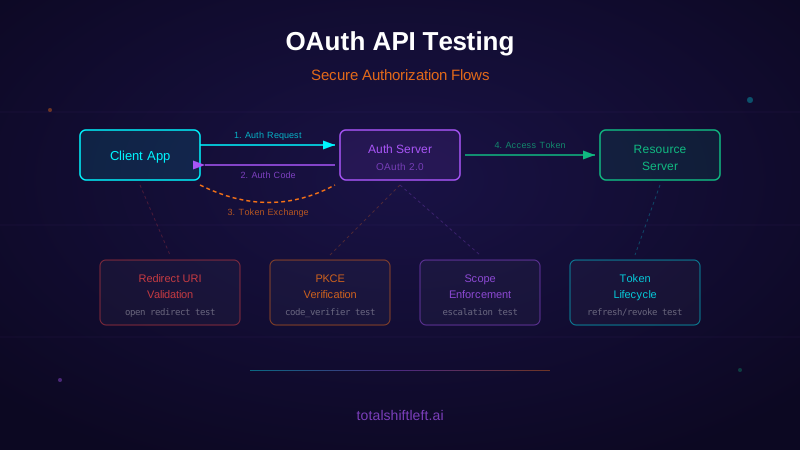
ens against the resource server: valid token with correct scope (should succeed), valid token with insufficient scope (should return 403), expired token (should return 401), revoked token (should return 401), token from a different authorization server (should return 401), and modified JWT access token (should return 401).
Phase 4 — Refresh and Revocation: Test the token lifecycle: refresh with a valid refresh token (should return new tokens), refresh with the old refresh token after rotation (should fail and trigger security alert), refresh after user logout (should fail), revoke an access token and verify it is rejected, revoke a refresh token and verify no new access tokens can be obtained.
Phase 5 — Integration Security: Test cross-cutting security concerns: CSRF protection via state parameter, token leakage through browser referrer headers, authorization server HTTPS enforcement, and proper cache-control headers on token responses to prevent token caching.
Test Examples: Authorization Code + PKCE, Client Credentials, Scopes
Runnable examples for the three tests most teams skip, per the OAuth 2.0 Authorization Framework (RFC 6749) and PKCE extension (RFC 7636).
1. Authorization Code + PKCE — verify the token endpoint rejects a mismatched code_verifier:
# Generate a PKCE pair
CODE_VERIFIER=$(openssl rand -base64 32 | tr -d '=+/' | cut -c1-43)
CODE_CHALLENGE=$(echo -n "$CODE_VERIFIER" | openssl dgst -sha256 -binary | openssl base64 | tr -d '=+/' | tr '/+' '_-')

# Step 1: authorization request with the challenge
curl -s "https://auth.example.com/authorize?response_type=code&client_id=$CLIENT_ID\
&redirect_uri=$REDIRECT_URI&code_challenge=$CODE_CHALLENGE&code_challenge_method=S256\
&state=$(openssl rand -hex 16)"
# ... user authorizes, authorization server redirects with ?code=AUTH_CODE

# Step 2: exchange with the WRONG verifier — must fail with invalid_grant
curl -s -X POST https://auth.example.com/token \
  -d "grant_type=authorization_code&code=$AUTH_CODE&redirect_uri=$REDIRECT_URI" \
  -d "client_id=$CLIENT_ID&code_verifier=wrong-verifier-value" \
  | jq -e '.error == "invalid_grant"'   # exit 0 = test passes
2. Client Credentials Grant — machine-to-machine token acquisition and scope enforcement:
async function testClientCredentialsScopeEnforcement() {
  const tokenRes = await fetch('https://auth.example.com/token', {
    method: 'POST',
    headers: { 'Content-Type': 'application/x-www-form-urlencoded' },
    body: new URLSearchParams({
      grant_type: 'client_credentials',
      client_id: process.env.TEST_CLIENT_ID,
      client_secret: process.env.TEST_CLIENT_SECRET,
      scope: 'read:orders', // deliberately narrow scope
    }),
  });
  const { access_token } = await tokenRes.json();

  // A token scoped to read:orders must be rejected on a write endpoint
  const writeRes = await fetch('https://api.example.com/orders', {
    method: 'POST',
    headers: { Authorization: `Bearer ${access_token}` },
    body: JSON.stringify({ item: 'test' }),
  });

  if (writeRes.status !== 403) {
    throw new Error(`Expected 403 for out-of-scope write, got ${writeRes.status}`);
  }
}
3. Refresh token rotation — the old refresh token must be invalidated after use:
async function testRefreshTokenRotation(oldRefreshToken) {
  const first = await refreshTokens(oldRefreshToken);
  if (!first.access_token || !first.refresh_token) {
    throw new Error('Refresh did not return a new token pair');
  }

  // Replay the ORIGINAL refresh token — must now fail
  const replay = await refreshTokens(oldRefreshToken);
  if (replay.status !== 400 && replay.status !== 401) {
    throw new Error(`Expected rejection on reused refresh token, got ${replay.status}`);
  }
}
For teams testing against a specific enterprise identity provider — Okta, Azure AD / Entra ID, or Ping Identity — see the OAuth 2.0 negative testing guide for enterprise IdPs for vendor-specific worked examples of PKCE mismatch, token reuse, and scope escalation.
Tools for OAuth API Testing
| Tool | Type | Best For | Open Source |
|---|---|---|---|
| Postman | Functional | OAuth flow testing and collection automation | No (Free tier) |
| Burp Suite + OAuth Extension | DAST | Manual OAuth security testing and interception | No |
| OWASP ZAP | DAST | Automated OAuth vulnerability scanning | Yes |
| Keycloak | IdP | Testing against a standards-compliant OAuth server | Yes |
| Total Shift Left | Automated | OAuth test generation from OpenAPI security specs | No |
| oauth2-proxy | Utility | Testing OAuth flows in reverse proxy configurations | Yes |
| Hydra (Ory) | Authorization Server | Testing OAuth flows with a lightweight server | Yes |
| Insomnia | Functional | OAuth flow debugging and testing | Yes |
Postman provides built-in OAuth 2.0 support that handles the full authorization code flow, making it the fastest way to manually test OAuth flows. Its collection runner can automate OAuth test scenarios, including token acquisition, scope testing, and refresh token validation.
Burp Suite with its OAuth-specific extensions allows testers to intercept and modify OAuth requests in real-time. This is essential for testing redirect URI validation, state parameter enforcement, and PKCE code_verifier manipulation — attacks that require modifying requests mid-flow.
For CI/CD integration, use the client credentials grant for automated tests that do not require user interaction, and pre-provision tokens for user-context tests. Centralizing these grants in reusable OAuth and token auth profiles keeps every test suite pointed at the same credentials without duplicating secrets. Keycloak or Ory Hydra can serve as test authorization servers that run in Docker alongside your API in the CI pipeline.
OAuth 2.0 API testing in practice: a worked example
Problem: A marketplace platform with 50+ third-party OAuth integrations discovered that their authorization endpoint accepted any URL within their domain as a redirect URI, not just the registered callback URL. An attacker could craft an authorization URL with redirect_uri=https://marketplace.com/user-content/attacker-page to capture authorization codes, since user-generated content pages were on the same domain. Three OAuth clients (out of 52) were also not implementing PKCE, making their authorization codes vulnerable to interception on mobile devices.
Solution: The team overhauled their OAuth security testing:
- Implemented exact redirect URI matching — the authorization server now rejects any redirect URI that does not exactly match a pre-registered value, including URIs on the same domain
- Required PKCE for all public clients and strongly encouraged it for confidential clients
- Created an automated OAuth security test suite covering: redirect URI manipulation (12 attack variations), authorization code replay, code expiration, PKCE validation (missing, incorrect, wrong method), scope escalation, state parameter CSRF protection, and refresh token rotation
- Implemented OAuth client security auditing that automatically tests each registered client's configuration for known vulnerabilities
- Added runtime monitoring for suspicious OAuth patterns: multiple authorization requests with different redirect URIs, unusually rapid code exchange attempts, and refresh tokens used from unexpected IP ranges
Free PDF guide (12 pages)
Top 50 API Testing Mistakes
50 real-world API testing mistakes organized by category — from authentication to performance — each with a concrete fix strategy.
Download FreeResults:
- Fixed the open redirect vulnerability within 24 hours and notified affected users
- All 52 OAuth clients now pass automated security validation
- OAuth security test suite runs 148 test cases on every deployment in under 3 minutes
- Caught 2 additional redirect URI validation bypasses during testing (URL encoding and case sensitivity issues)
- Reduced OAuth-related security incidents from 4 per quarter to zero over the following six months
- Third-party client onboarding now includes mandatory PKCE and redirect URI security requirements
OAuth 2.0 API testing challenges and how to solve them
Testing User-Interactive Flows in CI/CD
The authorization code flow requires a user to interact with a browser — clicking "Authorize" — which cannot be automated in standard CI/CD test runners.
Solution: Use browser automation (Playwright, Cypress) for end-to-end OAuth flow tests that run in CI. For API-level tests, use the resource owner password grant (test environments only) or pre-provision tokens using the client credentials grant. Test the authorization endpoint's validation logic separately from the user interaction.
Managing OAuth State Across Test Steps
OAuth flows are stateful — the authorization code ties the authorization request to the token exchange, and PKCE ties the code_challenge to the code_verifier. Test frameworks that do not maintain state between steps cannot test these flows correctly.
Solution: Use test frameworks that support sequential, stateful test execution. Store authorization codes, state parameters, and PKCE verifiers in test context that persists across steps. Alternatively, use Postman's collection runner or similar tools that natively handle OAuth state management.
Testing Multiple OAuth Grant Types
Different clients may use different grant types (authorization code, client credentials, device code), each requiring distinct test approaches.
Solution: Create separate test suites for each grant type, sharing common token validation tests. The resource server token validation tests are identical regardless of grant type — the token was obtained through the authorization code flow or client credentials flow, the resource server validates it the same way. Only the token acquisition tests differ by grant type.
Scope Enforcement Across Microservices
In microservices architectures, each service may enforce scopes differently, and scope definitions may not be consistent across services.
Solution: Centralize scope definitions in a shared configuration. Create scope enforcement tests that run against each microservice independently, verifying that each service rejects tokens lacking the required scopes. Use an API gateway for centralized scope validation as a first line of defense.
Testing Token Revocation Propagation
When a token is revoked at the authorization server, the revocation must propagate to all resource servers. With JWTs, revocation requires deny lists, and propagation delay creates a vulnerability window.
Solution: Test revocation propagation explicitly: revoke a token, then immediately test it against all resource servers. Measure the propagation delay and document it. If the delay exceeds acceptable limits, implement token introspection (checking with the authorization server on each request) for sensitive endpoints.
OAuth 2.0 API testing best practices
- Validate redirect URIs with exact string matching: Never use partial, prefix, or regex matching for redirect URIs — exact match only prevents open redirect attacks
- Require PKCE for all public clients: Mobile apps, single-page applications, and any client that cannot securely store a client secret must use PKCE with the S256 challenge method
- Enforce the state parameter: Every authorization request should include a cryptographically random state parameter, and the client should verify it on the callback to prevent CSRF
- Issue short-lived access tokens: Access tokens should expire in 15-60 minutes, forcing clients to use refresh tokens and giving you a mechanism to revoke access
- Rotate refresh tokens on every use: When a refresh token is exchanged for new tokens, invalidate the old refresh token immediately to prevent token theft replay
- Validate scopes at the resource server: Do not rely on the authorization server alone — the resource server must independently verify that the token's scopes authorize the requested operation
- Test every registered OAuth client: Automatically validate each client's configuration for security requirements (PKCE support, redirect URI security, scope limitations)
- Log all OAuth events: Authorization grants, token issuance, refresh, revocation, and failures should all be logged with client ID, user ID, and scope for audit trails
- Test with production-like OAuth configuration: Development OAuth servers with relaxed validation miss the vulnerabilities that exist in production configurations
- Implement token binding when possible: Bind access tokens to the client's TLS certificate or device to prevent token theft and replay from different clients
- Review third-party client permissions regularly: Audit which scopes each OAuth client has been granted and revoke unnecessarily broad permissions
OAuth Testing Checklist
- ✔ Test authorization endpoint with unregistered and manipulated redirect URIs (expect rejection)
- ✔ Verify state parameter is required and validated on callback (CSRF prevention)
- ✔ Test PKCE: missing code_verifier, incorrect code_verifier, and wrong challenge method
- ✔ Verify authorization codes are single-use (replay must fail)
- ✔ Verify authorization codes expire within 10 minutes
- ✔ Test token exchange with wrong client credentials (expect rejection)
- ✔ Test scope enforcement: tokens with insufficient scope rejected at resource server (403)
- ✔ Test scope escalation: refreshed tokens cannot have broader scopes than original grant
- ✔ Verify refresh token rotation: old refresh tokens are invalidated after use
- ✔ Test token revocation: revoked access tokens rejected immediately at resource server
- ✔ Test refresh token revocation: no new tokens can be obtained with a revoked refresh token
- ✔ Verify logout invalidates both access and refresh tokens
See also: jwt authentication in our learn hub for the underlying concept.
OAuth 2.0 API testing FAQ
What is OAuth API testing?
OAuth API testing validates that an API's OAuth 2.0 implementation correctly handles authorization flows, token issuance, scope enforcement, token refresh, and revocation. It verifies that the authorization server, resource server, and client application interact securely and that access tokens cannot be misused or forged.
How do you test OAuth authorization code flow?
Test the OAuth authorization code flow by verifying: the authorization endpoint redirects correctly with a code, the code is single-use and time-limited, the token endpoint exchanges the code for valid tokens, PKCE is required for public clients, the redirect_uri is validated exactly (no open redirects), and the state parameter prevents CSRF attacks.
What are common OAuth security vulnerabilities?
Common OAuth security vulnerabilities include open redirect on the authorization endpoint, missing PKCE for public clients, authorization code reuse, insufficient scope validation, token leakage through referrer headers, missing state parameter (CSRF), overly broad scopes, and insecure token storage on the client side.
How do you test OAuth scopes and permissions?
Test OAuth scopes by requesting tokens with specific scopes and verifying that the API enforces those scope boundaries. A token with 'read:users' scope should be rejected when calling a write endpoint. Test scope escalation by requesting broader scopes than the client is authorized for, and verify the authorization server rejects or downgrades the request.
How do you automate OAuth testing in CI/CD?
Automate OAuth testing in CI/CD using the client credentials grant for machine-to-machine tests and the resource owner password grant for user-context tests (in test environments only). Pre-provision tokens before test execution, test scope enforcement and token lifecycle automatically, and use mocked authorization servers for unit-level OAuth tests.
What is PKCE and how do you test it?
PKCE (Proof Key for Code Exchange) prevents authorization code interception attacks by requiring clients to send a code_verifier when exchanging the authorization code for tokens. Test PKCE by verifying that the authorization server rejects token exchange requests with missing, incorrect, or mismatched code_verifier values, and that the code_challenge is properly validated.
Sources and further reading
- RFC 6749 — The OAuth 2.0 Authorization Framework — the normative OAuth 2.0 flows.
- RFC 7636 — PKCE — the code-challenge extension public clients must implement.
- OAuth 2.0 Security Best Current Practice — the IETF list of OAuth attacks and required mitigations.
Key takeaways
- OAuth 2.0 is the backbone of API authorization, but its complexity creates numerous opportunities for security vulnerabilities.
- Systematic testing of every grant type, every token lifecycle stage, and every scope boundary — automated in your CI/CD pipeline — is the only way to ensure your OAuth implementation remains secure as your API ecosystem grows.
Start securing your OAuth flows today. Try Total Shift Left free to automatically generate OAuth security tests from your OpenAPI specifications and catch authorization vulnerabilities before they reach production.
Related: API Testing: The Complete Guide | API Security Testing: Complete Guide | OWASP API Security Top 10 | How to Test API Authentication and Authorization | JWT Authentication Testing Guide | REST API Testing Best Practices | What Is Shift-Left Testing | OAuth 2.0 Negative Testing for Enterprise IdPs
Continue learning
Go deeper in the Learning Center
Hands-on lessons with runnable code against our live sandbox.
OAuth 2.0's machine-to-machine flow. Clean, standard, and easy to test once you see the shape.
Simple, common, and surprisingly easy to get wrong. Here's the API key playbook.
Short-lived access tokens need graceful refresh. Three common patterns, one big pitfall.
Ready to shift left with your API testing?
Try our no-code API test automation platform free.