
OpenAPI 3.0 vs 3.1: Every Difference Explained (2026)
Quick answer
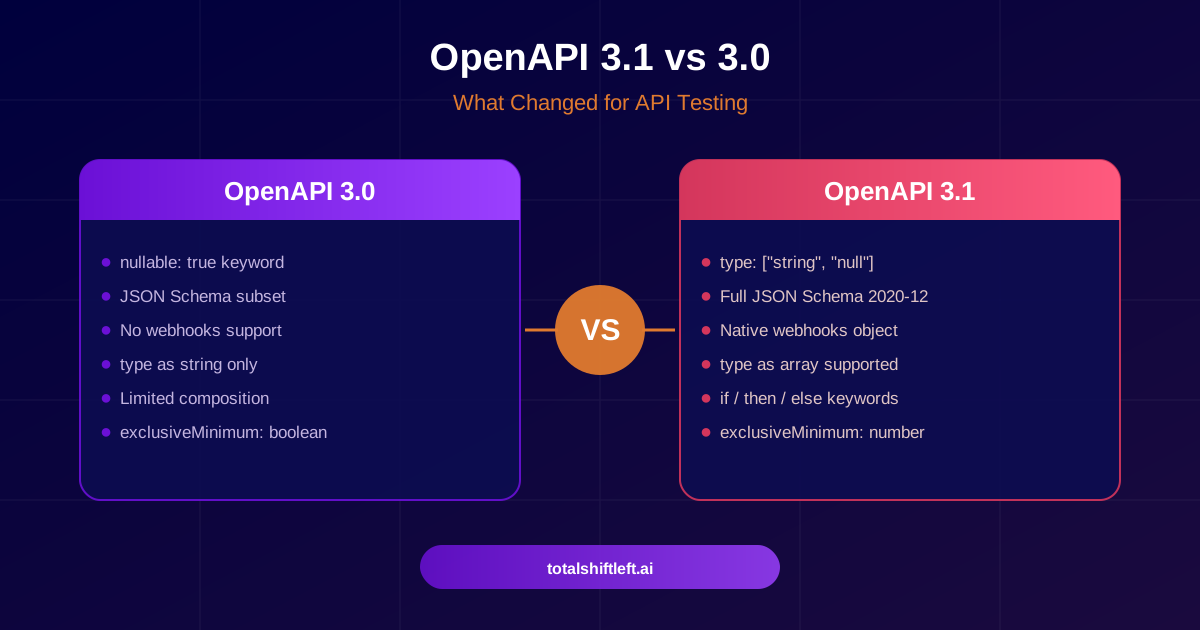
OpenAPI 3.1's biggest change is full JSON Schema 2020-12 compatibility, which replaces the nullable keyword with type arrays, makes exclusiveMinimum and exclusiveMaximum standalone numeric values instead of booleans, and adds if/then/else, patternProperties, and prefixItems. It also adds a top-level webhooks object. None of this is a formality — every one of these changes can silently break spec-driven test generation, so migrate one service at a time and diff the generated test suite before and after.
Reviewed by Smeet Gohel
In this guide
- OpenAPI 3.0 vs 3.1: the diff at a glance
- What changed in OpenAPI 3.1 and why it matters
- Detailed breakdown of every key change
- Should you migrate to OpenAPI 3.1?
- Why these differences impact API and contract testing
- Step-by-step migration guide from 3.0 to 3.1
- Common mistakes teams make during migration
- Best practices for multi-version testing
- Tool compatibility comparison
- Real-world migration example
- How to measure migration success
- Frequently asked questions
Your test suite passes on every build. Your schema validation catches drift. Then someone on the platform team updates the API spec from OpenAPI 3.0 to 3.1, and suddenly half your generated tests fail on fields that have not changed at all. The spec version bump was supposed to be a formality. It was not.
OpenAPI 3.0 vs 3.1 comes down to one structural change with several consequences: 3.1 adopts JSON Schema 2020-12 as its schema language, where 3.0 used a custom, restricted subset. Everything else — the removal of nullable, the new webhooks object, the change to exclusiveMinimum/exclusiveMaximum — follows from that one decision. By early 2026, adoption of 3.1 has crossed the tipping point: major API gateways, documentation platforms, and testing tools now default to 3.1 support, and teams maintaining 3.0 specs are increasingly running into compatibility walls.
This guide breaks down every difference between OpenAPI 3.0 and 3.1 that affects test generation, schema validation, and contract testing — with before/after YAML for each change — then walks through exactly how to migrate without losing test coverage.
Designing the contract before the handler changes what testing has to do at all — schema-first API development and testing covers that loop end to end.
Still on Swagger 2.0? The Swagger to OpenAPI migration guide covers what converts cleanly and what your tests have to be re-pointed at.
Quick Reference: OpenAPI 3.0 vs 3.1 Comparison
| Feature | OpenAPI 3.0 | OpenAPI 3.1 | Testing Impact |
|---|---|---|---|
| JSON Schema | Extended subset (Draft 4) | Full 2020-12 | More schema keywords to validate |
| Nullable | nullable: true keyword | type: ["string", "null"] | Test generators must parse type arrays |
| Webhooks | Not supported | Top-level webhooks object | New test surface for event payloads |
| Conditional schemas | Not available | if / then / else | Branch coverage for conditional logic |
| Pattern properties | Not available | patternProperties | Tests for dynamic property names |
| Tuple validation | Not available | prefixItems | Positional array element validation |
| Exclusive ranges | Boolean modifier | Standalone numeric value | Boundary test generation changes |
| Content encoding | Limited | contentMediaType, contentEncoding | Validate encoded string content |
| Examples | example only | example + examples | More test data sources in spec |
| Schema identifier | N/A | $id supported | Schema resolution changes for tools |
| Dynamic references | N/A | $dynamicRef / $dynamicAnchor | Recursive schema test generation |
The single highest-impact row for testing teams is nullable: it's the change most likely to silently break an existing test suite, covered in detail below.
What Is OpenAPI 3.1 and Why It Matters
OpenAPI 3.1, released in February 2021, is the first version of the OpenAPI Specification to achieve full alignment with JSON Schema. Specifically, it adopts JSON Schema draft 2020-12 as its schema language, replacing the custom "extended subset" of JSON Schema that OpenAPI 3.0 used.
This matters because OpenAPI 3.0 maintained its own dialect of JSON Schema. It borrowed most keywords from JSON Schema Draft 4 but modified others and excluded several entirely. The nullable keyword, for example, was an OpenAPI invention with no equivalent in standard JSON Schema. The type field could only be a single string, not an array. Keywords like if, then, else, patternProperties, and prefixItems were unavailable entirely.
OpenAPI 3.1 removes those restrictions. Any valid JSON Schema 2020-12 document is now a valid OpenAPI 3.1 schema. This has cascading effects on OpenAPI test automation because test generators, validators, and contract testing tools must now handle the full expressiveness of JSON Schema rather than a predictable subset.
The practical impact is significant. Teams gain access to richer validation constraints, cleaner nullable handling, native webhook definitions, and better content encoding support. But they also face a migration path that requires updating their specs, their tooling, and their tests.
How the Changes Work: A Detailed Breakdown
The following diagram summarizes the key specification differences between OpenAPI 3.0 and 3.1 that directly impact API testing workflows:
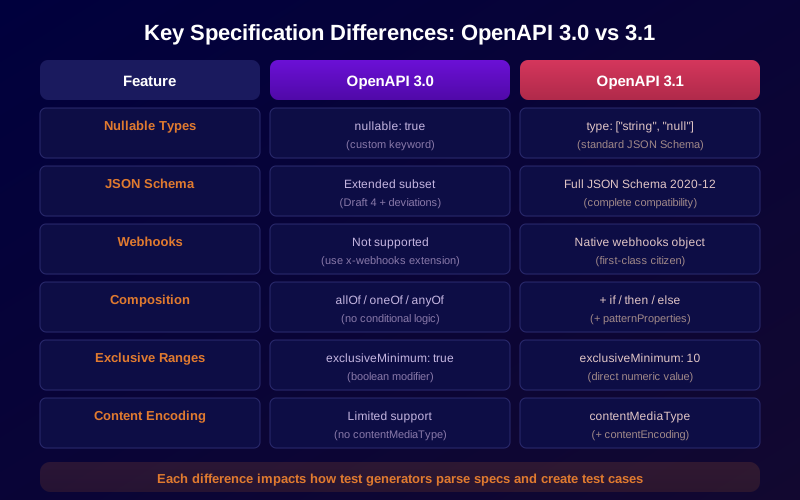
Nullable Type Handling
This is the most visible breaking change. In OpenAPI 3.0, you declare a nullable field like this:
# OpenAPI 3.0
type: string
nullable: true
In OpenAPI 3.1, the nullable keyword no longer exists. Instead, you use a type array:
# OpenAPI 3.1
type:
  - string
  - "null"
For testing, this change means every test case that validates nullable fields must understand type arrays. Negative tests that send null for a non-nullable field need to check for the absence of "null" in the type array rather than checking nullable: false. Boundary tests around nullable fields need to cover both the primary type and the null type as distinct branches.
Full JSON Schema 2020-12 Compatibility
OpenAPI 3.0 supported a subset of JSON Schema Draft 4 with several modifications. OpenAPI 3.1 supports the entirety of JSON Schema 2020-12. The newly available keywords include:
if/then/else: Conditional schemas that change validation rules based on the data. A test generator encounteringif/then/elsemust create test cases for each conditional branch.patternProperties: Schema validation for property names matching a regex pattern. Tests must cover properties matching and not matching the pattern.prefixItems: Tuple validation for arrays where each position has a different schema. Tests must validate each positional element against its specific schema.$dynamicRef/$dynamicAnchor: Dynamic schema references that enable recursive schemas. Test generators must resolve these references correctly.contentMediaType/contentEncoding: Declare the media type and encoding of string content, allowing validators to check that a base64-encoded string actually decodes to valid JSON or a valid image.
Webhooks as First-Class Citizens
OpenAPI 3.0 had no standard way to define webhooks. Teams used vendor extensions (x-webhooks) or separate documents. OpenAPI 3.1 introduces a top-level webhooks object:
# OpenAPI 3.1
webhooks:
  orderStatusChanged:
    post:
      requestBody:
        content:
          application/json:
            schema:
              $ref: '#/components/schemas/OrderStatus'
      responses:
        '200':
          description: Webhook received
For OpenAPI test automation, this means test generators can now produce webhook payload validation tests directly from the spec. Your contract testing can verify that webhook payloads match the documented schema, and your test coverage metrics can include webhook endpoints alongside regular API endpoints.
Exclusive Minimum and Maximum
OpenAPI 3.0 used exclusiveMinimum and exclusiveMaximum as boolean modifiers on minimum and maximum:
# OpenAPI 3.0
minimum: 0
exclusiveMinimum: true
OpenAPI 3.1 follows JSON Schema 2020-12, where these are standalone numeric values:
# OpenAPI 3.1
exclusiveMinimum: 0
Test generators that create boundary value tests must handle both formats. A boundary test for exclusiveMinimum: 0 should test with values 0 (expecting rejection), 1 (expecting acceptance), and -1 (expecting rejection).
Ready to shift left with your API testing?
Try our no-code API test automation platform free. Generate tests from OpenAPI, run in CI/CD, and scale quality.
Schema Version Identifier
OpenAPI 3.0 specs use openapi: "3.0.x". OpenAPI 3.1 specs use openapi: "3.1.0" and can optionally include a jsonSchemaDialect field pointing to the JSON Schema 2020-12 meta-schema URI. Test tools should check the openapi version field to determine which parsing rules to apply and which schema keywords to expect.
Should You Migrate to OpenAPI 3.1?
Migrate when your toolchain fully supports 3.1 and you need one of three things: webhooks as first-class spec objects, full JSON Schema 2020-12 expressiveness for richer contract validation, or cleaner nullable handling for a spec with many optional fields. If your 3.0 spec already tests cleanly and none of those apply, migration is beneficial but not urgent — 3.0 remains a fully valid, widely supported spec version, not a deprecated one.
The decision hinges on your weakest-supported tool, not your strongest. Check the tool compatibility table below before committing to a date: if any tool in your pipeline (a gateway, a codegen step, a contract-testing platform) only has partial 3.1 support, either wait for that tool to catch up or budget time to maintain 3.0 and 3.1 specs in parallel during the transition — which is real, ongoing overhead, not a one-time cost.
Why the Differences Matter for Testing
The gap between OpenAPI 3.0 and 3.1 is not academic. Each specification change maps directly to a change in how testing tools must behave.
Test generation is the most immediately affected area. Tools that generate API tests from OpenAPI specs parse schema definitions to create positive, negative, and boundary test cases. When the schema language changes -- when nullable: true becomes type: ["string", "null"] -- the parser must handle the new syntax or it will misinterpret the schema and generate incorrect tests. A test generator that does not understand type arrays will treat a nullable string field as having an invalid type definition and either skip it or produce a false-positive failure.
Schema validation must also adapt. If your contract tests use a JSON Schema validator configured for the 3.0 dialect, it will reject valid 3.1 constructs like if/then/else or array-based type fields. The validator does not know these keywords exist in the 3.1 dialect, so it treats them as unknown properties and either ignores them silently or throws errors.
Contract testing gains new power with 3.1. The addition of conditional schemas (if/then/else), pattern properties, and tuple validation (prefixItems) means you can express API contracts with far more precision. A contract that previously required custom validation logic can now be expressed entirely within the spec, which means your test automation pipeline can validate those constraints automatically. Feeding the richer spec into schema-aware test generation turns each new constraint — type arrays, conditional branches, pattern properties — into concrete positive and negative cases without hand-authoring them.
How Total Shift Left does this: Total Shift Left auto-detects whether an imported spec is OpenAPI 3.0 or 3.1 and applies the correct parsing rules automatically, so a version bump does not require reconfiguring your test tooling. When a later version of the spec is imported, each change is classified as breaking or non-breaking and waits for your approval; if tests then fail, Fix with AI proposes the updated assertions as a before/after diff for you to accept instead of leaving the suite red.
The bottom line: ignoring these differences does not leave your tests unchanged. It leaves them silently wrong.
Step-by-Step Migration Guide from 3.0 to 3.1
Migrating your API specifications and test suite from OpenAPI 3.0 to 3.1 requires a structured approach. Skipping steps will introduce silent test failures that surface at the worst possible time.
Step 1: Audit Your Existing 3.0 Spec
Before changing anything, inventory the 3.0-specific constructs in your current spec that will need updating. Search for:
- Every instance of
nullable: true(must convert to type arrays) - Usage of
exclusiveMinimum: true/falseandexclusiveMaximum: true/false(must convert to numeric values) - Any
x-vendor extensions that duplicate features now available natively in 3.1 (such asx-webhooks) - The
examplekeyword (3.1 supports bothexampleandexampleswith slightly different semantics) - Any tooling-specific workarounds for JSON Schema features that 3.0 did not support
Step 2: Update the Version and Nullable Fields
Change the version identifier and convert all nullable fields:
# Before
openapi: "3.0.3"

# After
openapi: "3.1.0"
Then systematically replace every nullable: true with a type array. This is the most tedious step but also the most critical. Automated migration scripts can help, but review each change manually to catch edge cases where nullable interacts with oneOf or allOf compositions.
Step 3: Convert Exclusive Range Keywords
Replace boolean-style exclusive range modifiers with standalone numeric values. For each occurrence:
# Before (3.0)
minimum: 0
exclusiveMinimum: true

# After (3.1)
exclusiveMinimum: 0
Remove the original minimum or maximum keyword when it was only serving as the base for the boolean modifier.
Step 4: Add Webhook Definitions
If your API sends webhooks, move any x-webhooks definitions into the new top-level webhooks object. Define request body schemas for each webhook event so that test generators can produce payload validation tests.
Step 5: Validate the Migrated Spec
Run your updated spec through a 3.1-compatible linter such as Spectral with the 3.1 ruleset or the Swagger Editor 5.x validator. Fix any errors before proceeding to test regeneration. Common issues at this stage include leftover nullable keywords, incorrect type array syntax, and missing $ref targets in reorganized schemas.
Step 6: Regenerate and Compare Test Suites
Import the migrated 3.1 spec into your test automation platform and generate a fresh test suite. Compare the new suite against your previous 3.0-generated tests. Look for:
- Tests that disappeared (likely due to parsing differences in the new spec format)
- New tests that appeared (from features like webhooks or richer schema constraints)
- Tests with different expected behaviors (especially around nullable fields and boundary values)
Run both suites against your API to confirm the 3.1 suite produces equivalent or better coverage.
This comparison is much easier when the generator explains itself. Shift-Left API's coverage-driven generation reports which tests it created, updated or skipped on each pass and why, and its Coverage dashboard shows which endpoints and cases are tested and where the gaps are — so a test that vanished because of a parsing difference shows up as a gap rather than going unnoticed. See coverage gap detection.
Common Migration Mistakes to Avoid
Mistake 1: Assuming the Migration Is Just a Version Bump
Changing openapi: "3.0.3" to openapi: "3.1.0" without updating the schema keywords produces a spec that claims to be 3.1 but contains invalid 3.0 syntax. Validators will reject it, and test generators will produce unpredictable results.
Mistake 2: Forgetting Nullable in Composed Schemas
When nullable: true appears alongside allOf, oneOf, or anyOf in 3.0, the conversion to type arrays requires careful handling. You cannot simply add "null" to the type array inside a $ref target because that would change the referenced schema globally. Instead, wrap the nullable variant in its own schema.
Mistake 3: Not Updating Test Tool Configurations
Your test generation tool may need configuration changes to parse 3.1 specs correctly. Check for version flags, schema dialect settings, or parser mode switches. Running a 3.1 spec through a 3.0 parser will silently ignore new keywords and produce incomplete test suites.
Mistake 4: Ignoring the exclusiveMinimum/Maximum Change
This is a subtle breaking change that affects boundary value tests. If your test generator still interprets exclusiveMinimum as a boolean, it will generate incorrect boundary tests that pass invalid values or reject valid ones.
Mistake 5: Migrating All Specs at Once
Large organizations often maintain dozens or hundreds of API specs. Migrating them all simultaneously creates a blast radius that is impossible to debug when tests start failing. Migrate one service at a time, validate the test suite, confirm coverage, and then proceed to the next.
Free 1-page checklist
API Testing Checklist for CI/CD Pipelines
A printable 25-point checklist covering authentication, error scenarios, contract validation, performance thresholds, and more.
Download FreeBest Practices for OpenAPI 3.1 Testing
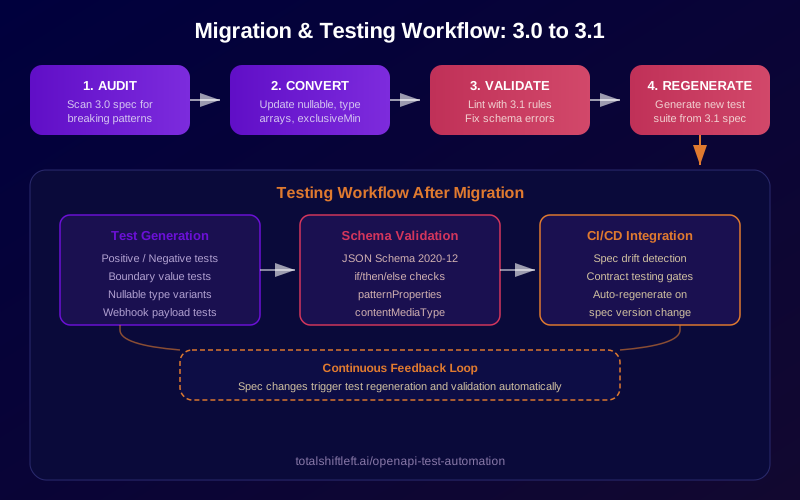
The following diagram illustrates a recommended migration and testing workflow for teams transitioning from OpenAPI 3.0 to 3.1:
Use a Spec-Driven Testing Platform That Supports Both Versions
During migration, you will have some services on 3.0 and others on 3.1. Your testing platform must handle both without manual configuration switching. Total Shift Left auto-detects the spec version and applies the correct parsing rules, eliminating version-related test failures during the transition period.
Validate Schemas Before Generating Tests
Always run your spec through a version-appropriate validator before importing it into your test generator. A malformed spec produces malformed tests. Integrate spec validation into your CI pipeline so that invalid specs are caught before they reach the test generation stage.
Leverage New 3.1 Features for Better Coverage
Do not just migrate the syntax -- take advantage of what 3.1 offers. Add if/then/else conditional schemas where your API behavior depends on input values. Define patternProperties for dynamic key-value responses. Use prefixItems for APIs that return ordered tuples. Each new constraint becomes an automatic test case when processed by a spec-driven test generator.
In Shift-Left API, each endpoint is put through several test-design techniques — boundary values, equivalence classes, decision tables and authentication depth — so a corrected exclusiveMinimum: 0 produces the just-inside and just-outside values, and an if/then/else branch gives each condition its own case. Nested body fields are covered too, and each potential issue found is given a business-impact severity. See test strategy fan-out.
Maintain a Changelog of Spec Changes
Track every change you make during migration. This log becomes invaluable when a test fails and you need to determine whether the failure is caused by the migration itself or by an actual API regression. Include the before and after syntax for each modified schema.
Tooling can carry part of this load. Shift-Left API diffs each newly synced spec against the previous one and flags every test a breaking change affects for review (API change detection). It also checks passing runs, not only failing ones: a green test is examined for whether the response still matches its documentation, which is how a migration that quietly changed what a schema means gets noticed before a consumer does.
Test Webhook Payloads Alongside API Endpoints
Now that webhooks are first-class in the spec, include them in your test coverage metrics. Generate tests that validate webhook payload structures and ensure your webhook delivery mechanism sends payloads that match the documented schema. This closes a testing gap that most teams have been ignoring since 3.0 had no standard way to describe webhooks.
Tools and Compatibility: OpenAPI 3.0 vs 3.1
Not all testing tools have caught up with OpenAPI 3.1. Before migrating, verify that your toolchain supports the new spec version.
| Tool | OpenAPI 3.0 | OpenAPI 3.1 | Notes |
|---|---|---|---|
| Total Shift Left | Full support | Full support | Auto-detects version, generates tests for webhooks |
| Swagger Editor 5.x | Full support | Full support | Validates 3.1 schemas natively |
| Stoplight Studio | Full support | Full support | Visual editor handles type arrays |
| Spectral | Full support | Full support (v6+) | Requires 3.1 ruleset configuration |
| Swagger Codegen 2.x | Full support | No support | Must upgrade to OpenAPI Generator 7.x+ |
| Postman (2025+) | Full support | Partial support | Imports 3.1 specs but may ignore some keywords |
| Dredd | Full support | Limited support | Does not handle type arrays or webhooks |
| Schemathesis | Full support | Full support | Supports full JSON Schema 2020-12 |
| Prism (Stoplight) | Full support | Full support | Mock server handles 3.1 schemas |
| OpenAPI Generator 7.x | Full support | Full support | Code generation from 3.1 specs |
If any critical tool in your pipeline does not support 3.1, you have two options: delay migration until support arrives, or maintain parallel 3.0 and 3.1 versions of your spec (which is expensive and error-prone).
Real-World Example: Migrating a Microservices API
Consider a team running 12 microservices, each with its own OpenAPI 3.0 spec. Their test pipeline uses a spec-driven tool to generate API tests from OpenAPI specs and runs them in CI on every pull request.
The trigger: The team wanted to add webhook documentation for three event-driven services. Since 3.0 had no webhook support, they decided to migrate to 3.1.
The approach: They migrated one service at a time, starting with the simplest (a read-only reference data API with no nullable fields). This let them validate their toolchain and process before tackling complex services.
The challenges: Their payment service had 47 nullable fields spread across 12 schemas, many nested inside allOf compositions. Converting these required creating wrapper schemas to avoid modifying shared $ref targets. Their test generation tool initially produced 23% fewer tests for the migrated spec because it was ignoring if/then/else schemas -- a tool configuration issue resolved after updating to the latest version.
The result: After migrating all 12 services over six weeks, the team saw a net increase of 340 generated test cases. The new tests covered webhook payloads, conditional response schemas, and pattern-property fields that were previously untestable from the spec alone. Schema drift detection caught three undocumented fields that had been invisible under the less-strict 3.0 validation.
Metrics: Measuring Migration Success
Migration is not complete when the spec file parses without errors. Track these metrics to confirm your migration succeeded:
Test count comparison: Compare the number of generated test cases before and after migration. A well-migrated spec with the same API surface should produce equal or more tests, not fewer. If the count drops, investigate which endpoints or schemas lost coverage.
Test pass rate: Run the post-migration test suite against your API. The pass rate should be comparable to your pre-migration baseline. Failures indicate either spec migration errors (the spec no longer matches the API) or tool parsing issues (the tool misinterprets 3.1 syntax).
Schema coverage percentage: Measure what percentage of your spec's schemas, endpoints, and response codes are covered by generated tests. 3.1 specs with richer schemas should enable higher coverage. If coverage drops, your tool may not be leveraging the new schema features.
Webhook test coverage: If you added webhook definitions, track how many webhook event types have test cases. This metric was zero before migration -- it should reflect your full webhook surface after migration.
Spec validation score: Run your migrated specs through a linter and track the number of warnings and errors. A clean linter output confirms the spec is syntactically correct for 3.1.
Pipeline execution time: Test suite execution time should remain stable or improve. If execution time increases significantly, investigate whether the tool is struggling with new schema constructs.
Frequently asked questions about OpenAPI 3.0 vs 3.1
What are the main differences between OpenAPI 3.1 and 3.0? OpenAPI 3.1 introduces full JSON Schema 2020-12 compatibility (replacing the subset in 3.0), native webhooks support, simplified nullable handling (using type arrays instead of the nullable keyword), and improved schema composition with if/then/else. These changes affect how test tools parse specs and generate test cases.
Does OpenAPI 3.1 break existing API tests? It can. Tests that rely on the nullable keyword, custom x- extensions for JSON Schema features, or tools that only support the 3.0 schema subset may break. The type field changing from a string to an array for nullable types is the most common breaking change for test tooling.
Should I migrate from OpenAPI 3.0 to 3.1? Migrate when your toolchain supports 3.1 and you need features like webhooks, full JSON Schema compatibility, or cleaner nullable handling. If your current 3.0 spec works well with your testing tools, migration is beneficial but not urgent.
How does OpenAPI 3.1 improve API contract testing? Full JSON Schema compatibility means richer validation constraints (if/then/else, patternProperties, prefixItems) that enable more precise contract testing. Test generators can create more targeted test cases from the additional schema information.
What tools support OpenAPI 3.1 for testing? Total Shift Left, Swagger Editor 5.x, Stoplight Studio, and most modern API platforms support OpenAPI 3.1. Some older tools like Swagger Codegen 2.x and older Postman versions may have limited 3.1 support.
Sources and further reading
- OpenAPI Specification — the normative spec for describing HTTP APIs.
- JSON Schema 2020-12 — the schema dialect OpenAPI 3.1 aligns with.
- OpenAPI 2.0 (Swagger) specification — the Swagger 2.0 spec, for comparison against OAS 3.x.
Key takeaways
- OpenAPI 3.1 is not a minor update. Full JSON Schema 2020-12 compatibility changes how every testing tool must parse and interpret your API specification.
- The nullable keyword removal is the most common breaking change. Converting
nullable: trueto type arrays affects test generation, schema validation, and contract testing. - New schema features enable richer tests. Conditional schemas, pattern properties, and tuple validation create test cases that were impossible to generate from 3.0 specs.
- Webhook support closes a major testing gap. Event-driven APIs can now be tested from the spec like any other endpoint.
- Tool compatibility varies widely. Verify every tool in your pipeline supports 3.1 before migrating, or maintain parallel spec versions during the transition.
- Migrate incrementally. One service at a time, with test suite comparison at each step, prevents cascading failures.
- Measure before and after. Test count, pass rate, schema coverage, and pipeline stability are the metrics that confirm a successful migration.
Start Testing with OpenAPI 3.1 Today
Whether you are migrating from 3.0 or starting fresh with 3.1, Total Shift Left auto-detects your spec version and generates comprehensive test suites from either format. Import your spec, generate tests, and run them in your CI pipeline -- no manual test scripting required.
Start your free trial and see how spec-driven testing works with your OpenAPI 3.1 specifications. Already evaluating? Compare plans on our pricing page to find the right fit for your team.
See also: generate tests from openapi in our learn hub for the underlying concept.
Ready to shift left with your API testing?
Try our no-code API test automation platform free.