
Testing Strategy for Platform Engineering Teams (2026)
Quick answer
Platform engineering testing validates internal developer platforms across four deliverables: golden path templates, platform APIs, infrastructure provisioning, and developer workflows — because a platform defect has organization-wide blast radius rather than affecting one team. The practice layers template rendering checks, consumer-driven contract testing (Pact) for backward compatibility, Terratest for infrastructure modules, and canary rollouts to contain risk before organization-wide release.
Reviewed by Smeet Gohel

Platform engineering testing is the practice of validating internal developer platforms, golden path templates, self-service infrastructure, and shared platform services. It ensures that the tools, templates, and infrastructure platform teams provide to development teams are reliable, performant, backward-compatible, and produce correct outcomes across all supported configurations.
Platform engineering has emerged as a critical discipline for scaling engineering organizations. By providing internal developer platforms (IDPs) with self-service capabilities, golden path templates, and managed infrastructure, platform teams multiply the productivity of every development team in the organization. But a platform that is unreliable is worse than no platform at all—it creates a single point of failure that affects every team simultaneously and destroys the trust that adoption depends on.
Platform engineering is the discipline of designing and building internal developer platforms that enable development teams to be self-sufficient. Instead of filing tickets for infrastructure, environments, or CI/CD pipelines, developers use the platform's self-service capabilities to provision what they need. Golden path templates provide standardized, pre-tested patterns for creating new services, deploying applications, and configuring infrastructure.
The platform is software that serves developers as its users. And like all software, it must be tested. But platform testing differs from application testing in fundamental ways. The platform's correctness is defined not just by its own behavior, but by the behavior of the artifacts it produces. A template that generates a broken Kubernetes deployment is a platform defect even though the template engine itself functions correctly.
The 2025 Gartner report on platform engineering estimates that 80% of large engineering organizations will have platform teams by 2027. Yet testing practices for platform deliverables remain immature—most platform teams test their services but not their templates, pipelines, or infrastructure provisioning workflows.
This guide provides a comprehensive testing strategy for platform engineering teams. It covers testing golden paths, platform APIs, infrastructure provisioning, developer experience, and backward compatibility. Whether you are building a new internal developer platform or maturing an existing one, this strategy ensures your platform earns and maintains developer trust. For foundational testing strategy concepts, see Software Testing Strategy for Modern Applications.
In this guide
- What Is Platform Engineering Testing?
- Why Platform Testing Is Different
- Key Components of a Platform Testing Strategy
- Platform Testing Architecture
- Tools for Platform Engineering Testing
- Platform engineering testing in practice: a worked example
- Platform engineering testing challenges and how to solve them
- Platform engineering testing best practices
- Platform Testing Strategy Checklist
- Ship the golden path as a reusable workflow
- Platform engineering testing FAQ
What Is Platform Engineering Testing?
Platform engineering testing validates four categories of platform deliverables:
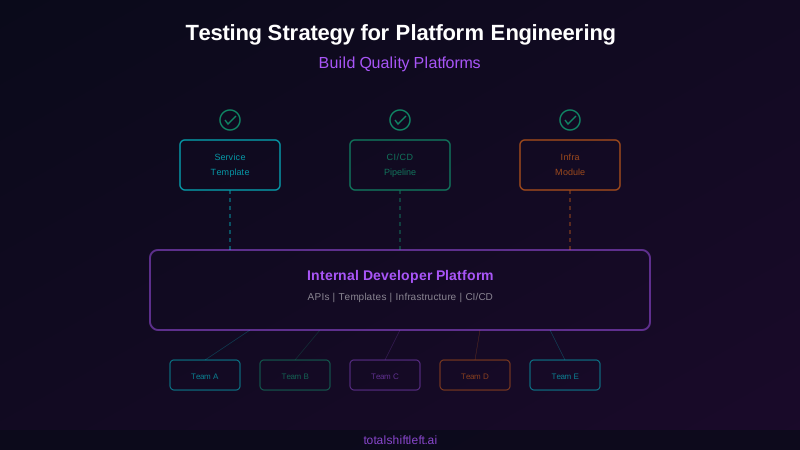
Golden Path Templates: Pre-configured templates that developers use to create new services, CI/CD pipelines, Kubernetes deployments, and infrastructure. Testing validates that templates render correctly across all supported configurations, produce secure and functional artifacts, and follow organizational standards.
Platform APIs and Services: The APIs that power the internal developer platform—service catalogs, infrastructure provisioning APIs, deployment APIs, and monitoring configuration APIs. Testing validates correctness, performance, reliability, backward compatibility, and error handling.
Infrastructure Provisioning: The Terraform modules, Helm charts, and cloud configurations that the platform provisions on behalf of development teams. Testing validates that provisioned infrastructure is correct, secure, and performant. This intersects with DevOps testing practices and infrastructure-as-code validation.
Developer Workflows: The end-to-end workflows developers follow when using the platform—creating a new service, deploying to production, provisioning a database, configuring monitoring. Testing validates that these workflows complete successfully, produce expected outcomes, and provide useful error messages when things go wrong.
Each category requires different testing techniques, tools, and cadences. A platform testing strategy must address all four to ensure comprehensive platform quality.
For the tool landscape underneath this, see continuous integration testing tools — what each one integrates with and where it fits in the pipeline.
Why Platform Testing Is Different
Blast Radius Is Organization-Wide
When a platform defect reaches production, it does not affect one service—it affects every service that uses the platform. A broken CI/CD template stops all deployments across the organization. A misconfigured Terraform module provisions insecure infrastructure for every team that uses it. The blast radius of platform defects is orders of magnitude larger than application defects.
Consumers Cannot Be Coordinated
Application teams can coordinate with their users for breaking changes. Platform teams serve dozens or hundreds of internal teams who consume platform services asynchronously. You cannot schedule a maintenance window for a platform API that development teams depend on for continuous deployment. Backward compatibility is not a nice-to-have—it is a requirement for platform trust. Testing the platform under a multi-tenant architecture where each consumer team is isolated also lets you validate that one team's usage or misconfiguration cannot degrade another's.
Outputs Are More Important Than Internals
An application test validates that the application behaves correctly. A platform test must validate that the artifacts the platform produces behave correctly. Testing a Helm chart template engine is necessary but insufficient—you must also test that the Helm charts it generates deploy correctly to Kubernetes. This output-focused testing requires different tooling and approaches.
Configuration Combinatorics Explode Quickly
Golden path templates support many configurations: different languages, frameworks, cloud providers, Kubernetes cluster versions, and infrastructure sizes. Testing all combinations is infeasible. Platform teams must use strategic testing—combinatorial testing, pairwise testing, and risk-based selection—to achieve confidence without exhaustive coverage.
Key Components of a Platform Testing Strategy
Golden Path Template Testing
Test templates at three levels:
-
Render validation: Verify that templates produce syntactically valid output for all supported configurations. Use template rendering tools (Helm template, Cookiecutter dry-run, Backstage scaffolder preview) to generate output and validate it against expected schemas.
-
Artifact testing: Deploy the generated artifacts to a test environment and validate they work correctly. For a service template, this means: render the template, build the generated code, run its test suite, deploy it to Kubernetes, validate health checks pass, and confirm monitoring is configured.
-
Upgrade testing: When you update a template, verify that existing services using the old version can upgrade to the new version without breaking. This requires maintaining a set of reference applications generated from previous template versions and testing upgrade paths.
Ready to shift left with your API testing?
Try our no-code API test automation platform free. Generate tests from OpenAPI, run in CI/CD, and scale quality.
Platform API Contract Testing
Platform APIs must maintain backward compatibility rigorously. Use Shift-Left API to generate comprehensive API tests from the platform's OpenAPI specifications. Run these tests on every platform change to detect breaking changes before they affect consumers. Implement semantic versioning and maintain explicit deprecation policies.
Consumer-driven contract testing is especially valuable for platform APIs. Allow consuming teams to publish their expectations as contracts, and validate these contracts on every platform release. This ensures that platform changes do not break any consumer's specific usage pattern.
Infrastructure Module Testing
Test Terraform modules, Helm charts, and cloud configurations using the same test automation strategy principles as application code:
- Static analysis: Lint and validate configurations. Enforce policies with OPA, Sentinel, or Checkov.
- Plan validation: Assert that planned changes match expectations without deploying real infrastructure.
- Integration testing: Deploy to a sandbox environment and validate the infrastructure works correctly. Clean up after testing.
- Compliance testing: Verify that provisioned infrastructure meets security, networking, and governance policies.
Developer Experience Testing
Test the workflows developers follow when using the platform. This is functional testing from the developer's perspective:
- Can a developer crea
te a new service from a template in under 5 minutes?
- Can they deploy the service to staging and production?
- Do error messages help them fix problems without filing support tickets?
- Is the documentation accurate and up to date?
Automate these workflows as end-to-end tests that exercise the platform from the developer's entry point to the final deployed artifact.
Backward Compatibility Testing
Every platform release must be validated against existing consumers:
- Run consumer contract tests against the new platform version.
- Deploy reference applications (generated from previous template versions) with the new platform services.
- Validate that platform API deprecations include adequate migration periods.
- Monitor canary rollouts of platform changes for increased error rates from consumer teams.
Chaos Engineering for Platforms
Test platform resilience by injecting failures into platform services:
- What happens when the service catalog is unavailable?
- What happens when infrastructure provisioning times out?
- What happens when the CI/CD system loses connectivity to the artifact registry?
- Do developer workflows provide clear error messages during platform outages?
Platform Testing Architecture
The platform testing architecture operates in concentric rings:
Ring 1: Unit and Component Tests — Test platform service internals, template rendering logic, and API handlers. These tests run in the platform team's CI/CD pipeline on every commit. No external dependencies.
Ring 2: Contract and API Tests — Validate platform API contracts using Shift-Left API and consumer-driven contract tests. Ensure backward compatibility. These tests run on every pull request.
Ring 3: Golden Path Integration Tests — Render templates, build generated artifacts, deploy to a test Kubernetes cluster, and validate end-to-end. These tests run on every platform release candidate.
Ring 4: Infrastructure Smoke Tests — Deploy Terraform modules and Helm charts to sandbox environments. Validate correct provisioning, security compliance, and cleanup. Run on changes to infrastructure modules.
Ring 5: Platform System Tests — Exercise complete developer workflows from template creation to production deployment. Run against a staging platform environment. Validate developer experience, monitoring integration, and error handling.
Ring 6: Consumer Canary — Roll out platform changes to a small group of consumer teams first. Monitor for increased error rates, support tickets, and deployment failures before full rollout.
This architecture ensures that defects in the platform are caught at the cheapest layer possible while still validating the end-to-end developer experience. For detailed guidance on designing testing architecture, see the companion article.
Tools for Platform Engineering Testing
| Tool | Type | Best For | Open Source |
|---|---|---|---|
| Shift-Left API | API Testing | Platform API contract testing and backward compatibility | No |
| Terratest | IaC Testing | Testing Terraform modules and Kubernetes configs | Yes |
| Pact | Contract Testing | Consumer-driven contract testing for platform APIs | Yes |
| Backstage | IDP Framework | Internal developer platform with testable scaffolding | Yes |
| chart-testing (ct) | Helm Testing | Automated Helm chart linting and testing | Yes |
| Open Policy Agent | Policy Testing | Policy enforcement for infrastructure and configs | Yes |
| Checkov | Security Scanning | IaC security and compliance validation | Yes |
| Playwright | Workflow Testing | End-to-end developer workflow testing through UI | Yes |
| k6 | Performance Testing | Load testing platform APIs and services | Yes |
| Crossplane | IaC Testing | Testing cloud infrastructure compositions | Yes |
| Conftest | Policy Testing | Policy tests for structured data and configs | Yes |
| Testcontainers | Integration Testing | Local integration testing with containers | Yes |
Platform engineering testing in practice: a worked example
Problem: A technology company with 150 developers across 20 teams built an internal developer platform based on Backstage, Kubernetes, and Terraform. Within six months, developer trust in the platform eroded. Golden path templates generated services with outdated dependencies. Infrastructure provisioning occasionally created resources in the wrong region. A platform API change broke 8 teams' deployment pipelines simultaneously. Support tickets to the platform team tripled, and teams began bypassing the platform entirely.
Solution: They implemented a comprehensive platform testing strategy:
- Built golden path integration tests that rendered every template configuration, built the generated code, deployed to a test cluster, and validated health checks and monitoring—running on every template change.
- Adopted Shift-Left API for platform API testing, catching backward compatibility issues in CI before they affected consumers.
- Implemented consumer-driven contract testing: each consuming team published contracts that were validated on every platform release.
- Added Terratest integration tests for all Terraform modules, deploying to sandbox accounts and validating provisioned resources.
- Created developer workflow smoke tests that exercised the top 10 platform workflows end-to-end nightly.
- Established a canary rollout process: platform changes deployed to 3 volunteer teams before organization-wide rollout.
Results: Platform-caused incidents dropped from 12 per month to 1. Developer satisfaction scores (measured quarterly) increased from 3.2 to 4.6 out of 5. Support tickets decreased by 65%. Platform adoption increased from 60% to 95% of teams. The platform team shifted from firefighting to feature development, shipping new capabilities twice as fast.
Platform engineering testing challenges and how to solve them
Challenge: Template Combinatorial Explosion
Golden path templates support many configurations. Testing every combination is infeasible.
Free Guided worksheet
Build Your Testing Strategy in 30 Minutes
A structured worksheet that walks you through defining your testing strategy in 30 minutes. Cover architecture, tools, layers, and team responsibilities.
Download FreeSolution: Use pairwise testing to achieve coverage of configuration interactions with a manageable number of test cases. Identify the highest-risk configurations (production-grade, security-sensitive) and test those exhaustively. Use property-based testing to generate random configurations and verify invariants hold.
Challenge: Slow Infrastructure Tests
Deploying real infrastructure for testing takes minutes to hours and costs money.
Solution: Layer infrastructure testing: static analysis and plan validation are fast and free (seconds). Reserve deployment testing for critical modules and run it on a schedule rather than every commit. Use cloud provider sandboxes with spending limits. Implement parallel infrastructure provisioning.
Challenge: Consumer Contract Management
Managing contracts from dozens of consuming teams is operationally complex.
Solution: Use a centralized contract broker (Pact Broker) that stores and versions contracts automatically. Integrate contract publication into consumer CI/CD pipelines. Run provider verification in the platform's CI/CD pipeline. Automate stale contract detection and cleanup.
Challenge: Testing Developer Experience
Developer experience is subjective and difficult to test automatically.
Solution: Combine automated workflow testing (can a developer complete the workflow successfully?) with periodic usability studies (is the experience intuitive?). Track quantitative metrics: time to create a new service, number of support tickets per workflow, and developer satisfaction surveys. Use these metrics as quality indicators alongside automated tests.
Challenge: Platform Versioning Complexity
Multiple platform versions may be in use simultaneously as teams upgrade on different schedules.
Solution: Maintain support for N-1 versions at minimum. Test new platform releases against applications generated from all supported template versions. Automate upgrade path testing that takes an application from version N-1 to version N and validates correctness.
Platform engineering testing best practices
- Test the outputs of your platform, not just the internals—a template engine that works but produces broken artifacts is defective
- Treat backward compatibility as a hard requirement and test for it on every platform change
- Implement consumer-driven contract testing so consuming teams define their expectations explicitly
- Use Shift-Left API to automate API testing for all platform services and ensure contract stability
- Test golden paths end-to-end: template rendering, code generation, build, deployment, health validation, and monitoring
- Maintain reference applications generated from previous template versions for upgrade testing
- Implement canary rollouts for platform changes—deploy to a small group before organization-wide
- Track platform reliability metrics: incident count, MTTR, support ticket volume, developer satisfaction
- Build developer workflow smoke tests that exercise the top 10 platform workflows end-to-end
- Invest in automated testing in CI/CD for all platform deliverables—templates, APIs, infrastructure modules, and workflows
- Document the platform testing strategy and review it quarterly with platform consumers
- Budget for infrastructure test environments as a platform operating cost
Platform Testing Strategy Checklist
- ✔ Implement golden path template testing across all configurations
- ✔ Deploy automated API testing for all platform services using Shift-Left API
- ✔ Establish consumer-driven contract testing with a centralized broker
- ✔ Add infrastructure module testing with static analysis and integration tests
- ✔ Create developer workflow end-to-end smoke tests for top workflows
- ✔ Implement backward compatibility testing on every platform release
- ✔ Maintain reference applications for upgrade path testing
- ✔ Set up canary rollout process for platform changes
- ✔ Configure platform reliability dashboards with incident and satisfaction metrics
- ✔ Implement chaos engineering for platform service resilience
- ✔ Enforce security and compliance policies on all platform infrastructure
- ✔ Document the platform testing strategy and share with consumer teams
- ✔ Schedule quarterly testing strategy reviews with platform consumers
- ✔ Establish platform SLAs for reliability, availability, and incident response
See also: contract testing in our learn hub for the underlying concept.
Ship the golden path as a reusable workflow
A platform team's testing deliverable is not a document — it is the pipeline every product team calls. Publish it once, version it, and the bar moves for everyone when you bump the tag:
# acme/platform-workflows/.github/workflows/api-quality.yml
name: API quality (golden path)
on:
  workflow_call:
    inputs:
      spec:           { type: string, default: openapi.yaml }
      tier:           { type: string, default: tier-2 }
      preview-url:    { type: string, required: false }
    secrets:
      staging-url:    { required: true }
jobs:
  quality:
    runs-on: ubuntu-latest
    steps:
      - uses: actions/checkout@v4
        with: { fetch-depth: 0 }
      - name: Resolve the tier's thresholds
        id: policy
        run: |
          FLOOR=$(yq -r '.tiers."${{ inputs.tier }}".unit_coverage_min' policy.yaml)
          echo "floor=$FLOOR" >> "$GITHUB_OUTPUT"
      - run: npx @stoplight/spectral-cli lint ${{ inputs.spec }} --fail-severity error
      - run: |
          git show origin/${{ github.base_ref }}:${{ inputs.spec }} > /tmp/base.yaml
          oasdiff breaking /tmp/base.yaml ${{ inputs.spec }} --fail-on ERR
      - run: pytest --cov=app --cov-fail-under=${{ steps.policy.outputs.floor }}
      - run: schemathesis run ${{ inputs.spec }} --url "${{ secrets.staging-url }}" --checks all
Product teams opt in with four lines, which is the difference between a platform and a policy:
# each product repository
jobs:
  api-quality:
    uses: acme/platform-workflows/.github/workflows/api-quality.yml@v2
    with: { tier: tier-1 }
    secrets: { staging-url: ${{ secrets.STAGING_URL }} }
Platform engineering testing FAQ
What is platform engineering testing?
Platform engineering testing is the practice of validating internal developer platforms, golden path templates, self-service infrastructure, and shared platform services. It ensures that the tools and infrastructure platform teams provide to development teams are reliable, performant, secure, and produce correct outcomes.
How do you test an internal developer platform?
Test an internal developer platform across four dimensions: template correctness (do golden paths produce working applications), infrastructure reliability (do provisioned resources work correctly), API stability (do platform APIs maintain backward compatibility), and developer experience (can developers use the platform without friction). Automate all four dimensions in CI/CD.
What are golden path tests?
Golden path tests validate that the standardized templates and workflows provided by the platform produce correct, secure, and functional applications. They test the entire golden path end-to-end: template rendering, infrastructure provisioning, application deployment, health check validation, and monitoring setup.
Why is backward compatibility testing critical for platform teams?
Platform teams serve many consumer teams. A breaking change in a platform API or template can break dozens of applications simultaneously. Backward compatibility testing ensures that platform updates do not break existing consumers, which is essential for maintaining trust and adoption.
How does API testing fit into platform engineering?
Platform services expose APIs that development teams depend on for deployment, infrastructure provisioning, and service management. Testing these APIs with tools like Shift-Left API ensures contract stability, backward compatibility, and reliability—protecting all consumer teams from platform regressions.
Sources and further reading
- Kubernetes documentation — the platform primitives cloud-native tests run on.
- DORA State of DevOps research — the multi-year dataset behind the four delivery metrics.
- Spectral (Stoplight) — the OpenAPI linter most governance programmes standardise on.
Key takeaways
- Platform engineering multiplies the productivity of every development team in your organization.
- But that multiplier cuts both ways—a reliable platform accelerates everyone, while an unreliable platform blocks everyone.
- The testing strategy for your platform must be at least as rigorous as the testing strategy for your most critical production application.
- Test golden paths end-to-end. Validate platform API contracts and backward compatibility on every change.
- Test infrastructure modules before they provision real resources. Exercise developer workflows as automated smoke tests.
- And roll out platform changes through canary releases to contain blast radius.
If you are ready to automate API testing for your platform services, start your free trial of Shift-Left API and ensure your platform APIs maintain the reliability and backward compatibility your consumer teams depend on.
Related: DevOps Testing Complete Guide | Software Testing Strategy for Modern Applications | Testing Architecture for Scalable Systems | Test Automation Strategy | What Is Shift Left Testing? | Automated Testing in CI/CD
Ready to shift left with your API testing?
Try our no-code API test automation platform free.