
DevOps Testing Strategy: A Practical Guide (2026)
Quick answer
A DevOps testing strategy is a documented plan defining what tests to run, when they run in the pipeline, who owns them, and what quality gates a build must pass before advancing. It follows the test pyramid — a common target of roughly 50% unit, 30% API/service, 15% integration, and 5% end-to-end tests — with the API layer treated as the highest-leverage place to automate, since it validates the contracts between microservices.
Reviewed by Smeet Gohel

A DevOps testing strategy is a plan that defines how automated testing integrates with continuous delivery across the software lifecycle. It covers test type selection, pipeline integration, quality gate design, and team ownership to align testing with deployment velocity and release quality.
A DevOps testing strategy defines how quality is built, measured, and enforced throughout the entire software delivery lifecycle—from the first design decision to the final production deployment. Teams with a coherent strategy ship faster, with fewer incidents, and with greater confidence than those that test reactively and inconsistently.
DevOps promised to unite development and operations under a common goal: deliver reliable software continuously and rapidly. In practice, many teams adopted the deployment automation half of DevOps but neglected the quality assurance half. The result is pipelines that deploy faster but also break faster, because the testing infrastructure needed to catch regressions at speed was never built.
A mature DevOps testing strategy closes this gap. It defines the types of tests to run at each stage of the pipeline, the tools to automate them, the culture required to sustain them, and the quality gates that enforce them. It transforms testing from a periodic bottleneck into a continuous activity that runs invisibly alongside development.
This guide is written for engineering leaders, CTOs, DevOps architects, and QA leads who want to build or improve a testing strategy that genuinely supports DevOps velocity without compromising reliability. It covers the test pyramid, the culture shift required, tooling recommendations, and how platforms like Shift-Left API automate the most neglected—and most impactful—layer of the strategy: API testing. For the foundational shift left principles this strategy builds on, see What Is Shift Left Testing?.
In this guide
- What Is a DevOps Testing Strategy?
- Why Testing Strategy Is Central to DevOps Success
- Key Components of a DevOps Testing Strategy
- The Test Pyramid in a DevOps Context
- Tools for Every Layer of the Strategy
- DevOps testing strategy in practice: a worked example
- DevOps testing strategy challenges and how to solve them
- DevOps testing strategy best practices
- DevOps Testing Strategy Checklist
- Write the strategy down as a machine-readable policy
- Frequently asked questions about DevOps testing strategy
What Is a DevOps Testing Strategy?
A DevOps testing strategy is a documented, systematic approach to quality assurance that is integrated into every stage of the software delivery pipeline. It answers four fundamental questions:
- What to test: Which components, interfaces, and behaviors must be verified at each stage?
- When to test: At what point in the pipeline does each type of test run?
- Who is responsible: Are tests owned by developers, QA engineers, DevOps teams, or all three?
- What gates to enforce: What quality thresholds must a build meet before advancing to the next stage?
Unlike a traditional QA plan—which is typically a document produced at the start of a project and rarely updated—a DevOps testing strategy is a living system embedded in the pipeline. It evolves as the codebase grows, as services multiply, and as teams learn from production incidents.
DevOps Testing Strategy vs. Traditional QA
| Dimension | Traditional QA | DevOps Testing Strategy |
|---|---|---|
| When testing happens | After development completes | Throughout the entire SDLC |
| Who tests | Dedicated QA team | All engineers share ownership |
| Automation level | Partially automated | Automation-first; manual only for exploratory |
| Feedback speed | Days to weeks | Minutes |
| Quality gate location | Before release | At every pipeline stage |
| Test maintenance | QA team updates scripts | Tests tied to specs and auto-updated |
The two terms are used interchangeably and should not be — continuous testing vs shift-left testing separates when a check first runs from how often it keeps running.
If the gap is tooling rather than process, start with continuous integration testing tools and its comparison matrix.
Why Testing Strategy Is Central to DevOps Success
Speed Without Quality Is Dangerous
DevOps accelerates deployment frequency. A team that ships daily rather than monthly has 20 times more opportunities to introduce defects—unless testing infrastructure scales proportionally. A DevOps testing strategy ensures quality keeps pace with velocity.
Shared Ownership Requires Shared Framework
When testing is owned by a separate QA team, developers write code and throw it over the wall. In DevOps, everyone shares responsibility for quality. But shared responsibility without a shared strategy produces chaos: inconsistent coverage, overlapping test suites, and gaps in critical areas. A strategy provides the framework within which every engineer knows their role.
The Cost of Reactive Testing
Organizations without a proactive testing strategy spend enormous resources on reactive incident response. A production outage caused by a broken API endpoint might cost tens of thousands of dollars in engineering time, customer compensation, and reputational damage. The same defect caught by an automated API test in the pipeline costs minutes.
Compliance and Auditability
Regulated industries require evidence that software was tested appropriately before release. A DevOps testing strategy that is embedded in the pipeline produces this evidence automatically—every test run, every result, every gate decision is timestamped and logged. Manual testing produces none of this automatically.
Enabling Continuous Delivery
True continuous delivery—the ability to release any green build to production—is impossible without a comprehensive testing strategy. If any stage of quality assurance is manual, it becomes a deployment bottleneck. Automation across all testing layers is what enables the "continuous" in continuous delivery.
Key Components of a DevOps Testing Strategy
Test Classification and Ownership
The first step in any DevOps testing strategy is classifying tests by type, speed, and ownership. Common classifications:
- Unit tests: Fast, isolated, owned by developers, run on every commit.
- API tests: Medium speed, owned jointly by developers and QA, run on every pull request.
- Integration tests: Slower, owned by QA or DevOps, run on merge to protected branches.
- End-to-end tests: Slow, owned by QA, run before production deployment.
- Performance tests: Variable speed, owned by DevOps, run on defined schedules or before major releases.
- Security tests: Variable speed, owned by security team or shared, run in parallel with functional tests.
Pipeline Integration
Every test type must have a defined place in the CI/CD pipeline with automatic triggers. Tests that require manual initiation will not be run consistently. Pipeline integration is not optional—it is definitional to a DevOps testing strategy. For a practical walkthrough, see How to Build a CI/CD Testing Pipeline. Understanding what shift left testing is provides the foundational context for why early pipeline integration matters.
Ready to shift left with your API testing?
Try our no-code API test automation platform free. Generate tests from OpenAPI, run in CI/CD, and scale quality.
Quality Gates
Quality gates enforce the strategy automatically. They define the minimum criteria a build must meet before advancing. Common quality gates include:
- All unit tests must pass
- API test pass rate must be 100% (or above a defined threshold for known-flaky tests)
- Code coverage must exceed a defined minimum
- No critical security vulnerabilities
- Performance regression within acceptable bounds
Test Data Management
Tests require data. In a DevOps environment, test data must be available on demand, isolated between test runs, and representative of production scenarios without containing sensitive production data. A testing strategy must include a test data management approach built on reusable, centrally managed data sources, including synthetic data generation, data masking, and environment isolation.
Reporting and Analytics
Test results must be visible, actionable, and trended over time. A testing strategy includes the reporting layer: where results are published, how failures are triaged, and how test metrics are tracked over time. Trending is particularly valuable—a test suite that passes consistently for three months and then begins failing signals an architectural problem worth investigating.
The Test Pyramid in a DevOps Context
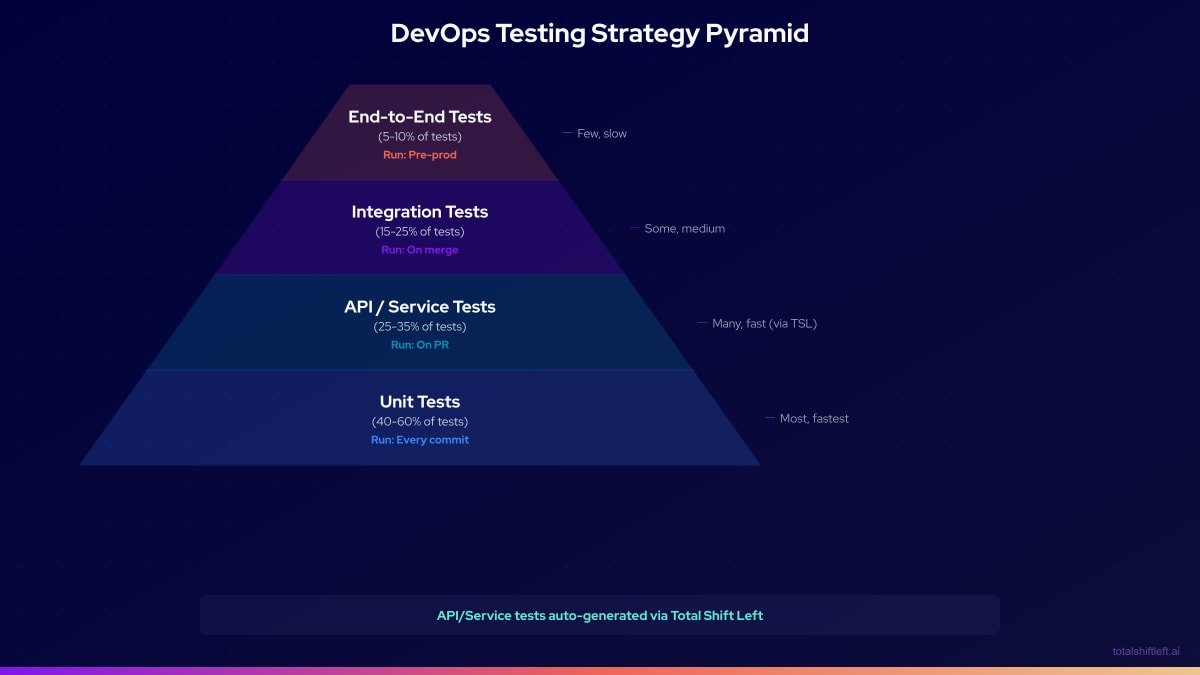
The test pyramid, originally articulated by Mike Cohn, describes the ideal distribution of tests across a software system. In a DevOps context, the pyramid becomes a pipeline structure:
Why the Pyramid Shape Matters
The pyramid is widest at the base because unit tests are fastest and cheapest to run and maintain. It narrows toward the top because end-to-end tests are slowest, most brittle, and most expensive to maintain. Inverting the pyramid—having more end-to-end tests than unit tests—produces a slow, fragile pipeline that frustrates developers and erodes trust.
The API Layer: The Critical Middle
In microservices architectures, the API layer is the most important layer to get right. APIs are the contracts between services. A broken API propagates failure across every service that depends on it. Yet many teams either skip API testing (relying on end-to-end tests to catch API problems) or treat it as the exclusive domain of manual QA. For microservices teams, a dedicated API testing strategy is essential.
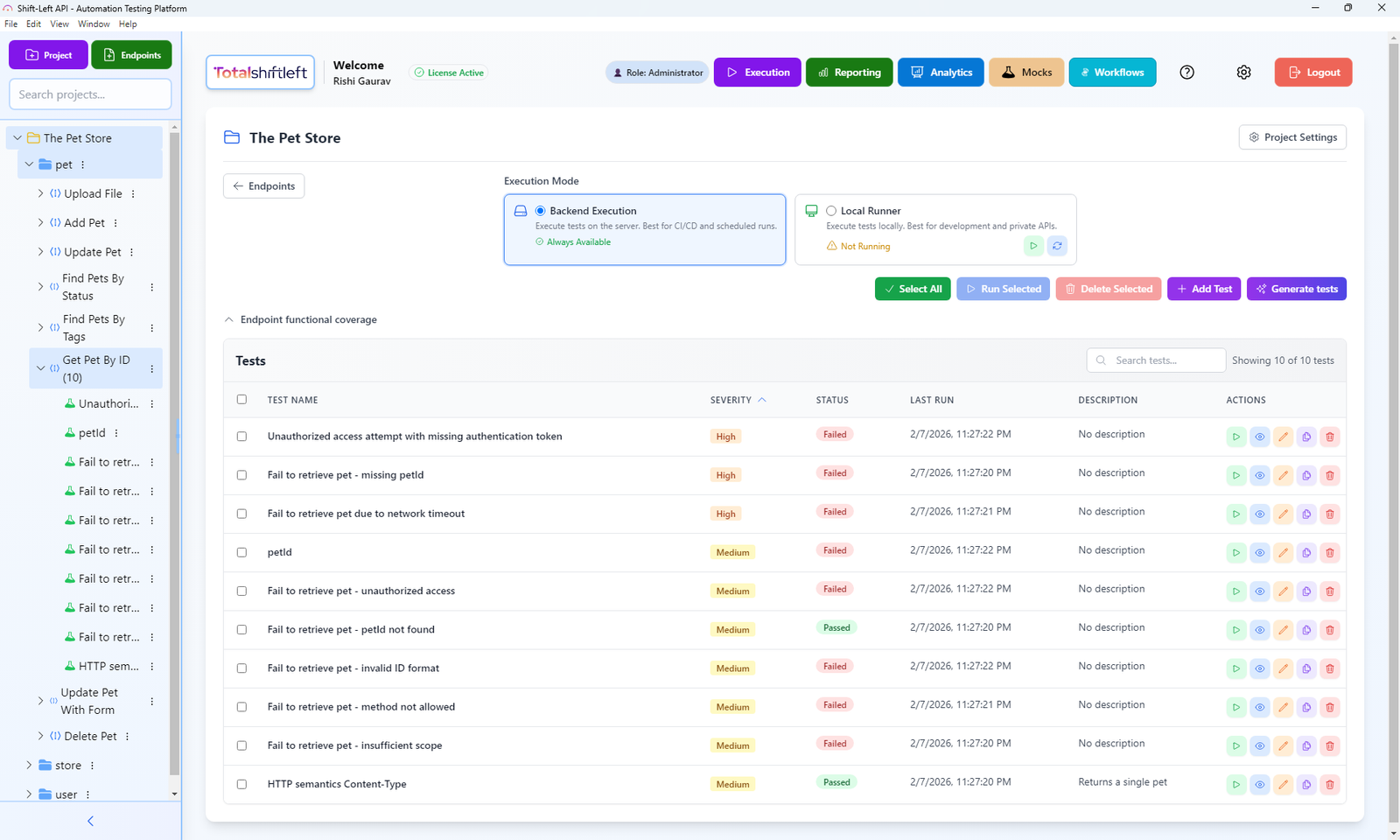
Shift-Left API addresses this gap by automating the entire API test layer. Upload your OpenAPI or Swagger spec, and the platform generates comprehensive tests for every endpoint—covering success paths, error paths, authentication, and schema validation. These tests run in your pipeline on every pull request without any test code being written or maintained by your team.
Tools for Every Layer of the Strategy
| Layer | Recommended Tools | Notes |
|---|---|---|
| Unit Testing | JUnit, pytest, Jest, Go test, NUnit | Language-specific; no external dependencies |
| API Testing | Shift-Left API, REST Assured, Karate, Postman | TSL generates tests from OpenAPI; others require scripting |
| Contract Testing | Shift-Left API, Pact, Spring Cloud Contract | Validates provider/consumer compatibility |
| Integration Testing | Testcontainers, Docker Compose + test frameworks | Spin up real dependencies in isolated containers |
| End-to-End Testing | Playwright, Cypress, Selenium | Use sparingly; reserve for critical user journeys |
| Performance Testing | k6, JMeter, Gatling, Locust | Run on schedule or before major releases |
| Security Testing | Snyk, OWASP ZAP, Trivy, Semgrep, Checkmarx | Run in parallel with functional tests |
| Test Reporting | Allure, TestRail, TSL Analytics, DataDog | Aggregate and trend test results |
| Test Data | Faker libraries, Mockaroo, Synthetic data tools | Never use raw production data in tests |
| Mock Servers | Shift-Left API Mocks, WireMock, Mockoon | Enable testing before dependent services exist |
DevOps testing strategy in practice: a worked example
The Problem
A healthcare technology company with 40 engineers was running weekly deployments. Their testing consisted primarily of manual QA testing in a staging environment, conducted by a team of 4 QA engineers. Each deployment required 3–4 days of QA review, limiting release cadence and creating a QA bottleneck that frustrated developers. When QA found defects, they were typically from code merged 2–3 weeks earlier.
The Solution
Engineering leadership commissioned a DevOps testing strategy with the following components:
- Unit tests added as a mandatory PR gate—developers were expected to maintain 70% line coverage.
- API tests automated via Shift-Left API—the team uploaded 18 OpenAPI specs covering their microservices architecture, generating over 800 API tests automatically.
- Integration tests run in Docker containers on merge to the main branch, using Testcontainers to spin up real database and messaging dependencies.
- Quality gates configured in their GitHub Actions pipeline—no code advanced without passing all test stages.
- Test reporting centralized in Allure, with weekly trend reviews by engineering leads.
The Results
After two sprints of rollout:
- Deployment frequency increased from weekly to daily.
- The QA team's role shifted from executing test scripts to designing exploratory tests, reviewing quality metrics, and mentoring developers on testing practices.
- API regressions caught in the pipeline: 34 in the first month, all before reaching staging.
- Time from code commit to deployment approval dropped from 4 days to 6 hours.
DevOps testing strategy challenges and how to solve them
Challenge 1: Developers Resist Testing Ownership
Problem: Developers hired to build features view testing as someone else's job. Culture change is slow and resisted.
Solution: Make testing easy. When unit test frameworks are pre-configured in project templates, when API tests generate themselves from specs via Shift-Left API, and when quality gates provide clear, actionable failure messages, the friction of testing decreases. Combine with leadership emphasis on quality as an engineering value, not just a QA function.
Challenge 2: Legacy Codebases Have No Test Infrastructure
Problem: Years of code written without tests cannot be retrofitted overnight. Where do you start?
Solution: Start at the API layer. Unit-testing legacy code often requires significant refactoring. API tests, however, can be written against the external interface without touching internals. Shift-Left API generates these tests from existing API specs, making the legacy API layer testable immediately without code changes.
Challenge 3: Test Environments Are Unstable
Problem: Tests that fail due to environment instability, not code defects, erode trust in the pipeline.
Solution: Invest in environment stability before expanding test coverage. Use containerized test environments (Docker, Testcontainers) for reproducibility. Use mock servers for external dependencies. Define environment readiness checks at the start of each pipeline stage.
Free YAML templates + guide
CI/CD Testing Pipeline Templates
Production-ready CI/CD pipeline templates for GitHub Actions and GitLab CI. Includes API testing, contract testing, and performance testing stages.
Download FreeChallenge 4: Testing Strategy Is Not Documented or Enforced
Problem: Verbal agreements about testing expectations are forgotten, inconsistently applied, and impossible to audit.
Solution: Document the strategy and enforce it through pipeline configuration, not policy documents. Quality gates are the enforcement mechanism. The strategy document explains the "why"; the pipeline configuration enforces the "what."
Challenge 5: Too Many End-to-End Tests
Problem: Teams over-invest in end-to-end tests because they feel more comprehensive. The result is a slow, brittle pipeline that takes 90 minutes to run.
Solution: Follow the test pyramid. Aggressively replace end-to-end tests that validate API behavior with API tests. API tests are faster, more stable, and easier to maintain. Reserve end-to-end tests for the critical user journeys that cannot be validated at a lower level.
DevOps testing strategy best practices
- Document the strategy in version control. A testing strategy that lives in a wiki is out of date within a month. Maintain it alongside your code.
- Own the test pyramid actively. Review the distribution of tests quarterly. If end-to-end tests are growing faster than unit tests, rebalance.
- Generate API tests from specs. Hand-written API test scripts drift from the actual API. Spec-driven generation (via Shift-Left API) keeps tests accurate automatically. Compare all the options in our best shift left testing tools guide.
- Make quality gates non-negotiable. The moment you allow an exception for deadline pressure, the gates stop being gates.
- Invest in test data management. Flaky tests are often caused by inconsistent test data, not flaky code. Solve the data problem.
- Measure and report test health. Track pass rates, flakiness rates, duration trends, and coverage over time. Review weekly.
- Train all engineers in testing practices. Testing is a skill. Investment in training pays dividends in test quality and coverage. Our DevOps testing best practices guide covers the specific techniques to train on.
- Start with high-risk APIs. Not every endpoint needs 100% coverage on day one. Prioritize the APIs that are most critical to business function.
- Use mocks for dependencies. Tests that depend on live third-party services are slow and unreliable. Mock external dependencies in CI.
- Treat test failures as urgent. A failing test gate that is ignored destroys the credibility of the entire strategy.
DevOps Testing Strategy Checklist
- ✔ Testing strategy is documented and accessible to all engineers
- ✔ Test types are classified with defined ownership and pipeline triggers
- ✔ Unit tests run on every commit with a coverage threshold enforced
- ✔ API tests run on every pull request automatically
- ✔ API tests are generated from OpenAPI/Swagger specs (not hand-written)
- ✔ Integration tests run on every merge to the main branch
- ✔ Quality gates are configured at every pipeline stage
- ✔ Security scans run in parallel with functional tests
- ✔ Test data management approach is defined and implemented
- ✔ Mock servers are available for all external API dependencies
- ✔ Test results are centrally reported and trended over time
- ✔ Test pyramid distribution is monitored quarterly
- ✔ All engineers understand their testing responsibilities
- ✔ Flaky tests are tracked and prioritized for resolution
- ✔ Testing strategy is reviewed and updated quarterly
See also: contract testing in our learn hub for the underlying concept.
Write the strategy down as a machine-readable policy
A strategy nobody can enforce is a preference. Expressing it as a policy file gives every team the same answer to "what has to pass before this ships", and lets the platform team change the answer in one place:
# quality-policy.yaml — the single source of truth the pipeline reads
version: 2
tiers:
  tier-1:                       # customer-facing, revenue-carrying
    unit_coverage_min: 85
    endpoint_coverage_min: 90
    contract_tests: required
    breaking_changes: blocked
    security_scan: every-pr
    performance_budget: { p99_ms: 300, error_rate: 0.001 }
  tier-2:                       # internal, has consumers
    unit_coverage_min: 70
    endpoint_coverage_min: 70
    contract_tests: required
    breaking_changes: warn
    security_scan: nightly
  tier-3:                       # experimental, no external consumers
    unit_coverage_min: 50
    contract_tests: optional
    security_scan: weekly
services:
  orders-api:    tier-1
  inventory-api: tier-1
  reporting-api: tier-2
  labs-api:      tier-3
The pipeline then resolves the rules for the service it is building, so a tier promotion is a one-line change rather than a workflow rewrite:
TIER=$(yq -r ".services.\"$SERVICE\"" quality-policy.yaml)
FLOOR=$(yq -r ".tiers.\"$TIER\".unit_coverage_min" quality-policy.yaml)
pytest --cov=app --cov-fail-under="$FLOOR"
Frequently asked questions about DevOps testing strategy
What is a DevOps testing strategy?
A DevOps testing strategy is a plan that defines what types of tests to run, when to run them, who is responsible, and what quality gates must pass before code advances through a CI/CD pipeline. It aligns testing with the speed and automation goals of DevOps, transforming quality from a final checkpoint into a continuous activity.
How does the test pyramid apply to DevOps?
The test pyramid in DevOps means running many fast unit tests at the base, fewer API and service tests in the middle, and minimal end-to-end tests at the top. This balance maximizes feedback speed while keeping the pipeline efficient. A common target distribution is 50% unit, 30% API/service, 15% integration, and 5% end-to-end.
Why is shift left testing important for a DevOps strategy?
Shift left testing is a core principle of DevOps quality strategy. It moves testing earlier in the development process—to the commit and pull request stages—so defects are caught during coding and code review rather than after deployment. This dramatically reduces the cost of remediation and keeps feedback loops tight. Read more in our shift left testing strategy guide and understand how it compares with production testing in shift left vs shift right testing.
What tools support a DevOps testing strategy?
Shift-Left API provides automated API test generation from OpenAPI specs, CI/CD integration via CLI, mock servers for early testing, and an analytics dashboard for trend analysis—covering the API testing layer of any DevOps testing strategy without requiring test engineers to write code. Start your free trial to add automated API testing to your DevOps pipeline today.
Sources and further reading
- DORA State of DevOps research — the multi-year dataset behind the four delivery metrics.
- Martin Fowler — The Practical Test Pyramid — the reference argument for test-layer proportions.
- Martin Fowler — Continuous Integration — the original definition of the practice CI tooling implements.
Key takeaways
- A DevOps testing strategy is not an optional supplement to a DevOps transformation—it is a fundamental requirement.
- Without it, teams accelerate deployment without accelerating quality, which ultimately means accelerating failure.
- The strategy defines what to test, when, who owns it, and what constitutes acceptable quality.
- The pipeline enforces it automatically. The test pyramid provides the structural framework: many fast unit tests, a robust API test layer, targeted integration tests, and minimal end-to-end tests.
- Each layer runs automatically at the appropriate pipeline stage, enforced by quality gates that cannot be bypassed by deadline pressure or optimistic assumptions.
- For most engineering teams, the biggest gap in their testing strategy is the API layer.
APIs are the contracts between microservices—when they break, systems fail broadly. Yet API testing is often manual, incomplete, or entirely absent. Shift-Left API solves this by generating comprehensive API tests from existing OpenAPI specifications and running them automatically in any CI/CD pipeline. Build the strategy. Automate the tests. Enforce the gates. The result is a DevOps pipeline that earns the continuous delivery promise it makes.
Explore the Shift-Left API platform or start your free trial to begin automating your API testing layer today.
Related: What Is Shift Left Testing? Complete Guide | Shift Left Testing Strategy | Shift Left vs Shift Right Testing | API Testing Strategy for Microservices | How to Build a CI/CD Testing Pipeline | Best Shift Left Testing Tools | No-code API testing platform | Start Free Trial
Ready to shift left with your API testing?
Try our no-code API test automation platform free.