
API Discovery: One Inventory of the APIs You Run
What It Does
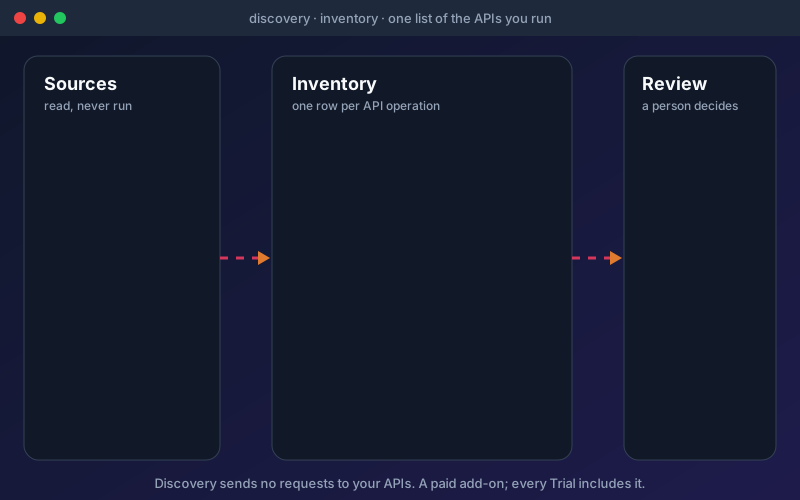
Discovery answers a question most organizations cannot: which APIs do we actually run? It builds one inventory from the sources you connect: specification files and addresses, gateway exports and live gateways, Kubernetes routes, AI model gateways, MCP servers and agent cards, Postman and SwaggerHub, OpenTelemetry traces, Datadog, Splunk and Elastic records, access logs, HAR files and repositories. Source-code discovery reads routes from Express, Fastify, NestJS, Spring, ASP.NET Core, FastAPI, Flask, Django and Go projects as text, within caps on file count and size. It never compiles or runs your code, and you tick each source to allow it. APIs found in code show as inferred, with the file and line, until a specification or traffic agrees. A route whose method or path is computed is counted as not listed, with the reason, rather than guessed. Every row says how sure we are it exists, whether it has a specification, and whether it can be tested. The Review and Changes views show what is new, changed or missing, and drift compares APIs that are documented but never seen with APIs that are seen but undocumented, with the time window stated. Sources run when someone presses Run now or on a schedule, on the server or through an approved agent inside your network. You control retention, and you can Forget a source to erase what it read. In the desktop app, Scan for APIs looks at programs listening on your own computer after asking for your consent, and Capture its calls records one application in a Studio window. Discovery finds APIs that have no tests; it does not generate tests from traffic. APIs of kinds Shift-Left API does not test, such as messaging, are listed for visibility and cannot be accepted into a project.
Overview
Most teams cannot list every API they run. Discovery builds one inventory from the places that already know: specifications, gateways such as Kong, Azure API Management and AWS API Gateway, Kubernetes routes, AI gateways and MCP servers, Postman and SwaggerHub, traces and logs, and repositories on GitHub, GitLab, Azure Repos and Bitbucket Cloud. Every row says how sure we are that the API exists (Confirmed, Observed or Inferred) and whether it is ready to test. Routes in Express, Fastify, NestJS, Spring, ASP.NET Core, FastAPI, Flask, Django and Go projects are read as text, and your code is never run. Discovery sends no requests to your APIs; the desktop scan only looks at programs on your own computer, after asking. Accepting an API into a project uses the normal importer, so you decide what gets tested. Discovery is a paid add-on in Starter, Team and Scale packages, and every 15-day Trial includes it.
Key Capabilities
How It Works
- 1
Add a source: a specification address or file, a gateway, a repository, a log or HAR file, or add an API by hand
- 2
Run it now or on a schedule, on the server or through an agent you approve inside your network
- 3
Read the Inventory: each row shows how sure we are it exists, its specification status and whether it is ready to test
- 4
Confirm or dismiss rows in the Review queue; a dismissal always carries a reason
- 5
Accept the APIs you want into a project; the normal importer creates the endpoints, no tests are created and nothing is sent
Available on
API Discovery add-on (paid add-on)
Added to a Professional, Custom or Enterprise licence. Included in the 15-day free trial — no credit card required.
Documentation
Step-by-step guides for setting up and using API Discovery.
- API Discovery: Find the APIs You Already RunBuild one inventory of the APIs your organisation runs, from specifications, gateways, repositories, traffic and logs. Every row says how sure we are it exists, and you can accept the real ones into a project.
- Scan for APIs on This Computer (Desktop App)Find the APIs running on your own computer, record an application's calls, and bring what you find into your inventory. Desktop app only, and every step asks for your consent first.
- Import and Discover EndpointsImport endpoints from OpenAPI/Swagger, WSDL, or GraphQL, bring in requirements from your backlog, and detect endpoint changes as your API evolves.
Built for regulated teams
Teams in regulated industries rely on this capability to ship API changes with an audit trail.
Go deeper
Guides and playbooks that show this capability in practice.
Related Features
API Quality Evidence
Open one API and see its tests, security findings, mocks, load results, workflows and requirements in one place.
Learn moreAPI Dependencies
See which APIs run before and after an API, which use its values, and how we know.
Learn moreChange Review
Before you approve a specification change, see every test, mock, load test, workflow and requirement it touches.
Learn moreTry API Discovery Today
Start your 15-day free trial — no credit card required.