
Test Strategy Fan-Out
What It Does
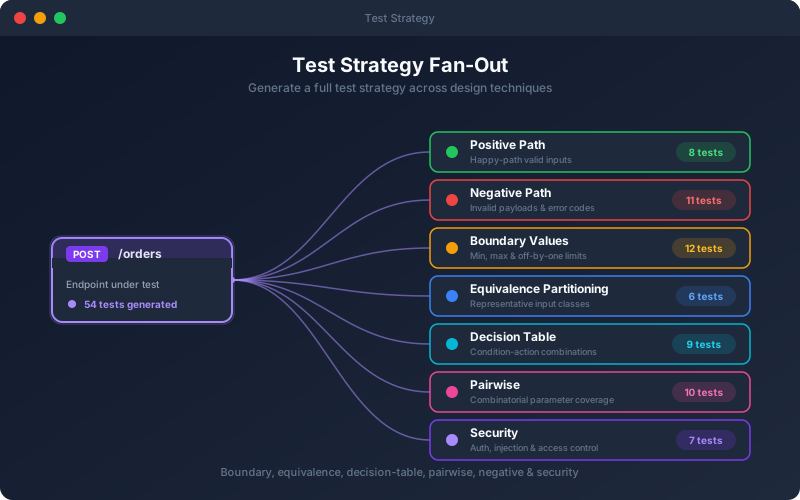
Test Strategy Fan-Out applies the discipline of formal test design at machine speed. Rather than writing a handful of happy-path checks, you select the techniques that matter for a project (boundaries, equivalence classes, decision tables, pairwise combinations, negative, authentication-depth and, if you opt in, security and latency cases) and the platform generates the corresponding tests for every endpoint and requirement. Each generated test records the technique that produced it, which the traceability matrix shows, and a severity filter with ISTQB S1 to S4 hints lets a release-gate suite keep only Critical and High tests. The result mirrors how an experienced test analyst would approach the API, applied uniformly so coverage is intentional and repeatable.
Overview
From your endpoints and requirements, the platform fans out a complete test strategy across established design techniques: positive and negative paths, boundary values, equivalence partitioning, decision tables, pairwise combinations, HTTP semantics, authentication depth and schema fuzzing, with security probes and latency checks available as opt-in techniques. Choose which techniques apply for each project and the platform generates the matching tests with deterministic rules, so the same spec and requirements always give the same suite. Strategies run on spec-only endpoints too, so you get boundary and negative coverage before anyone writes a requirement.
Key Capabilities
How It Works
- 1
Choose the techniques in the project’s test generation settings
- 2
Optionally narrow the severity filter, for example Critical and High only
- 3
Generate tests for an endpoint or across the whole project
- 4
Review, refine and add the generated tests to your suite
- 5
Track the resulting coverage across functional and edge scenarios
Available on
All Plans
Included in the free trial — no credit card required.
Documentation
Step-by-step guides for setting up and using Test Strategy.
- Understanding Rule IntelligenceRule Intelligence turns requirement documents and API specs into structured, testable requirements—review them, then feed them into test generation with coverage and traceability.
- Test Generation SettingsControl per project which requirement types the AI extracts, which test strategies fire, and which severity tiers are kept—so generation focuses on what matters for that project.
Go deeper
Guides and playbooks that show this capability in practice.
Try Test Strategy Today
Start your 15-day free trial — no credit card required.