10 Best API Mocking & Service Virtualization Tools (2026)
Quick answer
The best API mocking tools split into three categories: spec-driven mocks generated from an OpenAPI spec (Prism, Postman Mock Servers, Microcks), standalone stub servers defined by hand (WireMock, MockServer, Mockoon, json-server), and enterprise service virtualization simulating databases and legacy systems beyond HTTP (Parasoft Virtualize, Traffic Parrot, Hoverfly). Spec-driven tools stay closer to the real contract by construction; hand-defined stubs give more control but can silently drift from reality.
Reviewed by Sushant Joshi
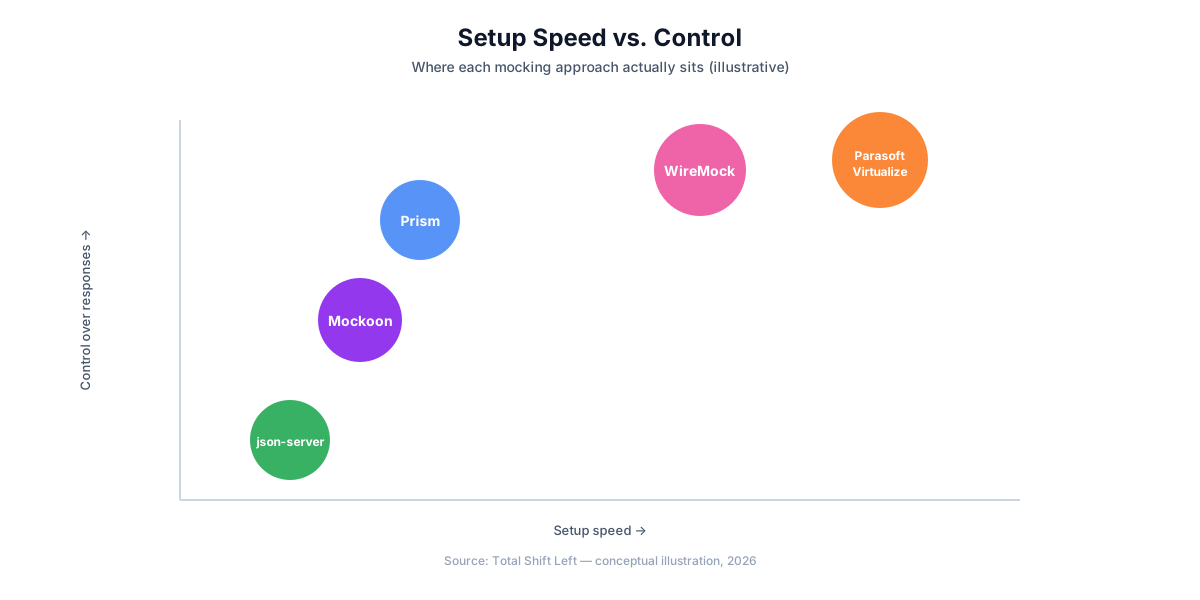
API mocking tools simulate an API's responses so development and testing can proceed without depending on the real service being available, stable, or even built yet. They range from simple standalone stub servers to spec-driven mock generation to full enterprise service virtualization covering dependencies well beyond HTTP.
In this guide
- API mocking comparison table
- Spec-Driven Mocking
- Standalone Stub Servers
- Enterprise Service Virtualization
- Stateful behaviour: what most mocks cannot do
- Running a mock in CI
- How to Choose
- Which layer should use a mock
- Mocking vs Contract Testing
- The same stub in WireMock and in Prism
- Common API mocking mistakes
- Frequently asked questions about API mocking
API mocking comparison table
| Tool | Category | Source of truth | Best for |
|---|---|---|---|
| Prism (Stoplight) | Spec-driven | OpenAPI spec | Generating a mock directly from a spec you already maintain |
| Postman Mock Servers | Spec-driven | Postman Collection | Teams already building requests in Postman |
| Microcks | Spec-driven | OpenAPI, AsyncAPI, gRPC, GraphQL | Multi-protocol microservices, Kubernetes-native |
| WireMock | Standalone stub | Hand-defined JSON stubs | Precise control over individual response behavior (Java ecosystem) |
| MockServer | Standalone stub | Hand-defined stubs | Java teams needing HTTP/HTTPS mocking with proxying and verification |
| Mockoon | Standalone stub | Visual GUI editor | Quick local mocking with no code |
| json-server | Standalone stub | A single JSON file | Fastest possible fake REST API for frontend development |
| Hoverfly | Virtualization | Capture/replay | Lightweight service simulation with recorded real traffic |
| Parasoft Virtualize | Virtualization | Enterprise config | Simulating databases, queues, and legacy/mainframe systems |
| Traffic Parrot | Virtualization | Enterprise config | Enterprise teams needing broad protocol and stateful mock support |
Spec-Driven Mocking
These tools generate a working mock server directly from an OpenAPI (or equivalent) spec, so the mock inherits the spec's accuracy automatically instead of being hand-maintained separately.
1. Prism (Stoplight) — reads an OpenAPI spec and serves example or dynamically generated responses matching the documented schema, with no separate stub-definition step. Its --dynamic mode generates fresh values conforming to the schema on every call, which is useful precisely because it stops consumers hard-coding against one fixed example.
2. Postman Mock Servers — generates a mock endpoint directly from a saved Collection, useful for teams already building and sharing requests in Postman. The source of truth is the collection rather than a spec, so it inherits whatever drift the collection already has.
3. Microcks — an open-source, Kubernetes-native platform that mocks OpenAPI, AsyncAPI, gRPC, and GraphQL APIs from the same source specs, making it the strongest choice for teams with a mixed-protocol microservices architecture rather than REST alone. It also replays the same examples as conformance tests against the real service, which closes the drift loop the other tools leave open.
The tradeoff of spec-driven mocking is direct: your mock is only as good as your spec. A stale or incomplete OpenAPI file produces a stale or incomplete mock — but it produces it visibly, because the mock 404s on anything the spec does not describe.
Standalone Stub Servers
These give full manual control over exactly what each endpoint returns, independent of any spec — useful for simulating specific edge cases (a flaky dependency, a rare error response) a generated mock wouldn't produce on its own.
4. WireMock — a mature, widely used Java-based HTTP mock server supporting stub definition, request matching, recording real traffic, and verification that a stub was called as expected; runs standalone or embedded directly in a test suite. Its fault injection — fixed delays, random delays, malformed responses, connection resets — is the most complete in this list, and it is the reason to pick it.
5. MockServer — similar territory to WireMock, with HTTP/HTTPS mocking plus proxying and verification, also Java-based. Its proxy mode is the differentiator: sit it in front of a real dependency and selectively override only the calls you care about.
6. Mockoon — a desktop app (plus CLI for CI) with a visual editor for building mocks with no code, popular for quick local setup without touching JSON stub files directly. The GUI makes it the easiest to hand to someone who is not going to learn a stub DSL.
7. json-server — spins up a full fake REST API from a single JSON file in seconds; the fastest option here for simple CRUD mocking, especially common in frontend development workflows, though it offers less fine-grained control over individual response behavior than the others. It is a scaffolding tool, not a testing tool.
Enterprise Service Virtualization
Service virtualization is the broader term for simulating any dependency — not just an HTTP API, but databases, message queues, and legacy or mainframe systems too — usually with more sophisticated stateful behavior than a simple stub server.
Ready to shift left with your API testing?
Try our no-code API test automation platform free. Generate tests from OpenAPI, run in CI/CD, and scale quality.
8. Hoverfly — open source (SpectroLabs), lightweight, supports capturing and replaying real traffic as a simulation — useful for building a realistic mock from actual recorded interactions rather than hand-writing every response. The capture step also means whatever was in those payloads is now in your simulation file, so mask before you commit.
9. Parasoft Virtualize — commercial, enterprise-focused, with protocol support extending into databases and messaging systems alongside HTTP. Relevant when the dependency you cannot get access to is a mainframe or a licensed third-party system rather than another team's REST service.
10. Traffic Parrot — commercial, enterprise service virtualization with broad protocol and stateful mock support, aimed at the same class of problem as Parasoft with a lighter footprint.
Stateful behaviour: what most mocks cannot do
The single biggest gap between a mock and the service it replaces is state. A stub that returns the same order on every GET /orders/42 cannot express the flow that actually matters: create an order, fetch it, cancel it, fetch it again and see a different status.
| Need | Reach for |
|---|---|
| Same response every time | json-server, Prism, Mockoon |
| Response varies by request content | WireMock, MockServer, Prism dynamic mode |
| Response changes after a prior call (scenarios) | WireMock scenarios, Microcks, Traffic Parrot |
| Full stateful simulation of a non-HTTP dependency | Parasoft Virtualize, Traffic Parrot |
If your consumer's logic branches on a state transition, a stateless stub will let a broken implementation pass. That is the point at which mocking stops being enough and you need either scenarios or the real service.
Running a mock in CI
A mock is only useful in a pipeline if it starts, gets waited for, and stops cleanly. The pattern is the same whichever tool you use:
# .github/workflows/test.yml
services:
  mock:
    image: stoplight/prism:4
    ports: ['4010:4010']
    options: >-
      --health-cmd "wget -qO- http://localhost:4010 || exit 1"
      --health-interval 5s --health-retries 10
steps:
  - uses: actions/checkout@v4
  - run: npm ci
  - run: npm test
    env:
      API_BASE_URL: http://localhost:4010
Two rules keep this honest. Fail the job if the mock did not start — a suite that silently falls back to a real endpoint, or to nothing, reports green for the wrong reason. And never let a mock reach a production-like environment; scope it to the test job by URL, not by a global config someone can forget to switch.
How to Choose
- You already maintain an OpenAPI spec → Prism or Microcks — let the mock inherit the spec's accuracy.
- You need precise control over a specific edge case → WireMock or MockServer.
- You need to simulate timeouts, latency or connection failures → WireMock's fault injection.
- You want the fastest possible setup with no code → Mockoon (GUI) or json-server (one JSON file).
- You're mocking gRPC, AsyncAPI, or GraphQL, not just REST → Microcks.
- You need to simulate a database or message queue, not just HTTP → Parasoft Virtualize or Traffic Parrot.
- You want a mock built from real recorded traffic → Hoverfly's capture/replay mode.
See API mocking for parallel development for the broader workflow question of when and how to introduce mocking into a team's development process, independent of which specific tool you pick.
Which layer should use a mock
A mock belongs at some test layers and actively damages others. Getting this wrong is why teams end up with a large green suite and production incidents at the integration boundary.
| Layer | Mock the dependency? | Why |
|---|---|---|
| Unit tests | Yes, in-process fakes | Speed, and the dependency is irrelevant to the logic under test |
| Component / service tests | Yes, a stub server | You are testing one service's behaviour, not the network |
| Contract tests | No — that is the point | The contract is between two real parties |
| Integration tests | Rarely, and only for third parties you cannot call | The whole purpose is that the wiring is real |
| End-to-end tests | No | A mocked E2E test proves nothing about the system |
The useful rule: mock what you cannot control, and only for as long as you cannot control it. A payment provider's sandbox that rate-limits you is a legitimate permanent mock. Another team's service in the same deployment is not — mocking it permanently means nobody ever tests the integration until a customer does.
Mocking vs Contract Testing
A mock and a contract test solve related but distinct problems, and confusing them is a common mistake. Mocking unblocks development by simulating a dependency that isn't ready or reachable — a test passing against a mock proves the mock's definition is internally consistent, nothing more. Contract testing verifies that the real API still matches what its consumers expect. A mock can silently drift from what the real API actually does; contract testing (and schema validation more broadly) is specifically what catches that drift. Use mocking to move fast during development, and contract testing to confirm reality still matches the mock before you ship.
Free Guided worksheet
Build Your Testing Strategy in 30 Minutes
A structured worksheet that walks you through defining your testing strategy in 30 minutes. Cover architecture, tools, layers, and team responsibilities.
Download FreeThe same stub in WireMock and in Prism
WireMock is explicit — you declare the request match and the response, which is what you want when a test needs one exact edge case:
{
  "request": {
    "method": "GET",
    "urlPath": "/v1/orders/42",
    "headers": { "Accept": { "equalTo": "application/json" } }
  },
  "response": {
    "status": 200,
    "headers": { "Content-Type": "application/json" },
    "jsonBody": { "id": "42", "sku": "A-1", "qty": 2, "status": "pending" },
    "fixedDelayMilliseconds": 150
  }
}
Prism is derived — it serves every operation in the OpenAPI document without a stub file, which is what you want when the consumer needs the whole API rather than one case:
npx @stoplight/prism-cli mock openapi.yaml --port 4010 --dynamic
# 404s on any path the spec does not define, so drift shows up immediately
Common API mocking mistakes
Letting the mock become the specification. Once a team has been developing against a stub for a month, the stub encodes assumptions nobody checked against the real service. Re-validate against reality on a schedule, not at integration time.
Mocking your own code. Mocks are for dependencies you do not control. A stub standing in for a module in the same repository usually means the design needs the seam, not the stub.
Hand-writing stubs that a spec already describes. If an OpenAPI document exists, a generated mock is free and stays current. Hand-written stubs for the same endpoints are a second artifact to maintain and a second thing to drift.
Recording production traffic without masking. Capture-and-replay tools write whatever was in the payload into a file that then lives in version control. Decide the masking rules before the first capture.
Only mocking the happy path. The reason to introduce a mock is often to exercise the paths the real dependency will not produce on demand — timeouts, 500s, malformed bodies, slow responses. A mock that only returns 200 has bought you very little.
Frequently asked questions about API mocking
What is the difference between API mocking and service virtualization? API mocking typically means simulating a single HTTP API's responses, often for frontend development or testing in isolation. Service virtualization is the broader enterprise term for simulating any dependency an application relies on — databases, message queues, mainframes, third-party APIs — usually with more sophisticated stateful behavior and enterprise tooling.
What is the best free API mocking tool? WireMock and Mockoon are both fully free and open source, and Prism (spec-driven, generated from an OpenAPI spec) is as well. json-server is the fastest to start with for a simple fake REST API from a JSON file, though it offers less control over individual response behavior than the others.
Should my mock server be generated from my OpenAPI spec or hand-defined? Generated, when a spec already exists and is kept up to date — the mock inherits the spec's accuracy automatically and can't silently drift from the documented contract. Hand-defined stubs (WireMock, MockServer) make more sense when you need precise control over specific edge-case responses a spec alone can't express, like simulating a flaky downstream dependency.
Can API mocking replace contract testing? No — they solve different problems. Mocking unblocks development by simulating a dependency that isn't ready or reachable. Contract testing verifies the real API still matches what consumers expect. A mock can silently drift from the real API's actual behavior; contract testing is specifically what catches that drift.
How do I mock a gRPC or GraphQL API, not just REST? Most tools on this list are REST/HTTP-focused. Microcks specifically supports OpenAPI, AsyncAPI, gRPC, and GraphQL mocking in one platform, making it the more natural choice for teams with a mixed-protocol microservices architecture rather than REST alone.
Do I still need to test against the real API if I use a mock? Yes. A mock unblocks parallel development and fast test execution, but only the real API (or a generated suite that exercises it directly) proves the actual implementation is correct — a passing test against a mock only proves the mock's definition is internally consistent, not that reality matches it.
Sources and further reading
- WireMock documentation — the standard JVM stubbing and service-virtualization tool.
- Prism mock server — spec-driven mocking used for parallel development.
- Microcks — open-source mocking and contract testing from OpenAPI/AsyncAPI.
Key takeaways
- Spec-driven mocks inherit your OpenAPI spec's accuracy automatically; hand-defined stubs give more control but can drift silently.
- Mocking and contract testing solve different problems — don't treat a passing mock-based test as proof the real API behaves the same way.
- Microcks is the standout choice for mixed-protocol microservices (OpenAPI, AsyncAPI, gRPC, GraphQL in one tool).
- json-server and Mockoon are the fastest ways to get a working fake API with the least setup.
- Service virtualization tools go beyond HTTP — reach for them specifically when you need to simulate a database or message queue, not just an API.
Keep Your Mock and Your Real Tests in Sync
A mock built from your OpenAPI spec is only as accurate as that spec — and only testing the real implementation proves it actually matches. Total Shift Left generates a full functional test suite from the same OpenAPI spec you could mock from, so you can verify the real API matches its contract, not just that your mock is internally consistent.
Start your free trial to see generated coverage for your own spec, or see plans and pricing if you're already evaluating.
Ready to shift left with your API testing?
Try our no-code API test automation platform free.