
Continuous Quality in DevOps: Beyond Continuous Testing (2026)
Quick answer
Continuous quality in DevOps is a holistic framework that embeds quality validation into every stage of delivery — requirements, code, build, test, deploy, and production — going beyond continuous testing to include static analysis, security scanning, performance validation, and observability. Organizations practicing continuous quality report 4.2x fewer production incidents than those relying on continuous testing alone, per a 2025 Gartner study.
Reviewed by Smeet Gohel
Continuous quality in DevOps is a holistic framework that embeds quality validation into every stage of the software delivery lifecycle—from requirements definition through production monitoring—going beyond automated testing to include code analysis, security scanning, performance validation, compliance checks, and production observability as integrated, automated quality activities.
A 2025 Gartner study found that organizations practicing continuous quality deliver 4.2x fewer production incidents than those practicing only continuous testing. The distinction matters: continuous testing is about running automated tests in your pipeline. Continuous quality is about building quality into every activity your team performs.
Most DevOps organizations have achieved continuous integration and continuous deployment. Many have added continuous testing—automated test suites that run on every commit. But they still experience quality problems because testing alone cannot catch every quality issue. Code that passes all tests can still have security vulnerabilities, performance regressions, architecture violations, accessibility problems, and operational blind spots.
Continuous quality addresses this gap by treating quality as a continuous, multi-dimensional practice rather than a single activity (testing) at specific pipeline stages. This guide explains what continuous quality means in practice, how it extends beyond continuous testing, and how to implement it in your organization. If your team has achieved continuous testing but still struggles with production quality, this is the framework that bridges the remaining gap.
In this guide
- What Is Continuous Quality in DevOps?
- Why Continuous Quality Matters Beyond Continuous Testing
- Key Components of Continuous Quality
- Continuous Quality Architecture
- Tools Supporting Continuous Quality
- Real-World Example: From Continuous Testing to Continuous Quality
- Common Challenges Implementing Continuous Quality
- Best Practices for Continuous Quality
- Continuous Quality Implementation Checklist
- Quality signals at every stage, not just the test stage
- Continuous quality FAQ
What Is Continuous Quality in DevOps?
Continuous quality in DevOps is the practice of validating software quality across every dimension—functionality, reliability, performance, security, maintainability, and usability—at every stage of the delivery lifecycle, using automated checks, human reviews, and production feedback loops.
It differs from continuous testing in scope and philosophy. Continuous testing asks: "Does the software work correctly?" Continuous quality asks: "Is the software good enough to deliver value to users without causing problems?" The second question is broader and requires more diverse validation methods.
In a continuous quality framework, quality is not a phase or an activity. It is a property of the entire delivery system. Every stage—from story writing to production monitoring—includes quality practices that contribute to the overall quality of the delivered software. No single stage is responsible for quality; every stage shares responsibility.
The framework recognizes that different quality dimensions require different validation methods. Functional correctness requires automated tests. Code maintainability requires static analysis and code review. Security requires vulnerability scanning and penetration testing. Performance requires load testing and production monitoring. Usability requires exploratory testing and user feedback. Continuous quality integrates all of these into a coherent system.
This approach aligns with the broader DevOps testing culture where quality is a shared responsibility across the entire organization rather than the domain of a single team.
Picking the runner first? Our comparison of continuous integration testing tools covers the CI systems, languages and licence models side by side.
Why Continuous Quality Matters Beyond Continuous Testing
Testing Alone Has Blind Spots
Automated tests verify that software behaves as expected under tested conditions. They cannot verify behavior under untested conditions, detect performance degradation under realistic load, identify security vulnerabilities in dependencies, or assess code maintainability. These blind spots mean that software can pass all tests and still have significant quality problems.
Continuous quality fills these blind spots by adding complementary validation methods at every stage. Static analysis catches code quality issues that tests miss. Dependency scanning catches security vulnerabilities in third-party libraries. Performance profiling catches regressions before they reach production. Production monitoring catches issues that no pre-production testing can predict.
Quality Issues Compound Across Dimensions
A codebase with high test coverage but poor code quality will become increasingly difficult to maintain. Tests will become brittle as the code becomes tangled. New features will take longer to deliver as developers navigate technical debt. Eventually, the cost of maintaining the test suite exceeds its value because the underlying code is too complex.
Continuous quality prevents this compounding effect by maintaining quality across all dimensions simultaneously. Code quality standards prevent the technical debt that makes testing expensive. Security scanning prevents the vulnerabilities that require emergency patches. Performance validation prevents the degradation that frustrates users and drives churn.
Production Quality Requires Production Feedback
Pre-production testing, no matter how comprehensive, cannot fully simulate production conditions. Real user behavior, production data volumes, infrastructure interactions, and third-party service behaviors introduce variables that test environments cannot replicate. Continuous quality includes production observability as a quality practice—monitoring, alerting, and feedback loops that detect quality issues in production and feed back into the development process.
This production feedback is essential for improving test effectiveness. When a production incident occurs, the continuous quality framework asks: "Which quality gate should have caught this, and how do we improve it?" This drives systematic improvement in the quality system itself. The shift-left and shift-right testing approaches work together within continuous quality.
Compliance and Governance Require Continuous Verification
Regulated industries—finance, healthcare, government—require demonstrable compliance with quality standards. Continuous quality provides automated evidence of quality practices at every stage, creating audit trails that satisfy regulatory requirements without slowing delivery. Quality gates produce logs, reports, and artifacts that demonstrate compliance continuously rather than through periodic audits.
Key Components of Continuous Quality
Requirements Quality
Quality starts before code is written. Continuous quality validates that requirements are testable, unambiguous, and complete. This includes automated checks for acceptance criteria format, traceability between requirements and tests, and coverage analysis that identifies requirements without corresponding test cases.
Practices include structured acceptance criteria templates (Given-When-Then), requirement review checklists, and automated traceability tools that link user stories to test cases. When requirements are vague or untestable, quality issues are guaranteed downstream.
Code Quality
Code quality encompasses maintainability, readability, complexity, and adherence to standards. Continuous quality automates code quality validation through static analysis tools that run on every commit. These tools measure cyclomatic complexity, code duplication, naming conventions, and architecture violations.
Code review is the human complement to automated analysis. Continuous quality frameworks define code review standards that include quality criteria: test coverage for new code, absence of known anti-patterns, and adherence to team conventions. Test automation best practices apply to test code quality as well.
Ready to shift left with your API testing?
Try our no-code API test automation platform free. Generate tests from OpenAPI, run in CI/CD, and scale quality.
Build Quality (Continuous Testing)
This is the component most teams already have: automated tests that run in the CI/CD pipeline. Continuous quality ensures that testing is comprehensive across the test pyramid—unit tests, integration tests, API tests, and end-to-end tests—with appropriate coverage thresholds at each level.
The continuous quality framework adds structure to continuous testing by defining which tests run at which pipeline stage, what coverage thresholds must be met, and how test results feed into deployment decisions. Quality gates enforce these standards automatically.
Security Quality
Security scanning is integrated into every stage of the continuous quality pipeline. Static application security testing (SAST) analyzes code for vulnerabilities. Software composition analysis (SCA) checks dependencies for known vulnerabilities. Dynamic application security testing (DAST) probes running applications for security weaknesses.
Continuous quality treats security findings with the same urgency as test failures. Critical vulnerabilities block pipeline advancement. High-severity findings trigger mandatory review. All findings are tracked, prioritized, and resolved within defined SLAs.
Performance Quality
Performance validation ensures that software meets response time, throughput, and resource utilization requirements. Continuous quality includes performance testing in the CI/CD pipeline—not just periodic load tests, but continuous performance profiling that detects regressions on every build.
This includes API response time benchmarks, database query performance checks, memory usage profiling, and load testing under realistic conditions. Performance quality gates prevent regressions from reaching production by comparing current metrics against established baselines.
Production Quality
Production quality encompasses monitoring, observability, and incident response. It validates that deployed software meets quality standards under real conditions. Key practices include SLI/SLO monitoring, distributed tracing, log analysis, error rate tracking, and user experience monitoring.
Production quality creates the feedback loop that makes continuous quality truly continuous. Production data informs test priorities, reveals coverage gaps, and drives quality improvement across all other stages.
Continuous Quality Architecture
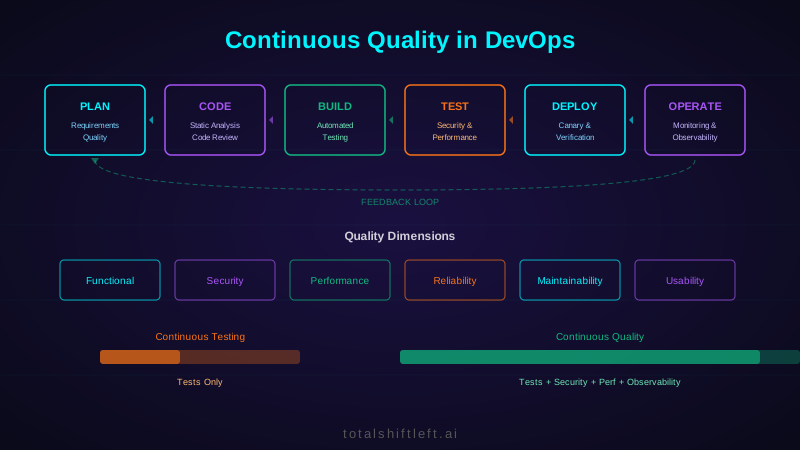
The continuous quality architecture operates as a pipeline of quality gates across six stages:
Stage 1 - Plan: Requirements quality validation. Automated checks for acceptance criteria completeness and testability. Traceability matrix generation linking requirements to planned test coverage.
Stage 2 - Code: Static analysis, code review, and local test execution. Quality gates enforce complexity thresholds, duplication limits, and test coverage minimums before code can be committed.
Stage 3 - Build: Automated testing across all pyramid levels. Unit tests, integration tests, API testing, and contract tests run on every build through native CI/CD integrations. Quality gates enforce pass rates and coverage thresholds.
Stage 4 - Test: Extended validation including security scanning, performance testing, accessibility testing, and cross-browser compatibility. Quality gates enforce security vulnerability thresholds and performance benchmarks.
Stage 5 - Deploy: Canary releases, feature flags, and deployment verification tests. Quality gates validate that deployment succeeds and key metrics remain within acceptable ranges during progressive rollout.
Stage 6 - Operate: Production monitoring, SLO tracking, error rate alerting, and user experience monitoring. Quality signals feed back into planning and testing priorities for the next iteration.
Each stage produces quality data that feeds into a central quality dashboard, providing real-time visibility into quality across the entire delivery lifecycle.
Tools Supporting Continuous Quality
| Tool | Type | Best For | Open Source |
|---|---|---|---|
| Total Shift Left | API Test Automation | Codeless API testing integrated with CI/CD pipelines | No |
| SonarQube | Code Quality | Static analysis, code coverage, technical debt tracking | Yes |
| Snyk | Security Scanning | Dependency vulnerability scanning and remediation | No |
| OWASP ZAP | Security Testing | Dynamic application security testing | Yes |
| k6 | Performance Testing | Developer-friendly load testing with CI integration | Yes |
| Gatling | Performance Testing | High-performance load testing with detailed reports | Yes |
| Datadog | Observability | Full-stack monitoring and APM | No |
| Grafana | Dashboards | Quality metrics visualization and alerting | Yes |
| Playwright | E2E Testing | Cross-browser end-to-end testing | Yes |
| Trivy | Container Security | Container image vulnerability scanning | Yes |
| Lighthouse | Web Quality | Performance, accessibility, SEO auditing | Yes |
| Checkov | IaC Security | Infrastructure-as-code security scanning | Yes |
Real-World Example: From Continuous Testing to Continuous Quality
Problem: An e-commerce platform (200 engineers, 15 squads) had achieved continuous testing with 85% test automation coverage. Despite this, they experienced monthly production incidents averaging $180K in revenue impact each. Root cause analysis showed that incidents fell into categories testing did not cover: dependency vulnerabilities (23%), performance regressions (31%), configuration errors (18%), and edge cases from production data patterns (28%).
Solution: They implemented a continuous quality framework across all six stages. They added SonarQube for code quality gates (blocking merges with critical code smells), Snyk for dependency scanning (blocking builds with high-severity CVEs), k6 for automated performance benchmarks on every PR (comparing against production baselines), and Datadog for production SLO monitoring with automated alerts that fed back into sprint planning priorities. They used Total Shift Left for comprehensive API testing across their pipeline. Quality engineers in each squad became responsible for the full quality spectrum, not just test automation. Monthly quality reviews analyzed incidents by category and adjusted quality gates accordingly.
Results: Within 9 months, production incidents dropped from 8 per month to 1.5 per month. Revenue impact from incidents decreased by 78%. The dependency vulnerability backlog was eliminated. Performance regressions were caught pre-production 94% of the time. The mean time to detect production issues dropped from 45 minutes to 3 minutes through improved observability. Development velocity actually increased by 15% because developers spent less time on incident response and hotfixes.
Common Challenges Implementing Continuous Quality
Tool Sprawl and Integration Complexity
Challenge: Continuous quality requires multiple specialized tools. Integrating them into a coherent pipeline, managing their configurations, and correlating their outputs becomes complex.
Solution: Adopt a platform approach where tools integrate through the CI/CD pipeline rather than directly with each other. Use standardized quality gates that aggregate results from multiple tools into pass/fail decisions. Invest in a quality dashboard that provides a unified view across all tools. Do not try to replace specialized tools with a single platform—specialization matters.
Alert Fatigue from Too Many Quality Signals
Challenge: When quality checks run at every stage, teams can be overwhelmed by findings—hundreds of code quality issues, dozens of security findings, and thousands of test results per day.
Solution: Implement severity-based routing. Only critical findings block the pipeline. High findings create tickets with SLAs. Medium findings are batched into quality sprints. Low findings are tracked for trending. Tune tool sensitivity over time to reduce false positives. The goal is signal, not noise.
Free YAML templates + guide
CI/CD Testing Pipeline Templates
Production-ready CI/CD pipeline templates for GitHub Actions and GitLab CI. Includes API testing, contract testing, and performance testing stages.
Download FreeBalancing Speed and Quality Gate Strictness
Challenge: Strict quality gates slow delivery. Lenient gates allow quality issues through. Finding the right balance is difficult, especially when business pressure favors speed.
Solution: Start with quality gates that block only for critical issues and gradually increase strictness as the team matures. Use fast-feedback gates (static analysis, unit tests) at every commit and slower gates (performance testing, security scanning) at release boundaries. Monitor DevOps quality metrics to find the optimal balance.
Organizational Resistance to Quality Investment
Challenge: Continuous quality requires investment in tools, infrastructure, and process changes. Stakeholders may view this as overhead rather than value.
Solution: Calculate the cost of quality failures: incident response hours, revenue impact, customer churn, and developer productivity lost to firefighting. Compare this against the investment required for continuous quality. Most organizations find that the cost of quality failures exceeds the investment in quality prevention by 3-10x.
Maintaining Quality Standards Across Teams
Challenge: Different teams may adopt different quality standards, creating inconsistency and allowing low-quality code to enter shared components.
Solution: Establish organization-wide minimum quality standards enforced through shared pipeline templates. Allow teams to exceed minimums but not fall below them. Use a Quality Guild to coordinate standards and share best practices across teams. Automate enforcement through pipeline configuration rather than relying on process compliance.
Best Practices for Continuous Quality
- Treat quality as a multi-dimensional property, not just test pass rates
- Implement quality gates at every pipeline stage, not just in the test phase
- Start with blocking gates for critical issues only and increase strictness gradually
- Integrate security scanning as a first-class quality activity, not an afterthought
- Automate performance benchmarking against production baselines on every build
- Create production feedback loops that inform test priorities and coverage investments
- Build a unified quality dashboard that aggregates metrics from all quality tools
- Define SLAs for quality finding resolution by severity level
- Invest in quality infrastructure (fast CI, reliable environments) before demanding quality improvements
- Practice shift-left testing to catch issues at the earliest possible stage
- Review quality metrics monthly with the entire engineering organization
- Assign quality engineering ownership for each continuous quality stage
Continuous Quality Implementation Checklist
- ✔ Requirements include testable acceptance criteria with Given-When-Then format
- ✔ Static code analysis runs on every commit with quality gates blocking critical violations
- ✔ Automated tests cover all pyramid levels (unit, integration, API, E2E) with defined coverage thresholds
- ✔ Dependency vulnerability scanning blocks builds with high-severity CVEs
- ✔ SAST security scanning is integrated into the CI/CD pipeline
- ✔ Performance benchmarks run on every PR and compare against production baselines
- ✔ Deployment verification tests confirm successful deployment before traffic shift
- ✔ Production SLOs are defined, monitored, and alerted upon with automated escalation
- ✔ Quality dashboard provides unified view across all quality dimensions
- ✔ Incident postmortems identify quality gate improvements and feed back into the system
- ✔ Quality metrics are reviewed monthly with engineering leadership
- ✔ Quality gate severity thresholds are tuned quarterly to reduce false positives
- ✔ Cross-team quality standards are enforced through shared pipeline templates
- ✔ Each quality dimension has an assigned owner responsible for tool maintenance and improvement
Take the next step. See how shift-left API testing platform applies these ideas to your workflow, or explore API testing in CI/CD for the broader picture.
See also: contract testing in our learn hub for the underlying concept.
Quality signals at every stage, not just the test stage
Continuous quality means each stage carries its own signal and its own gate. This pipeline puts a different check at each transition rather than piling everything into one "test" job:
# .gitlab-ci.yml
stages: [commit, build, test, staging, production]

lint-spec:            # commit stage — seconds
  stage: commit
  script: [npx @stoplight/spectral-cli lint openapi.yaml --fail-severity error]

unit:
  stage: build
  script: [pytest tests/unit -q --cov=app --cov-fail-under=80]

contract:             # test stage — minutes
  stage: test
  script:
    - git fetch origin main
    - git show origin/main:openapi.yaml > /tmp/base.yaml
    - oasdiff breaking /tmp/base.yaml openapi.yaml --fail-on ERR
    - schemathesis run openapi.yaml --url "$STAGING_URL" --checks all

slo-check:            # staging — the gate before production
  stage: staging
  script: [./scripts/check-slo.sh --window 30m --error-budget 0.1]

canary:               # production — quality after release, not instead of before
  stage: production
  script: [./scripts/canary.sh --step 10 --analysis 5m --rollback-on error_rate>0.01]
Continuous quality FAQ
What is continuous quality in DevOps?
Continuous quality in DevOps is a holistic approach that embeds quality validation into every stage of the software delivery lifecycle—from requirements definition through production monitoring. It goes beyond continuous testing by including code quality analysis, security scanning, performance validation, compliance checks, and production observability as integrated quality activities.
How is continuous quality different from continuous testing?
Continuous testing focuses specifically on running automated tests throughout the CI/CD pipeline. Continuous quality is broader—it encompasses continuous testing plus static analysis, security scanning, architecture compliance, performance monitoring, production observability, and feedback loops that drive quality improvement. Continuous testing is a subset of continuous quality.
What are the stages of continuous quality?
The stages of continuous quality are: requirements quality (testable acceptance criteria), design quality (architecture reviews), code quality (static analysis, code reviews), build quality (automated testing at all levels), deployment quality (canary releases, feature flags), and production quality (monitoring, observability, incident response). Each stage has specific quality gates and feedback mechanisms.
How do you measure continuous quality in DevOps?
Measure continuous quality using the four DORA metrics (deployment frequency, lead time, change failure rate, MTTR), plus defect escape rate, quality gate pass rate, mean time to detect issues, test automation coverage, code quality trends (technical debt ratio), and customer-reported defect rate. These metrics together provide a comprehensive view of quality across the delivery lifecycle.
What tools support continuous quality in DevOps?
Continuous quality requires tools across multiple categories: test automation (Total Shift Left, Playwright, Selenium), code quality (SonarQube, CodeClimate), security scanning (Snyk, OWASP ZAP), performance testing (k6, Gatling), observability (Datadog, Grafana), and CI/CD orchestration (Jenkins, GitHub Actions). The key is integrating these tools into a unified quality pipeline.
Sources and further reading
- DORA State of DevOps research — the multi-year dataset behind the four delivery metrics.
- Martin Fowler — Continuous Integration — the original definition of the practice CI tooling implements.
- Accelerate / DORA four key metrics — the definitions behind lead time, deploy frequency, CFR and MTTR.
Key takeaways
- Continuous quality is the natural evolution beyond continuous testing.
- It recognizes that software quality is multi-dimensional and that testing alone—no matter how comprehensive—cannot ensure quality across all dimensions.
- By embedding quality validation into every stage of delivery and creating feedback loops from production back to planning, continuous quality delivers the reliability and user experience that modern software demands.
- The investment in continuous quality pays for itself through reduced incident costs, faster delivery, and higher customer satisfaction.
- Teams that achieve continuous quality ship with confidence because they have validated quality across every dimension, at every stage, with every deployment.
- Start by assessing which quality dimensions your current pipeline covers and which it misses.
Add one new dimension at a time, starting with the one responsible for your most frequent production incidents. Build the feedback loops that make the system self-improving. Quality is not a destination—it is a continuous practice.
Ready to build continuous quality into your API testing pipeline? Start your free trial of Total Shift Left and integrate automated API testing as a core component of your continuous quality framework.
Related: DevOps Testing: The Complete Guide | What Is Shift-Left Testing? | DevOps Testing Culture Explained | DevOps Metrics for Software Quality | Shift-Left vs Shift-Right Testing | How to Build CI/CD Testing Pipeline
Ready to shift left with your API testing?
Try our no-code API test automation platform free.