
DevOps Testing Culture: Building Quality-First Teams (2026)
Quick answer
DevOps testing culture is the shared organizational mindset where quality ownership is distributed across the entire engineering team — developers, QA, product, and ops — rather than isolated in a QA department, built on automation-first habits, continuous feedback loops, and blameless postmortems. Elite teams with mature testing cultures deploy 973x more frequently than low performers while keeping change failure rates under 5%, versus over 46% for low performers, per DORA research.
Reviewed by Sushant Joshi

DevOps testing culture is the shared organizational mindset where quality ownership is distributed across the entire engineering team rather than isolated in a QA department. It combines automated testing, continuous feedback loops, and collaborative practices to embed quality into every phase of the software delivery lifecycle.
The 2025 DORA State of DevOps report confirmed what high-performing teams already knew: elite engineering organizations deploy 973x more frequently than low performers while maintaining lower change failure rates. The differentiator is not better tools or bigger budgets. It is culture.
Specifically, it is testing culture. Organizations that treat testing as a phase—something that happens after development—consistently underperform. Organizations that embed testing into their engineering DNA ship faster, break less, and recover quicker. Yet most teams struggle to make this transition because culture change is harder than tooling change.
This guide explains what DevOps testing culture actually means in practice, why it matters more than your test automation framework, and how to build it from the ground up. Whether you are a QA lead trying to modernize your team, a VP of Engineering evaluating organizational structure, or a developer wondering why your pipeline keeps breaking, this is the playbook for building quality-first teams in 2026.
In this guide
- What Is DevOps Testing Culture?
- Why DevOps Testing Culture Matters
- Key Components of DevOps Testing Culture
- DevOps Testing Culture Architecture
- Tools That Support DevOps Testing Culture
- Real-World Example: From QA Bottleneck to Quality-First Culture
- Common Challenges in Building DevOps Testing Culture
- Best Practices for Building DevOps Testing Culture
- DevOps Testing Culture Readiness Checklist
- Encode the culture in the repository, not the wiki
- DevOps testing culture FAQ
What Is DevOps Testing Culture?
DevOps testing culture is the set of shared beliefs, practices, and behaviors that determine how an engineering organization approaches software quality. It is not a tool, a framework, or a methodology. It is the answer to the question: "Who is responsible for quality in this organization?"
In a mature DevOps testing culture, the answer is "everyone." Developers write unit and integration tests as part of their definition of done. Platform engineers build and maintain testing infrastructure. QA engineers design test strategies, create automation frameworks, and coach developers on testing practices. Product managers define acceptance criteria that are testable. Operations teams contribute production monitoring and observability that feeds back into testing priorities.
This contrasts sharply with traditional organizations where quality is delegated to a separate QA team that tests after development is complete. In those organizations, testing is a gate that code must pass through. In DevOps testing culture, testing is an integral part of how code is written, reviewed, merged, deployed, and monitored.
The cultural shift requires changes at every level: individual habits, team processes, organizational structures, and leadership expectations. A developer who has never written a test needs training and mentorship. A QA engineer who has only done manual testing needs automation skills. A manager who measures productivity by lines of code needs new metrics. These changes are difficult, but they are prerequisites for achieving the velocity and reliability that DevOps promises.
Picking the runner first? Our comparison of continuous integration testing tools covers the CI systems, languages and licence models side by side.
Why DevOps Testing Culture Matters
Deployment Frequency Depends on Testing Confidence
Teams deploy as fast as their confidence allows. If every deployment might break production because testing is inadequate, teams naturally slow down. They add manual review steps, staging environment validations, and change advisory boards. Each layer reduces risk but also reduces speed.
DevOps testing culture eliminates this tradeoff by building confidence through automation. When a comprehensive test suite runs on every commit and the team trusts those results, deployments become routine rather than risky events. Shift-left testing practices move validation earlier, making it faster and more reliable.
Culture Eats Tooling for Breakfast
Organizations frequently invest heavily in test automation tools without achieving meaningful improvement. They purchase enterprise testing platforms, hire automation engineers, and build elaborate frameworks. Six months later, the test suite is flaky, developers bypass it, and manual testing persists.
The problem is never the tool. It is the culture surrounding the tool. If developers do not feel responsible for test quality, they will not maintain tests. If QA is a separate team with separate priorities, they will build tests that duplicate developer effort. If leadership does not measure quality metrics, quality will degrade. The DevOps testing strategy must address culture first, tooling second.
Change Failure Rate Reflects Cultural Health
DORA's change failure rate metric—the percentage of deployments causing a failure in production—is one of the best indicators of testing culture health. Elite teams maintain change failure rates below 5%. Low performers exceed 46%.
The gap is not about testing volume. Low-performing teams often run more tests than elite teams. The gap is about testing quality, test maintenance discipline, and the feedback loops between production incidents and test coverage. These are cultural attributes, not technical ones.
Recovery Speed Requires Cultural Readiness
When production incidents occur, teams with strong testing cultures recover faster because they have the infrastructure and habits needed for rapid response. They can quickly write a test that reproduces the issue, verify the fix, and deploy with confidence. Teams without this culture scramble to understand what broke, why their tests did not catch it, and whether their fix might cause additional problems.
Key Components of DevOps Testing Culture
Shared Quality Ownership
The foundational component is shared ownership. Every team member—developer, QA, DevOps, product manager—shares responsibility for quality. This does not mean everyone writes the same types of tests. It means everyone contributes to quality in their role and no one can say "quality is not my job."
Practically, shared ownership manifests as developers writing unit and integration tests, participating in test reviews, and investigating test failures. QA engineers focus on test strategy, automation frameworks, and exploratory testing rather than repetitive manual regression. DevOps engineers ensure testing infrastructure is reliable and fast. Product managers write testable acceptance criteria and prioritize quality-related work.
Automation-First Mindset
In a mature testing culture, the default expectation is that every test will be automated. Manual testing is reserved for exploratory testing, usability evaluation, and scenarios that are genuinely impractical to automate. This is a cultural norm, not a policy. Developers and testers instinctively think about automation when they encounter a new test scenario.
The test automation best practices that support this mindset include maintaining fast, reliable test suites; investing in test infrastructure; and treating test code with the same standards as production code.
Continuous Feedback Loops
Testing culture requires fast, reliable feedback. When a developer pushes code, they should know within minutes whether it passes all quality checks. When a test fails, the failure message should be clear and actionable. When a production incident occurs, the team should quickly identify the gap in test coverage and address it.
Ready to shift left with your API testing?
Try our no-code API test automation platform free. Generate tests from OpenAPI, run in CI/CD, and scale quality.
These feedback loops operate at multiple speeds: seconds (local unit tests), minutes (CI pipeline tests), hours (integration and performance tests), and days (production monitoring and user feedback). Each loop reinforces the culture by demonstrating that testing catches problems and that investment in testing pays off.
Blameless Learning from Failures
Production incidents are inevitable. What differentiates testing cultures is how teams respond. Blameless postmortems focus on systemic issues rather than individual blame. When a bug escapes to production, the question is not "who missed this?" but "why didn't our testing process catch this, and how do we prevent similar escapes?"
This approach encourages transparency. Developers report near-misses. QA engineers share concerns about coverage gaps. Operations teams flag monitoring blind spots. The result is continuous improvement in testing effectiveness rather than a cycle of blame and concealment.
Test-Driven Development Practices
Teams with strong testing cultures often practice test-driven development (TDD) or behavior-driven development (BDD), not as rigid mandates but as default approaches. Writing tests before or alongside code ensures that testability is designed in rather than bolted on. It also produces higher-quality tests because the tests are written with a clear understanding of the intended behavior.
Quality Gates in CI/CD Pipelines
CI/CD testing pipelines enforce cultural norms through automation. Wiring test runs into GitHub Actions, GitLab, Jenkins, or Azure DevOps is what turns "everyone owns quality" from a slogan into an enforced default. Quality gates prevent code from advancing through the pipeline if it fails defined quality thresholds: test pass rate, code coverage minimums, performance benchmarks, and security scan results. These gates make quality non-negotiable and remove the need for subjective judgment about whether code is "good enough."
--
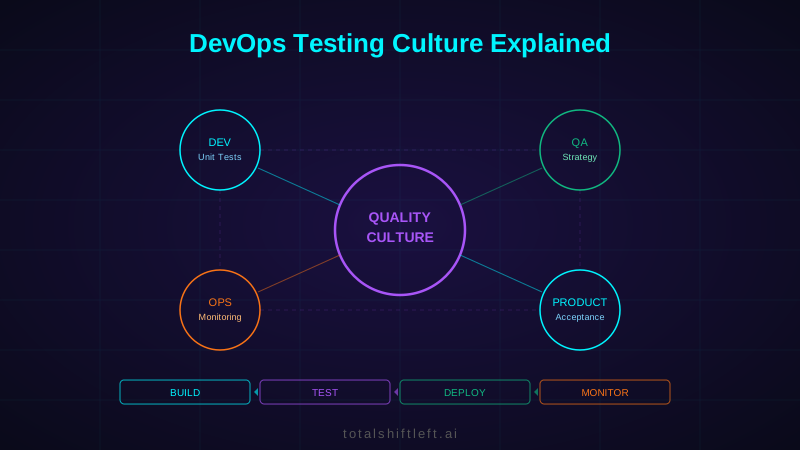
DevOps Testing Culture Architecture
A mature DevOps testing culture operates across four interconnected layers:
Individual Layer: Developers write tests locally using TDD or test-alongside practices. They run unit tests before committing. They review test quality during code reviews. They investigate and fix test failures promptly.
Team Layer: Cross-functional squads include embedded QA engineers who own test strategy for their domain. The team collectively defines and maintains quality standards. Sprint retrospectives include testing effectiveness discussion. The team's definition of done includes test coverage requirements.
Pipeline Layer: CI/CD pipelines enforce quality gates at every stage. Unit tests run on every commit. Integration tests run on every merge. Performance and security tests run on every release candidate. Failed gates block advancement and trigger immediate investigation.
Organization Layer: Leadership tracks DORA metrics and quality KPIs. Quality engineering is a recognized career path. Testing communities of practice share knowledge across teams. Investment in test infrastructure is treated as strategic rather than overhead.
These layers reinforce each other. Individual habits create team norms. Team norms shape pipeline requirements. Pipeline data informs organizational decisions. Organizational investment enables individual effectiveness.
Tools That Support DevOps Testing Culture
| Tool | Type | Best For | Open Source |
|---|---|---|---|
| Total Shift Left | API Test Automation | Codeless API testing with CI/CD integration | No |
| Jenkins | CI/CD | Pipeline orchestration and quality gates | Yes |
| GitHub Actions | CI/CD | Cloud-native pipeline automation | No |
| SonarQube | Code Quality | Static analysis and coverage tracking | Yes |
| Selenium | UI Testing | Browser-based functional testing | Yes |
| Playwright | UI Testing | Modern cross-browser end-to-end testing | Yes |
| Cypress | UI Testing | Developer-friendly component and E2E testing | Yes |
| Grafana | Observability | Production monitoring dashboards | Yes |
| PagerDuty | Incident Management | Alert routing and on-call management | No |
| Jira | Project Management | Quality metrics tracking and test management | No |
| TestRail | Test Management | Test case organization and reporting | No |
| k6 | Performance Testing | Load testing with developer-friendly scripting | Yes |
Tools support culture but do not create it. The best tool in the wrong culture will be underutilized. The right culture can make even basic tools highly effective.
Real-World Example: From QA Bottleneck to Quality-First Culture
Problem: A mid-size fintech company (180 engineers, 12 squads) had a centralized QA team of 15 testers responsible for all testing. Release cycles stretched to 6 weeks because every change required manual regression testing. The QA team was perpetually behind, developer-QA handoffs created friction, and change failure rates exceeded 35%. Developers viewed testing as "QA's problem" and rarely wrote tests.
Solution: The company restructured over 9 months. They embedded 2-3 QA engineers within each squad, shifting from centralized QA to distributed quality ownership. They implemented mandatory unit test coverage gates (80% minimum) in their CI/CD pipeline. QA engineers transitioned from manual testing to automation coaching and test strategy. They adopted shift-left testing practices that moved API validation into development. They created a Testing Guild—a cross-squad community of practice—that met biweekly to share patterns and standards. Leadership added quality metrics (change failure rate, defect escape rate) to squad performance reviews.
Results: Within 12 months, deployment frequency increased from biweekly to daily. Change failure rate dropped from 35% to 8%. Developer-written test coverage went from 22% to 78%. Manual regression testing was eliminated entirely. The QA team (now embedded quality engineers) reported higher job satisfaction because they focused on strategy and coaching rather than repetitive manual testing. Mean time to recovery dropped from 4 hours to 25 minutes.
Common Challenges in Building DevOps Testing Culture
Developer Resistance to Writing Tests
Challenge: Developers see test writing as overhead that slows them down. They have been shipping code without tests for years and perceive no benefit.
Solution: Start with pain points. Identify the most common production incidents, trace them to untested code, and demonstrate how tests would have prevented them. Pair QA engineers with developers for the first sprint to build skills and habits. Make test coverage visible in code reviews and celebrate improvements. Use automated testing in CI/CD to show developers immediate value from their testing investment.
QA Team Identity Crisis
Challenge: When testing becomes everyone's responsibility, QA engineers worry about job security and role clarity. They feel their expertise is being devalued.
Solution: Redefine QA as quality engineering—a strategic role focused on test architecture, automation frameworks, risk assessment, and coaching. Quality engineers become force multipliers who make entire squads better at testing rather than bottleneck testers who validate every change. Invest in training that helps QA engineers build automation and infrastructure skills.
Flaky Tests Eroding Trust
Challenge: Test suites become unreliable over time. Flaky tests—tests that pass and fail intermittently without code changes—destroy confidence in the testing process and the culture that depends on it.
Solution: Treat flaky tests as production bugs with high priority. Establish a zero-tolerance policy: flaky tests are quarantined immediately and fixed within one sprint. Track flakiness rates as a team metric. Invest in test infrastructure (deterministic test data, isolated environments, proper wait mechanisms) that prevents flakiness.
Free YAML templates + guide
CI/CD Testing Pipeline Templates
Production-ready CI/CD pipeline templates for GitHub Actions and GitLab CI. Includes API testing, contract testing, and performance testing stages.
Download FreeLeadership Not Prioritizing Quality Investment
Challenge: Leadership views testing as cost rather than investment. They pressure teams to ship features rather than build test infrastructure.
Solution: Present quality investment in business terms. Calculate the cost of production incidents (engineering time, revenue impact, customer churn). Show how DevOps testing best practices reduce these costs. Use DORA metrics to demonstrate the correlation between testing culture maturity and business outcomes. Build a business case showing ROI of testing infrastructure investment.
Measuring Culture Change
Challenge: Culture is intangible. Teams struggle to measure whether their cultural transformation is working.
Solution: Use proxy metrics that reflect cultural behaviors. Track developer-written test coverage (are developers testing their own code?), test-to-code commit ratios (are tests written alongside features?), mean time to fix broken tests (does the team prioritize test health?), and deployment frequency (is confidence increasing?). Survey team members quarterly on testing attitudes and practices.
Scaling Culture Across Teams
Challenge: One team builds a great testing culture but it does not spread to other teams. Each team operates independently with different standards.
Solution: Create cross-team communities of practice (Testing Guilds, Quality Chapters). Establish organization-wide minimum standards enforced through shared pipeline templates. Rotate quality engineers between teams to spread practices. Celebrate and publicize quality improvements at all-hands meetings.
Best Practices for Building DevOps Testing Culture
- Start with leadership commitment—culture change requires top-down support and resource allocation
- Embed QA engineers within development squads rather than maintaining a centralized QA team
- Make quality metrics (change failure rate, defect escape rate) visible alongside velocity metrics in team dashboards
- Enforce quality gates in CI/CD pipelines so that quality is automated and non-negotiable
- Treat test code with the same standards as production code: code reviews, refactoring, documentation
- Invest in testing infrastructure (fast CI, reliable test environments, deterministic test data) before demanding test coverage increases
- Practice blameless postmortems that focus on systemic improvement rather than individual blame
- Create a Testing Guild or Community of Practice for cross-team knowledge sharing
- Celebrate quality improvements publicly—recognize developers who improve test coverage and reduce defect rates
- Implement shift-left testing gradually, starting with the highest-risk components
- Measure and track testing culture metrics quarterly, treating them with the same importance as business metrics
- Provide training budgets and time allocation for testing skills development across all engineering roles
DevOps Testing Culture Readiness Checklist
- ✔ Leadership has publicly committed to quality-first culture and allocated budget for testing infrastructure
- ✔ QA engineers are embedded within cross-functional squads, not in a centralized department
- ✔ Developers include unit tests in their definition of done for every user story
- ✔ CI/CD pipeline enforces quality gates (coverage, pass rate, security scans) at every stage
- ✔ Test failures block pipeline advancement and trigger immediate investigation
- ✔ DORA metrics (deployment frequency, lead time, change failure rate, MTTR) are tracked and reviewed monthly
- ✔ Blameless postmortems are conducted for every production incident with follow-up action items
- ✔ Test code undergoes the same code review process as production code
- ✔ A cross-team Testing Guild or Community of Practice meets regularly to share knowledge
- ✔ Quality metrics are visible on team dashboards alongside velocity metrics
- ✔ Flaky tests are quarantined immediately and fixed within one sprint
- ✔ Testing skills training is available and encouraged for all engineering roles
- ✔ Production monitoring and observability data feeds back into test coverage priorities
- ✔ Test automation percentage exceeds 80% of total test execution
Take the next step. See how shift-left API testing platform applies these ideas to your workflow, or explore API testing in CI/CD for the broader picture.
See also: contract testing in our learn hub for the underlying concept.
Encode the culture in the repository, not the wiki
A quality culture that lives in a wiki page decays. The same expectations expressed as repository configuration survive team changes, because the tooling asks for them on every pull request:
# .github/CODEOWNERS — whoever changes the contract owns the consumer impact
/openapi.yaml            @acme/api-owners @acme/qa-guild
/tests/                  @acme/service-team
/.github/workflows/      @acme/platform

# .github/pull_request_template.md
# ## What changed
# ## How it was tested
# - [ ] Unit tests added or updated
# - [ ] Contract impact checked (oasdiff clean, or breaking change agreed with consumers)
# - [ ] No test was skipped or quarantined to make this pass
Then make the invisible visible: fail the build when someone quarantines a test and forgets it, which is where "we have a quality culture" usually breaks down in practice:
# scripts/check_quarantine.py — a skip needs an owner and an expiry
import re, sys, datetime, pathlib

PATTERN = re.compile(r'@pytest\.mark\.skip\(reason="(?P<r>[^"]*)"\)')
today, failures = datetime.date.today(), []

for f in pathlib.Path("tests").rglob("*.py"):
    for m in PATTERN.finditer(f.read_text()):
        reason = m.group("r")
        due = re.search(r"until=(\d{4}-\d{2}-\d{2})", reason)
        owner = re.search(r"owner=@[\w-]+", reason)
        if not (due and owner):
            failures.append(f"{f}: skip needs owner=@handle and until=YYYY-MM-DD")
        elif datetime.date.fromisoformat(due.group(1)) < today:
            failures.append(f"{f}: quarantine expired on {due.group(1)}")

print("\n".join(failures)); sys.exit(1 if failures else 0)
DevOps testing culture FAQ
What is DevOps testing culture?
DevOps testing culture is a shared organizational mindset where quality is everyone's responsibility, not just the QA team's. It embeds testing into every phase of the software delivery lifecycle through automation, collaboration, and continuous feedback loops, enabling teams to ship faster with higher reliability.
How do you build a quality-first DevOps team?
Build a quality-first DevOps team by making testing a shared responsibility, embedding QA engineers within cross-functional squads, automating tests at every pipeline stage, implementing quality gates, measuring DORA metrics alongside quality KPIs, and creating blameless postmortem processes that drive systemic improvement.
What is the difference between DevOps testing culture and traditional QA?
Traditional QA treats testing as a phase performed by a separate team after development. DevOps testing culture distributes quality ownership across the entire team, automates testing within CI/CD pipelines, and uses continuous feedback loops to catch defects during development rather than after it.
Why does DevOps testing culture improve deployment frequency?
DevOps testing culture improves deployment frequency because automated quality gates replace manual QA bottlenecks, developers write and run tests locally before committing, and pipeline-integrated testing provides instant feedback. Teams with mature testing cultures deploy 973x more frequently than low performers according to DORA research.
What metrics measure DevOps testing culture maturity?
Key metrics include deployment frequency, lead time for changes, change failure rate, mean time to recovery (the four DORA metrics), test automation percentage, defect escape rate, test execution time, and code coverage trends. Mature teams track both velocity and quality metrics together.
Sources and further reading
- DORA State of DevOps research — the multi-year dataset behind the four delivery metrics.
- Google Testing Blog — Google's engineering write-ups on test sizing and flakiness.
- Accelerate / DORA four key metrics — the definitions behind lead time, deploy frequency, CFR and MTTR.
Key takeaways
- DevOps testing culture is not a destination—it is a continuous practice.
- The teams that ship the fastest and break the least are not the ones with the most sophisticated tools.
- They are the ones where every engineer thinks about quality instinctively, where testing is woven into every workflow, and where quality improvement is celebrated as a core engineering achievement.
- Building this culture requires investment in people, processes, and infrastructure.
- It requires leadership commitment, structural changes, and patience. But the payoff—measured in deployment frequency, reliability, developer satisfaction, and business outcomes—is substantial and compounding.
- Start by assessing where your team stands today. Identify the highest-impact cultural gap.
Address it with a specific, measurable initiative. Then repeat. Culture changes one habit at a time.
Ready to accelerate your DevOps testing culture transformation? Start your free trial of Total Shift Left and give your team the automated API testing infrastructure that makes quality-first practices practical.
Related: DevOps Testing: The Complete Guide | What Is Shift-Left Testing? | QA in DevOps: The Evolving Role | Testing Ownership in DevOps Teams | DevOps Testing Best Practices | DevOps Testing Strategy
Ready to shift left with your API testing?
Try our no-code API test automation platform free.