
DevOps Metrics for Software Quality: What to Measure (2026)
Quick answer
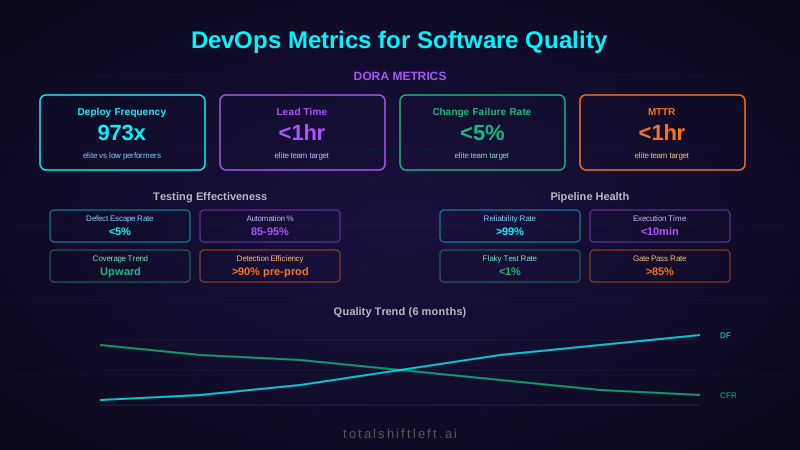
DevOps quality metrics are the quantitative measures — the four DORA metrics (deployment frequency, lead time, change failure rate, MTTR), plus defect escape rate, test automation percentage, pipeline reliability, and mean time to detect — that teams track across delivery velocity, testing effectiveness, pipeline health, and production quality. Elite teams keep defect escape rate and change failure rate below 5%, automate 85-95% of test execution, and deploy 973x more frequently than low performers.
Reviewed by Sushant Joshi

DevOps quality metrics are the quantitative measures that engineering teams use to assess software quality across the delivery lifecycle. They encompass delivery performance (DORA metrics), testing effectiveness (automation coverage, defect escape rate), pipeline health (reliability, speed), and production quality (incident rate, MTTR) to provide a comprehensive view of quality outcomes.
Peter Drucker's axiom applies perfectly to DevOps quality: you cannot improve what you do not measure. Yet most engineering organizations either measure the wrong things (lines of code, bug counts) or measure nothing at all and rely on gut feeling to assess quality.
The 2025 DORA State of DevOps report established clear correlations between specific metrics and organizational performance. Elite teams that track and optimize the right metrics deploy 973x more frequently, have 6,570x faster lead times, and experience 3x lower change failure rates than low performers. The metrics are not just indicators—they are drivers of improvement.
This guide defines the essential DevOps quality metrics, explains what each measures and why it matters, provides benchmarks for elite performance, and shows how to build quality dashboards that drive continuous improvement. If your team argues about whether quality is improving or declining, the answer is better metrics.
In this guide
- What Are DevOps Quality Metrics?
- Why DevOps Quality Metrics Matter
- Key Categories of DevOps Quality Metrics
- Quality Metrics Architecture
- Tools for DevOps Quality Metrics
- Real-World Example: Building a Quality Metrics Program
- Common Challenges in Quality Metrics
- Best Practices for DevOps Quality Metrics
- DevOps Quality Metrics Implementation Checklist
- Compute the four key metrics from data you already have
- DevOps quality metrics FAQ
What Are DevOps Quality Metrics?
DevOps quality metrics are quantitative indicators that measure software quality across four dimensions: delivery velocity (how fast you ship), quality outcomes (how reliable your software is), testing effectiveness (how well your testing catches defects), and pipeline health (how reliable your delivery infrastructure is).
Unlike traditional QA metrics that focus on testing activity (test cases executed, bugs found), DevOps quality metrics focus on outcomes. The question shifts from "how much testing did we do?" to "how good is the software we delivered?" This outcome focus aligns with the DevOps testing culture principle that quality is measured by results, not effort.
Effective metrics have five properties. They are measurable automatically (no manual data collection). They are actionable (knowing the metric drives specific improvement actions). They are not gameable (improving the metric genuinely improves quality). They track trends (point-in-time values are less useful than directional changes). They are visible (the team sees metrics regularly, not just during reviews).
The metrics described below are organized into four categories. No single metric tells the full quality story. The power is in the combination—metrics that would be misleading in isolation become highly informative when analyzed together.
For the reporting layer above this — which numbers to put in front of engineering leadership and which ones get gamed — see API quality metrics that matter.
Picking the runner first? Our comparison of continuous integration testing tools covers the CI systems, languages and licence models side by side.
Why DevOps Quality Metrics Matter
Metrics Replace Opinions with Data
Without metrics, quality discussions devolve into opinions. Developers think quality is fine because they wrote tests. QA thinks quality is poor because they find bugs. Operations thinks quality is terrible because they handle incidents. Metrics provide a shared, objective reality that eliminates subjective disagreement and focuses discussions on improvement.
Metrics Drive Improvement Through Visibility
Making quality metrics visible—on team dashboards, in sprint reviews, in leadership reports—creates accountability and motivation. Teams that see their defect escape rate trending upward take corrective action. Teams that see deployment frequency increasing celebrate progress. Visibility turns abstract quality goals into concrete, trackable improvements.
Metrics Reveal Systemic Issues
Individual incidents and bugs are symptoms. Metrics reveal patterns. A rising change failure rate indicates systemic testing gaps. Increasing pipeline execution time indicates infrastructure degradation. Growing flaky test rates indicate test quality problems. Metrics help teams address root causes rather than chasing individual symptoms.
Metrics Connect Quality to Business Outcomes
Business leaders care about revenue, customer satisfaction, and competitive advantage—not test coverage or bug counts. DevOps quality metrics bridge this gap. Deployment frequency connects to time-to-market. Change failure rate connects to customer experience. MTTR connects to revenue protection. DevOps testing strategies become easier to fund when their metrics connect to business value.
Key Categories of DevOps Quality Metrics
DORA Metrics (Delivery Performance)
The four DORA metrics are the gold standard for measuring DevOps performance. They are validated by years of research across thousands of organizations.
Deployment Frequency: How often code is deployed to production. Elite teams deploy on-demand (multiple times per day). This metric indicates delivery capability and team confidence. Higher frequency correlates with smaller, safer changes.
Lead Time for Changes: The time from code commit to production deployment. Elite teams achieve lead times under one hour. This metric indicates pipeline efficiency and process overhead. Long lead times suggest bottlenecks in testing, review, or deployment.
Change Failure Rate: The percentage of deployments that cause a failure in production (requiring a hotfix, rollback, or patch). Elite teams maintain rates below 5%. This is the most direct quality metric in the DORA set—it measures how often deployments break production.
Mean Time to Recovery (MTTR): The time from a production failure to full recovery. Elite teams recover in under one hour. This measures the team's ability to detect, diagnose, and resolve production issues quickly. Fast recovery depends on monitoring, testing infrastructure, and deployment automation.
Testing Effectiveness Metrics
Defect Escape Rate: The percentage of total defects found in production rather than pre-production. Calculated as: production defects / (pre-production defects + production defects). Elite teams maintain rates below 5%. This metric directly measures testing effectiveness—lower rates mean testing catches more defects before they reach users.
Test Automation Percentage: The percentage of test execution that is automated versus manual. Elite teams automate 85-95%. This metric indicates testing scalability and speed. Low automation percentages create bottlenecks that limit deployment frequency.
Test Coverage Trends: Code coverage measured over time rather than as a single number. Trending upward indicates improving quality practice. Trending downward indicates accumulating untested code. The trend matters more than the absolute number because coverage can be gamed with low-quality tests.
Defect Detection Efficiency: The percentage of defects found at each stage (development, CI, staging, production). High detection efficiency at early stages indicates effective shift-left testing. Low early-stage detection indicates testing gaps.
Ready to shift left with your API testing?
Try our no-code API test automation platform free. Generate tests from OpenAPI, run in CI/CD, and scale quality.
Pipeline Health Metrics
Pipeline Reliability Rate: The percentage of pipeline runs that produce accurate results (no false positives or false negatives). Target: above 99%. Low reliability destroys developer trust and leads to pipeline bypass.
Pipeline Execution Time: The total time from code push to pipeline completion. Track both commit-stage time (target: under 10 minutes) and full pipeline time (target: under 30 minutes). Increasing execution times indicate infrastructure issues or test suite bloat.
Flaky Test Rate: The percentage of tests that produce inconsistent results across runs. Target: below 1%. Flaky tests are a leading indicator of pipeline reliability degradation and developer trust erosion.
Quality Gate Pass Rate: The percentage of pipeline runs that pass all quality gates on the first attempt. Low pass rates indicate either overly strict gates or poor code quality. Analyze which gates fail most frequently to identify improvement areas.
Production Quality Metrics
Incident Rate: The number of production incidents per deployment or per time period. Trending downward indicates improving pre-production quality. Trending upward indicates quality regression.
Mean Time to Detect (MTTD): The time from when a production issue begins to when it is detected. Fast detection (minutes) depends on comprehensive monitoring and alerting. Slow detection (hours or days) indicates monitoring gaps.
Customer-Reported Defect Rate: The number of defects reported by customers versus found internally. High customer-reported rates indicate that both testing and monitoring are missing issues. This is the ultimate quality metric—it measures what users actually experience.
SLO Compliance Rate: The percentage of time that servi
ces meet their Service Level Objectives. This measures the quality that customers experience, aggregating all quality dimensions (availability, latency, error rate) into a single compliance measure.
Quality Metrics Architecture
A quality metrics system collects data from five sources, aggregates it in a central data store, and presents it through dashboards and alerts:
Data Sources: CI/CD platform (pipeline execution data), test frameworks (test results, coverage), code analysis tools (quality findings), monitoring systems (production metrics), and incident management tools (incident data).
Data Pipeline: Automated collection from each source feeds a central metrics database. Collection happens in real-time for pipeline and production metrics, and daily for aggregate metrics. The data pipeline should require zero manual data entry.
Dashboard Layer: Grafana, Datadog, or custom dashboards present metrics at three levels: team dashboards (real-time pipeline and testing metrics), management dashboards (weekly quality trends and DORA metrics), and executive dashboards (monthly quality outcomes and business impact). A role-based analytics dashboard for API testing can feed test-result and coverage data straight into these layers without manual collection.
Alert Layer: Automated alerts trigger when metrics cross defined thresholds. Change failure rate exceeding 15% triggers investigation. Pipeline execution time exceeding budget triggers optimization. Defect escape rate spike triggers coverage review.
Integrating quality metrics with the continuous quality framework ensures that metrics inform quality improvement across every delivery stage.
Tools for DevOps Quality Metrics
| Tool | Type | Best For | Open Source |
|---|---|---|---|
| Grafana | Dashboards | Custom quality metrics dashboards with alerting | Yes |
| Datadog | Observability | Full-stack monitoring with DORA metrics support | No |
| Total Shift Left | API Testing | API test results and quality metrics for CI/CD | No |
| SonarQube | Code Quality | Code coverage, technical debt, and quality trends | Yes |
| Sleuth | DORA Metrics | Automated DORA metrics tracking and analysis | No |
| LinearB | Engineering Metrics | Developer productivity and quality metrics | No |
| Allure | Test Reporting | Detailed test execution analytics and trends | Yes |
| Prometheus | Metrics | Time-series metrics collection and storage | Yes |
| PagerDuty | Incident Mgmt | Incident tracking and MTTR measurement | No |
| Jira | Project Mgmt | Defect tracking and quality analytics | No |
| Jellyfish | Engineering Mgmt | Engineering investment and quality ROI tracking | No |
| Apache Superset | BI/Analytics | Custom quality analytics and reporting | Yes |
Real-World Example: Building a Quality Metrics Program
Problem: A media technology company (250 engineers, 18 squads) had no quality metrics. Teams argued about quality constantly. Leadership made investment decisions based on opinions rather than data. Some teams deployed daily with few incidents; others deployed monthly with frequent incidents. There was no way to identify what the high-performing teams did differently or to spread their practices.
Solution: They implemented a quality metrics program in three phases. Phase 1 (month 1): deployed Sleuth for automated DORA metrics tracking across all teams, requiring zero workflow changes from developers. Phase 2 (months 2-3): added testing effectiveness metrics by integrating SonarQube (coverage trends), Allure (test execution analytics), and their incident management tool (defect escape rate calculations). Built Grafana dashboards at team and organization levels. Phase 3 (months 4-6): implemented DevOps testing best practices based on metric insights. Identified that the top-performing teams had 3 common practices: pre-commit hooks, API contract testing, and production canary deployments. Created playbooks from these practices and coached underperforming teams.
Results: Within 9 months, organization-wide deployment frequency increased 3.2x. Change failure rate decreased from an average of 18% to 7%. The gap between highest and lowest performing teams narrowed by 60%. Leadership gained confidence to increase engineering investment because quality improvements were quantifiable. The company saved an estimated $2.1M annually in incident response costs. Quality became a data-driven conversation rather than an opinion-driven argument.
Common Challenges in Quality Metrics
Goodhart's Law: Gaming Metrics
Challenge: When a metric becomes a target, it ceases to be a good metric. Developers write meaningless tests to hit coverage targets. Teams cherry-pick easy deployments to inflate deployment frequency. Incidents are reclassified to reduce change failure rates.
Solution: Use metric combinations that are hard to game simultaneously. High coverage with low defect escape rate indicates genuine quality. High deployment frequency with low change failure rate indicates genuine capability. Track metric quality (mutation testing for coverage, incident reviews for classification) alongside the metrics themselves.
Measuring Too Many Things
Challenge: Teams track 30+ metrics, creating information overload. No one knows which metrics matter. Dashboards become wallpaper that nobody reads.
Solution: Limit to 8-12 core metrics across the four categories. Display the most important 4-6 metrics prominently on team dashboards. Reserve detailed metrics for deep-dive analysis. Every metric on the dashboard should have a clear owner and a defined response when the metric trends negatively.
Free YAML templates + guide
CI/CD Testing Pipeline Templates
Production-ready CI/CD pipeline templates for GitHub Actions and GitLab CI. Includes API testing, contract testing, and performance testing stages.
Download FreeComparing Teams Unfairly
Challenge: Different teams work on different problems with different risk profiles. Comparing a team maintaining a legacy monolith against a team building a new microservice using the same metrics is misleading.
Solution: Compare teams against their own historical trends rather than against other teams. Use metrics to identify improvement opportunities, not to rank teams. When cross-team comparison is needed, normalize for factors like system complexity, age, and risk profile. Focus on whether each team is improving, not which team is "best."
Metrics Without Action
Challenge: Teams collect metrics but do not act on them. Dashboards show declining quality, but no one investigates or takes corrective action.
Solution: Define response playbooks for each metric. When change failure rate exceeds 15%, the team conducts a targeted testing review. When pipeline execution time exceeds budget, the team schedules optimization. When defect escape rate spikes, the team conducts a coverage gap analysis. Metrics without response plans are metrics without value.
Attribution Challenges
Challenge: Quality outcomes are influenced by many factors. Attributing metric changes to specific causes is difficult, making it hard to know which improvements are working.
Solution: Introduce changes incrementally and track metrics before, during, and after each change. Use A/B comparisons when possible (one team adopts a practice, a comparable team does not). Accept that perfect attribution is impossible—directional correlation is sufficient for improvement decisions.
Best Practices for DevOps Quality Metrics
- Track the four DORA metrics as your baseline quality measurement framework
- Measure defect escape rate as the primary testing effectiveness indicator
- Display quality metrics on team dashboards visible to all team members daily
- Combine delivery velocity metrics with quality metrics to prevent speed-vs-quality tradeoffs
- Track metric trends over time rather than focusing on point-in-time values
- Define response playbooks for every metric threshold to ensure metrics drive action
- Automate metric collection to eliminate manual data entry and ensure accuracy
- Review metrics weekly with the team and monthly with engineering leadership
- Use metric combinations that resist gaming (coverage + defect escape rate together)
- Limit core dashboards to 8-12 metrics to prevent information overload
- Compare teams against their own historical trends, not against each other
- Connect quality metrics to business outcomes (revenue impact, customer satisfaction) for leadership visibility
DevOps Quality Metrics Implementation Checklist
- ✔ DORA metrics (deployment frequency, lead time, change failure rate, MTTR) are tracked automatically
- ✔ Defect escape rate is calculated and tracked monthly
- ✔ Test automation percentage is measured and reported
- ✔ Code coverage trends are tracked across the organization
- ✔ Pipeline reliability rate and execution time are monitored
- ✔ Flaky test rate is tracked with automated detection
- ✔ Production incident rate is correlated with deployment data
- ✔ Customer-reported defect rate is tracked separately from internal defect rate
- ✔ Team-level quality dashboards are visible and updated in real-time
- ✔ Management-level quality dashboard provides weekly trend summaries
- ✔ Response playbooks exist for each metric threshold breach
- ✔ Metric collection is fully automated with no manual data entry
- ✔ Metrics are reviewed weekly with the team and monthly with leadership
- ✔ Quality metrics are connected to business outcome reporting
Take the next step. See how shift-left API testing platform applies these ideas to your workflow, or explore API testing in CI/CD for the broader picture.
See also: contract testing in our learn hub for the underlying concept.
Compute the four key metrics from data you already have
Deployment frequency, lead time, change failure rate and time to restore can all be derived from the deployment table and the incident table — no new instrumentation required:
-- DORA four keys over the trailing 30 days
WITH deploys AS (
  SELECT id, service, deployed_at, first_commit_at, succeeded
  FROM deployments
  WHERE deployed_at > now() - interval '30 days'
),
incidents AS (
  SELECT deployment_id, detected_at, resolved_at
  FROM incidents
  WHERE detected_at > now() - interval '30 days'
)
SELECT
  d.service,
  count(*) / 30.0                                                   AS deploys_per_day,
  percentile_cont(0.5) WITHIN GROUP (
    ORDER BY extract(epoch FROM d.deployed_at - d.first_commit_at)/3600
  )                                                                 AS median_lead_time_hours,
  count(i.deployment_id)::float / nullif(count(*), 0)                AS change_failure_rate,
  percentile_cont(0.5) WITHIN GROUP (
    ORDER BY extract(epoch FROM i.resolved_at - i.detected_at)/60
  )                                                                 AS median_restore_minutes
FROM deploys d
LEFT JOIN incidents i ON i.deployment_id = d.id
GROUP BY d.service
ORDER BY change_failure_rate DESC;
Report them per service and per month. A single organisation-wide number hides the one team whose change failure rate is 30%, which is the only number worth acting on.
DevOps quality metrics FAQ
What are the most important DevOps quality metrics?
The most important DevOps quality metrics are the four DORA metrics (deployment frequency, lead time for changes, change failure rate, mean time to recovery), plus defect escape rate, test automation percentage, pipeline reliability rate, code coverage trends, and mean time to detect issues. Together these provide a comprehensive view of both delivery velocity and software quality.
What are DORA metrics and why do they matter for quality?
DORA metrics are four key software delivery performance indicators identified by the DevOps Research and Assessment team: deployment frequency, lead time for changes, change failure rate, and mean time to recovery. They matter for quality because they prove that speed and quality are not tradeoffs—elite teams excel at both. Change failure rate and MTTR directly measure quality outcomes.
How do you measure defect escape rate?
Defect escape rate is calculated as the number of defects found in production divided by the total number of defects found (in all stages including production), expressed as a percentage. For example, if your team finds 90 defects pre-production and 10 in production, the defect escape rate is 10/(90+10) = 10%. Elite teams maintain defect escape rates below 5%.
What is a good test automation percentage for DevOps?
Elite DevOps teams automate 85-95% of their test execution. The remaining 5-15% consists of exploratory testing, usability evaluation, and edge cases that are impractical to automate. A team below 60% automation is likely bottlenecked by manual testing. The goal is not 100%—some testing activities genuinely require human judgment.
How do you build a DevOps quality metrics dashboard?
Build a quality metrics dashboard by selecting 8-12 key metrics across four categories (delivery velocity, quality outcomes, testing effectiveness, pipeline health), integrating data from CI/CD tools, test frameworks, monitoring systems, and incident trackers, and displaying trends over time rather than point-in-time values. Use Grafana, Datadog, or a custom dashboard. Review metrics weekly with the team and monthly with leadership.
Sources and further reading
- DORA State of DevOps research — the multi-year dataset behind the four delivery metrics.
- Accelerate / DORA four key metrics — the definitions behind lead time, deploy frequency, CFR and MTTR.
- Google SRE Workbook — Implementing SLOs — how to define SLOs and error budgets.
Key takeaways
- DevOps quality metrics transform quality from a subjective opinion into an objective, measurable practice.
- The right metrics—tracked consistently, displayed visibly, and acted upon promptly—drive continuous improvement that compounds over time.
- Teams that measure quality systematically outperform teams that rely on intuition because they can identify problems earlier, validate improvements faster, and allocate resources more effectively.
- Start with the four DORA metrics. They require minimal setup, correlate strongly with organizational performance, and establish the measurement habit.
- Add testing effectiveness and pipeline health metrics as your measurement maturity grows.
- Build dashboards that the team sees daily. Define response playbooks that turn metric signals into improvement actions.
The goal is not perfect metrics—it is a measurement system that drives continuous quality improvement. Even imperfect metrics, tracked consistently, are vastly more valuable than no metrics at all.
Ready to generate quality metrics from your API testing automatically? Start your free trial of Total Shift Left and get built-in test reporting and analytics that feed directly into your DevOps quality dashboards.
Related: DevOps Testing: The Complete Guide | What Is Shift-Left Testing? | Continuous Quality in DevOps | DevOps Testing Maturity Model | DevOps Testing Best Practices | How to Build CI/CD Testing Pipeline
Ready to shift left with your API testing?
Try our no-code API test automation platform free.