
Database Testing Strategies for DevOps Teams (2026)
Quick answer
Database testing strategies are systematic approaches — schema validation, migration testing (forward and rollback), data integrity constraints, query performance baselines, and stored procedure unit tests — that validate every database change inside automated DevOps pipelines. Using ephemeral databases via Testcontainers, teams test migrations on every pull request and gate deployment on all six categories passing, since untested migrations are the highest-risk deployment artifact in most systems.
Reviewed by Smeet Gohel

Database testing strategies are systematic approaches to validating database schema changes, data integrity, migration reliability, query performance, and stored procedure correctness within automated DevOps pipelines. Effective database testing prevents data loss, catches performance regressions, and ensures every deployment leaves the database in a valid, performant state.
Database changes are the highest-risk artifact in most deployment pipelines. A bad code deployment can be rolled back in minutes. A bad database migration can corrupt data, break referential integrity, or create performance bottlenecks that take hours or days to resolve. Despite this, most DevOps teams invest heavily in application code testing while treating database changes as an afterthought—manually reviewed SQL scripts that are tested, if at all, against a shared staging database.
Every application depends on its database. The API layer, the business logic, the frontend—all of them ultimately read from and write to a data store. When that data store malfunctions due to a schema error, a broken migration, or a performance regression, every layer above it fails. Yet in most DevOps organizations, database testing receives a fraction of the investment that application testing does.
The consequences are predictable. Teams discover migration failures in production. Performance degradations caused by missing indexes go undetected until response times spike. Data integrity violations accumulate silently until a customer reports corrupt data. These are not edge cases—they are common occurrences in teams without structured database testing strategies.
This guide provides the complete database testing strategy for DevOps teams: what to test, how to test it, where to test it in the pipeline, and which tools to use. The strategies here integrate with the broader DevOps testing best practices framework and complement your CI/CD testing pipeline implementation.
In this guide
- What Are Database Testing Strategies
- Why Database Testing Matters for DevOps
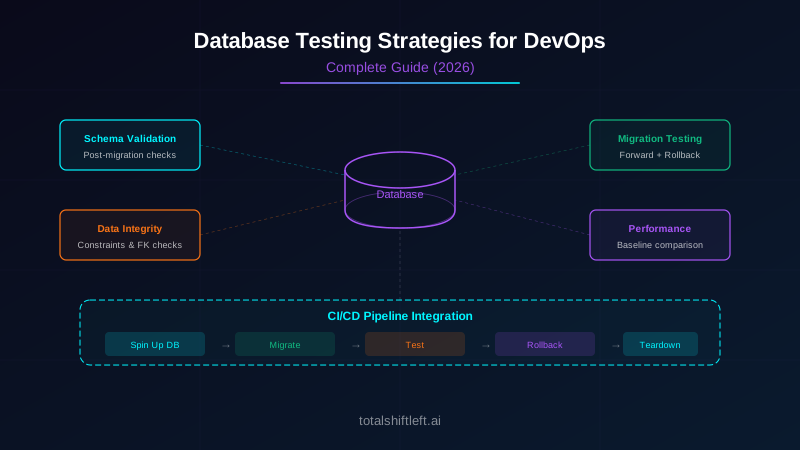
- Key Components of Database Testing
- Architecture for Database Testing in CI/CD
- Tools for Database Testing
- Database testing in practice: a worked example
- Database testing challenges and how to solve them
- Database testing best practices
- Database testing checklist
- Frequently asked questions about database testing
What Are Database Testing Strategies
Database testing strategies are structured approaches to verifying that every aspect of a database—schema, data, migrations, performance, and stored procedures—works correctly after every change. Unlike application testing, which verifies behavior through APIs or UIs, database testing verifies the correctness of the data layer directly.
The core categories of database testing are:
- Schema validation testing: Verifying that the database schema matches the expected definition after migrations run.
- Migration testing: Validating that every migration applies forward correctly, rolls back cleanly, and preserves existing data.
- Data integrity testing: Ensuring constraints, foreign keys, unique indexes, and business rules are enforced.
- Query performance testing: Measuring query execution times against baselines to catch regressions.
- Stored procedure testing: Unit testing database-side logic including triggers, functions, and procedures.
- API-database integration testing: Verifying that API operations produce the correct database state and that database state produces the correct API responses.
Each category requires different tools, techniques, and pipeline integration points. A comprehensive database testing strategy covers all six categories and runs automatically on every change.
Backend teams testing databases, queues and internal services alongside HTTP endpoints have a different shortlist — see the best backend testing tools.
Why Database Testing Matters for DevOps
Database Failures Are the Costliest Deployment Failures
A broken API endpoint returns an error to the user. A broken database migration can corrupt data for thousands of users simultaneously. The blast radius of database failures is fundamentally larger than application failures because the database is the shared state that every component depends on. Recovery from data corruption requires backups, point-in-time recovery, and sometimes manual data repair—operations that take hours, not minutes.
Migration Velocity Increases Risk
DevOps teams that deploy multiple times per day may apply multiple database migrations per week. Each migration modifies the shared state of the system. Without automated testing, the risk of a destructive migration slipping through increases linearly with migration frequency. High deployment velocity demands high testing rigor for database changes.
Performance Regressions Are Silent Until They Are Critical
A missing index on a new column does not cause a test to fail. A query that scans a full table instead of using an index returns the correct result—it just takes 100x longer. Without performance baseline testing, these regressions are invisible until production traffic exposes them. By then, the database is under stress, response times have spiked, and the team is in incident response mode.
Regulatory and Compliance Requirements
Many industries require audit trails, data retention guarantees, and proof that data transformations preserve integrity. Database testing provides the evidence that these requirements are met. Without it, compliance audits become manual, expensive, and uncertain.
Key Components of Database Testing
Schema Migration Testing
Every database migration should be tested in three phases:
Forward migration: Apply the migration to a clean database matching the current production schema. Verify that the schema matches the expected post-migration state. This catches syntax errors, constraint violations, and incompatible changes.
Backward migration (rollback): Apply the migration, then roll it back. Verify that the schema returns to the pre-migration state. This ensures that every migration has a working rollback—critical for production incident recovery.
Data preservation: Apply the migration to a database containing representative data. Verify that existing data is preserved, transformed correctly, or cleaned up as intended. This catches migrations that silently drop data, truncate columns, or break foreign key relationships.
-- Example: testing a migration that adds a NOT NULL column
-- Forward: add column with default
ALTER TABLE orders ADD COLUMN status VARCHAR(20) NOT NULL DEFAULT 'pending';
-- Verify: all existing rows have status = 'pending'
SELECT COUNT(*) FROM orders WHERE status != 'pending'; -- expect 0
-- Rollback: remove column
ALTER TABLE orders DROP COLUMN status;
-- Verify: table returns to original schema
Data Integrity Constraint Testing
Data integrity tests verify that the database enforces its own rules:
- Foreign key enforcement: Inserting a row with an invalid foreign key reference should fail.
- Unique constraint enforcement: Inserting a duplicate value in a unique column should fail.
- NOT NULL enforcement: Inserting a NULL value in a NOT NULL column should fail.
- Check constraint enforcement: Inserting values outside the allowed range should fail.
- Cascading behavior: Deleting a parent row should cascade correctly to child rows.
Ready to shift left with your API testing?
Try our no-code API test automation platform free. Generate tests from OpenAPI, run in CI/CD, and scale quality.
These tests seem trivial, but they catch a common class of bugs: migrations that accidentally drop constraints, code that disables constraints for data loading and forgets to re-enable them, and ORM configurations that do not match the actual database constraints.
Query Performance Baseline Testing
Performance baseline testing establishes expected execution times for critical queries and flags regressions:
- Establish baselines: Run each critical query against a representative dataset and record the execution time.
- Run on changes: After schema changes or migration changes, run the same queries against the same dataset.
- Compare against baselines: Flag any query that exceeds the baseline by more than a configurable threshold (typically 10-15%).
- Inspect execution plans: Compare EXPLAIN/ANALYZE output before and after changes to identify execution plan changes.
Stored Procedure and Function Testing
Database-side logic—stored procedures, triggers, and functions—requires unit testing just like application code. Frameworks like pgTAP (PostgreSQL), tSQLt (SQL Server), and utPLSQL (Oracle) provide assertion libraries for writing database unit tests.
Architecture for Database Testing in CI/CD
┌──────────────────────────────────────────────────────────────┐
│ Pull Request Gate │
│ │
│ ┌──────────────┐ ┌──────────────┐ ┌───────────────────┐ │
│ │ Schema │ │ Migration │ │ Data Integrity │ │
│ │ Validation │ │ Forward + │ │ Constraint Tests │ │
│ │ Tests │ │ Rollback │ │ │ │
│ └──────────────┘ └──────────────┘ └───────────────────┘ │
│
│
│ ┌──────────────┐ ┌──────────────┐ ┌───────────────────┐ │
│ │ Stored Proc │ │ Performance │ │ API-Database │ │
│ │ Unit Tests │ │ Baseline │ │ Integration Tests │ │
│ │ │ │ Comparison │ │ │ │
│ └──────────────┘ └──────────────┘ └───────────────────┘ │
├──────────────────────────────────────────────────────────────┤
│ Ephemeral Database Instance │
│ (Testcontainers / Docker Compose per PR) │
└──────────────────────────────────────────────────────────────┘
Pipeline flow for database changes:
- PR opened: Pipeline detects that the PR contains migration files or schema changes.
- Spin up ephemeral database: A fresh database container is created matching the current production schema version.
- Apply migrations: The pending migrations are applied to the ephemeral database.
- Run schema validation: The post-migration schema is compared against the expected schema definition.
- Run integrity tests: Constraint tests verify that all expected constraints exist and are enforced.
- Run rollback test: The migration is rolled back and the schema is verified to match the pre-migration state.
- Run performance baselines: Critical queries are executed and compared against stored baselines.
- Run API integration tests: The application connects to the ephemeral database and API tests verify correct behavior—this is where automated API testing intersects with database testing.
- Destroy ephemeral database: The container is removed after all tests complete.
Tools for Database Testing
| Tool | Category | Best For | Pipeline Integration |
|---|---|---|---|
| Flyway | Migration Management | Versioned migration execution | Excellent—CLI and API for CI/CD |
| Liquibase | Migration Management | Complex schema evolution | Excellent—supports rollback verification |
| Testcontainers | Ephemeral Databases | Isolated DB per test run | Excellent—native Docker integration |
| pgTAP | Unit Testing (Postgres) | Stored procedure testing | Good—TAP output for CI integration |
| tSQLt | Unit Testing (SQL Server) | Stored procedure testing | Good—integrates with SQL Server tooling |
| Great Expectations | Data Quality | Data validation and profiling | Good—Python-based, pipeline-friendly |
| SchemaSpy | Schema Documentation | Visual schema comparison | Good—generates HTML reports |
| Shift-Left API | API-DB Integration | API tests that validate DB state | Excellent—generates from OpenAPI specs |
| DBUnit | Test Data Management | Loading/verifying test datasets | Good—Java ecosystem standard |
| SchemaHero | Schema as Code | Declarative schema management | Good—Kubernetes-native |
Database testing in practice: a worked example
Scenario: A fintech team running PostgreSQL across 8 microservices, deploying 3-5 times per day, experiencing an average of 2 database-related incidents per month.
Before: Migrations were reviewed manually in PRs. Database testing consisted of running migrations against a shared staging database. Performance testing did not exist. Rollback capability was untested.
Implementation:
-
Phase 1 - Migration Testing (Week 1-2): Added Testcontainers to the CI pipeline. Every PR with migration files now spins up a fresh Postgres 16 container, applies all migrations from scratch, then applies and rolls back the new migration. Forward and rollback tests must pass to merge.
-
Phase 2 - Data Integrity (Week 3): Created a constraint test suite using pgTAP that verifies all foreign keys, unique constraints, and check constraints exist and are enforced. This runs after migration application in the pipeline.
-
Phase 3 - Performance Baselines (Week 4-5): Identified the top 50 critical queries across all services. Established execution time baselines against a 1M-row representative dataset. Added pipeline step that runs these queries after migration and compares against baselines with a 15% regression threshold.
-
Phase 4 - API Integration (Week 6): Connected the Shift-Left API test suite to the ephemeral test database, with the suite generated automatically from each service's OpenAPI spec. API tests now validate that database operations produce correct results through the full application stack.
Results after 3 months:
- Database-related incidents dropped from 2/month to 0 over 3 months
- Two potentially destructive migrations were caught by rollback testing before reaching staging
- One missing index was caught by performance baseline testing, preventing a production performance incident
- Average pipeline time for database changes: 4 minutes (Testcontainers spin-up + migration + tests + teardown)
Database testing challenges and how to solve them
Challenge: Migration Testing Takes Too Long
Applying all migrations from scratch on every PR can take 10+ minutes for databases with hundreds of migrations.
Solution: Maintain a baseline database image that includes all migrations up to a recent point. Rebuild this image weekly or when a significant batch of migrations accumulates. PR pipeline only applies migrations from the baseline forward, reducing migration time to seconds.
Free PDF + code examples
OpenAPI to Test Generation Template Pack
Go from OpenAPI spec to full test coverage. Includes sample specs, example generated tests, edge case patterns, and CI/CD integration guides.
Download FreeChallenge: Performance Baselines Drift Over Time
As the dataset grows or query patterns change, baselines established months ago may not reflect current reality.
Solution: Rebuild performance baselines on a scheduled basis (monthly or quarterly) using a standardized representative dataset. Store baselines as versioned artifacts alongside the service code. When baselines are rebuilt, commit the new baselines and review the changes in a dedicated PR.
Challenge: Shared Databases Between Services
Some legacy architectures have multiple services reading from and writing to the same database, making isolated testing difficult.
Solution: Use database schemas (PostgreSQL) or separate databases within the same instance to logically isolate service data. Test each service's schema independently. For cross-schema queries, create dedicated integration tests that spin up the full shared database. This is a common test data challenge in distributed systems that requires incremental decoupling.
Challenge: Testing Database-Side Logic (Triggers, Views)
Triggers and materialized views introduce hidden logic that is easy to miss in testing.
Solution: Treat database-side logic as first-class code. Write unit tests for every trigger and function using pgTAP or tSQLt. Include trigger behavior in integration tests—verify that inserting a row fires the expected trigger and produces the expected side effect. Document all triggers and views in the schema documentation.
Database testing best practices
- Every migration must have a tested rollback. If a migration cannot be rolled back, it must be flagged as irreversible and reviewed with additional scrutiny. Production incident recovery depends on rollback capability.
- Use ephemeral databases for all pipeline testing. Shared test databases create coupling between test runs and between services. Testcontainers provides isolated databases in seconds.
- Test data integrity constraints explicitly. Do not assume that the ORM creates the right constraints. Verify constraints exist and are enforced with dedicated tests.
- Establish and maintain performance baselines. Track the top 20-50 critical queries. A 15% regression threshold catches meaningful degradation while avoiding false positives from normal variance.
- Version database schemas as code. Use Flyway, Liquibase, or SchemaHero to define schemas declaratively and version them alongside application code.
- Separate data migration from schema migration. Data transformations should be in separate migration files from schema changes. This makes rollback testing simpler and makes it easier to identify data-related failures.
- Run database tests in parallel where possible. Schema validation, integrity tests, and performance baselines can often run in parallel against the same ephemeral database.
- Include database testing metrics in team dashboards. Track migration test pass rates, performance baseline trends, and database-related incident frequency.
Database testing checklist
- ✔ Every migration has automated forward and rollback tests
- ✔ Ephemeral database containers are used for all pipeline testing
- ✔ Schema validation tests compare post-migration schema against expected definition
- ✔ Data integrity constraint tests verify all foreign keys, unique indexes, and check constraints
- ✔ Performance baselines are established for top 20-50 critical queries
- ✔ Performance regression threshold is configured (recommended: 10-15%)
- ✔ Stored procedures and functions have unit tests (pgTAP, tSQLt, or equivalent)
- ✔ API-database integration tests verify correct behavior through the application layer
- ✔ Baseline database image is maintained and rebuilt regularly
- ✔ Database-side logic (triggers, views) has dedicated test coverage
- ✔ Migration files are separated into schema changes and data transformations
- ✔ Database testing metrics are visible in team dashboards
- ✔ Pipeline gates block deployment on database test failures
See also: contract testing in our learn hub for the underlying concept.
Frequently asked questions about database testing
What are the most important database testing strategies for DevOps?
The most important database testing strategies for DevOps are: schema migration testing (validating every migration runs forward and backward successfully), data integrity testing (enforcing constraints and referential integrity), query performance baseline testing (catching regression before production), stored procedure unit testing, and automated rollback verification. These strategies should be integrated into the CI/CD pipeline as automated quality gates that block deployment if any database test fails.
How do you integrate database testing into CI/CD pipelines?
Integrate database testing into CI/CD by running schema migrations against ephemeral test databases on every pull request, executing data integrity constraint tests after migration, running query performance benchmarks against baseline thresholds, and gating deployments on all database tests passing. Use Testcontainers or Docker Compose to spin up isolated database instances for each pipeline run. The entire database test cycle—container spin-up, migration, testing, teardown—should complete in under 5 minutes.
Should database migrations be tested before deployment?
Every database migration should be tested in an automated pipeline before reaching production. This includes testing forward migration (applying the change), backward migration (rolling back the change), data preservation (verifying no data loss during migration), and performance impact (ensuring the migration completes within acceptable time). Untested migrations are the single highest-risk deployment artifact in most systems. A single bad migration can corrupt data for all users simultaneously.
What tools are best for database testing in DevOps?
The best tools depend on your database engine and stack. Flyway and Liquibase handle migration versioning and testing. Testcontainers provides ephemeral database instances for isolated pipeline testing. pgTAP (PostgreSQL) and tSQLt (SQL Server) enable stored procedure unit testing. Great Expectations validates data quality. For API-level database testing, Shift-Left API generates tests from OpenAPI specs that validate database operations through the API layer, ensuring that schema changes do not break API behavior.
How do you test database performance in a CI/CD pipeline?
Establish performance baselines by recording query execution times for critical queries against a representative dataset stored as a versioned artifact. In the pipeline, load the same dataset into an ephemeral database, apply pending migrations, then run the same queries and compare execution times against baselines. Flag any query that regresses more than 10-15% from baseline. Additionally, compare EXPLAIN/ANALYZE output before and after changes to detect execution plan changes that indicate potential performance issues even when the dataset is small.
Sources and further reading
- Liquibase documentation — versioned, testable database schema migrations.
- Testcontainers — throwaway real dependencies for integration tests.
- PostgreSQL documentation — Transactions — the isolation semantics database tests depend on.
Key takeaways
- Database testing is not optional for DevOps teams that deploy frequently.
- Every deployment that includes a database change carries risk—risk of data corruption, performance degradation, constraint violations, and failed rollbacks.
- The strategies in this guide transform database changes from high-risk manual operations into automated, validated, predictable pipeline stages.
- The investment required is modest compared to the cost of database incidents.
- Testcontainers provides isolated databases in seconds. Migration testing frameworks like Flyway and Liquibase have built-in rollback support.
- Performance baseline comparison requires a representative dataset and a simple comparison script.
The infrastructure exists—teams just need to build the discipline of using it on every change. For the API layer that sits above your database—where schema changes manifest as changed API behavior—Shift-Left API generates comprehensive test suites from your OpenAPI specifications. These tests validate that your API endpoints return correct data after database changes, closing the gap between database testing and application testing automatically.
Start your free trial and add API-database integration testing to your DevOps pipeline today.
Related: DevOps Testing Best Practices | DevOps Testing Strategy | How to Build a CI/CD Testing Pipeline | Test Data Automation in CI/CD Pipelines | Automated Testing in CI/CD | Top Test Automation Tools for CI/CD | Platform | Start Free Trial
Ready to shift left with your API testing?
Try our no-code API test automation platform free.