
Test Data Challenges in Distributed Systems (2026)
Quick answer
Test data in distributed systems is hard because data lives across dozens of independently owned services, databases, and message queues instead of one shared store. The five recurring challenges are cross-service consistency, eventual-consistency verification, parallel test isolation, stateful orchestration across dependency graphs, and coordinated cleanup — solved with a shared orchestration layer, polling-based assertions instead of sleep(), and ephemeral infrastructure per test run.
Reviewed by Parveen Kumari

Test data challenges in distributed systems are the obstacles that make test data management exponentially harder when data is spread across multiple services, databases, message queues, and caches. These challenges include cross-service data consistency, eventual consistency verification, parallel test isolation, stateful orchestration, and coordinated cleanup—problems that do not exist in monolithic architectures.
Distributed systems multiply every test data problem. In a monolith, test data lives in one database. In a distributed system, it lives in dozens of databases, caches, message queues, and event logs—each owned by a different service, each with different consistency guarantees, and each evolving on its own deployment schedule. A test that verifies "customer places an order" requires coordinated data across 5 or more services, and if any one of those services has stale, missing, or inconsistent data, the test fails for reasons that have nothing to do with the code being tested.
Every engineering team that migrates from a monolith to a distributed architecture discovers the same uncomfortable truth: testing gets harder. Not marginally harder—fundamentally harder. The shared database that made test data management simple is replaced by a constellation of independent data stores, each with its own schema, access patterns, and consistency model.
The teams that acknowledge and address these challenges build reliable test suites that provide genuine confidence in their distributed systems. The teams that apply monolithic testing patterns to distributed architectures accumulate flaky tests, slow pipelines, and a growing list of test scenarios that are simply skipped because "the data setup is too complex."
This guide catalogs the specific test data challenges that arise in distributed systems and provides proven solutions for each one. It builds on the test data management strategies for microservices foundation and connects to the broader DevOps testing best practices framework that high-performing teams follow.
In this guide
- What Are Test Data Challenges in Distributed Systems
- Why These Challenges Matter
- Key Challenge Areas
- Architecture for Addressing Distributed Test Data
- Tools for Distributed Test Data Management
- Test data in distributed systems in practice: a worked example
- Challenge-Solution Pairs
- Test data in distributed systems best practices
- Test data in distributed systems checklist
- Frequently asked questions about test data in distributed systems
What Are Test Data Challenges in Distributed Systems
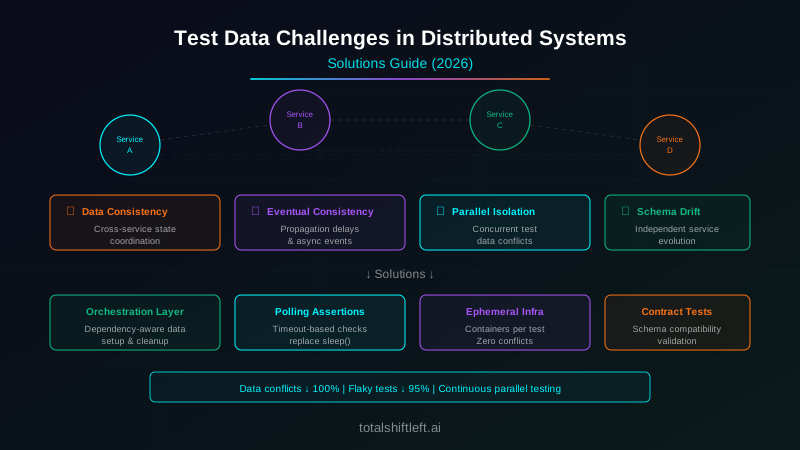
Test data challenges in distributed systems fall into categories that are unique to architectures where data is owned and managed by multiple independent services:
Cross-service data consistency: Ensuring that data across multiple services represents a valid, coherent state for a test scenario. An order test requires a customer in the customer service, products in the catalog service, inventory in the inventory service, and pricing in the pricing service—all in compatible states.
Eventual consistency verification: Distributed systems often use asynchronous communication (events, messages) between services. Data changes propagate with delays. Tests must account for propagation time and verify behavior during and after propagation.
Parallel test isolation: When multiple tests or pipeline runs execute simultaneously against shared infrastructure, their data must not interfere. Test A creates customer "test@example.com" while Test B tries to create the same customer—resulting in a constraint violation that fails one test randomly.
Stateful test orchestration: Creating a specific test state in a distributed system often requires a sequence of operations across services in a specific order. Testing order cancellation requires: create customer, create product, create inventory, create order, then cancel order—a five-step sequence across five services.
Coordinated cleanup: After test execution, data must be cleaned from multiple services in the correct order. Deleting a customer before deleting their orders may violate referential integrity in the order service.
Schema evolution across services: Each service evolves its schema independently. Test data that was valid for Service A version 2.3 may not be valid for version 2.4. When services deploy on different schedules, test data must accommodate multiple schema versions simultaneously.
The generation step itself — Faker, json-schema-faker and schema-derived payloads — is covered in how to generate test data for API testing.
Why These Challenges Matter
Flaky Tests Erode Trust in the Test Suite
In distributed systems, the majority of flaky tests are caused by test data issues—not code bugs. Data propagation delays, parallel test interference, and stale data states create intermittent failures that pass on retry but fail on the next run. When developers cannot trust test results, they stop paying attention to failures. This is the most damaging outcome of unaddressed test data challenges: the test suite becomes noise rather than signal.
Pipeline Reliability Determines Deployment Velocity
A pipeline that fails 10% of the time due to data issues requires manual investigation for every failure. Engineering time spent investigating data-related flakes is time not spent building features. Teams with unreliable pipelines deploy less frequently, accumulate larger changesets, and face higher risk per deployment—the opposite of what distributed architectures are designed to enable.
Test Complexity Grows Exponentially with Service Count
The number of cross-service test data scenarios grows combinatorially with service count. A system with 3 services has manageable cross-service data requirements. A system with 20 services has cross-service data scenarios that are impossible to manage manually. Without structured solutions, test data complexity becomes the bottleneck that limits how many services a team can reliably test.
Regulatory Requirements Apply to Test Data
Data privacy regulations apply to test environments that contain personally identifiable information. In distributed systems, PII can propagate across multiple services through events and API calls. If production data is used for testing—even in one service—it may propagate to other services' test databases, creating compliance exposure across the entire system.
Key Challenge Areas
Challenge 1: Cross-Service Data State Setup
Setting up a valid data state across multiple services is the most common challenge. A single test scenario may require data in 5 or more services, each created through that service's API or event interface.
The problem: Services have different APIs, different authentication mechanisms, and different data creation semantics. Creating a customer in the customer service returns a customer ID that must be used in the order service, which requires a product ID from the catalog service, which requires a category ID from the category service.
The solution: Build a test data orchestration layer that abstracts cross-service data setup into reusable scenarios. This layer knows the dependency graph between services and creates data in the correct order, passing identifiers between services automatically. Pairing this orchestration with data-driven testing that parameterizes each scenario lets you exercise the same cross-service flow against many data permutations without duplicating setup code.
// Test data orchestration
class TestScenarioBuilder {
  async createOrderScenario() {
    const customer = await this.customerService.create(generateCustomer());
    const product = await this.catalogService.create(generateProduct());
    await this.inventoryService.setStock(product.id, 100);
    const order = await this.orderService.create({
      customerId: customer.id,
      items: [{ productId: product.id, quantity: 1 }]
    });
    return { customer, product, order };
  }
}
This orchestration layer should be shared across test suites and maintained as first-class test infrastructure—not duplicated in individual test files.
Challenge 2: Eventual Consistency Testing
Distributed systems that use asynchronous messaging (Kafka, RabbitMQ, SNS/SQS) have propagation delays between services. When Service A publishes an event, Service B may not process it for milliseconds to seconds.
The problem: Tests that assert on Service B's state immediately after Service A's action fail intermittently because the event has not been processed yet. Adding fixed delays (sleep for 2 seconds) makes tests slow and still flaky because propagation time varies.
The solution: Use polling with timeouts instead of fixed delays. Assert that the expected state appears within a configurable timeout, checking repeatedly with short intervals.
// Polling-based eventual consistency assertion
async function assertEventuallyConsistent(assertion, { timeout = 5000, interval = 200 } = {}) {
  const start = Date.now();
  while (Date.now() - start < timeout) {
    try {
      await assertion();
      return; // Success
    } catch (e) {
      await sleep(interval);
    }
  }
  await assertion(); // Final attempt - throw actual error
}

// Usage
await assertEventuallyConsistent(async () => {
  const orderStatus = await orderService.getStatus(orderId);
  expect(orderStatus).toBe('confirmed');
});
Ready to shift left with your API testing?
Try our no-code API test automation platform free. Generate tests from OpenAPI, run in CI/CD, and scale quality.
Also test the intermediate state explicitly: what should the system return when data is still propagating? The answer should be a defined, documented behavior—not an error.
Challenge 3: Parallel Test Isolation
When multiple pipeline runs or test suites execute simultaneously, they must not share mutable data state. This is trivial with ephemeral databases but challenging with shared infrastructure.
The problem: Pipeline Run A creates a user with email "test@example.com". Pipeline Run B, running in parallel, tries to create the same user. One run fails with a unique constraint violation. The failure is random—whichever run executes second fails.
The solution approaches:
-
Ephemeral infrastructure: Each test run gets its own service instances and databases via Docker Compose or Kubernetes namespaces. Complete isolation, zero conflict risk.
-
Unique test data per run: Prefix all test data with a run-specific identifier. Run A creates "runA-test@example.com", Run B creates "runB-test@example.com". No conflicts, but requires consistent prefixing throughout all test data.
-
Logical tenant isolation: Each test run operates as a separate tenant. Multi-tenant systems naturally isolate data between tenants. Single-tenant systems can add a test tenant dimension for testing purposes.
Challenge 4: Network Partition and Failure Simulation
Distributed systems must handle network failures gracefully. Test data for failure scenarios includes not just request payloads but network conditions: latency, packet loss, connection timeouts, and service unavailability.
The problem: Standard test data focuses on request/response payloads. It does not address what happens when the network between services fails during a multi-step operation.
The solution: Use chaos engineering tools (Toxiproxy, Chaos Monkey, Litmus) to inject network failures during test execution. Define test data scenarios that include failure conditions alongside request data:
# Test scenario with network failure
scenario: order-creation-during-inventory-outage
setup:
  customer: { name: "Test Customer" }
  product: { name: "Test Product", stock: 100 }
network_condition:
  target: inventory-service
  fault: connection_timeout
  duration: 30s
expected:
  order_status: pending
  retry_queue: contains order event
  customer_notification: "Order processing delayed"
Architecture for Addressing Distributed Test Data
┌──────────────────────────────────────────────────────────────┐
│                Test Data Orchestration Layer                   │
│                                                              │
│  ┌────────────────┐  ┌─────────────────┐  ┌──────────────┐  │
│  │ Scenario        │  │ Dependency      │  │ Cleanup      │  │
│  │ Builder         │  │ Graph Manager   │  │ Coordinator  │  │
│  └────────┬───────┘  └────────┬────────┘  └──────┬───────┘  │
│           │                   │                   │           │
└───────────┼───────────────────┼───────────────────┼───────────┘
            │                   │                   │
            ▼                   ▼                   ▼
┌───────────────────────────────────────────────────────────────┐
│                   Service Data Layer                           │
│                                                               │
│  ┌──────────┐  ┌──────────┐  ┌──────────┐  ┌──────────┐     │
│  │ Customer │  │ Product  │  │ Order    │  │ Payment  │     │
│  │ Service  │  │ Service  │  │ Service  │  │ Service  │     │
│  │ ┌──────┐ │  │ ┌──────┐ │  │ ┌──────┐ │  │ ┌──────┐ │     │
│  │ │ DB   │ │  │ │ DB   │ │  │ │ DB   │ │  │ │ DB   │ │     │
│  │ └──────┘ │  │ └──────┘ │  │ └──────┘ │  │ └──────┘ │     │
│  └──────────┘  └──────────┘  └──────────┘  └──────────┘     │
│       ▲              ▲              ▲              ▲          │
│       └──────────────┴──────────────┴──────────────┘          │
│                    Event Bus (Kafka/RabbitMQ)                  │
└───────────────────────────────────────────────────────────────┘

Isolation Strategies:
┌────────────────┐  ┌────────────────┐  ┌─────────────────────┐
│ Ephemeral      │  │ Tenant-Based   │  │ Unique ID           │
│ Infrastructure │  │ Isolation      │  │ Prefixing           │
│ (strongest)    │  │ (balanced)     │  │ (lightest)          │
└────────────────┘  └────────────────┘  └─────────────────────┘
The architecture has three layers: orchestration (coordinates cross-service data setup and cleanup), service data (individual service databases and APIs), and isolation strategy (prevents parallel test interference). The orchestration layer understands the dependency graph between services and executes data operations in the correct order.
Tools for Distributed Test Data Management
| Tool | Category | Best For | Distributed System Fit |
|---|---|---|---|
| Testcontainers | Ephemeral Infrastructure | Isolated services per test | Excellent—multi-container orchestration |
| Docker Compose | Environment Orchestration | Full-stack test environments | Good—standard for local and CI |
| Toxiproxy | Network Simulation | Latency and failure injection | Excellent—proxy-based fault injection |
| Pact | Contract Testing | Cross-service data contracts | Excellent—consumer-driven stubs |
| LocalStack | Cloud Emulation | AWS services (SQS, DynamoDB) | Excellent—full AWS API mock |
| WireMock | Service Mocking | External service simulation | Good—programmable HTTP stubs |
| Shift-Left API | API Test Generation | Cross-service API test data | Excellent—generates from specs |
| Kubernetes | Infrastructure | Namespace-based isolation | Good—production-like environments |
| Litmus / Chaos Mesh | Chaos Engineering | Failure scenario testing | Good—Kubernetes-native chaos |
| Kafka Testcontainer | Event Testing | Event-driven data scenarios | Excellent—containerized Kafka |
The tool selection for distributed systems is more complex than for monoliths because you need infrastructure orchestration, service isolation, and failure simulation in addition to standard test data generation. Most teams combine 3-5 of these tools for comprehensive coverage.
Test data in distributed systems in practice: a worked example
Scenario: An online marketplace with 15 microservices, event-driven communication via Kafka, and a shared staging environment used by 4 development teams.
Before: All teams shared a single staging environment for testing. Test data was created manually through a Postman collection. Each team's tests interfered with other teams' data. Approximately 20% of integration test failures were caused by data conflicts. Teams scheduled "testing windows" to avoid conflicts, reducing effective testing time by 40%.
Implementation:
-
Phase 1 - Ephemeral Service Stacks (Weeks 1-3): Built Docker Compose configurations for each team's critical service subset. Each team could spin up their 5-7 most-used services with isolated databases and a containerized Kafka instance. Test suites were modified to target the ephemeral stack instead of shared staging.
-
Phase 2 - Test Data Orchestration (Weeks 4-5): Created a shared test scenario library with orchestrated data setup for common cross-service scenarios: customer registration flow, product listing flow, purchase flow, payment flow, and refund flow. Each scenario handled dependency ordering and cross-service ID propagation automatically.
-
Phase 3 - Eventual Consistency Testing (Week 6): Replaced all fixed sleep() calls in tests with polling-based assertions using configurable timeouts. Added explicit tests for intermediate consistency states—verifying that the system returns appropriate responses while events are still propagating.
-
Phase 4 - Failure Scenario Testing (Weeks 7-8): Integrated Toxiproxy into the test infrastructure. Created test scenarios that inject network latency, connection failures, and service unavailability during multi-service operations. Verified that retry mechanisms, circuit breakers, and fallback behaviors work correctly with appropriate test data.
Results:
- Data-conflict-related test failures dropped from 20% to 0 (ephemeral isolation)
- Testing windows eliminated—all teams test in parallel continuously
- Integration test suite execution time dropped from 35 minutes to 12 minutes
- 7 failure-handling bugs discovered by Toxiproxy-based testing in the first month
- New services can be added to the test infrastructure with a single Docker Compose entry
Challenge-Solution Pairs
Challenge: Data Ordering Dependencies Across Services
Creating a valid cross-service state requires operations in a specific order (customer before order, product before inventory), but the order is not always obvious and changes as services evolve.
Solution: Maintain an explicit dependency graph as code. The orchestration layer uses this graph to determine creation order and cleanup order (reverse of creation). When a new dependency is added between services, update the graph. The orchestration layer detects cycles and reports them as configuration errors.
Free PDF + code examples
OpenAPI to Test Generation Template Pack
Go from OpenAPI spec to full test coverage. Includes sample specs, example generated tests, edge case patterns, and CI/CD integration guides.
Download FreeChallenge: Test Data for Saga Patterns
Distributed transactions using the saga pattern involve a sequence of local transactions with compensating actions for rollback. Testing sagas requires data for both the forward path and every compensation path.
Solution: Create saga-specific test data factories that produce data for each step of the saga plus compensating data for each rollback step. Test both the successful completion path and every possible failure point. For a 5-step saga, this means 1 success scenario plus 5 failure scenarios (one for each step), each with appropriate compensating data.
Challenge: Stale Data in Caches
Distributed systems often cache data (Redis, Memcached, CDN) for performance. Tests that create or modify data may not see changes reflected in cached responses.
Solution: In test environments, either disable caching entirely (simplest), use cache-busting headers in test requests, or include explicit cache invalidation steps in test data setup. For tests that specifically validate caching behavior, use deterministic cache TTLs and test both the cached response and the post-expiry response.
Challenge: Schema Version Mismatches Between Services
Service A deploys a schema change (adds a required field) before Service B updates its client code. During this window, Service B's test data for Service A is invalid because it lacks the new required field.
Solution: Use contract testing to detect schema mismatches before deployment. Consumer-driven contracts define the data shape each consumer expects. When a provider changes its schema in a way that breaks a consumer's contract, the provider's build fails—preventing the mismatch from reaching test or production environments.
Challenge: Reproducing Production Failures with Test Data
A production incident involves a specific combination of data states across services. Reproducing this in a test environment requires recreating the exact data conditions.
Solution: Build a production state capture tool that snapshots the relevant data from each involved service (anonymized), converts it to test data fixtures, and imports it into the test environment. This is a special-purpose tool used for incident investigation, not for regular testing. Regular testing should use synthetic data; production reproduction should use anonymized snapshots.
Test data in distributed systems best practices
- Build a test data orchestration layer as shared infrastructure. Cross-service data setup is too complex to duplicate in individual test files. A shared orchestration library ensures consistency and reduces maintenance.
- Use ephemeral infrastructure as the default isolation strategy. Docker Compose or Kubernetes namespaces provide complete isolation with acceptable overhead. Reserve shared infrastructure for scenarios that truly require it.
- Replace all sleep() calls with polling assertions. Fixed delays are both too slow (waste time) and too fast (still flaky). Polling with timeout provides both speed and reliability for eventual consistency testing.
- Maintain an explicit dependency graph between services. The orchestration layer needs to know which services depend on which for data creation and cleanup ordering. Keep this graph as code, version it, and validate it.
- Test failure scenarios with the same rigor as success scenarios. Network partitions, service outages, and timeout conditions are not edge cases in distributed systems—they are regular occurrences. Test data for failure scenarios is as important as test data for happy paths.
- Generate test data from API specifications. Shift-Left API generates valid test data from OpenAPI specs, keeping data synchronized with service schemas automatically. This eliminates the schema drift problem for API-level test data.
- Clean up test data in reverse dependency order. If orders depend on customers, delete orders before customers. The orchestration layer should reverse the creation dependency graph for cleanup.
- Monitor cross-service test data health. Track metrics for data setup time, data conflict rate, eventual consistency assertion timeout frequency, and cleanup success rate. These metrics reveal degrading test data infrastructure before it causes widespread flaky tests.
Test data in distributed systems checklist
- ✔ Cross-service test data orchestration layer exists and is shared across teams
- ✔ Dependency graph between services is maintained as code
- ✔ Ephemeral infrastructure (Docker Compose or K8s namespaces) is available for isolated testing
- ✔ All eventual consistency assertions use polling with configurable timeout (no sleep())
- ✔ Intermediate consistency states are tested explicitly
- ✔ Parallel test runs use isolated data (ephemeral infra, unique IDs, or tenant isolation)
- ✔ Failure scenarios are tested with network simulation tools (Toxiproxy or similar)
- ✔ Saga patterns have test data for both forward and every compensating path
- ✔ Contract tests validate cross-service data schemas
- ✔ Cache behavior is accounted for in test data setup
- ✔ Test data cleanup runs in reverse dependency order
- ✔ Production incident data can be anonymized and imported for reproduction
- ✔ Cross-service test data health metrics are monitored
See also: validation errors in our learn hub for the underlying concept.
Frequently asked questions about test data in distributed systems
What are the biggest test data challenges in distributed systems?
The biggest challenges are: data consistency across services (ensuring all services have compatible data states for a test scenario), eventual consistency testing (verifying system behavior during propagation delays), cross-service data isolation (preventing parallel tests from interfering with each other's data), stateful test data orchestration (creating multi-service data states in the correct dependency order), and coordinated test data cleanup across distributed stores (ensuring no orphaned data remains after test execution). Each of these challenges is absent in monolithic architectures and requires purpose-built solutions.
How do you test eventual consistency in distributed systems?
Test eventual consistency by creating a data change in one service and polling dependent services until the change propagates, using a configurable timeout. Assert that the final state is correct after propagation completes. Critically, also test the intermediate state—verify that the system returns appropriate responses while data is still propagating (e.g., "processing" status rather than an error). Use controlled delays and artificial latency injection to make propagation timing more deterministic in test environments.
How do you prevent test data conflicts in parallel distributed system tests?
Use three strategies depending on your infrastructure constraints: ephemeral infrastructure per test run (each run gets its own service instances and databases via Docker containers), unique test data identifiers per run (prefix all test data with a run-specific ID to avoid collisions), or logical tenant isolation (each test run operates as a separate tenant with isolated data partitions). Ephemeral infrastructure provides the strongest isolation guarantee but has the highest provisioning overhead.
How do you handle test data for event-driven distributed systems?
For event-driven systems, test data must be created as event sequences rather than database records. Build event factories that produce ordered event streams for test scenarios (e.g., CustomerCreated followed by EmailVerified followed by AccountActivated). Publish these events to containerized message brokers (Kafka or RabbitMQ via Testcontainers). Verify that downstream consumers process events correctly by checking their resulting state. Include tests for out-of-order events, duplicate events, and missing events to validate error handling.
What is the best strategy for test data cleanup in distributed systems?
The best strategy is ephemeral infrastructure—each test run creates its own services and databases via containers, and the entire environment is destroyed after testing. This eliminates cleanup complexity entirely. When ephemeral infrastructure is impractical (for cost or complexity reasons), use tagged cleanup: assign a unique run identifier to all test data during creation, then sweep all tagged data from all services after test execution. Execute cleanup in reverse dependency order to respect foreign key constraints and data relationships between services.
Sources and further reading
- Testcontainers — throwaway real dependencies for integration tests.
- Faker (Python) — locale-aware fake data generation.
- Martin Fowler — Testing Strategies in a Microservice Architecture — the canonical breakdown of microservice test layers.
Key takeaways
- Test data challenges in distributed systems are not incidental difficulties—they are fundamental consequences of distributing data ownership across independent services.
- Cross-service consistency, eventual consistency verification, parallel isolation, stateful orchestration, and coordinated cleanup are problems that every team building distributed systems must solve.
- The teams that solve them build reliable test suites and fast pipelines.
- The teams that ignore them accumulate flaky tests and lose confidence in their quality assurance process.
- The solutions are architectural, not tactical. You cannot fix distributed test data challenges with better test assertions or more careful fixture management.
- You need a test data orchestration layer that understands cross-service dependencies, ephemeral infrastructure that guarantees isolation, polling-based assertions that handle eventual consistency, and failure simulation that validates resilience.
For the API testing layer across your distributed services—where each service exposes endpoints that must be tested with valid, schema-compliant data—Shift-Left API generates comprehensive test suites from OpenAPI specifications. Each service's tests stay synchronized with its schema automatically, eliminating one of the most persistent test data challenges in distributed architectures.
Start your free trial and solve API test data challenges across your distributed system today.
Related: Managing Test Data in Microservices | API Testing Strategy for Microservices | Contract Testing for Microservices | Test Data Automation in CI/CD Pipelines | Database Testing Strategies for DevOps | DevOps Testing Best Practices | Platform | Start Free Trial
Ready to shift left with your API testing?
Try our no-code API test automation platform free.