
Shift Left Testing Strategy: Implementation Guide (2026)
Quick answer
A working shift-left testing strategy assigns each test type to the earliest stage where it is reliable: unit tests at commit, API and contract tests at PR, integration tests on merge to main, and end-to-end tests on release candidates. The strategy fails when test ownership is unclear or when one slow gate is allowed to dominate developer cycle time — both fixable with the right tooling and team agreements.
Reviewed by Smeet Gohel

A shift left testing strategy is a plan that defines how engineering teams embed quality checks at every stage of development — from design through deployment. It aligns testing types, tools, pipeline stages, and team ownership into a cohesive system that catches defects early and reduces release risk.
The blueprint above transforms a collection of quality tools and practices into a cohesive system that consistently delivers high-quality software faster and at lower cost. Without a deliberate strategy, shift left testing initiatives are fragmented: some teams adopt unit testing, others run API tests manually, quality gates are inconsistent, and the compounding benefits of a layered quality system never materialize.
This guide provides the complete step-by-step implementation framework that DevOps and engineering teams need to build a shift left testing strategy that works — one that is technically sound, culturally sustainable, and measurably effective.
Most engineering teams understand what shift left testing is. Fewer have a clear strategy for implementing it. The gap between understanding and implementation is where quality initiatives stall — not from lack of intent, but from lack of a coherent execution framework.
A shift left testing strategy answers the questions that individual tools and techniques cannot:
- What types of testing run at which stages of the development lifecycle?
- Who owns each testing layer — developers, QA engineers, platform engineers?
- How are tests integrated into the CI/CD pipeline, and what are the quality gates?
- Which tools are selected, and how do they integrate with each other?
- When does code advance through the pipeline, and what blocks it?
- How is success measured, and how does the strategy evolve over time?
Without answers to these questions, shift left testing is a set of disconnected practices rather than a quality system. With them, it becomes a competitive advantage — the infrastructure that enables faster, safer, more confident software delivery.
This guide walks through every component of a complete shift left testing strategy, providing specific, actionable guidance for DevOps teams building or improving their quality practices in 2026.
The two terms are used interchangeably and should not be — continuous testing vs shift-left testing separates when a check first runs from how often it keeps running.
In this guide
- What Is a Shift Left Testing Strategy?
- Why a Strategy Matters More Than Individual Tools
- The 7 Core Components of a Shift Left Testing Strategy
- Shift Left Testing Pipeline Architecture
- Tools and Technology Stack
- Step-by-Step Implementation Example
- Common Strategy Execution Challenges
- Best Practices for Strategy Execution
- Shift Left Strategy Implementation Checklist
- Move one check at a time, and prove each move
- Frequently asked questions about shift-left testing strategy
What Is a Shift Left Testing Strategy?
A shift left testing strategy is an organization-level plan for continuously integrating quality into software development from the earliest possible stage. It defines the testing layers that exist, the pipeline stages where they execute, the team members who own each layer, the tools that support the strategy, the standards that measure quality, and the roadmap for maturing the strategy over time.
A well-designed shift left testing strategy has five key properties:
Comprehensive coverage. Every critical quality dimension — functionality, security, performance, reliability, and API contract correctness — is addressed by at least one testing layer.
Appropriate speed. Tests at each pipeline stage are fast enough that developers receive actionable feedback without being blocked for unreasonable durations. The fastest tests (unit, static analysis) run on every commit. Slower tests (end-to-end) run less frequently but still in automated fashion.
Clear ownership. Every testing layer has an owner who is responsible for its health, maintenance, and evolution. Shared ownership without clear accountability leads to test suite decay.
Enforced quality gates. Tests are not advisory — they are gates that block pipeline progression when they fail. This is the mechanism that makes the strategy effective rather than aspirational.
Measurable outcomes. The strategy produces data — defect escape rates, coverage percentages, pipeline duration trends, defect discovery by stage — that enables continuous improvement based on evidence.
For background on the fundamentals that this strategy builds on, see the complete guide to shift left testing and the shift left testing framework guide. To understand how shift left compares with shift right approaches, read our shift left vs shift right testing comparison.
Why a Strategy Matters More Than Individual Tools
The difference between a shift left strategy and ad hoc shift left adoption is compounding quality returns. Individual tools catch individual classes of defects. A coordinated strategy catches defects at every layer, ensuring that defects missed by one layer are caught by the next. Understanding the concrete benefits of shift left testing helps build organizational buy-in for strategy investment.
Consider the defect cascade:
- A logic error escaping unit tests reaches API tests, where it manifests as an unexpected response code
- An API contract violation escaping API tests reaches contract tests, where it manifests as a consumer expectation mismatch
- A contract violation escaping contract tests reaches staging end-to-end tests
- An issue escaping all pre-production tests reaches production
Each layer in a well-designed strategy reduces the number of defects that reach subsequent layers. The compounding effect means that a strategy with four quality layers — each catching 80% of the defects that reach it — produces an overall escape rate of approximately 0.2^4 = 0.0016, or 0.16%. No single layer could achieve this; the system does.
The 7 Core Components of a Shift Left Testing Strategy
Component 1: The Testing Pyramid
The testing pyramid defines the types of tests in your strategy and their relative proportions. The canonical layers are:
Foundation: Unit Tests (highest volume)
- Scope: Individual functions, methods, components in isolation
- Speed: Seconds per test suite
- Ownership: Developers
- Coverage target: 75-90% for business logic
- Gate: Blocks commit or pull request on failure
Layer 2: API Tests (high volume)
- Scope: Individual API endpoints and their contracts
- Speed: Minutes per suite
- Ownership: QA engineers + developers (with automated generation)
- Coverage target: 100% of endpoints in OpenAPI spec
- Gate: Blocks pull request merge on failure
Layer 3: Integration Tests (medium volume)
- Scope: Inter-service communication, database interactions
- Speed: Minutes per suite
- Ownership: Developers + QA engineers
- Coverage target: All critical integration paths
- Gate: Blocks pull request merge on failure
Layer 4: Contract Tests (medium volume)
- Scope: Consumer-provider interface contracts
- Speed: Minutes per suite
- Ownership: Teams on both sides of each interface
- Coverage target: All critical service interfaces
- Gate: Blocks deployment on failure
Apex: End-to-End Tests (lower volume)
- Scope: Complete user journeys across multiple services
- Speed: 10-30 minutes per suite
- Ownership: QA engineers
- Coverage target: Critical user paths
- Gate: Blocks production deployment on failure
Component 2: CI/CD Pipeline Quality Gates
Quality gates are the enforcement mechanism of a shift left strategy. They transform tests from advisory checks into mandatory standards. Every stage of the CI/CD pipeline should have defined quality gates that block progression when criteria are not met.
Standard quality gate structure:
- Commit stage: Static analysis pass, linting, secret scanning
- Build stage: Unit tests pass, minimum code coverage met
- Pull request stage: API tests pass, integration tests pass
- Merge stage: Contract tests pass, security scans pass
- Staging deployment: End-to-end smoke tests pass
- Production deployment: Canary health checks pass, rollback triggers defined
Component 3: Test Environment Architecture
The test environment strategy defines how testing environments are provisioned, what dependencies are available, and how test isolation is achieved.
Key decisions:
- Local development: Docker Compose for local service dependencies; mock servers for external APIs
- CI environments: Ephemeral, containerized environments spun up per pipeline run
- Staging: A long-lived environment that mirrors production; used for end-to-end testing
- Production-adjacent: Canary deployments, synthetic monitoring, real user monitoring
Service isolation in CI is achieved through mock servers. Shift-Left API's built-in mock capabilities and tools like WireMock allow API tests and integration tests to run against realistic service simulations without requiring all dependent services to be running.
Component 4: Team Ownership Model
A shift left testing strategy requires explicit ownership for each testing layer:
| Testing Layer | Primary Owner | Secondary Owner | Escalation |
|---|---|---|---|
| Unit Tests | Developer | Tech Lead | Engineering Manager |
| Static Analysis | Developer | DevOps/Platform | Tech Lead |
| API Tests | QA Engineer | Developer | QA Lead |
| Contract Tests | Both teams at interface | QA Lead | Engineering Manager |
| Integration Tests | Developer | QA Engineer | Tech Lead |
| End-to-End Tests | QA Engineer | Product | QA Lead |
| Performance Tests | QA Engineer | SRE | Engineering Manager |
| Security Tests | Security Engineer | Developer | CISO / Engineering Manager |
Ready to shift left with your API testing?
Try our no-code API test automation platform free. Generate tests from OpenAPI, run in CI/CD, and scale quality.
The QA engineer's role in this model is fundamentally different from traditional QA: instead of manual regression testing, QA engineers own the quality strategy, design test scenarios, maintain automation infrastructure, and identify coverage gaps. This is a higher-value, higher-impact role.
Component 5: API Testing from Specifications
API testing is the highest-leverage shift left investment for microservices teams. APIs are the primary interface between services, between frontend and backend, and between your platform and external consumers. Defects in API behavior cascade across multiple system components. For a dedicated deep dive, see our API testing strategy for microservices.
The most efficient approach to comprehensive API test coverage is generating tests from OpenAPI/Swagger specifications. This approach:
- Provides immediate, comprehensive coverage when the spec is defined
- Keeps tests synchronized with the API definition automatically
- Ensures no endpoints are missed through manual test case authoring
- Enables API testing to begin before implementation is complete (against a mock)
- Requires no custom test code for basic coverage
Shift-Left API implements this approach: import an OpenAPI or Swagger spec, and the platform automatically generates a comprehensive test suite covering all endpoints, HTTP methods, parameters, and expected response codes.
Component 6: Quality Standards and Metrics
Quality standards define the minimum acceptable state for code to advance through the pipeline. They should be specific, measurable, and enforced:
- Minimum unit test coverage: Define per-layer thresholds (e.g., 80% for service layer, 70% overall)
- API test coverage: 100% of endpoints in OpenAPI spec must have at least one test
- Zero critical security vulnerabilities: Static analysis and dependency scanning must find no critical issues
- Contract test pass rate: 100% — any contract test failure blocks deployment
- End-to-end test pass rate: 100% for smoke suite, 95% for full regression
Metrics to track strategy effectiveness:
- Defect escape rate (% of defects discovered in production vs. pre-production)
- Mean time to detect (MTTD) for defects introduced in each sprint
- Pipeline duration at each stage (track and optimize)
- Release frequency (a shift left strategy should increase this over time)
- Engineering hours on rework (should decrease as strategy matures)
Component 7: Maturity Roadmap
Shift left testing maturity is incremental. A realistic 12-month maturity roadmap:
Months 1-2 (Foundation): Unit tests, static analysis, API test generation from specs, basic CI integration, initial quality gates
Months 3-4 (Integration): Contract testing for critical interfaces, integration tests, mock server infrastructure, containerized test environments
Months 5-6 (Coverage): End-to-end test suite, performance baseline testing, security scanning integration, coverage threshold enforcement
Months 7-9 (Optimization): Pipeline performance optimization, test parallelization, advanced reporting and dashboards, quality metrics integration with engineering management tools
Months 10-12 (Culture): Quality metrics in team retrospectives, quality standards enforced across all teams, QA engineer role fully evolved to quality architect, shift left practices embedded in hiring and onboarding
Shift Left Testing Pipeline Architecture
The following pipeline architecture shows a complete shift left testing strategy implemented in a modern CI/CD system:
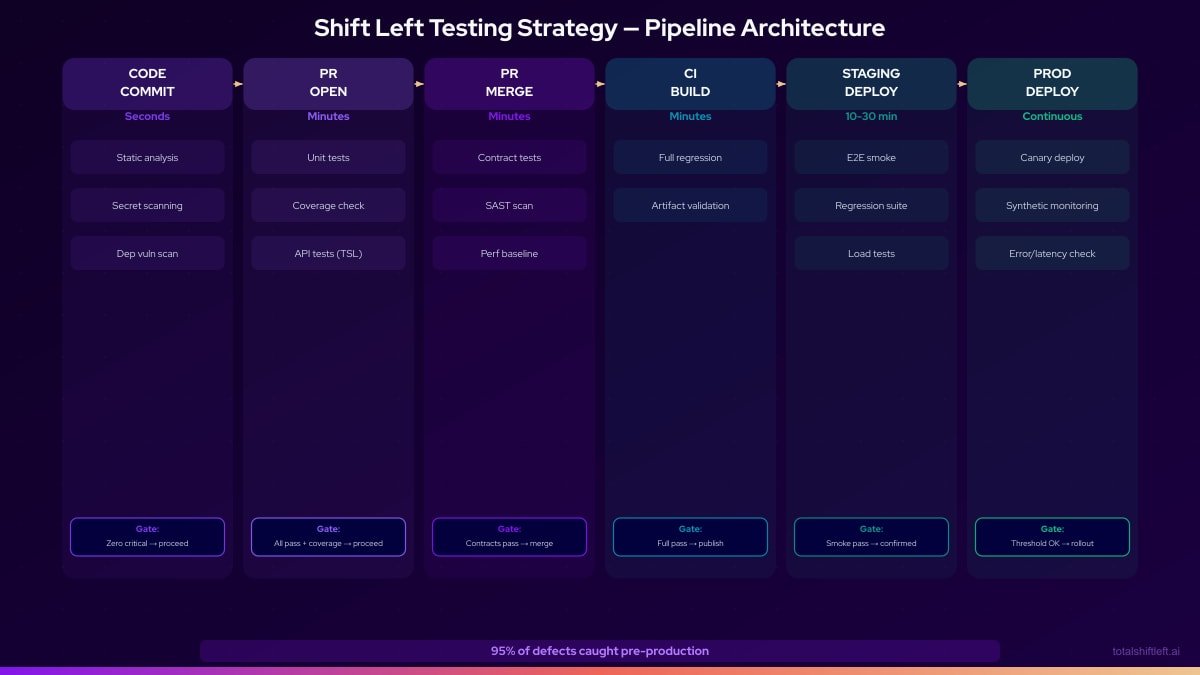
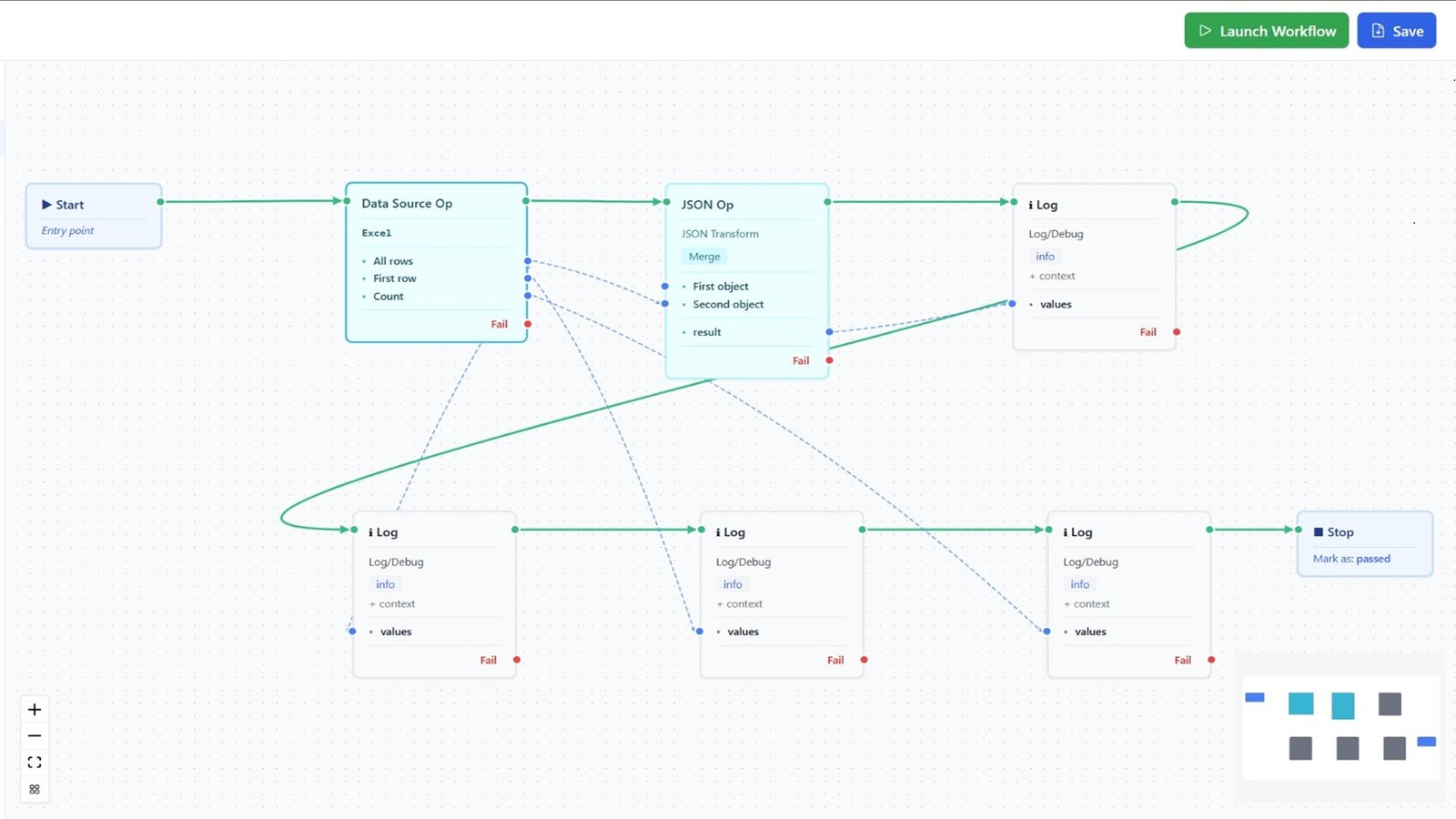
This architecture reflects a mature shift left strategy. Teams starting out implement Stages 1-4 first, then add Stages 5-6 as their automation maturity grows. Each stage adds quality coverage and reduces the defect escape rate incrementally. For a step-by-step walkthrough of building each stage, see How to Build a CI/CD Testing Pipeline.
Tools and Technology Stack
| Layer | Recommended Tools | Purpose |
|---|---|---|
| Unit Testing | Jest, JUnit, PyTest, Mocha, NUnit | Function and component testing |
| API Test Generation | Shift-Left API | Auto-generate from OpenAPI/Swagger specs |
| API Test Execution | Shift-Left API, REST Assured, Karate | Execute and validate API behavior |
| Contract Testing | Pact, Spring Cloud Contract | Consumer-driven interface validation |
| Static Analysis | SonarQube, ESLint, Checkmarx, Semgrep | Code quality and security scanning |
| Mock Servers | WireMock, MockServer, Shift-Left API | Dependency isolation for early testing |
| End-to-End Testing | Playwright, Cypress, Selenium | Full user journey validation |
| Performance Testing | k6, Gatling, JMeter | Load and performance validation |
| CI/CD Orchestration | GitHub Actions, GitLab CI, Jenkins, CircleCI | Pipeline execution and gate enforcement |
| Secret Scanning | git-secrets, TruffleHog, GitHub Secret Scanning | Prevent credential exposure |
| Dependency Scanning | Snyk, Dependabot, OWASP Dependency-Check | Third-party vulnerability detection |
| Canary/Progressive Delivery | Argo Rollouts, Flagger, Spinnaker | Controlled production rollouts |
| Production Monitoring | Datadog, New Relic, Prometheus + Grafana | Production observability |
| Test Reporting | Allure, TestRail, Shift-Left API Analytics | Unified quality visibility |
The Role of Shift-Left API in the Strategy
Shift-Left API addresses the API testing layer comprehensively, which is typically the most critical and hardest-to-cover layer for microservices teams. The workflow integrates directly into the pipeline architecture above:
- API specifications (OpenAPI/Swagger) are imported into Shift-Left API
- The platform generates comprehensive test suites automatically — all endpoints, methods, parameters, and response codes
- Tests are configured to run in CI/CD pipelines at the pull request stage
- Mock server capabilities enable testing against API simulations for services not yet implemented
- Analytics dashboards provide visibility into test results, coverage trends, and API health
This eliminates the manual test authoring burden that typically prevents API testing from being comprehensive, and ensures tests remain synchronized with the API specification as it evolves.
Step-by-Step Implementation Example
Phase 0: Establish Baseline (Week 1)
Before implementing any changes, document the current state:
- Production incident count over the last 3 months (by root cause category)
- Average defect detection time (from introduction to discovery)
- Current release frequency and average time from code complete to production
- Current test coverage percentage (if tracked)
- Engineering hours spent on manual QA and defect remediation (estimate from retrospectives)
This baseline is the foundation for demonstrating ROI after implementation.
Phase 1: Foundation (Weeks 2-4)
Step 1: Implement static analysis. Configure SonarQube or ESLint as a CI check on every pull request. Set a baseline for existing code quality and define thresholds for new code. This is the fastest, lowest-effort shift left implementation with immediate defect prevention value.
Step 2: Establish unit testing standards. Define minimum coverage thresholds for business logic (start achievably — 60-70% — and increase over time). Create a pull request template that includes a testing checklist. Configure coverage reporting in CI.
Step 3: Generate API tests from OpenAPI specs. Import all API specifications into Shift-Left API. Within hours, you have test suites for every endpoint. Configure these tests to run on every pull request. This single step is often the highest-ROI shift left action for microservices teams.
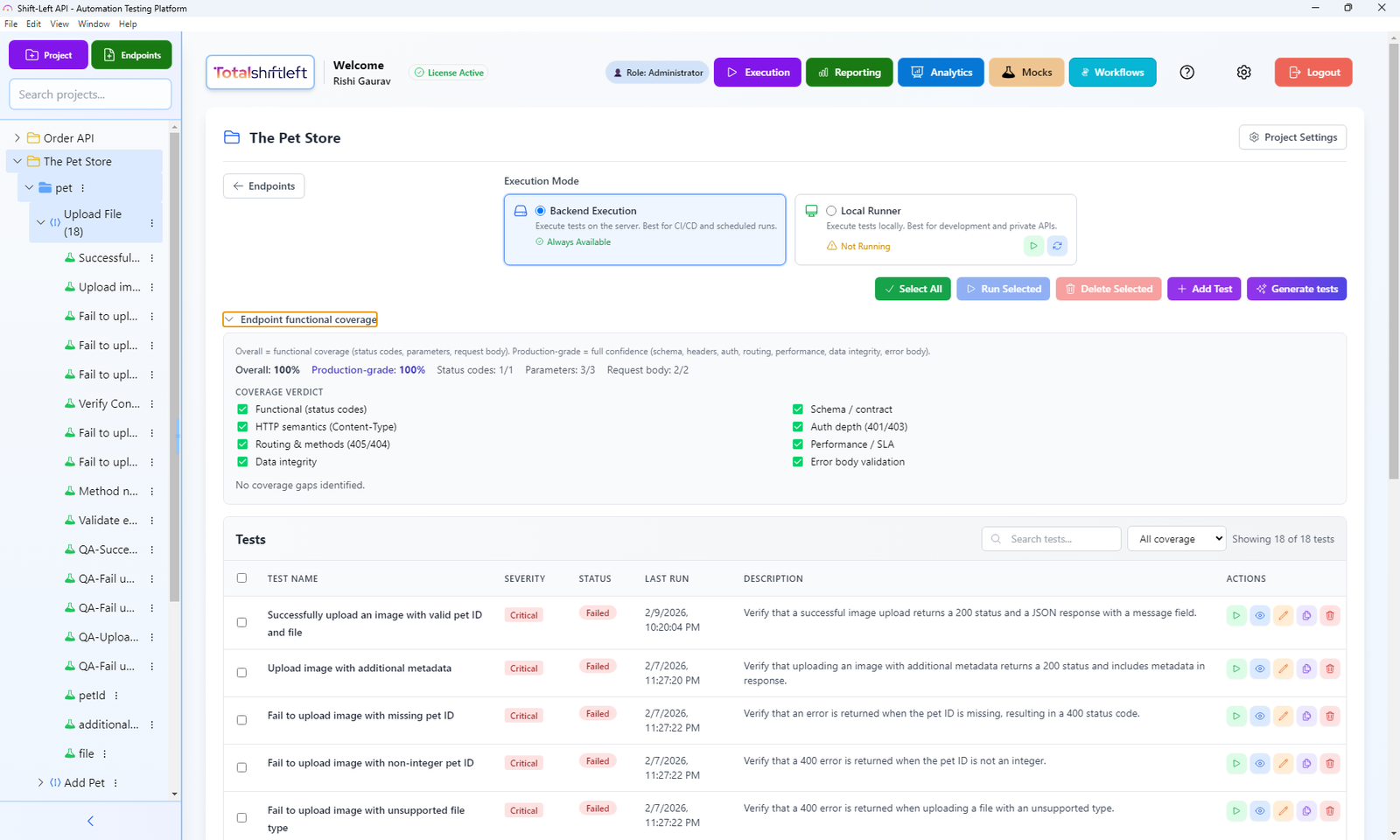
The test execution view in Shift-Left API shows test results in real time — pass/fail status for each endpoint, request/response details, and error diagnostics. This visibility is available immediately, without any custom infrastructure.
Step 4: Enforce pull request quality gates. Configure your CI/CD platform (GitHub Actions, GitLab CI, Jenkins) to block pull request merges when:
- Static analysis finds critical issues
- Unit tests fail
- API tests fail
- Code coverage falls below threshold
This is the step that transforms testing from advisory to mandatory.
Phase 2: Integration Layer (Weeks 5-8)
Step 5: Add mock server infrastructure. Configure mock servers for the most common external and inter-service dependencies. Shift-Left API's mock capabilities can handle many API mocking scenarios directly. For more complex scenarios, add WireMock configurations.
Step 6: Implement integration tests. With mock servers in place, add integration tests that verify service interactions in CI. Start with the highest-risk integration paths — authentication flows, payment processing, data persistence.
Step 7: Begin contract testing. Identify the 3-5 most critical inter-service interfaces where a breaking change would cause the most damage. Implement consumer-driven contract tests using Pact for these interfaces. Integrate contract test verification into the CI pipeline as a deployment gate.
Step 8: Containerize test environments. Replace shared or manual test environment setup with Docker Compose or Kubernetes-based ephemeral environments. Each CI run should provision its own isolated environment, eliminating configuration drift and environment contention.
Free PDF (10 pages)
Shift Left Testing Playbook
Move testing earlier in your SDLC with a proven adoption roadmap. Includes CI/CD architecture, tool stack recommendations, and metrics to track success.
Download FreePhase 3: Advanced Quality (Weeks 9-12)
Step 9: End-to-end test suite. Build a smoke test suite covering the 5-10 most critical user journeys. Run this suite on every staging deployment. Expand to a full regression suite over time as coverage grows.
Step 10: Security testing integration. Add SAST scanning (e.g., Semgrep, Checkmarx) and dependency vulnerability scanning (Snyk, Dependabot) to the pipeline. Define policies for critical severity findings (must block) vs. moderate findings (must triage within X days).
Step 11: Performance baseline testing. Run k6 or Gatling performance tests against staging on every release. Establish baseline performance metrics and alert when new releases regress beyond defined thresholds.
Step 12: Analytics and reporting. Configure unified test reporting across all layers. Track defect escape rate, pipeline duration trends, coverage trends, and defect discovery by stage. Review these metrics in every engineering retrospective.
Measuring Results Against Baseline
After completing Phase 3 (approximately 3 months in), compare against the Week 1 baseline:
- Has the production incident rate decreased? By how much?
- Has defect detection time improved?
- Has release frequency increased?
- How has engineering time spent on rework changed?
- What is the current defect escape rate?
These comparisons provide concrete ROI evidence and define the starting point for the next maturity phase.
Common Strategy Execution Challenges
Challenge: Strategy Remains on Paper
Problem: A testing strategy document exists but is not implemented — teams continue their existing practices, and the strategy has no enforcement mechanism.
Solution: Implementation requires pipeline changes, not documents. Configure quality gates in CI/CD before publishing the strategy document. The gates enforce the strategy automatically, regardless of whether teams remember to follow it.
Challenge: Inconsistent Adoption Across Teams
Problem: Some teams adopt the strategy enthusiastically; others pay lip service. The result is inconsistent quality across the organization.
Solution: Define quality standards as platform-level requirements, not team-level suggestions. Enforce common CI/CD pipelines with built-in quality gates that apply to all teams. This removes the option to opt out.
Challenge: Strategy Does Not Evolve with the Codebase
Problem: The strategy defined 12 months ago no longer fits the current architecture — new services lack test coverage, new tooling has emerged, and old quality gates are no longer relevant.
Solution: Treat the quality strategy as a living document with a defined review cadence (quarterly). Assign ownership to a QA architect or engineering lead. Include strategy review as part of quarterly engineering planning.
Challenge: Test Suite Performance Degradation
Problem: As the test suite grows, pipeline duration increases from minutes to tens of minutes. Developers begin to skip running tests locally or ignore slow CI runs.
Solution: Test performance is a first-class quality concern. Audit test suite duration quarterly. Parallelize test execution. Use test impact analysis (run only tests affected by changed code). Separate fast tests (run every commit) from slow tests (run on merge or nightly). Set pipeline duration SLOs: commit stage under 5 minutes, PR stage under 15 minutes.
Best Practices for Strategy Execution
- Lead with pipeline implementation, not documentation. The most effective way to establish a shift left testing strategy is to configure it in the CI/CD pipeline. Gates enforce behavior automatically.
- Generate API tests from OpenAPI specs immediately. This is the highest-ROI first step for microservices teams and requires minimal effort with tools like Shift-Left API. See our best shift left testing tools guide for a full comparison.
- Start with the most critical paths. Begin contract testing, end-to-end testing, and performance testing on the highest-risk, highest-business-value flows first. Coverage can expand incrementally. For common obstacles, see shift left testing challenges and their solutions.
- Make quality standards visible and measurable. Dashboards showing coverage trends, defect escape rates, and pipeline health make quality tangible and drive team engagement.
- Review metrics in every engineering retrospective. Quality is a team concern. Making quality metrics part of retrospective agendas drives continuous improvement and shared accountability.
- Treat test code with the same standards as production code. Require code review for test changes, enforce testing standards in the test code itself (no magic numbers, clear assertions, descriptive names), and track test code quality.
- Automate environment provisioning. Manual test environment management is the biggest bottleneck in shift left adoption. Every test environment should be defined as code and provisioned automatically.
- Evolve the strategy based on data. When a class of defect repeatedly escapes the pipeline, add a testing layer that catches it. When a testing layer consistently produces zero findings, investigate whether it is still needed or needs different scenarios.
- Celebrate quality wins publicly. When shift left testing catches a bug that would have been a production incident, make it visible. These moments build culture and justify continued investment.
- Measure speed alongside coverage. A comprehensive test suite that takes an hour to run will be bypassed. Coverage and speed are equally important quality infrastructure concerns.
Shift Left Strategy Implementation Checklist
- ✔ Testing pyramid defined with specific test types assigned to each CI/CD stage
- ✔ API tests generated from OpenAPI/Swagger specifications and integrated into CI
- ✔ Unit tests run on every pull request with coverage threshold enforced
- ✔ Static analysis and security scanning integrated at commit/PR stage
- ✔ Contract tests implemented for all critical inter-service interfaces
- ✔ Mock server infrastructure in place for CI test isolation
- ✔ Quality gates configured to block pipeline progression on test failure
- ✔ Quality metrics (defect escape rate, pipeline duration, coverage) tracked and reviewed quarterly
See also: contract testing in our learn hub for the underlying concept.
Move one check at a time, and prove each move
A shift-left strategy is a sequence of moves, each one taking a specific check from a later stage to an earlier one. Start with the check that fails most often and costs most to discover late:
# stage 0 — where the checks are today (everything after merge)
# stage 1 — move the two cheapest checks to pre-commit
# .pre-commit-config.yaml
repos:
  - repo: local
    hooks:
      - id: spec-lint
        name: API spec lint
        entry: npx @stoplight/spectral-cli lint openapi.yaml --fail-severity error
        language: system
        files: ^openapi\.yaml$
        pass_filenames: false
      - id: unit
        name: Unit tests for changed modules
        entry: pytest tests/unit -q -x
        language: system
        types: [python]
Then measure the move. If the check is not failing earlier than it used to, the strategy has produced work rather than feedback:
-- where each class of failure is first detected, month over month
SELECT date_trunc('month', detected_at) AS month,
       check_name,
       stage,                                   -- precommit | pr | staging | production
       count(*) AS failures
FROM quality_events
WHERE detected_at > now() - interval '6 months'
GROUP BY 1, 2, 3
ORDER BY 1, 2,
         array_position(ARRAY['precommit','pr','staging','production'], stage);
-- a working shift-left programme moves the mass of each check's rows upward
Frequently asked questions about shift-left testing strategy
What is a shift left testing strategy?
A shift left testing strategy is a deliberate, organization-wide plan for embedding quality activities earlier in the software development lifecycle. It defines which testing types occur at which pipeline stages, who owns each testing layer, which tools support the strategy, and how success is measured. It goes beyond individual testing practices to create a cohesive system for continuous quality assurance.
How do you build a shift left testing strategy step by step?
Building a shift left testing strategy involves: (1) establishing a baseline by measuring current defect discovery rates and pipeline metrics, (2) defining the testing pyramid and assigning testing types to pipeline stages, (3) implementing CI/CD quality gates, (4) generating API tests from OpenAPI/Swagger specifications, (5) adding contract testing for microservice interfaces, (6) establishing team ownership and quality standards, and (7) measuring ROI through defect escape rate and release velocity improvements.
What does a shift left testing strategy include?
A complete shift left testing strategy includes: a defined testing pyramid (unit, integration, API, contract, end-to-end), CI/CD pipeline stages with quality gates, tool selection for each testing layer, team ownership and responsibility definitions, quality standards and coverage thresholds, metrics for measuring strategy effectiveness, and a maturity roadmap for continuous improvement.
How long does it take to implement a shift left testing strategy?
Basic shift left testing capabilities (unit testing, API test automation from specs, CI quality gates) can be implemented within 4-8 weeks for most teams. Full strategy maturity — including contract testing, comprehensive coverage, optimized pipelines, and cultural integration — typically takes 3-6 months. The benefits begin accruing immediately as each layer is implemented, not just after full maturity is reached.
Sources and further reading
- DORA State of DevOps research — the multi-year dataset behind the four delivery metrics.
- Martin Fowler — The Practical Test Pyramid — the reference argument for test-layer proportions.
- NIST SP 800-218 (SSDF) — the secure software development practices auditors map to.
Key takeaways
- A shift left testing strategy is the architecture of software quality.
- Like any architecture, it requires deliberate design, incremental implementation, and ongoing refinement.
- The teams that build this architecture deliberately — with defined testing layers, enforced quality gates, clear ownership, and continuous measurement — consistently outperform those that treat testing as an afterthought or a collection of disconnected tools.
The implementation path laid out in this guide is proven. Start with the foundation: static analysis, unit testing, and API test generation from your OpenAPI/Swagger specifications. Enforce quality gates in your CI/CD pipeline. Add integration, contract, and end-to-end testing as your maturity grows. Measure against your baseline and use data to guide each improvement cycle. The investment compounds over time, producing a quality system that makes faster delivery and higher reliability mutually reinforcing rather than mutually exclusive. For broader context on how this strategy fits within a DevOps testing strategy, see our dedicated guide. Shift-Left API accelerates the API testing layer of this strategy — import your specs, generate comprehensive tests, and integrate them into your pipeline in hours. Start your free trial today.
Related: What Is Shift Left Testing? Complete Guide | Shift Left vs Shift Right Testing | API Testing Strategy for Microservices | How to Build a CI/CD Testing Pipeline | DevOps Testing Strategy | Best Shift Left Testing Tools | Benefits of Shift Left Testing | API Testing in CI/CD | API Test Coverage | No-code API testing platform | Start Free Trial
Ready to shift left with your API testing?
Try our no-code API test automation platform free.