
Distributed Tracing for Microservices Explained
Quick answer
Distributed tracing tracks a single request as it flows through multiple microservices, linking each service's "span" of work to a shared trace ID so engineers can see exactly where time was spent and where failures occurred. OpenTelemetry is the vendor-neutral instrumentation standard, the W3C Trace Context header (traceparent) propagates trace identity across service boundaries, and tail-based sampling in tools like Jaeger retains 100% of error and slow traces while sampling normal traffic.
Reviewed by Parveen Kumari

Distributed tracing is the practice of tracking a single request as it flows through multiple microservices, creating a complete timeline of every service interaction, database query, and external API call. It uses trace IDs and span hierarchies to connect operations across service boundaries, enabling engineers to diagnose latency bottlenecks and failures in distributed systems.
A 2025 CNCF survey found that 78% of organizations running microservices in production identified cross-service debugging as their number one operational challenge. The reason is fundamental: when a single user request touches 10-20 services, and something goes wrong, finding the root cause without distributed tracing is like debugging a program without a stack trace.
In a monolithic application, a stack trace shows you exactly which function calls led to an error. In a microservices architecture, there is no equivalent—unless you implement distributed tracing. Each service has its own logs, its own metrics, and its own error tracking. Without a mechanism to connect these isolated data points into a coherent story, debugging requires manually correlating timestamps across dozens of log streams.
This guide provides a complete walkthrough of distributed tracing for microservices: the concepts, the standards, the tools, and the practical implementation patterns that make it work in production. Whether you are building a new microservices testing strategy or improving observability for an existing system, distributed tracing is the foundational capability you need.
In this guide
- What Is Distributed Tracing?
- Why Distributed Tracing Matters for Microservices
- Core Concepts and Components
- Trace Context Propagation
- Architecture of a Distributed Tracing System
- Tools for Distributed Tracing
- Real-World Example: Payment Processing Pipeline
- Distributed tracing challenges and how to solve them
- Best Practices for Implementation
- Distributed Tracing Implementation Checklist
- A trace, from the header to the assertion
- Distributed tracing FAQ
What Is Distributed Tracing?
Distributed tracing is a method for tracking the lifecycle of a request as it propagates through a distributed system. When a user makes a request—loading a product page, submitting an order, processing a payment—that request may be handled by a dozen services, each performing a specific function.
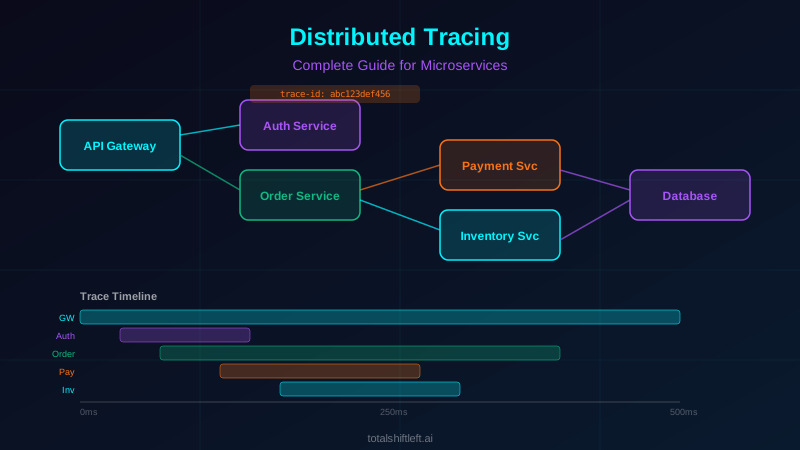
A distributed trace captures this entire journey as a tree of operations called spans. The root span represents the initial request. Each downstream service call creates a child span. The parent-child relationship between spans mirrors the actual call graph of the request.
Each span records four critical pieces of information: the service name, the operation being performed (HTTP request, database query, message publish), the start and end timestamps, and the outcome (success, error, timeout). Together, the spans in a trace create a complete timeline that shows exactly what happened, in what order, and how long each step took.
The trace is identified by a globally unique trace ID that propagates from service to service via HTTP headers or message metadata. Every service that participates in the request includes this trace ID in its spans, enabling the tracing backend to reconstruct the full request path from independently submitted span data.
Why Distributed Tracing Matters for Microservices
Cross-Service Visibility
Microservices decompose a single application into independently deployed services. This improves development velocity and deployment flexibility but creates a visibility gap. No single team owns the entire request path. Distributed tracing provides the cross-service visibility that reconnects these isolated services into a coherent view.
Latency Diagnosis
In a monolith, profiling tools show exactly where time is spent. In microservices, latency can accumulate across multiple services, network hops, and serialization boundaries. A request that takes 800ms might spend 200ms in the API gateway, 50ms in auth, 300ms in the product service, and 250ms in the recommendation engine—with most of that time being database queries. Distributed tracing reveals this breakdown instantly.
Dependency Mapping
Service dependency graphs evolve over time. Teams add new services, introduce new inter-service calls, and create unexpected dependency chains. Distributed tracing produces accurate, real-time dependency maps derived from actual production traffic rather than outdated architecture diagrams. This is critical for understanding blast radius during incidents and for planning API testing strategies.
Error Propagation Tracking
When an error occurs deep in a service chain, the upstream services often mask the original error with generic 500 responses. Distributed tracing preserves the original error context: which service failed, what error was thrown, and how that error propagated through the call chain. This eliminates the need to check logs in every service to find the origin of an error.
Core Concepts and Components
Traces
A trace represents the complete end-to-end journey of a single request through the distributed system. It is a directed acyclic graph (DAG) of spans, rooted at the initial request entry point. The trace is identified by a 128-bit trace ID that is globally unique.
Spans
A span is a named, timed operation within a trace. Each span has a span ID, a parent span ID (except for the root span), a service name, an operation name, start and end timestamps, status (OK, ERROR), and optional attributes (key-value pairs with contextual data).
Spans model the actual work performed by each service: handling an HTTP request, executing a database query, publishing a message, calling a downstream service. The span hierarchy mirrors the call graph.
Span Context
The span context is the minimal set of data that must be propagated across service boundaries to maintain trace continuity. It includes the trace ID and the current span ID. When Service A calls Service B, it injects the span context into the outgoing request. Service B extracts the context and creates a new span that references Service A's span as its parent.
Span Attributes and Events
Attributes are key-value pairs attached to spans that provide context: http.method=GET, http.status_code=200, db.statement=SELECT..., user.tier=enterprise. Events are timestamped annotations within a span that mark significant occurrences: cache_miss, retry_attempt, circuit_breaker_open.
Baggage
Baggage is application-specific data that propagates through the entire trace, accessible by every downstream service. Unlike span attributes (which are local to a span), baggage travels across service boundaries. Common uses include propagating user IDs, feature flag states, or A/B test group assignments. Use baggage sparingly—every item adds overhead to every request.
Sampling
Not every request needs to be traced. Sampling strategies control which requests generate traces. Head-based sampling makes the decision at the trace root (simple but may miss interesting traces). Tail-based sampling makes the decision after the trace completes (captures all errors and slow traces but requires buffering). Adaptive sampling adjusts rates based on traffic patterns.
Trace Context Propagation
Trace context propagation is the mechanism that makes distributed tracing work across service boundaries. Without it, each service would create isolated spans with no connection to the broader request flow.
The W3C Trace Context standard defines two HTTP headers for propagation: traceparent (containing the trace ID, parent span ID, and trace flags) and tracestate (containing vendor-specific state). This standard ensures interoperability between different tracing implementations.
Ready to shift left with your API testing?
Try our no-code API test automation platform free. Generate tests from OpenAPI, run in CI/CD, and scale quality.
When Service A makes an HTTP call to Service B, the tracing library in Service A serializes the current span context into the traceparent header. Service B's tracing library extracts this header, deserializes the context, and creates a new span that is a child of Service A's span. This happens automatically with OpenTelemetry auto-instrumentation.
Propagation is not limited to HTTP. Message queues (Kafka, RabbitMQ) carry trace context in message headers. gRPC uses metadata. The principle is the same: inject context at the producer, extract context at the consumer.
The critical implementation detail is ensuring that context propagation covers every service boundary. A single service that does not propagate context breaks the trace—all downstream spans become orphaned root spans in separate traces. This is the most common distributed tracing implementation failure and requires systematic testing across all service integration points. Exercising those hops as multi-step integration test workflows is an effective way to confirm context survives every boundary before code ships.
Architecture of a Distributed Tracing System
A production distributed tracing system has four layers: instrumentation, collection, storage, and visualization.
The instrumentation layer runs within each service. OpenTelemetry SDKs provide the API for creating spans, recording attributes, a
nd propagating context. Auto-instrumentation libraries handle common frameworks automatically—HTTP servers, HTTP clients, database drivers, message clients. Manual instrumentation adds business-specific spans for operations that auto-instrumentation does not cover.
The collection layer sits between services and the storage backend. The OpenTelemetry Collector is the standard component here. It receives spans from services (via OTLP protocol), processes them (batching, filtering, sampling, attribute enrichment), and exports them to one or more backends. The Collector decouples services from specific backends, enabling backend migration without application changes.
The storage layer persists trace data for querying. Jaeger supports Elasticsearch, Cassandra, and Kafka-based backends. Grafana Tempo uses object storage (S3, GCS) for cost-effective trace retention. The storage choice depends on query patterns, retention requirements, and scale. Most organizations retain detailed traces for 7-14 days and sampled traces for 30-90 days.
The visualization layer provides the interface for querying and analyzing traces. Jaeger UI and Grafana Explore provide trace search, trace detail views (Gantt charts showing span timing), service dependency graphs, and comparison tools. Engineers use this layer during incident response to find the traces associated with errors or latency anomalies.
Tools for Distributed Tracing
| Tool | Type | Best For | Open Source |
|---|---|---|---|
| OpenTelemetry | Instrumentation SDK | Vendor-neutral trace instrumentation | Yes |
| Jaeger | Trace Backend | Production-scale trace storage and analysis | Yes |
| Zipkin | Trace Backend | Simple deployments and quick prototyping | Yes |
| Grafana Tempo | Trace Backend | Cost-effective storage with Grafana integration | Yes |
| AWS X-Ray | Cloud Tracing | AWS-native distributed tracing | No |
| Datadog APM | Full Platform | Unified tracing with metrics and logs | No |
| Lightstep | Trace Analysis | High-cardinality trace analysis at scale | No |
| Honeycomb | Observability | Event-based trace exploration and analysis | No |
| SigNoz | Full Platform | Open-source alternative to Datadog | Yes |
| Dynatrace | Full Platform | AI-powered root cause analysis | No |
When selecting tools, consider how tracing integrates with your broader testing and observability strategy. The instrumentation layer (OpenTelemetry) should be decoupled from the backend choice to preserve flexibility.
Real-World Example: Payment Processing Pipeline
Problem: A fintech company processing 50,000 transactions per hour experienced intermittent payment failures affecting 0.3% of transactions. Monitoring showed elevated error rates in the payment gateway service, but the errors were generic timeout exceptions. The team spent an average of 4 hours per incident manually correlating logs across 8 services involved in payment processing to identify the root cause.
Solution: The team instrumented all 8 payment pipeline services with OpenTelemetry, deployed Jaeger as the trace backend, and ensured W3C Trace Context propagation across all HTTP and Kafka boundaries. They added custom span attributes for business context: payment method, transaction amount range, merchant category, and customer region.
They also implemented tail-based sampling to retain 100% of error traces and 100% of traces with latency above the p95 threshold, while sampling only 5% of successful, normal-latency traces.
Results: On the next incident, the team queried Jaeger for traces with error status in the payment gateway. Within 3 minutes, they identified the pattern: all failing transactions involved a specific third-party fraud detection service that was intermittently responding after the 2-second timeout. The trace showed the exact call chain: API Gateway → Payment Service → Fraud Detection (timeout) → Payment Gateway (generic error). The fix was a configuration change to increase the fraud detection timeout and add a circuit breaker. Total diagnosis time dropped from 4 hours to under 10 minutes.
Distributed tracing challenges and how to solve them
Incomplete Trace Context Propagation
Challenge: A single service that does not propagate trace context breaks the trace chain. Downstream spans appear as orphaned root traces, making end-to-end analysis impossible. This commonly happens with custom HTTP clients, async operations, or services written in languages without auto-instrumentation support.
Solution: Implement a propagation verification test in your CI/CD pipeline. For every service-to-service integration, verify that the outgoing request includes the traceparent header with a valid trace ID matching the incoming request. This is a form of contract testing that validates observability contracts alongside API contracts.
High Cardinality Data Explosion
Challenge: Adding too many unique values as span attributes (user IDs, session IDs, full request bodies) creates high-cardinality data that explodes storage costs and slows down queries.
Solution: Be deliberate about which attributes you add. Use low-cardinality attributes for indexing (service name, HTTP method, status code, error type) and reserve high-cardinality attributes for non-indexed fields. Store request/response bodies in logs linked by trace ID rather than as span attributes.
Sampling Bias
Challenge: Head-based sampling randomly discards traces at the entry point. This means some error traces and slow traces are never captured. At 1% sampling, you miss 99% of interesting traces.
Solution: Implement tail-based sampling using the OpenTelemetry Collector's tail sampling processor. Keep 100% of traces with errors, 100% of traces exceeding latency thresholds, and sample normal traces at a lower rate. This ensures you always have complete data for the traces that matter most.
Async and Event-Driven Architectures
Challenge: Trace context propagation is straightforward for synchronous HTTP calls but more complex for async patterns. Message queues, event buses, and scheduled jobs do not automatically carry trace context.
Free Visual blueprint + guide
Microservices Testing Strategy Blueprint
A visual testing strategy for microservices architectures. Covers testing layers, contract testing, service mesh validation, and tool selection.
Download FreeSolution: For message-based communication, inject trace context into message headers at the producer and extract it at the consumer. OpenTelemetry provides instrumentation for Kafka, RabbitMQ, and SQS that handles this automatically. For scheduled jobs triggered by events, create a new trace that references the originating trace as a link rather than a parent.
Multi-Language Service Instrumentation
Challenge: Organizations often have microservices written in different languages (Java, Python, Go, Node.js). Ensuring consistent instrumentation across all languages requires effort.
Solution: OpenTelemetry provides SDKs for all major languages with consistent APIs. Use auto-instrumentation where available (Java Agent, Python auto-instrumentation, Node.js auto-instrumentation) to minimize per-service effort. Standardize on the same span naming conventions and attribute keys across languages through a shared instrumentation guide.
Trace Data Retention Costs
Challenge: Storing every span from every traced request for 30+ days generates significant storage costs, especially at high traffic volumes.
Solution: Implement tiered retention. Store full-fidelity traces for 7-14 days in a hot tier (Elasticsearch, Cassandra) for active debugging. Move aggregated trace summaries to a cold tier (object storage) for 90-day trend analysis. Use Grafana Tempo with S3 backend for cost-effective long-term storage.
Best Practices for Implementation
- Adopt OpenTelemetry as your instrumentation standard across all services and languages
- Use auto-instrumentation as the baseline and add manual instrumentation only for business-critical code paths
- Implement W3C Trace Context propagation across every service boundary, including async messaging
- Deploy the OpenTelemetry Collector as a centralized processing layer between services and the trace backend
- Implement tail-based sampling to retain 100% of error and high-latency traces
- Add business context as span attributes: customer tier, feature flags, transaction type
- Verify trace context propagation in your CI/CD pipeline with automated integration tests
- Name spans consistently across services:
{service}.{operation}(e.g.,payment.processCharge) - Set appropriate trace data retention policies based on debugging needs and cost constraints
- Link traces to logs by including trace ID and span ID in every structured log entry
- Build trace-based SLOs: track the percentage of traces that complete within latency targets
- Create saved trace queries for common investigation patterns to speed up incident response
Distributed Tracing Implementation Checklist
- ✔ OpenTelemetry SDK is installed and configured in every microservice
- ✔ Auto-instrumentation covers HTTP, database, and messaging operations
- ✔ W3C Trace Context headers propagate correctly across all service boundaries
- ✔ Trace context propagates through message queues and async operations
- ✔ A trace backend (Jaeger, Tempo, or commercial) is deployed and receiving spans
- ✔ OpenTelemetry Collector is deployed for centralized span processing
- ✔ Tail-based sampling retains all error and high-latency traces
- ✔ Business context attributes are attached to spans (customer tier, transaction type)
- ✔ Structured logs include trace ID and span ID for cross-pillar correlation
- ✔ Span naming follows a consistent convention across all services
- ✔ Service dependency graph is generated from live trace data
- ✔ Trace context propagation is validated in CI/CD integration tests
- ✔ Data retention policies are configured for cost-effective storage
- ✔ On-call runbooks include trace query templates for common incident types
A trace, from the header to the assertion
A trace is a tree of spans stitched together by one header. This is the whole mechanism — the caller injects, the callee extracts, and the backend reassembles:
traceparent: 00-4bf92f3577b34da6a3ce929d0e0e4736-00f067aa0ba902b7-01
             │  │                                │                │
             │  │                                │                └─ flags (01 = sampled)
             │  │                                └─ parent span id (8 bytes)
             │  └─ trace id (16 bytes, constant for the whole request)
             └─ version
Instrument once at the edge of each service and the ids propagate themselves; then a test can assert on the shape of the trace, not just the response:
# service: extract the incoming context, create a child span, inject on the way out
from opentelemetry import trace
from opentelemetry.propagate import extract, inject

tracer = trace.get_tracer("inventory")

def handle(request):
    ctx = extract(request.headers)                       # continue the caller's trace
    with tracer.start_as_current_span("reserve_stock", context=ctx) as span:
        span.set_attribute("sku", request.json["sku"])
        downstream = {}
        inject(downstream)                               # pass it on
        return call_warehouse(request.json, headers=downstream)
Distributed tracing FAQ
What is distributed tracing in microservices?
Distributed tracing is the practice of tracking a single request as it flows through multiple microservices. Each service creates a "span" representing its work, and all spans are linked by a shared trace ID. This creates a complete timeline showing exactly how the request was processed, how long each service took, and where failures or bottlenecks occurred.
How does OpenTelemetry support distributed tracing?
OpenTelemetry provides vendor-neutral SDKs and APIs for instrumenting applications with distributed tracing. It handles trace context creation, span management, context propagation across service boundaries (via HTTP headers or message metadata), and telemetry export to backends like Jaeger, Zipkin, or commercial platforms. It is the CNCF standard for observability instrumentation.
What is trace context propagation?
Trace context propagation is the mechanism that carries trace identity (trace ID and parent span ID) across service boundaries. When Service A calls Service B, the trace context is injected into the request (typically as HTTP headers using the W3C Trace Context standard). Service B extracts this context and creates child spans linked to the same trace.
How do I choose between Jaeger and Zipkin for distributed tracing?
Jaeger and Zipkin are both open-source distributed tracing backends. Jaeger offers more advanced features including adaptive sampling, a more scalable architecture with Kafka-based ingestion, and native OpenTelemetry support. Zipkin is simpler to deploy and has a smaller operational footprint. Choose Jaeger for production-scale deployments and Zipkin for smaller environments or quick prototyping.
What is the performance overhead of distributed tracing?
Distributed tracing typically adds 1-3% overhead to request latency when properly implemented. The majority of the overhead comes from context serialization and network transmission of spans, not span creation itself. Sampling strategies reduce this further—most production systems trace only 1-10% of requests while retaining 100% of error traces.
How does distributed tracing help with microservices testing?
Distributed tracing reveals the actual runtime behavior of microservices interactions, making it invaluable for testing. It identifies untested code paths, validates that service communication patterns match expectations, surfaces integration issues that unit tests miss, and provides concrete evidence of how services behave under real traffic conditions.
Sources and further reading
- OpenTelemetry documentation — the vendor-neutral tracing, metrics and logs standard.
- W3C Trace Context — the header format that propagates a trace across services.
- Jaeger documentation — the open-source distributed tracing backend.
Key takeaways
- Distributed tracing is not optional for organizations running microservices in production.
- Without it, debugging cross-service failures devolves into time-consuming log correlation exercises that extend MTTR and frustrate engineering teams.
- The path to effective distributed tracing is clear: adopt OpenTelemetry for vendor-neutral instrumentation, ensure trace context propagates across every service boundary (HTTP, messaging, async), deploy a trace backend that supports your scale and query patterns, and implement intelligent sampling that captures the traces you need while controlling costs.
- The investment pays for itself quickly. Teams consistently report 5-10x reductions in incident diagnosis time after implementing distributed tracing.
- That translates directly to reduced downtime, faster resolution, and engineering teams that spend less time firefighting and more time building.
Ready to strengthen your microservices testing and observability? Start your free trial of Total Shift Left and discover how automated API testing combined with observability best practices catches issues before they reach production.
Related Articles: Observability vs Monitoring in DevOps | Debugging Microservices with Distributed Tracing | Logging Strategies for Microservices Testing | API Testing Strategy for Microservices | Contract Testing for Microservices | Best Testing Tools for Microservices
Ready to shift left with your API testing?
Try our no-code API test automation platform free.