
AI API Testing: The Complete Guide for 2026
Quick answer
AI API testing uses AI to author, run, maintain, and triage API test suites end-to-end — the engine reads your OpenAPI/GraphQL spec and generates the test suite instead of a human writing it, then proposes repairs to the suite as the spec changes for a person to approve. It differs from AI-assisted tools (Postman Postbot, editor snippets) in that the AI is the primary author and a human reviews, not the other way around.
Reviewed by Smeet Gohel
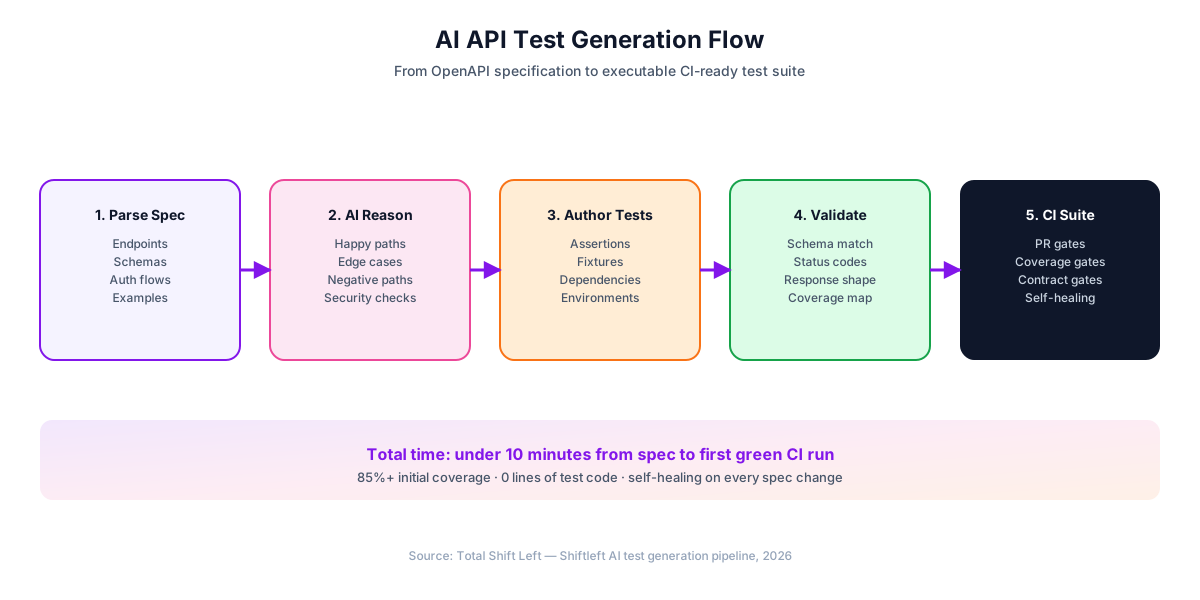
AI API testing has gone from buzzword to operational standard in less than two years. The category — covered in depth in What is Shift Left AI — uses AI to author, run, maintain, and triage API test suites end-to-end. This complete 2026 guide is the reference for engineering leaders evaluating, adopting, or scaling AI API testing. We cover what it is, why it works, how the platforms differ, and the practical playbook for getting it into production. Our own implementation is Shift-Left API; the broader category includes adjacent tools that occupy different parts of the same space.
Whether you are evaluating for a small team or rolling out to hundreds of engineers, the structure is similar: spec hygiene, AI generation, CI/CD integration, self-healing, governance. This guide walks through each.
API testing is one of the highest-leverage forms of automated quality work — APIs are the contracts between services, and a regression in an API breaks every consumer that depends on it. Traditional approaches (REST Assured, Postman + Newman, Karate, ReadyAPI, Katalon) rely on humans to author tests; the cost grows linearly with the number of endpoints, and coverage tends to decay as APIs evolve faster than test maintenance.
AI API testing inverts the labor model. The AI reads the OpenAPI / GraphQL / WSDL contract and generates a complete suite — happy paths, edge cases, negative paths, contract validation, security probes — in minutes. It runs the suite in CI on every commit, proposes repairs when the spec changes, and produces plain-language failure summaries so triage takes seconds instead of half an hour. Engineers move from authoring to reviewing.
The result is a different cost curve. Coverage no longer scales with engineering hours; it scales with spec quality. Maintenance no longer dominates QA work; review and policy do. For the category-level framing see What is Shift Left AI; for the head-to-head against legacy approaches see AI API Automation vs Traditional API Testing.
In this guide
- What Is AI API Testing?
- How the AI Generation Engine Works
- Why AI API testing matters in 2026
- Key Components of an AI API Testing Platform
- AI API testing reference architecture
- AI API testing tools compared
- AI API testing in practice: a worked example
- AI API testing challenges and how to solve them
- AI API testing best practices
- AI API testing checklist
- Generate an API test suite from an OpenAPI spec
- AI API testing FAQ
What Is AI API Testing?
AI API testing is the practice of using AI to perform the four functions that traditionally consumed engineering hours:
Authoring. The AI generates test cases from the API contract — every endpoint, every method, every documented response code, every parameter. Because the generation is driven directly by your OpenAPI or Swagger schema, the output is human-readable and reviewable, not a black-box.
Running. Tests execute in CI on every PR with intelligent retry, dependency ordering, and parallelism. Schema-aware retries (only on infrastructure failures) eliminate most flake.
Maintaining. When the spec changes, the AI rewrites affected tests. Non-breaking changes produce proposed updates a reviewer can accept in one step; breaking changes raise a reviewable diff with consumer impact analysis. The mechanics are detailed in How AI Generates API Tests from OpenAPI and AI API Contract Testing.
Triaging. When a test fails, the AI inspects request, response, schema, and recent changes, and produces a 2–3 sentence root cause plus a suggested fix.
A platform that does all four is in the AI API testing category. A platform that does one or two (snippet suggestions inside an editor, AI-generated assertions in a manual workflow) is AI-assisted, not AI API testing. The distinction matters because the operational impact is dramatically different — see AI vs Codeless API Testing Tools for the category map.
If your data cannot leave the network, self-hosted LLM test generation covers running the same generation step on Ollama or vLLM inside your own boundary.
When part of the system is a model rather than a function, equality assertions stop working — testing non-deterministic AI systems covers the invariants and evals that replace them.
The maintenance half of generated suites is covered separately in how self-healing API tests work.
For the longer view of where this is going, the future of software testing in AI-driven development covers what changes when most code is generated.
If you are being asked to test an MCP server rather than the API behind it, how to test MCP servers has the handshake, tool-schema and injection cases.
For the category where the agent decides what to test rather than executing a script, see agentic QA tools and the four questions worth asking any vendor.
How the AI Generation Engine Works
Under the "authoring" step above, mature engines combine three distinct layers rather than a single model call:
Semantic understanding (LLM layer). A large language model reads endpoint names, descriptions, and example payloads to infer intent — distinguishing POST /orders (create) from POST /orders/:id/cancel (state transition) and generating semantically coherent test data rather than random bytes.
Symbolic property and boundary reasoning. Where the LLM layer excels at semantics, a symbolic engine excels at type reasoning: it reads JSON Schema constraints (minimum, maximum, pattern, enum) and generates boundary-covering cases — smallest valid integer, largest valid string, regex-breaking input, empty array. Property-based tools like Schemathesis pioneered this approach standalone; AI-first platforms integrate it inline with the semantic layer.
Learned assertion inference. Rather than hard-coding "expect 200," the engine infers assertion strength from schema, examples, and observed responses. Required fields become existence assertions; format: date-time becomes parsing; enums become membership checks.
The three layers run in parallel over the ingested spec and produce a candidate test set covering positive paths, negative paths, boundaries, and stateful sequences (create → read → delete, chained with IDs propagated between steps). Each generated test is tagged with a rationale and the spec hash it was generated from, so the test set stays diffable and reviewable rather than becoming a black box.
Why AI API testing matters in 2026
Three forces have made 2026 the year AI API testing became operational standard.
The cost of manual authoring is no longer sustainable. Teams with hundreds of endpoints cannot keep up with daily spec changes through hand-authored tests. Coverage decays; regressions slip; postmortems blame "lack of test coverage" without naming the underlying labor problem. AI changes the cost curve so coverage and velocity stop competing.
CI-native runners are now the bar. Quality gating has moved entirely into CI/CD. Tools designed before this transition — Postman + Newman, codeless platforms with plugin shims — work but are fragile. CI-native platforms like Shift-Left API eliminate brittleness and make per-PR gating reliable. The pipeline-level integration is in Shift-Left API for CI/CD Pipelines.
Engineering leadership needs continuous quality metrics, not quarterly reports. AI API testing platforms produce continuous coverage, contract, and triage metrics that flow into engineering dashboards. Quality becomes a velocity input rather than a quarterly status update.
The result is that mid-2026 AI API testing has crossed from early adopter to mainstream. The platforms are mature, the playbooks are documented, and the operational impact is measurable.
Ready to shift left with your API testing?
Try our no-code API test automation platform free. Generate tests from OpenAPI, run in CI/CD, and scale quality.
Key Components of an AI API Testing Platform
A complete platform exposes six components. The shorthand from the Shift Left AI category guide applies here directly.
1. Spec ingestion. OpenAPI 3.x, Swagger 2.0, GraphQL SDL, Postman collections, and live-traffic discovery. The platform should treat every input format as first-class.
Requirements belong on that list too. Shift-Left API can generate from an OpenAPI, WSDL or GraphQL spec and from business or requirement documents (user stories can come from Jira, Azure DevOps, Gherkin or plain text), so each test traces back to the requirement it checks. Generation applies boundary values, equivalence classes, decision tables and authentication depth per endpoint, attaches a business-impact severity to each potential issue, and can cover a feature or a whole project in one pass, reporting what it created, updated or skipped and why.
2. AI test author. Generates happy paths, edge cases, negative paths, contract validations, and parameterized variants. Quality depends on spec quality. Detailed in How AI Generates API Tests from OpenAPI.
3. Self-healing engine. Classifies spec changes (additive vs breaking), proposes rewrites of affected tests for a person to accept, surfaces diffs. The operational unlock for sustainable maintenance.
4. CI-native runner. Runs suite as a pipeline step; reports coverage, contract, and assertion results to PR check. Native plugins for major CI platforms.
5. AI triage. Produces plain-language failure summaries and suggested fixes from request, response, schema, and change context. In Shift-Left API this now works at run level: a failed run is grouped into a few causes, each labelled test defect, data issue, environment problem or suspected product bug, and every test sharing a cause can be fixed in one step. Green runs are examined as well, for tests that would not notice a regression. Fixes are proposals with cited evidence — nothing changes until a person accepts.
6. Governance. Coverage thresholds, breaking-change policy, consumer registry, deprecation tracking, audit logs, RBAC.
A platform missing any of these is partial. Shift-Left API ships all six. Adjacent tools and how they compare are in Postman vs Shift-Left API and AI vs Codeless API Testing Tools.
AI API testing reference architecture
The canonical AI API testing deployment looks like this.
The OpenAPI spec lives in the same repository as the service. CI runs on every PR. A pipeline step invokes Shift-Left API, which pulls the spec, refreshes the suite, runs tests against the PR's preview environment, and posts the result as a status check. The contract gate, coverage gate, and assertion gate all run in the same step.
Spec changes flow through the self-healing engine. Additive changes produce proposed test updates for a reviewer to accept; breaking changes raise diffs with consumer impact analysis. The dashboard surfaces gaps, drift events, and triage queue items for QA and engineering leads.
Failure data flows back into the AI triage layer. When a test fails, the platform inspects the failure context and produces an RCA that posts to the PR. Engineers fix or override; the override is logged for governance.
Production observability connects via webhook — failure rates, latency, contract violations from real traffic feed back into the platform to refine generation. The detailed flow is in Automate API Regression with AI.
AI API testing tools compared
The 2026 platform landscape divides into three tiers.
Tier 1 — AI API testing platforms. Spec-driven generation, self-healing, CI-native runner, AI triage, governance. Shift-Left API is one example. Multi-protocol coverage spans REST, GraphQL, and SOAP through one engine. The detailed comparison vs Postman is in Postman vs Shift-Left API.
Tier 2 — AI-assisted tools. Postman + Postbot, ReadyAPI with AI snippets, codeless platforms with AI-generated assertions. These compress per-test authoring time but do not change the labor model. Useful for exploration; do not replace AI API testing for automation. See AI vs Codeless API Testing Tools.
Tier 3 — Code-based and codeless platforms. REST Assured, Karate, supertest, Katalon, ACCELQ. Mature, flexible, niche. Their cost structure makes them uncompetitive for most teams running APIs at scale.
Most engineering organizations end up with a Tier 1 platform as the automation engine and one Tier 2 or Tier 3 tool for exploration and design. The decision framework is in Postman vs Shift-Left API.
What each tool actually automates, and what it still leaves to you:
| Tool | What the AI does | Input it needs | Runs in CI | Open source | Best for |
|---|---|---|---|---|---|
| Schemathesis | Derives positive, negative and boundary cases from the schema | OpenAPI / GraphQL | Yes | Yes | The free baseline every other tool has to beat |
| Shift-Left API | Generates the suite from the spec and requirement documents, re-generates it as the spec changes, tracks coverage, explains failed runs as causes | OpenAPI, WSDL, GraphQL, requirement documents | Yes | No | Teams that want the suite maintained, not just generated |
| Postman (Postbot) | Suggests assertions and test scripts inside a collection | Saved requests | Via Newman | No | Teams already living in collections |
| Keploy | Records real traffic and converts it into test cases and mocks | Live traffic | Yes | Yes | APIs with no spec but plenty of traffic |
| Akto | Generates security test cases per endpoint from discovered traffic | Traffic / spec | Yes | Partly | API security coverage specifically |
| Coding assistants in the IDE | Draft test code a human reviews and owns | Your source code | No | No | Speeding up hand-written suites, not replacing them |
The dividing line worth noticing: the tools in the top half produce a suite you never edit, the ones in the bottom half produce a first draft you maintain forever.
AI API testing in practice: a worked example
A B2B SaaS engineering team with 12 microservices and ~400 endpoints had hit coverage decay with their existing Postman + Newman setup.
Starting state. ~1,500 manual collection tests, 48% coverage, 3.5 day regression cycle, 6 production API incidents in the prior year. QA team of 4 spent ~60% of their time maintaining collections.
Adoption. They onboarded the most painful service (a billing API with frequent spec changes) to Shift-Left API in week 1. CI integration via the GitHub Actions plugin landed in week 2. By week 6 all 12 services were live.
90-day result. Coverage 89%, regression cycle 8 minutes (per-PR), most spec changes absorbed through self-healing proposals the team reviewed and accepted, AI triage cutting failure debug from 25 minutes to 4. The team retired their Newman setup in week 8.
12-month result. Production API incidents dropped from 6 to 1. Coverage held above 88% as the API surface grew 28%. QA reallocated to security testing and accessibility. Total annual API testing labor decreased from ~5,800 to ~2,000 hours.
This pattern repeats across teams adopting AI API testing in 2026. For more comparative data see AI API Automation vs Traditional API Testing.
AI API testing challenges and how to solve them
Free PDF + code examples
OpenAPI to Test Generation Template Pack
Go from OpenAPI spec to full test coverage. Includes sample specs, example generated tests, edge case patterns, and CI/CD integration guides.
Download FreeFive challenges show up most often during adoption.
Spec drift on day one. First-run AI generation usually exposes that the OpenAPI spec doesn't match implementation. Most teams treat the resulting cleanup as a bonus (better documentation), not a blocker.
Auth complexity. OAuth2, mTLS, JWT rotation, custom auth — these are the most common reasons a service fails to onboard quickly. Configure auth per environment in the platform dashboard before generating tests.
Coverage threshold tuning. Set too high (95%+) on day one, the gate becomes obstructive. Start at 80%, hold for two weeks, ratchet to 90%+.
Breaking-change governance. Teams that haven't formalized which APIs are stable hit friction during rollout. Decide externally-consumed vs internal-only services early.
Mixing with E2E. AI excels at API-level coverage but does not replace cross-service end-to-end flows. Plan for a small E2E suite alongside. In Shift-Left API those flows can be built from approved use-case requirements, with each step's data wired to the earlier step that produces it; if a step has no test yet, the product names it and can generate the missing tests when you accept.
The deeper rollout playbook is in Automate API Regression with AI.
AI API testing best practices
Five practices distinguish high-leverage adopters.
1. Treat the spec as code. Lint, version, review in PRs. Spec quality determines test quality. See How AI Generates API Tests from OpenAPI.
2. Onboard service-by-service. Pick the most painful service first; build a real story; expand. Avoids change-management drag.
3. Wire AI triage into postmortems. When a regression escapes, include the AI's failure summary. Patterns emerge fast.
4. Configure breaking-change policy explicitly. Publish it; wire it into the gate. Predictable rollout requires predictable governance.
5. Pair with a small E2E suite. AI for breadth, E2E for the critical cross-service flows. Don't try to make AI do both.
10 Concrete AI API Testing Workflows You Can Run Today
"Automate with AI" gets used loosely — it can mean anything from "AI suggests an assertion while a human writes the test" to "AI owns the workflow end-to-end and a human reviews only exceptions." The operational impact differs by an order of magnitude. These ten are workflows engineering teams run end-to-end, not just assisted by AI:
- Spec-to-suite generation. Point AI at an OpenAPI spec; ship a full suite. Replaces weeks of manual scripting.
- AI-driven regression testing. Every commit re-runs full coverage automatically.
- Contract validation on every commit. See AI API Contract Testing.
- Self-healing on intentional schema change. The AI proposes updated assertions for review instead of just flagging failures.
- Negative-case generation. AI explores boundary, malformed, and adversarial inputs beyond what a human would think to write.
- Breaking-change detection in PRs. A spec diff plus consumer impact analysis posts as a PR comment before merge.
- Failure triage agent. Classifies each failure as flake, real bug, intentional change, or infrastructure issue.
- AI-generated mocks. Synthetic services generated from the spec, for testing consumers in isolation.
- Coverage gap detection. AI identifies untested endpoints, parameters, and error paths automatically.
- Governance reporting. Per-service contract health and SLA dashboards roll up across the whole API estate.
A day in CI at scale: a team of 30 engineers shipping 80 PRs across 60 services in a typical day triggers spec re-parse, generation, regression, contract validation, and triage on every one of those PRs. Total human time spent on tests that day: roughly 40 minutes, reviewing only the escalated failures. Before adopting these workflows, the same volume of PRs consumed an estimated 30 hours of manual testing time.
The highest-leverage starting point is generation (#1) — it's the easiest to validate and produces an immediate, visible suite. Automate one workflow at a time and let it stabilize for two weeks before adding the next; a team that tries to turn on all ten simultaneously usually rolls half of them back within a month.
AI API testing checklist
A 30-day adoption checklist that has worked for teams of 10–500 engineers.
- Day 1–3. Audit your top services. Pick the one with the most pain (frequent regressions, high spec change rate, low current coverage).
- Day 4–7. Sign up for the Shift-Left API free trial. Connect the spec. Generate the suite. Review.
- Day 8–14. Run against PR preview environments. Tune auth, environment config, retry policy.
- Day 15–21. Wire as a CI step. Set coverage threshold (80%) and contract gate (lenient). Watch the first 10 PR runs.
- Day 22–25. Document breaking-change policy. Configure consumer registry. Assign breaking-change reviewers.
- Day 26–30. Onboard 2–3 more services. Hold a retro. Plan the next 60 days.
By day 30 most teams have 1–4 services live with measurable regression catches. The CI-pipeline-level checklist is in Shift-Left API for CI/CD Pipelines.
See also: generate tests from openapi in our learn hub for the underlying concept.
Generate an API test suite from an OpenAPI spec
Every AI or spec-driven generator starts from the same input: a machine-readable contract. This is the baseline you can run today with open-source tooling, before any AI layer is involved — property-based cases derived from the schema for every operation in the document:
# derive and run cases for every operation in the spec
schemathesis run openapi.yaml \
  --url https://staging.example.com \
  --checks all \
  --hypothesis-max-examples 50 \
  --report junit --report-junit-path results.xml
Wire that into CI so the suite regenerates whenever the spec changes, and fail the build on any check that the spec says should hold:
# .github/workflows/api-tests.yml
name: API tests
on: [pull_request]
jobs:
  contract:
    runs-on: ubuntu-latest
    steps:
      - uses: actions/checkout@v4
      - uses: actions/setup-python@v5
        with: { python-version: '3.12' }
      - run: pip install schemathesis
      - run: schemathesis run openapi.yaml --url ${{ secrets.STAGING_URL }} --checks all
AI API testing FAQ
What is AI API testing?
AI API testing uses AI to author, run, maintain, and triage API test suites end-to-end. The category is also known as Shift Left AI.
How is AI API testing different from AI-assisted tools?
AI-assisted tools help a human author tests faster (snippets, suggestions). AI API testing inverts the labor model — the AI authors and the human reviews. See AI vs Codeless API Testing Tools.
Do I need an OpenAPI spec?
A spec produces the highest-quality suite. Some platforms can also infer a spec from live traffic during a discovery run if no spec exists yet; Shift-Left API can also generate tests from business and requirement documents, so a thin spec is not a dead end.
How does AI API testing handle breaking changes?
The platform classifies every spec change as additive or breaking, proposes updates for additive changes that a person accepts, and surfaces breaking changes for human review before they reach the test suite. Detailed in AI API Contract Testing.
What protocols are supported?
REST, GraphQL, and SOAP through one engine. In Shift-Left API, JSON-RPC 2.0 / MCP server testing and WebSocket-RPC testing are available on Trial and Enterprise, and Server-Sent Events streams are parsed into events you can assert on.
How does it integrate with my CI/CD?
Through a CI runner that writes JUnit XML and gates the build on pass rate. In Shift-Left API, GitHub Actions, Jenkins and Azure DevOps have first-party integrations; GitLab CI, CircleCI, Bitbucket and any other pipeline tool call the platform through its public REST API. See Shift-Left API for CI/CD Pipelines.
Is it secure?
Spec data and test artifacts stay in your private project. RBAC, audit logs, and compliance integrations are part of the governance layer.
What does this cost vs traditional?
Typical TCO reduction is 40–70% over 12 months. Detailed cost model in AI API Automation vs Traditional API Testing.
Sources and further reading
- OpenAPI Specification — the normative spec for describing HTTP APIs.
- Schemathesis documentation — property-based testing driven straight from an OpenAPI spec.
- OWASP Top 10 for LLM Applications — the risk list for AI-backed features.
Key takeaways
- AI API testing is the operational standard for API quality in 2026. The category is mature, the platforms are production-ready, and the cost curve favors AI for any team running APIs at scale.
- The bottleneck shifts from authoring to spec hygiene and policy — both higher-leverage problems for engineering leadership.
The fastest path to evaluation is hands-on. Start a free trial of Shift-Left API, connect one service's OpenAPI spec, and watch the AI suite running in CI within an afternoon. For deeper context across the cluster see What is Shift Left AI, AI API Automation vs Traditional API Testing, and the Shift-Left API platform page.
Continue learning
Go deeper in the Learning Center
Hands-on lessons with runnable code against our live sandbox.
Turn an OpenAPI spec into hundreds of tests in minutes. Here's what the AI actually does well — and where it still needs you.
AI is remarkably good at generating weird, hostile, and boundary inputs. Here's how to use it.
Every test suite decays. AI is finally good enough to slow the decay — if you let it.
Ready to shift left with your API testing?
Try our no-code API test automation platform free.