
Observability Testing Strategy for Microservices (2026)
Quick answer
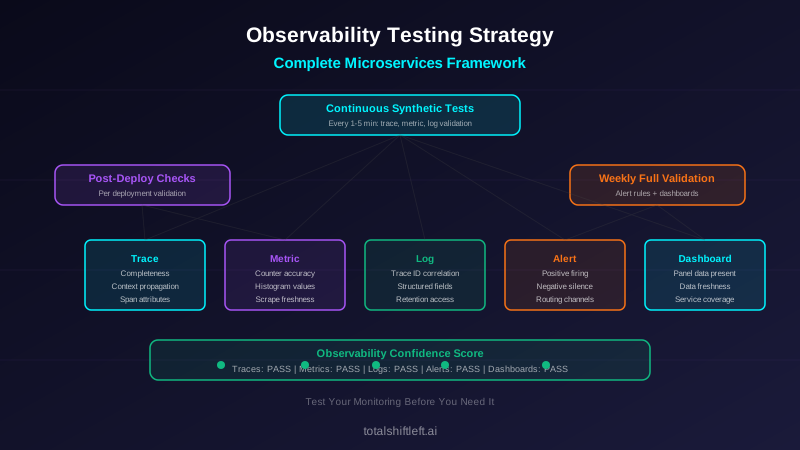
Observability testing verifies that your tracing, metrics, logging, and alerting infrastructure itself works correctly, rather than assuming it does — treating observability as software that needs testing. It operates at five levels (instrumentation, pipeline, query, alert, and dashboard testing) and three cadences: continuous synthetic checks every 1-5 minutes, post-deployment validation, and weekly comprehensive stack tests covering every alert rule and dashboard panel.
Reviewed by Parveen Kumari

An observability testing strategy for microservices is a systematic framework for validating that your monitoring, tracing, logging, and alerting infrastructure works correctly and completely. It treats observability as software that requires testing — ensuring that when an incident occurs, you have the telemetry data, alerts, and dashboards needed to detect, diagnose, and resolve it.
Here is a scenario that plays out at organizations every week: an incident occurs in production, the on-call engineer opens their dashboards and discovers that the metrics are stale, the traces are incomplete, and the alert that should have fired 10 minutes ago never triggered. The observability stack — the very infrastructure designed to help during incidents — has silently failed. A 2025 Catchpoint study found that 43% of engineering teams had experienced at least one incident where their monitoring tools failed to provide the data needed for diagnosis.
The root problem is that most teams treat observability as infrastructure they deploy but never test. They configure OpenTelemetry, deploy Jaeger, set up Grafana dashboards, and create alert rules — then assume everything works. But observability systems are complex software with their own failure modes: exporters drop data, collectors run out of memory, sampling rules exclude important traces, alert thresholds drift, and log pipelines silently drop fields during upgrades.
Observability testing is the discipline of verifying that your observability stack works before you need it. This guide presents a complete framework for testing observability in microservices architectures — covering traces, metrics, logs, alerts, and dashboards. It builds on the instrumentation foundation described in our OpenTelemetry for microservices observability guide and complements the debugging practices in our Jaeger for microservices debugging guide.
In this guide
- What Is Observability Testing?
- Why Observability Testing Matters for Microservices
- Key Components of an Observability Testing Framework
- Observability Testing Architecture
- Observability Testing Tools Comparison
- Observability testing in practice: a worked example
- Observability testing challenges and how to solve them
- Observability testing best practices
- Observability Testing Checklist
- Test the telemetry, not just the response
- Observability testing FAQ
What Is Observability Testing?
Observability testing is the practice of systematically validating that your telemetry collection, processing, storage, visualization, and alerting systems function correctly and provide the data needed for incident detection and resolution. It answers the meta-question: can we observe our system?
Traditional testing validates application behavior: does the API return the correct response? Does the database persist the record? Observability testing validates the instrumentation and monitoring layer: does the API request generate a complete trace? Does the database operation produce the expected metrics? Does an error condition trigger the correct alert?
Observability testing operates at five levels:
- Instrumentation testing: Verifying that application code produces the expected telemetry — traces with correct spans, metrics with correct values, logs with correct fields.
- Pipeline testing: Verifying that telemetry data flows correctly from applications through collectors, processors, and into storage backends without loss or corruption.
- Query testing: Verifying that stored telemetry can be retrieved correctly — trace searches return results, metric queries produce expected values, log searches find the right entries.
- Alert testing: Verifying that alert rules fire when conditions are met and do not fire when conditions are normal (testing both true positives and true negatives).
- Dashboard testing: Verifying that dashboards display data for all services and metrics, with no empty panels, stale data, or misconfigured queries.
If the monitoring-versus-observability line is still fuzzy, observability in DevOps draws it with examples.
Why Observability Testing Matters for Microservices
Silent Telemetry Failures Are Common
Telemetry pipelines fail silently. An OpenTelemetry exporter that cannot reach the Collector does not crash the application — it drops data. A misconfigured sampling rule that excludes error traces does not generate an error — it silently discards the traces you need most. A Prometheus scrape target that returns stale metrics does not alert — it reports the last known value. These silent failures accumulate until an incident reveals that your observability is incomplete.
Microservices Amplify Observability Complexity
In a monolithic application, observability testing is relatively simple: verify that the application emits metrics and logs. In a microservices architecture with 50 services, observability testing must verify that traces propagate correctly across all service boundaries, that every service emits the expected metrics, that log correlation works across the full request chain, and that alerts cover all critical failure modes. The complexity scales with the number of services, communication patterns, and observability backends.
Incidents Are the Wrong Time to Discover Gaps
When an incident is in progress, MTTR depends entirely on the quality of available telemetry. If traces are incomplete, the team cannot isolate the fault. If metrics are stale, the team cannot determine the current state. If alerts did not fire, the team did not start investigating until customers reported the problem. Every observability gap discovered during an incident adds minutes or hours to resolution time. The goal of observability testing is to discover and fix these gaps during normal operations — not during the 2 AM incident.
Compliance and SLA Requirements
Many organizations have SLAs that include monitoring and alerting requirements. Healthcare systems must detect and alert on data availability issues within defined timeframes. Financial systems must maintain audit trails with specific retention periods. Observability testing provides the evidence that these requirements are met — not just that monitoring is deployed, but that it functions correctly. Teams following a comprehensive API testing strategy for microservices should extend the same rigor to their observability layer.
Key Components of an Observability Testing Framework
Trace Completeness Tests
Trace completeness tests verify that distributed traces contain all expected spans when a request flows through the service chain. The test sends a synthetic request through a known path (e.g., API gateway -> auth service -> order service -> payment service), waits for the trace to appear in the backend, and asserts that all expected spans are present with correct parent-child relationships. Missing spans indicate instrumentation gaps or context propagation failures.
Metric Accuracy Tests
Metric accuracy tests verify that counters, histograms, and gauges reflect actual system behavior. The test sends a known number of requests with known characteristics (e.g., 100 requests, 10 with errors, specific response times) and then queries the metrics backend to verify that request count matches, error count matches, and latency histograms contain values in the expected range. Discrepancies indicate instrumentation bugs or metric pipeline issues.
Log Correlation Tests
Log correlation tests verify that structured log entries contain the trace context fields (trace_id, span_id) needed to link logs to traces. The test sends a request, captures the trace ID from the response headers, and then searches the log backend for entries with that trace ID. Every service in the request chain should produce at least one log entry with the correct trace ID. Missing correlation indicates that the logging integration with OpenTelemetry is not configured correctly.
Alert Rule Tests
Alert rule tests verify that alerting rules fire correctly. There are two types: positive tests (inject a condition that should trigger the alert and verify it fires within the expected timeframe) and negative tests (verify that the alert does not fire under normal conditions). Alert testing is critical because misconfigured thresholds, incorrect PromQL queries, or broken notification channels can render alerting useless — and you will not know until an incident is missed.
Dashboard Data Tests
Dashboard data tests verify that every panel on every critical dashboard displays current data for all services. The test queries each dashboard's underlying data sources and verifies that data exists, is recent (within the expected scrape/export interval), and covers all expected services. Empty dashboard panels during an incident are a common and preventable problem.
Ready to shift left with your API testing?
Try our no-code API test automation platform free. Generate tests from OpenAPI, run in CI/CD, and scale quality.
Pipeline Health Tests
Pipeline health tests monitor the observability infrastructure itself: OpenTelemetry Collector throughput, dropped span counts, export error rates, storage backend ingestion lag, and query latency. These are continuous checks that detect degradation in the observability pipeline before it causes data loss. Teams that monitor their monitoring are the teams that have reliable observability.
Observability Testing Architecture
A complete observability testing architecture operates at three layers:
Synthetic Test Layer: A synthetic test service runs continuously, sending known requests through the service mesh at regular intervals (every 1-5 minutes). Each synthetic request carries a unique identifier that can be traced through the entire observability stack. After sending a request, the test service queries the trace backend, metrics backend, and log backend to verify that the expected telemetry appeared within an acceptable time window. This layer catches pipeline failures, ingestion delays, and data loss.
Post-Deployment Validation Layer: After every service deployment, a validation suite runs that verifies the deployed service's observability instrumentation. It sends test traffic to the newly deployed service and checks: does the service produce spans with correct operation names and attributes? Does it propagate trace context to downstream calls? Does it emit the expected metrics? Are structured log fields present? This layer catches instrumentation regressions introduced by code changes. It integrates naturally with your CI/CD testing pipeline, and pairs with automated API change detection to flag when a deployment quietly alters the contract your telemetry assertions depend on.
Periodic Comprehensive Test Layer: A weekly or bi-weekly comprehensive test validates the entire observability stack: all alert rules (positive and negative tests), all dashboard panels (data freshness and coverage), retention policies (can you query data from 7 days ago?), and cross-signal correlation (can you navigate from a metric to a trace to a log?). This layer catches drift — gradual degradation that continuous checks might miss.
Observability Testing Tools Comparison
| Tool | Type | Best For | Open Source |
|---|---|---|---|
| Synthetic monitoring (Grafana Synthetic Monitoring) | Continuous validation | Automated telemetry pipeline checks | Yes |
| Prometheus Alertmanager | Alert testing | Alert rule validation and routing tests | Yes (CNCF) |
| Grafana | Dashboard testing | Panel data verification and visualization | Yes |
| OpenTelemetry Collector (testbed) | Pipeline testing | Collector configuration validation | Yes (CNCF) |
| Tracetest | Trace-based testing | Asserting on distributed trace data | Yes |
| Checkly | Synthetic monitoring | API and browser monitoring with alerting | Partial |
| Datadog Synthetic Tests | Full-stack synthetic | Integrated observability and testing | No |
| PagerDuty | Alert management | Alert routing and escalation testing | No |
| Chaos Mesh | Fault injection | Testing observability under failure conditions | Yes (CNCF) |
| Gremlin | Chaos engineering | Controlled failure injection for observability validation | No |
Observability testing in practice: a worked example
Problem: A logistics company with 35 microservices had deployed a comprehensive observability stack: OpenTelemetry instrumentation, Jaeger for tracing, Prometheus for metrics, Grafana Loki for logs, and Grafana for dashboards. During a critical incident — a routing optimization service failure that caused delivery delays — the on-call team discovered three observability gaps: traces were missing for the Kafka message processing path (no context propagation through Kafka), the alert for routing service error rates had been silently disabled during a Prometheus configuration change two months earlier, and the Grafana dashboard for the routing service showed "No Data" for three of five panels because the metric names had changed in a refactor.
Solution — Observability Testing Framework:
Step 1 — Trace completeness tests: The team created synthetic requests that traversed every communication protocol in their architecture: HTTP, gRPC, and Kafka. Each test sent a request, waited 30 seconds, and then queried Jaeger for the complete trace. The Kafka path test immediately caught the missing context propagation — the Kafka consumer was not extracting trace context from message headers.
Step 2 — Alert rule tests: The team built a test suite that validated every alert rule. For each rule, the suite injected a condition that should trigger the alert (e.g., sending 50 requests that return 500 errors to trigger the error rate alert) and verified that the alert fired within 2 minutes. The disabled routing service alert was caught immediately — the test expected an alert but none fired.
Step 3 — Dashboard data tests: An automated script queried every Grafana dashboard panel's data source and verified that each panel returned non-empty, recent data. The three broken panels on the routing service dashboard were flagged because they referenced metric names that no longer existed.
Step 4 — Continuous synthetic monitoring: The team deployed a synthetic test service that ran trace completeness, metric accuracy, and log correlation checks every 3 minutes. Any failure triggered a Slack notification and a PagerDuty alert. This continuous monitoring ensured that new observability regressions were caught within minutes rather than during the next incident.
Results: Over the following three months, the synthetic monitoring caught 12 observability regressions — 8 from service deployments that broke instrumentation, 3 from infrastructure changes that disrupted the telemetry pipeline, and 1 from an OpenTelemetry Collector upgrade that changed sampling behavior. Every regression was fixed before an incident required the affected telemetry. The team's next major incident (a database failover) was resolved in 18 minutes — compared to 2.5 hours for the routing service incident that prompted the observability testing initiative.
Observability testing challenges and how to solve them
Testing Alerts Without Impacting Production
Challenge: Testing alert rules requires injecting failure conditions — high error rates, elevated latency, resource exhaustion. In production, these injected conditions can trigger incident response, page on-call engineers, and send customer notifications.
Solution: Create a dedicated alert testing environment with a separate Alertmanager configuration that routes test alerts to a test notification channel (not the production PagerDuty escalation). Alternatively, use Prometheus recording rules to create synthetic metric series that can be used as alert rule inputs without affecting production metrics. Tag all test alerts with a test: true label and configure routing to suppress them from production channels.
Validating Sampling Does Not Drop Critical Traces
Challenge: Sampling reduces trace volume but risks dropping traces that would be needed for debugging. Head-based probability sampling is deterministic but cannot distinguish between interesting and uninteresting traces at the start of a request.
Solution: Test sampling rules by sending synthetic requests with known characteristics — some with errors (should always be sampled), some with high latency (should always be sampled), some normal (should be sampled at the configured rate). Query the tracing backend and verify that all error and high-latency traces are present and that the normal trace sample rate matches the configured probability within statistical tolerance.
Observability Tests Add System Load
Challenge: Synthetic test requests add to the system's request volume. In high-frequency testing (every 1-3 minutes across multiple paths), the synthetic traffic can become a measurable percentage of total traffic, affecting metrics (inflating request counts) and storage costs.
Solution: Tag all synthetic requests with a distinctive header or attribute (synthetic: true). Exclude synthetic requests from business metrics using PromQL label filters or trace attribute filters. Keep synthetic test frequency low enough that the traffic volume is negligible (typically less than 0.01% of production traffic). Use targeted tests that exercise specific paths rather than blasting all paths simultaneously.
Keeping Tests in Sync with Instrumentation Changes
Challenge: When a service refactors its API or changes operation names, the observability tests break because they assert on specific span names, metric names, or log fields. Maintaining test-instrumentation parity becomes an ongoing burden.
Free Visual blueprint + guide
Microservices Testing Strategy Blueprint
A visual testing strategy for microservices architectures. Covers testing layers, contract testing, service mesh validation, and tool selection.
Download FreeSolution: Store observability contracts alongside service code — a manifest file that declares the spans, metrics, and log fields each service produces. Tests validate against these contracts. When a service changes its instrumentation, it updates the contract, and the tests automatically adapt. This is the observability equivalent of API contract testing, and it pairs well with contract testing for microservices.
Flaky Observability Tests Due to Ingestion Lag
Challenge: Observability tests send a request and then query the backend for the resulting telemetry. If the query runs before the telemetry is ingested (due to batching, buffering, or backend processing lag), the test fails — not because telemetry is missing but because it has not arrived yet.
Solution: Implement polling with timeout rather than fixed-delay assertions. After sending the synthetic request, poll the backend at intervals (e.g., every 5 seconds) for up to a maximum wait time (e.g., 60 seconds). If the telemetry appears within the window, the test passes. If it does not appear after the maximum wait, the test fails. Track the actual ingestion latency as a metric to detect pipeline degradation trends.
Observability testing best practices
- Treat observability as software that needs testing — instrument it, validate it, and test it on the same cadence as application code
- Run continuous synthetic checks (every 1-5 minutes) that verify end-to-end telemetry pipeline health: trace completeness, metric freshness, and log correlation
- Test alert rules with both positive tests (verify alerts fire on bad conditions) and negative tests (verify alerts do not fire on normal conditions)
- Validate dashboard panels have data for all services after every deployment — empty panels during an incident are preventable
- Tag all synthetic observability test traffic with a distinctive attribute and exclude it from business metrics
- Include observability validation in your CI/CD pipeline: post-deployment checks that verify the newly deployed service produces expected telemetry
- Monitor the observability pipeline itself: Collector throughput, export errors, dropped spans, storage ingestion lag, and query latency
- Maintain observability contracts (manifests of expected spans, metrics, log fields) alongside service code so tests stay in sync with instrumentation changes
- Test trace context propagation across all communication protocols your services use: HTTP, gRPC, Kafka, RabbitMQ, SQS
- Verify that root cause analysis workflows work by periodically running a simulated incident and confirming that all necessary telemetry is available
- Test retention policies by querying for data at the retention boundary — verify that 7-day-old traces and metrics are still queryable
- Document the observability testing framework and include it in your team's shift-left testing strategy so that observability quality is a first-class concern
Observability Testing Checklist
- ✔ Create synthetic test requests that traverse all critical service paths and communication protocols
- ✔ Verify trace completeness: all expected spans are present with correct parent-child relationships
- ✔ Verify trace context propagation across HTTP, gRPC, and async messaging boundaries
- ✔ Verify that span attributes include expected semantic conventions and business-context tags
- ✔ Test metric accuracy: send known traffic and verify counters, histograms, and gauges match expected values
- ✔ Test log correlation: verify every service's log entries contain trace_id and span_id fields
- ✔ Test positive alert scenarios: inject failure conditions and verify alerts fire within expected timeframes
- ✔ Test negative alert scenarios: verify alerts do not fire under normal operating conditions
- ✔ Verify all dashboard panels display current data for all monitored services
- ✔ Test sampling configuration: verify error traces and high-latency traces are always captured
- ✔ Monitor telemetry pipeline health: Collector throughput, export errors, dropped data, ingestion lag
- ✔ Run post-deployment observability validation for every service deployment
- ✔ Test data retention policies: verify queryability at the retention boundary
- ✔ Test cross-signal correlation: navigate from metric to trace to log using trace IDs
- ✔ Schedule weekly comprehensive observability stack validation including all alert rules and dashboards
Test the telemetry, not just the response
Observability is a feature, and untested features regress. These assertions check that a request actually produced the trace, metric and log a responder would need at 3am:
# tests/test_observability.py
def test_a_failing_request_is_observable(client, jaeger, prom, capture_logs):
    r = client.post("/v1/orders", json={"sku": "DOES-NOT-EXIST", "qty": 1})
    assert r.status_code == 404
    trace_id = r.headers["traceparent"].split("-")[1]

    # 1. the trace exists, is complete, and is marked as an error
    spans = jaeger.get(f"/api/traces/{trace_id}").json()["data"][0]["spans"]
    assert {"gateway", "inventory"} <= {s["process"]["serviceName"] for s in spans}
    assert any(s["tags"] and s["tags"].get("error") for s in spans)

    # 2. the metric moved, with the route label an alert can group on
    series = prom.query('http_requests_total{route="/v1/orders",status="404"}')
    assert series and float(series[0]["value"][1]) > 0

    # 3. the log line is structured and carries the same trace id
    logs = [json.loads(l) for l in capture_logs.splitlines()]
    assert any(l["trace_id"] == trace_id and l["level"] == "WARNING" for l in logs)
Add these to the same suite as the functional tests. Telemetry that only breaks in production is telemetry you will not have during the incident that needs it.
Observability testing FAQ
What is observability testing for microservices?
Observability testing is the practice of verifying that your monitoring, tracing, logging, and alerting systems work correctly. It treats observability infrastructure as software that needs testing — validating that traces are complete across service boundaries, metrics are accurate and timely, logs contain the expected fields and correlation IDs, and alerts fire when conditions are met. Without observability testing, you discover observability gaps during incidents — the worst possible time.
Why do teams need to test their observability stack?
Teams need to test observability because silent failures in telemetry pipelines are common and devastating. A misconfigured exporter that drops 30% of traces, an alert rule with the wrong threshold, or a log pipeline that strips trace IDs — these failures are invisible until an incident occurs and the team discovers they cannot debug it. Observability testing catches these gaps before they matter.
How do you test distributed tracing in microservices?
Test distributed tracing by: (1) sending a synthetic request through the full service chain and verifying that a complete trace with all expected spans appears in your tracing backend, (2) checking that context propagation works across all communication protocols (HTTP, gRPC, messaging), (3) validating that span attributes contain the expected tags and semantic conventions, (4) verifying that sampling does not drop traces that should be captured (error traces, high-latency traces), and (5) measuring trace latency from generation to queryability.
What should an observability testing checklist include?
An observability testing checklist should include: trace completeness tests (all spans present for end-to-end requests), metric accuracy tests (counters and histograms match expected values), log correlation tests (logs contain trace_id and span_id), alert firing tests (alerts trigger on known bad conditions), alert silence tests (alerts do not fire on normal conditions), dashboard data tests (dashboard panels show data for all services), and pipeline health tests (no dropped telemetry, acceptable lag).
How often should observability tests run?
Observability tests should run at three cadences: (1) continuous synthetic checks that send test requests and verify trace/metric/log presence every 1-5 minutes, (2) post-deployment validation tests that run after every service deployment to verify instrumentation was not broken, and (3) weekly comprehensive tests that validate the full observability stack including alert rules, dashboard coverage, and retention policies. Critical path checks should run continuously; full suite tests can run less frequently.
What is the difference between monitoring and observability testing?
Monitoring validates that your application is healthy (are error rates normal? is latency acceptable?). Observability testing validates that your monitoring itself is healthy (are traces being collected? are metrics accurate? will alerts fire when needed?). Monitoring answers "is the system working?" while observability testing answers "will we know if the system stops working?" Both are essential — observability testing is the meta-layer that ensures monitoring is trustworthy.
Sources and further reading
- OpenTelemetry documentation — the vendor-neutral tracing, metrics and logs standard.
- Google SRE Book — Monitoring Distributed Systems — the four golden signals and alerting philosophy.
- Google SRE Workbook — Implementing SLOs — how to define SLOs and error budgets.
Key takeaways
- Observability testing is the practice that ensures your observability stack delivers on its promise — that when something goes wrong, you have the data, alerts, and dashboards to detect and resolve it.
- Without observability testing, your monitoring is a hope rather than a guarantee.
- With it, you can have confidence that every trace, metric, log, and alert will be there when you need it.
- The framework in this guide — synthetic tests, post-deployment validation, periodic comprehensive checks — provides a structured approach that scales with your microservices architecture.
- Start with trace completeness tests and alert rule tests (the highest-value, lowest-effort tests), then add metric accuracy, log correlation, and dashboard validation as your framework matures.
- The best time to discover an observability gap is in a test — not during a 2 AM production incident.
Build observability testing into your engineering culture, and your incident response capability will be fundamentally stronger.
Ready to build a comprehensive testing strategy for your microservices? Start your free trial of Total Shift Left and see how AI-driven API test generation complements your observability testing framework to catch issues at every layer of your stack.
Related reading: Microservices Testing Complete Guide | OpenTelemetry for Microservices Observability | Jaeger for Microservices Debugging | Root Cause Analysis for Distributed Systems | Debug Failed API Tests in CI/CD | What Is Shift Left Testing
Ready to shift left with your API testing?
Try our no-code API test automation platform free.