
Root Cause Analysis for Distributed Systems
Quick answer
Root cause analysis in distributed systems means moving from log inspection to trace-first investigation: collect distributed traces, correlate spans across services, identify the failing call path, and only then drill into logs and metrics for the offending service. In 2026 the fastest RCA teams use OpenTelemetry for correlated traces and an on-prem AI workflow for first-pass triage on incidents above a service-impact threshold.
Reviewed by Smeet Gohel

Root cause analysis for distributed systems is a systematic methodology for identifying the original cause of failures in multi-service architectures. It uses distributed tracing, log correlation, metric analysis, and structured investigation techniques to trace failure propagation across service boundaries and pinpoint the exact component, configuration, or condition that triggered the incident.
A 2025 Gartner study reported that the average cost of IT downtime is $5,600 per minute, and organizations running distributed microservices architectures experience 35% more incidents than those running monolithic systems. The increased incident rate is not because microservices are inherently less reliable — it is because distributed systems have exponentially more failure modes. A 50-service architecture has 50 services that can fail, 2,450 possible pairwise communication failures, and countless combinations of partial degradation.
The critical skill that separates high-performing engineering teams from the rest is not preventing every incident — it is resolving incidents quickly and permanently. Root cause analysis is the discipline that makes this possible. When done well, RCA transforms incidents from recurring firefighting into one-time events that make the system stronger.
This guide covers root cause analysis specifically for distributed systems and microservices. It goes beyond generic RCA frameworks to address the unique challenges of distributed failure modes: cascading failures, partial degradation, asynchronous propagation, and the gap between where a failure is observed and where it originates. If you are building the observability foundation needed for effective RCA, see our guide on OpenTelemetry for microservices observability.
In this guide
- What Is Root Cause Analysis for Distributed Systems?
- Why RCA Is Critical for Microservices
- Key Components of Distributed Systems RCA
- RCA Architecture and Workflow
- RCA Tools Comparison
- Real-World RCA Example
- Root cause analysis challenges and how to solve them
- Root cause analysis best practices
- RCA Checklist
- Narrow it down with three queries
- Root cause analysis FAQ
What Is Root Cause Analysis for Distributed Systems?
Root cause analysis (RCA) is the systematic process of identifying the fundamental reason why an incident occurred — not just what happened, but why it happened and why existing safeguards did not prevent it. In distributed systems, RCA has an additional dimension: tracing failure propagation across service boundaries to find the origin point.
In a monolithic application, when an error occurs, the stack trace typically points directly to the problem: a null pointer in a specific function, a failed database query on a specific line. In distributed systems, the error you observe is often several hops away from the root cause. A user sees a 504 Gateway Timeout on the checkout page. The API gateway timed out because the order service did not respond in time. The order service was slow because it was waiting for the inventory service. The inventory service was slow because its database connection pool was exhausted. The connection pool was exhausted because a configuration deployment reduced the max connections from 100 to 20.
The root cause is the configuration change — four services away from the observed symptom. Finding this requires distributed tracing, metric correlation, timeline analysis, and systematic elimination.
RCA in distributed systems answers three questions: (1) What was the proximate cause of the failure? (2) What was the root cause — the original trigger? (3) What systemic factors allowed the root cause to produce the observed impact?
For the wider framing, see observability in DevOps.
Why RCA Is Critical for Microservices
Cascading Failures Multiply Impact
Microservices architectures are designed for independent deployment and scaling, but they are tightly coupled at runtime. A failure in one service can cascade across the system through synchronous dependencies, shared resources, and backpressure propagation. Without RCA to identify the cascade origin, teams fix the symptoms (the service that returned errors) rather than the cause (the service that triggered the cascade). The same failure recurs because the root cause was never addressed.
Partial Degradation Hides the Origin
Distributed systems often degrade partially rather than failing completely. A service might slow down rather than crash, causing timeouts in some consumers but not others depending on their timeout configurations. This partial degradation makes it difficult to identify which service is the origin versus which services are victims. RCA methodology provides the framework for distinguishing between cause and effect in partially degraded systems.
Incident Recurrence Destroys Engineering Velocity
An incident that happens once is a learning opportunity. An incident that recurs is a team velocity killer. Each recurrence costs the same MTTR, the same customer impact, and the same on-call engineer disruption. RCA that identifies the true root cause and drives corrective actions is the only way to break the recurrence cycle. Pairing each fix with regression and flaky-test analysis turns those corrective actions into permanent regression guards. Teams without rigorous RCA practices often find that 60-70% of their incidents are recurring variants of previously seen failures.
Compliance and Regulatory Requirements
Many industries — finance, healthcare, telecommunications — require formal root cause analysis for significant incidents. Regulatory bodies expect documented RCA processes, timelines, and corrective actions. A structured RCA methodology for distributed systems meets these requirements while also delivering engineering value. This is especially relevant for teams maintaining robust testing strategies for microservices.
Key Components of Distributed Systems RCA
Distributed Tracing Analysis
Distributed traces are the single most valuable data source for RCA in microservices. A trace captures the complete request flow across all services, including timing for each operation. During RCA, you find representative traces from the incident period and analyze them: which span is the first to show elevated latency or errors? That is your starting point for fault isolation. Tools like Jaeger and Grafana Tempo make this analysis visual and interactive.
Metric Anomaly Detection
Metrics provide the timeline view that traces cannot. While a trace shows you what happened to a single request, metrics show you when the system behavior changed. During RCA, you overlay metrics from all suspect services on a shared timeline and look for the earliest anomaly: the first service to show increased error rates, the first resource metric (CPU, memory, connection count) to deviate from baseline. The earliest anomaly is the strongest candidate for the root cause.
Log Correlation and Event Analysis
Logs fill the gaps between traces and metrics. Traces tell you what happened to requests. Metrics tell you how the system was behaving. Logs tell you why — error messages, stack traces, warning conditions, configuration changes, deployment events, and health check transitions. Correlating logs by trace ID, timestamp, and service name connects the "what" of the trace to the "why" of the log.
Change Correlation
The majority of incidents in production systems are caused by changes: code deployments, configuration updates, infrastructure modifications, traffic pattern shifts, or third-party dependency changes. Effective RCA always includes a change correlation step: what changed in the system in the hours before the incident began? This requires maintaining a change log that captures deployments, config changes, scaling events, and dependency updates with precise timestamps.
Service Dependency Mapping
Understanding the dependency graph of your services is essential for RCA. When Service A fails, which services depend on it directly? Which depend on those services? The blast radius of a failure is determined by the dependency graph. During an incident, the dependency map tells you where to look for cascading effects and helps distinguish between the originating service and the services experiencing downstream impact.
Timeline Reconstruction
The most important RCA technique is timeline reconstruction: building a minute-by-minute (or second-by-second) chronology of the incident from all available data sources. The timeline includes: when metrics first deviated, when the first errors appeared in logs, when alerts fired, when customers first reported issues, when engineering began investigating, and when each mitigation action was taken. A well-constructed timeline almost always reveals the root cause by showing what happened first.
Ready to shift left with your API testing?
Try our no-code API test automation platform free. Generate tests from OpenAPI, run in CI/CD, and scale quality.
RCA Architecture and Workflow
A structured RCA workflow for distributed systems follows five phases:
Phase 1 — Incident Detection and Triage: The incident is detected through alerts, customer reports, or monitoring. The triage phase determines severity, blast radius, and the initial set of affected services. This phase produces the incident timeline start time and the initial service scope.
Phase 2 — Fault Isolation: Using distributed traces, metrics, and the service dependency map, the investigation team narrows down the failure origin. The goal is to identify the single service or component where the failure began. This is the most technically challenging phase and relies heavily on observability tooling.
Phase 3 — Root Cause Identification: Within the isolated fault domain, the team identifies the specific cause: a code bug, configuration error, resource exhaustion, infrastructure failure, or external dependency issue. This phase uses detailed log analysis, code review, and change correlation.
Phase 4 — Remediation and Verification: The root cause is addressed — a rollback, configuration fix, scaling action, or code fix. Verification confirms that the remediation resolves the incident by checking that metrics return to baseline and errors stop.
Phase 5 — Post-Incident Review: A blameless post-mortem documents the timeline,
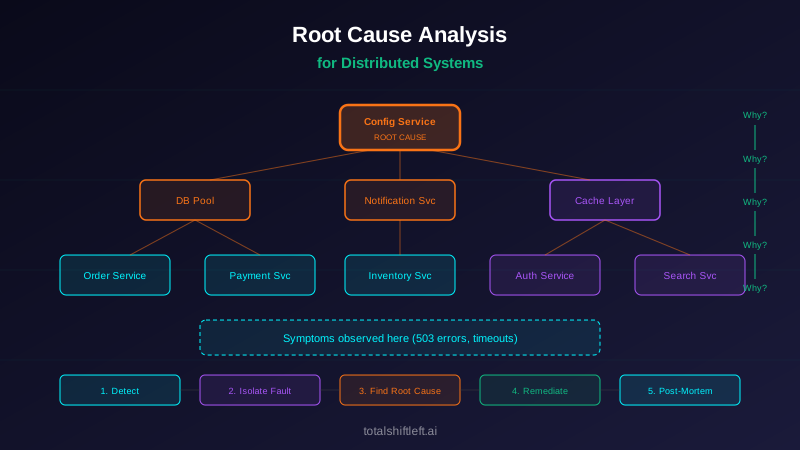
root cause, contributing factors, and corrective actions. Corrective actions are tracked to completion and include both immediate fixes and systemic improvements (better alerts, circuit breakers, load test gates, observability testing).
RCA Tools Comparison
| Tool | Type | Best For | Open Source |
|---|---|---|---|
| Jaeger | Distributed Tracing | Request flow analysis and fault isolation | Yes (CNCF) |
| Grafana Tempo | Distributed Tracing | High-scale trace storage with Grafana integration | Yes |
| Zipkin | Distributed Tracing | Lightweight trace collection and visualization | Yes |
| Prometheus | Metrics & Alerting | Time-series anomaly detection and alerting | Yes (CNCF) |
| Grafana | Visualization | Unified incident dashboards and timeline views | Yes |
| Grafana Loki | Log Aggregation | Label-based log search and trace correlation | Yes |
| Elasticsearch/Kibana | Log Analysis | Full-text log search and pattern analysis | Yes |
| Splunk | Log & Event Analysis | Enterprise-scale log correlation and analytics | No |
| PagerDuty | Incident Management | Alert routing, escalation, and post-mortem workflow | No |
| Datadog | Full-Stack APM | Automated root cause suggestions and impact analysis | No |
Real-World RCA Example
Problem: A healthcare SaaS platform experienced a 45-minute outage on their patient scheduling API. The API returned 503 errors to all clients. The scheduling service, appointment service, notification service, and billing service all showed elevated error rates. On-call engineers initially investigated the scheduling service (the service returning 503s) and found nothing obviously wrong in its code or recent deployments.
RCA Investigation:
Step 1 — Timeline reconstruction: The team built a minute-by-minute timeline. Metrics showed the first anomaly appeared in the notification service at 14:02 — database connection wait times spiked from 2ms to 500ms. The scheduling service errors began at 14:04, two minutes later.
Step 2 — Fault isolation: Distributed traces from 14:02-14:04 showed the scheduling service calling the notification service (to send appointment confirmations) and those calls timing out at 5 seconds. The notification service traces showed the timeout was in the database span. The scheduling service had no circuit breaker on the notification call, so every scheduling request waited the full 5 seconds and eventually exhausted the scheduling service's thread pool.
Step 3 — Root cause identification: The notification service's database connection pool was exhausted. Change correlation revealed that at 13:58, a configuration deployment had changed the notification service's database max connections from 50 to 5 — a typo in a Helm values file where maxConnections: 50 was accidentally changed to maxConnections: 5.
Step 4 — Remediation: The configuration was rolled back to maxConnections: 50. The notification service recovered in 30 seconds. The scheduling service recovered in 2 minutes as its thread pool drained.
Step 5 — Corrective actions: (1) Add a circuit breaker to the scheduling service's notification call so a slow notification service cannot take down scheduling. (2) Add a configuration validation step to the deployment pipeline that checks for out-of-range values. (3) Add an alert on database connection pool utilization exceeding 80%. (4) Add the notification service database pool size to the CI/CD test pipeline health check.
Result: MTTR for this incident was 45 minutes. With the corrective actions in place, the same configuration error was caught by the pipeline validation gate three months later — preventing the incident from recurring entirely.
Root cause analysis challenges and how to solve them
The Blame Game Derails Investigation
Challenge: RCA discussions devolve into blame — "who wrote the bad code" or "who approved the deployment." This causes engineers to become defensive, withhold information, and focus on protecting themselves rather than finding the root cause.
Solution: Establish a strict blameless post-mortem culture. The explicit rule is: RCA investigates systems, processes, and conditions — never individuals. Focus questions on "what" and "why" rather than "who." Document systemic failures (missing validation gates, insufficient alerting) rather than human errors. The goal is to make the system robust against the types of errors humans inevitably make.
Cascading Failures Obscure the Origin
Challenge: When a failure cascades across multiple services, every service shows errors. Engineers rush to investigate the service with the most visible errors (often the API gateway or frontend-facing service) rather than the originating service buried in the dependency chain.
Solution: Always start RCA by identifying the earliest anomaly in the timeline — the first metric deviation, the first error log, the first failing health check. Use the service dependency map to work backward from the observed failure to its dependencies. Distributed traces are invaluable here: find a trace that captures the failure and identify the first span with an error or elevated latency.
Insufficient Observability Data
Challenge: The investigation stalls because critical data is missing: no traces for the incident period, logs were rotated before collection, metrics granularity is too coarse to see the failure onset. Teams cannot perform RCA without data.
Solution: Treat observability as a prerequisite for RCA, not an afterthought. Implement distributed tracing with tail-based sampling (to capture all error traces), retain logs for a minimum of 30 days, and configure metrics at 15-second granularity for critical services. After every RCA where data was missing, add the missing telemetry as a corrective action. Build an observability testing strategy that validates telemetry completeness.
Intermittent Failures Resist Reproduction
Challenge: Some failures occur intermittently — triggered by specific timing, load patterns, or data conditions that are difficult to reproduce in a test environment. Engineers cannot perform RCA on failures they cannot observe.
Solution: Focus on collecting maximum diagnostic data during the failure window rather than trying to reproduce it afterward. Configure alerts to trigger diagnostic data collection (heap dumps, thread dumps, detailed trace sampling) when anomaly conditions are detected. Use chaos engineering to simulate partial failure conditions and validate that your RCA tooling captures the necessary data.
Post-Mortem Actions Are Not Tracked
Challenge: The post-mortem produces a list of corrective actions, but they are never completed. The same failure recurs because the fix was documented but not implemented.
Solution: Track post-mortem action items as engineering work items (Jira tickets, GitHub Issues) with owners and deadlines. Review open action items weekly. Report on action item completion rate as a team metric. If corrective actions are consistently deprioritized, escalate the pattern — it indicates a systemic underinvestment in reliability.
Free Visual blueprint + guide
Microservices Testing Strategy Blueprint
A visual testing strategy for microservices architectures. Covers testing layers, contract testing, service mesh validation, and tool selection.
Download FreeMultiple Contributing Factors Complicate Analysis
Challenge: Some incidents have more than one root cause — a combination of factors that individually would not cause a failure but together create the conditions for an incident. Identifying these multi-factor causes requires deeper analysis than single-cause incidents.
Solution: Use the "5 Whys" technique adapted for distributed systems. For each branch of the investigation, continue asking "why" until you reach a systemic factor that can be addressed. Document all contributing factors, not just the primary root cause. Prioritize corrective actions based on which factor had the largest contribution to the incident impact.
Root cause analysis best practices
- Start every RCA by building a timeline — the chronological sequence of events is the most powerful analytical tool
- Always identify the earliest anomaly in the timeline before investigating downstream symptoms — work backward from effects to causes
- Use distributed traces to isolate the fault to a specific service before diving into logs and code
- Correlate changes (deployments, config updates, scaling events) with the incident timeline — most production incidents are change-related
- Maintain a blameless post-mortem culture that focuses on systemic improvements rather than individual errors
- Track post-mortem corrective actions as engineering work items with owners, deadlines, and completion tracking
- Classify root causes by category (code bug, configuration error, capacity, dependency, infrastructure) and track distribution over time
- Store RCA reports in a searchable knowledge base so that future investigators can reference past incidents
- Include "what went well" in post-mortems — acknowledge effective monitoring, fast detection, or successful mitigation
- Set MTTR targets by severity level and measure progress over time — RCA quality directly impacts future MTTR
- Conduct pre-mortems for high-risk changes — ask "what could go wrong?" before deployment instead of only after
- Validate RCA tooling regularly by running observability tests that confirm traces, metrics, and logs are flowing correctly
RCA Checklist
- ✔ Establish the incident timeline: when did the first anomaly appear in metrics, logs, or traces?
- ✔ Identify the blast radius: which services and customers are affected?
- ✔ Check the change log: what deployments, config changes, or infrastructure modifications occurred before the incident?
- ✔ Pull distributed traces from the incident window and identify the first failing or slow span
- ✔ Isolate the fault to a specific service using trace analysis and the service dependency map
- ✔ Examine the isolated service's logs for error messages, warnings, and state changes
- ✔ Check resource metrics for the isolated service: CPU, memory, connection pools, thread pools, disk I/O
- ✔ Identify the root cause: code bug, configuration error, capacity issue, dependency failure, or infrastructure problem
- ✔ Apply the 5-Whys technique to drill past the proximate cause to systemic factors
- ✔ Implement the fix and verify that metrics return to baseline and errors stop
- ✔ Conduct a blameless post-mortem within 48 hours of the incident
- ✔ Document the timeline, root cause, contributing factors, and corrective actions
- ✔ Create tracked work items for every corrective action with an owner and deadline
- ✔ Update monitoring and alerting to detect the failure condition earlier in the future
- ✔ Add a regression test that would catch the root cause before it reaches production
Narrow it down with three queries
Root cause analysis in a distributed system is a search problem. These three steps take you from "the error rate is up" to a single span, and they work regardless of which vendor you use:
# 1. which service and which route — not "the API is slow"
curl -sG http://prometheus:9090/api/v1/query --data-urlencode 'query=
  topk(5, sum by (service, route) (rate(http_requests_total{status=~"5.."}[10m])))
' | jq -r '.data.result[] | "\(.metric.service) \(.metric.route) \(.value[1])"'

# 2. did it start with a deploy, or before it?
curl -sG http://prometheus:9090/api/v1/query_range --data-urlencode 'query=
  sum by (version) (rate(http_requests_total{service="orders",status=~"5.."}[5m]))
' --data-urlencode 'start='$(date -d '-2 hours' +%s) \
  --data-urlencode 'end='$(date +%s) --data-urlencode 'step=60' | jq '.data.result[].metric'

# 3. one failing trace, and the span that actually failed
TRACE=$(curl -s "http://jaeger:16686/api/traces?service=orders&tags=%7B%22error%22%3A%22true%22%7D&lookback=15m&limit=1" | jq -r '.data[0].traceID')
curl -s "http://jaeger:16686/api/traces/$TRACE" | jq -r '
  .data[0].spans | sort_by(.startTime)[]
  | "\(.process.serviceName)\t\(.operationName)\t\(.duration/1000)ms\t\(
      (.tags // []) | map(select(.key=="error")) | length > 0)"'
Then write the test. An RCA that ends in a document repeats; an RCA that ends in a failing-then-passing test does not:
# tests/regressions/test_inc_4192.py
def test_payment_callback_after_connection_drop_reconciles(client, chaos):
    order = client.post("/v1/orders", json={"sku": "A-1", "qty": 1}).json()
    with chaos.drop_connection(after="POST /pay"):
        client.post(f"/v1/orders/{order['id']}/pay", json={"method": "card"})
    run_reconciliation_job()
    assert client.get(f"/v1/orders/{order['id']}").json()["status"] in ("paid", "failed")
Root cause analysis FAQ
What is root cause analysis in distributed systems?
Root cause analysis (RCA) in distributed systems is a systematic process for identifying the underlying cause of an incident or failure in a multi-service architecture. Unlike monolithic applications where the failure origin is typically localized, distributed systems RCA must trace failure propagation across service boundaries, network layers, and infrastructure components to find the original trigger rather than just the observed symptom.
Why is root cause analysis harder in microservices than monoliths?
RCA is harder in microservices because failures propagate across service boundaries, creating cascading effects that mask the original cause. A single database connection pool exhaustion in one service can manifest as timeouts, 503 errors, and queue backlogs in a dozen downstream services. The asynchronous, distributed nature of microservices means the symptom often appears far from the cause — both in terms of service topology and time.
What tools are used for root cause analysis in distributed systems?
Key RCA tools include distributed tracing systems (Jaeger, Grafana Tempo, Zipkin) for request flow analysis, log aggregation platforms (Grafana Loki, Elasticsearch, Splunk) for event correlation, metrics systems (Prometheus, Datadog) for anomaly detection, and AIOps platforms (PagerDuty, Moogsoft, BigPanda) for automated correlation. OpenTelemetry provides the instrumentation foundation that feeds data to all these tools.
What is the 5-Whys technique for distributed systems incidents?
The 5-Whys technique adapted for distributed systems involves asking "why" repeatedly to drill past symptoms to root causes, while accounting for the distributed nature of failures. For example: Why did the checkout page timeout? (The order service was slow.) Why was the order service slow? (It was waiting for the inventory service.) Why was the inventory service slow? (Its database connection pool was exhausted.) Why was the pool exhausted? (A configuration change reduced the pool size by 80%.) Why was the change deployed without validation? (There was no load test gate in the deployment pipeline.)
How do you prevent recurring incidents in distributed systems?
Prevent recurring incidents by: implementing the fix for the root cause (not just the symptom), adding automated detection for the failure condition (monitoring, alerting), creating a regression test that would catch the same issue, updating runbooks with the diagnostic steps, conducting a blameless post-mortem to share learnings, and tracking corrective actions to completion. The goal is to make every incident a one-time event.
What is fault isolation in microservices architectures?
Fault isolation in microservices is the process of narrowing down which service, component, or infrastructure element is the origin of a failure. It typically involves analyzing distributed traces to find the first failing span, correlating metrics anomalies across services to find the earliest deviation, and eliminating healthy services from the investigation. Effective fault isolation reduces MTTR by focusing engineering attention on the actual source rather than the cascade of symptoms.
Sources and further reading
- Google SRE Book — Monitoring Distributed Systems — the four golden signals and alerting philosophy.
- OpenTelemetry documentation — the vendor-neutral tracing, metrics and logs standard.
- Jaeger documentation — the open-source distributed tracing backend.
Key takeaways
- Root cause analysis is the discipline that transforms incidents from recurring disruptions into permanent improvements.
- In distributed systems, RCA requires more than reading error messages — it requires systematic investigation using distributed traces, metric timelines, log correlation, and change analysis.
- The teams that invest in RCA methodology and tooling see measurable improvements in MTTR, incident recurrence rates, and overall system reliability.
- The key insight is that RCA is not just a post-incident activity. It is a capability that requires infrastructure (observability, change tracking, dependency mapping), process (blameless post-mortems, action tracking), and practice (running investigations, building timelines, conducting 5-Whys analysis).
- Each incident strengthens the capability if the team treats it as a learning opportunity rather than a blame event.
Ready to strengthen your testing foundation so fewer issues reach production? Start your free trial of Total Shift Left and catch API regressions in your pipeline before they become production incidents that require RCA.
Related reading: Microservices Testing Complete Guide | OpenTelemetry for Microservices Observability | Jaeger for Microservices Debugging | Debug Failed API Tests in CI/CD | API Testing Strategy for Microservices | What Is Shift Left Testing
Ready to shift left with your API testing?
Try our no-code API test automation platform free.