
Schema-First API Development & Testing Strategy (2026)
Quick answer
Schema-first API development means designing and approving the OpenAPI 3.x contract before writing any implementation code, then generating tests, mock servers, client SDKs, and documentation from that single source of truth. Teams adopting schema-first ship APIs 2.8x faster and see 57% fewer integration defects than code-first teams, per the 2025 World Quality Report, because a rich spec lets AI generate positive, negative, and boundary tests before a single endpoint is implemented.
Reviewed by Sushant Joshi
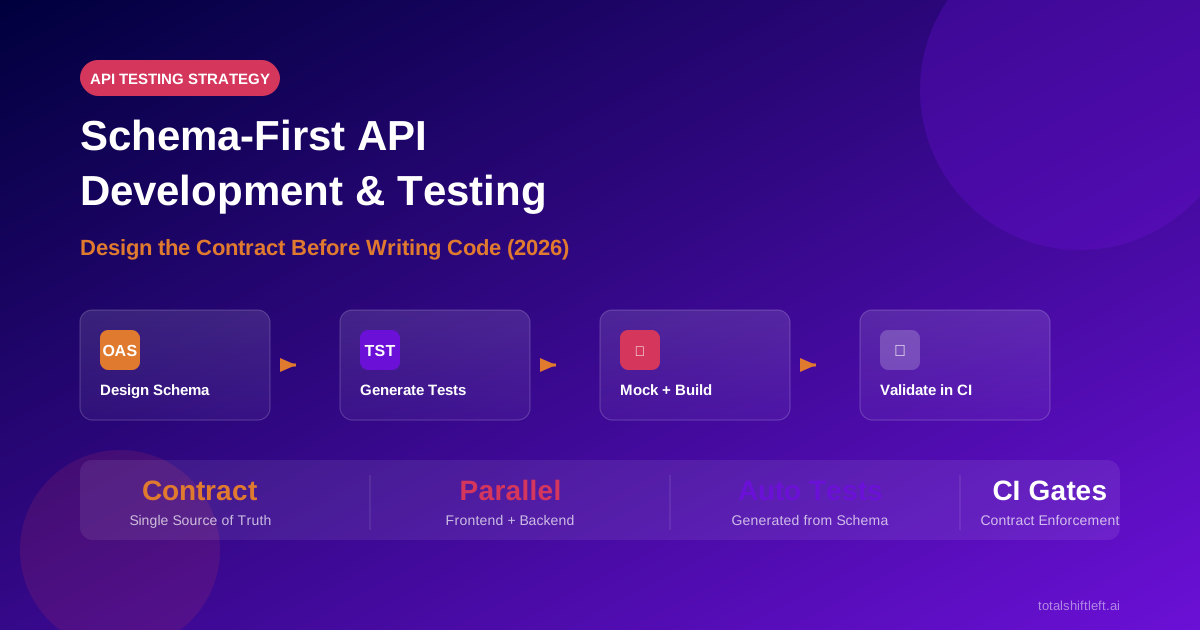
Schema-first API development is an engineering practice in which teams design and approve the API contract — an OpenAPI 3.x specification — before writing any implementation code, and then generate tests, mock servers, client SDKs, server stubs, and documentation from that single authoritative document. It replaces the sequential "code → annotate → ship" workflow with a parallel "design → generate → implement → validate" workflow where the spec, not the code, is the source of truth.
The shift is no longer theoretical. The World Quality Report 2025 found that teams adopting schema-first workflows ship APIs 2.8x faster and experience 57% fewer integration defects than teams using code-first or ad-hoc approaches. DORA's 2025 State of DevOps data links schema-first practices to higher deployment frequency and lower change-failure rate. In a landscape where the average SaaS runs 300+ internal APIs and release cadence has compressed to daily, designing the contract first is the difference between parallel velocity and serial bottleneck.
Most API teams still build the way they did a decade ago: a backend engineer writes an endpoint, adds annotations, pushes code, and a specification eventually gets generated from the implementation. Frontend waits. QA waits longer. Tests, when they arrive, cover paths someone remembered — not the paths the spec defines. The tax is predictable: integration bugs at merge time, undocumented behavior in production, and docs that drift the moment they ship.
Schema-first API development inverts the sequence. The OpenAPI spec is designed, reviewed, and merged first; tests, mocks, SDKs, and stubs derive from it. Every downstream artifact stays synchronized because each regenerates when the spec changes. The method is endorsed by IBM's API strategy guidance, the OpenAPI Initiative, and hyperscaler governance frameworks, and it is the foundation on which AI-first API testing platforms operate — without a high-quality spec, AI has nothing to generate against.
This guide explains how schema-first works end to end, the reference architecture, the tools, and the CI/CD enforcement model — alongside your OpenAPI test automation pipeline. For foundational context, the API Learning Center covers what is an API and request/response anatomy.
In this guide
- What Is Schema-First API Development?
- Why schema-first API development matters in 2026
- Key Components of a Schema-First Workflow
- Schema-first API development reference architecture
- Schema-first API development tools compared
- Schema-first API development in practice: a worked example
- Schema-first API development challenges and how to solve them
- Schema-first API development best practices
- Schema-first API development checklist
- The schema-first loop, in commands
- Schema-first API development FAQ
What Is Schema-First API Development?
Schema-first API development is an approach where teams design and finalize the API contract — typically an OpenAPI 3.x specification — before writing any backend or frontend implementation code. The specification defines every endpoint, HTTP method, request parameter, request body schema, response structure for every status code, security requirement, and example payload. Once merged, it is the single source of truth that drives all downstream work.
The core principle is simple: agree on the interface before building it. This is the HTTP-API application of interface-driven design, a discipline older than REST itself. By committing to the contract early, teams eliminate an entire category of integration problems that otherwise surface only at merge time or in staging.
In practice, a schema-first sprint starts with a design session where architects, backend developers, frontend developers, and QA engineers review and approve the API contract for the new capability. Once approved and merged, parallel streams begin:
- Backend developers generate server stubs and implement business logic against the defined interface.
- Frontend developers build against a mock server that serves realistic responses derived from the schema.
- QA engineers generate comprehensive test suites — covering positive, negative, and boundary cases — that run first against mocks, then against the real implementation.
- Technical writers and DevRel publish documentation directly from the schema.
Schema-first is not the same as "we have an OpenAPI spec." Many code-first teams do. The difference is sequence and authority: in schema-first the spec is designed first and reviewed with consumers, and the code is required to match it. In code-first the code is authoritative and the spec is generated from it, meaning the spec drifts the moment developers skip an annotation. That sequencing difference is what makes schema-first a testing strategy, not just a design preference.
To measure how much of the spec your suite actually touches, the OpenAPI test coverage guide sets out endpoint, response-code and schema coverage and how to compute each.
For the team-workflow side of this — unblocking a consumer before the provider exists — see API mocking for parallel development.
Which version of the spec you are on changes what a validator will accept — OpenAPI 3.0 vs 3.1 lists every difference that affects testing.
If the confusion is between the spec tooling and the client, Swagger vs Postman separates what each one owns.
Why schema-first API development matters in 2026
Microservice sprawl has outpaced manual coordination
A mid-sized SaaS routinely runs 200–500 internal APIs. Without a formal contract, every producer-consumer pair is a two-team negotiation conducted over Slack. Schema-first replaces that negotiation with a reviewable artifact. Each service owns its spec; consumers build against it without scheduling meetings.
Release cadence has compressed past traditional QA cycles
DORA's 2025 data shows elite performers deploying on-demand, many times per day. A QA model that requires manual test authoring after implementation cannot keep up. Schema-first enables test generation on day one — tests exist before the endpoint is implemented, and run on every pull request. See shift-left testing in CI/CD pipelines for wiring patterns.
Schema drift is a top cause of production incidents
When a backend adds a required field or changes a type without updating the spec, consumer services break. Without automated contract testing enforced at PR time, the first signal is a production error. Schema-first makes drift detectable by definition: the spec is the baseline, and any deviation is a test failure.
AI test generation needs a high-quality spec
AI-first test generation is only as good as its input. A rigorous schema-first workflow produces the kind of rich specs — with examples, constraints, and full error response coverage — that AI test generators need to produce useful output. Code-first specs, generated after the fact, tend to be thin and produce weak tests.
Governance and compliance require formal contracts
Regulated industries (finance, healthcare, public sector) increasingly require formal interface documentation for security review, data flow analysis, and audit. IBM and NIST API security guidance both presume a formal, reviewable spec. Schema-first delivers it as a byproduct.
Key Components of a Schema-First Workflow
Collaborative schema design
A schema-first workflow starts with a design artifact — an OpenAPI 3.x document authored in a visual editor (Stoplight Studio, SwaggerHub, Redocly) and reviewed by producer and consumer teams before merge. The design review catches naming, structure, and error-handling issues at the cheapest possible stage.
Schema linting and quality gates
Spectral, redocly-cli, or swagger-cli enforce structural validity, naming conventions, required examples, and organizational standards. Linting runs as a PR check so no merge introduces a spec that downstream tooling cannot consume. Investing in spec quality has the highest ROI of any single practice in the workflow.
Mock server generation
Tools like Prism (Stoplight) and WireMock serve the schema as a live mock API. Frontend teams build against it from day one; consumer teams integrate without waiting on the backend. The mock also validates incoming requests against the schema, catching consumer-side bugs before they hit the real implementation. See the learning center on validation errors for typical failure modes.
Integrated platforms offer the same step. Shift-Left API, for instance, generates a mock server from the imported spec, one per project on its own subdomain, with response bodies, status codes and headers you can customise — so the generated tests and the consumer teams can both point at it before the backend exists.
Server stub and SDK generation
OpenAPI Generator (and similar tools) produce server scaffolding in 50+ languages plus typed client SDKs. Developers implement business logic rather than boilerplate routing and serialization. When the spec changes, scaffolding regenerates; manual drift is structurally eliminated.
Spec-driven test generation
A spec-driven test generator reads the OpenAPI document and produces functional, contract, and boundary tests automatically. For OpenAPI workflows, see how to generate API tests from OpenAPI and the learning center on generating tests from OpenAPI. The tests are ready to run before implementation exists — first against the mock, then against real code as it comes online.
Contract validation and drift detection
A continuous validation layer compares the running API's actual responses against the committed schema. A field returning a string when the spec says number, a missing required field, or an extra undocumented property is flagged at PR time. For background, see API schema validation: catching drift.
Ready to shift left with your API testing?
Try our no-code API test automation platform free. Generate tests from OpenAPI, run in CI/CD, and scale quality.
CI/CD enforcement
Every commit runs linting, contract tests, generated functional tests, and coverage gates. The pipeline blocks merges on any failure. See API test automation with CI/CD step-by-step for the full wiring and API testing in CI/CD as a solution overview.
Governance and versioning
The spec lives alongside the code in version control. Breaking-change detection (Optic, oasdiff) runs on every PR; breaking changes require explicit versioning (semver, deprecation windows) rather than silent releases. RBAC, audit logging, and environment isolation provide the enterprise controls required for regulated deployments.
Schema-first API development reference architecture
A schema-first architecture operates as five layers connecting authoring, generation, execution, governance, and feedback.
The authoring layer is where the OpenAPI specification lives and evolves. It includes the editor (Stoplight Studio, SwaggerHub, Redocly), the linter (Spectral), the review process (pull requests, required approvers from consumer teams), and the versioning strategy. The spec is stored in the same repository as the service it describes, so schema changes travel with the code that implements them.
The generation layer consumes the spec and emits everything derivable from it: server stubs, client SDKs, mock servers, functional tests, contract tests, and reference documentation. This layer runs on every spec change. Nothing downstream is authored by hand — if it can be generated, it is. AI-powered generators add positive, negative, and boundary coverage beyond what deterministic templates produce. See AI test generation and test execution for feature detail.
The execution layer runs the generated tests. In the earliest phase it points at the mock server to validate the contract itself. Once backend implementation begins, execution shifts to the real service. Execution is parallel, headless, and deterministic — thousands of tests shard across CI workers and return aggregate results in minutes, not hours.
The governance layer cuts across the other four. It covers secrets management (OAuth2 clients, JWT signers, API keys — see JWT authentication, OAuth2 client credentials, and token refresh patterns), environment isolation, RBAC, audit logging, and breaking-change enforcement. Regulated industries lean heavily on this layer; unregulated teams often underinvest and regret it.
The feedback layer surfaces results where developers work: PR annotations, coverage dashboards, contract-drift alerts, and Slack/Teams escalations. The quality of this layer determines whether developers treat the workflow as help or friction. Rich diffs and one-click reproduction matter more than raw test count.
Schema-first API development tools compared
The schema-first ecosystem is broad. No single tool covers every layer, but each layer has mature options.
| Category | Tool | Best For | Key Strength |
|---|---|---|---|
| Schema Design | Stoplight Studio | Visual-first design and mocking | Built-in Prism mock server and style guides |
| Schema Design | SwaggerHub | Enterprise collaborative editing | Versioning, registry, governance workflows |
| Schema Design | Redocly | Developer-focused authoring | Strong linting, documentation output |
| Test Generation | Total Shift Left | Spec-to-CI test automation at scale | AI generation from specs and requirement documents, reviewed AI repair of failing tests, native CI/CD |
| Mock Servers | Prism | Zero-config OpenAPI mocking | Validates requests against schema automatically |
| Mock Servers | WireMock | Stateful, fault-injecting mocks | Custom delays, failure scenarios, recording |
| Code Generation | OpenAPI Generator | Server stubs and client SDKs | 50+ languages, active community |
| Schema Linting | Spectral | Configurable OpenAPI rules | Extensible rule sets, CI-friendly |
| Contract Testing | Pact | Consumer-driven contracts | Strong where consumers drive the contract |
| Breaking-Change Detection | oasdiff | CI gates on spec changes | Clear classification of breaking vs. non-breaking |
For deeper comparison, see best API test automation tools compared, top OpenAPI testing tools compared, and the learning center breakdowns: ReadyAPI vs Shift Left, Apidog vs Shift Left, and best AI API testing tools 2026. For teams migrating off collection-based tools, see best Postman alternatives and the Postman alternative solution page.
The category is converging on two patterns. Stand-alone tools for each layer (Stoplight for design, Prism for mocks, OpenAPI Generator for stubs, Spectral for lint) assembled into a pipeline, or integrated platforms that unify design, mocking, and testing in one product. The integrated approach reduces tool sprawl but sacrifices some flexibility; the stand-alone approach offers best-of-breed per layer at the cost of integration work.
Schema-first API development in practice: a worked example
Illustrative scenario: a composite of a typical rollout, not a named customer's measured results.
Problem: A global payments company operated 140 internal microservices across four business domains. Teams coordinated via Confluence pages and Slack; specs were generated from code when they existed at all. Integration bugs accounted for 43% of production incidents in the prior year. Frontend teams averaged 9 days of rework per sprint due to backend API changes landing without notice. QA wrote Postman collections manually and could not keep pace with the change rate. New partner integrations — a strategic business line — took 6–8 weeks to onboard, with contract negotiation and bespoke documentation eating most of the calendar.
Solution: The company adopted schema-first development in three stages over 16 weeks. Stage 1 (weeks 1–4): selected a pilot domain (payments ingress, 22 services), trained teams on OpenAPI 3.x, stood up Stoplight Studio for design, and wired Spectral into every repository's CI. Stage 2 (weeks 5–10): mandated schema-first for all new endpoints in the pilot domain; deployed Prism mock servers per service; integrated Total Shift Left to generate tests from every merged spec and run them in GitHub Actions. Stage 3 (weeks 11–16): rolled out to the remaining three domains, backfilled specs for the top 40 services by traffic, and introduced oasdiff for breaking-change gates. Partner integrations shifted to publishing OpenAPI specs on a public developer portal with auto-generated SDKs. Governance added RBAC, audit logging, and environment isolation via the platform's collaboration and security features.
What changes: Integration bugs make up a much smaller share of production incidents, frontend teams stop losing sprint time to unannounced backend changes, tests exist minutes after a spec merges instead of days, partner onboarding shrinks from weeks of negotiation to publishing a spec, and schema-drift incidents stop for services under the workflow. Measure each against your own baseline before and after.
Schema-first API development challenges and how to solve them
The team treats the schema as documentation only
The most common failure mode is writing the schema after the code and calling the result "schema-first." It is not. If developers implement first and update the spec to match, you are doing code-first with extra steps and extra drift. Solution: Require the spec to be merged before the implementation PR can be opened. Enforce the sequence with branch protection rules and PR templates that link the implementation back to the approved spec PR.
Specs are too thin for useful test generation
A schema that only defines 200 responses, uses type: string without constraints, and omits examples produces weak generated tests and unreliable mock responses. Solution: Define a spec-quality standard: every endpoint must document 400/401/403/404/500 responses, every string/number must carry constraints where applicable, and every schema must include examples. Enforce with Spectral rules as a PR check. The learning center on validation errors covers the constraints that matter most.
A second input helps while the spec catches up. Shift-Left API generates tests from business and requirement documents as well as the OpenAPI spec, so a rule that lives in a requirements spreadsheet rather than in a maximum keyword still becomes a test, traceable back to the requirement it came from. Each endpoint is put through boundary-value, equivalence-class, decision-table and authentication-depth techniques, and the requirements traceability matrix shows which requirements still have no test.
Over-designing the initial schema
Spending weeks perfecting every edge case before starting implementation defeats the purpose and breeds organizational resentment. Solution: Design the core contract, start generating and building, and iterate as you learn. The schema is a living document under version control — treat spec changes like code changes, with the same review cadence and granularity.
Self-heal versus breaking-change tension
When the spec evolves, tests need to evolve with it. Silently rewriting tests can mask real breaking changes; over-strict gating creates friction on harmless additions. Solution: Configure policy explicitly. Additive non-breaking changes (new optional fields, new endpoints) are approved quickly or automatically. Anything that touches required semantics, removes capability, or changes types requires review. oasdiff classifies changes reliably; see AI test maintenance for how modern platforms handle this.
Free 1-page checklist
API Testing Checklist for CI/CD Pipelines
A printable 25-point checklist covering authentication, error scenarios, contract validation, performance thresholds, and more.
Download FreeIn Shift-Left API this policy is split between two mechanisms. Spec change detection runs when the updated spec is imported: it classifies each change as breaking or non-breaking, shows every changed endpoint and field, and holds the change set for team review; approved changes become new endpoint versions, and existing tests are not rewritten. Repairs to failing tests — from Fix with AI — are proposals a person accepts, citing the spec, requirement and run evidence; a product bug is never "fixed" by changing the test, and a negative test is never weakened into one that cannot fail.
Authentication complexity blocks mock fidelity
Mock servers are easy to stand up for simple APIs and painful for APIs with OAuth2 flows, mTLS, and tenant-scoped tokens. Solution: Evaluate mocking tools against your most complex auth flow, not the simplest. Prefer platforms whose mock engine understands your auth scheme natively rather than requiring custom scripting. Centralize auth configuration in the platform's vault rather than scattering it across environment variables. In Shift-Left API that means authentication profiles — OAuth 2.0 with five grant types and automatic refresh, JWT Bearer signing, NTLM, Hawk and multi-step sign-in — applied the same way to tests, packs, workflows and schedules, with secrets encrypted at rest.
Enforcement stops after the design phase
Teams celebrate the design review and then skip the CI/CD enforcement, letting implementation drift from spec. Within a quarter the spec is fiction. Solution: Make schema compliance a merge-blocking CI gate from day one. Measure drift-caught-pre-merge as a KPI. Treat a spec that fails its own generated tests as a build failure, not a warning.
Schema-first API development best practices
- Version the schema alongside the code. The spec lives in the same repository as the service it describes. Spec changes go through the same review, branching, and merge process as code changes. This is non-negotiable — external spec registries drift.
- Require consumer sign-off on schema changes. At least one frontend, partner, or downstream-service owner reviews and approves any change to a public-facing schema. Catching usability issues at design time is 10–50x cheaper than catching them after implementation, per IBM Systems Sciences Institute data.
- Automate everything derivable from the schema. Tests, mocks, docs, stubs, SDKs — if the spec defines it, a tool generates it. Manual artifacts drift; generated artifacts stay synchronized by construction.
- Lint aggressively on every PR. Spectral or redocly-cli catches structural issues, missing examples, and organizational-standard violations before they propagate. Spec-quality ROI compounds — every downstream tool works better with a well-formed spec.
- Define complete response coverage. Every endpoint documents 200, 400, 401, 403, 404, 409 (where applicable), and 500 responses with schemas. Thin specs produce thin tests; rich specs produce thorough tests.
- Add parameter constraints rigorously.
minLength,maxLength,minimum,maximum,pattern,enum,formaton every applicable field. The more constraints, the more targeted the generated boundary tests. - Enforce schema compliance in CI/CD. Four gates: lint, contract tests, generated functional tests, coverage threshold. Any failure blocks the merge. No exceptions — a spec that is not enforced is not authoritative.
- Shard tests for fast PR feedback. Sequential execution is the death of shift-left. Parallelize across CI workers so the full suite returns in under 5 minutes on a PR. See test execution for parallelization patterns.
- Track breaking-change signals. oasdiff or equivalent classifies every spec change. Breaking changes require semver bumps and deprecation windows, not silent merges.
- Treat the mock server as production-quality. The mock is the frontend team's runtime during development. Invest in it — realistic examples, auth emulation, stateful behavior where needed. A flaky mock teaches the team to distrust the schema.
- Measure adoption, not just coverage. Track time-from-spec-merge to first-green-test, percent of PRs with passing generated tests, drift-caught-pre-merge count, and frontend rework per sprint. Concrete metrics sustain organizational buy-in.
- Start with one domain and expand. Pilot a single team or domain, prove the metrics, then expand systematically. Big-bang rollouts generate resistance; staged rollouts build believers who evangelize internally.
Schema-first API development checklist
- ✔ Select a schema design tool (Stoplight Studio, SwaggerHub, or Redocly) and standardize across teams
- ✔ Establish a schema review process with required sign-off from backend, frontend, and QA
- ✔ Define a spec-quality standard: required response codes, parameter constraints, examples on every schema
- ✔ Configure Spectral (or redocly-cli) with organizational rules and run it as a PR check
- ✔ Store the OpenAPI spec in the same repository as the service it describes
- ✔ Select and deploy a mock server (Prism for zero-config, WireMock for stateful needs)
- ✔ Wire the mock into the frontend development environment so teams build against it from day one
- ✔ Integrate a spec-driven test generator that imports OpenAPI and produces positive, negative, and boundary tests
- ✔ Generate server stubs with OpenAPI Generator or equivalent so developers implement logic, not boilerplate
- ✔ Run generated tests against the mock server first to validate the contract itself
- ✔ Wire tests into CI/CD (GitHub Actions, GitLab, Azure DevOps, or Jenkins) with merge-blocking pass/fail gates
- ✔ Add breaking-change detection (oasdiff) as a PR check with an explicit change-review policy
- ✔ Centralize authentication configuration (OAuth2, JWT, API keys) in the platform's vault
- ✔ Shard test execution to keep PR feedback under 5 minutes
- ✔ Configure coverage gates — minimum percent of endpoints and response codes exercised
- ✔ Integrate failure notifications into Slack or Microsoft Teams with one-click reproduction
- ✔ Establish KPIs: time-to-first-green-test, drift-caught-pre-merge, frontend rework per sprint
- ✔ Pilot on one team and 10–20 APIs; expand to additional domains after 4–6 weeks of proven results
- ✔ Conduct a quarterly review of schema-first ROI against baseline defect and cycle-time metrics
The schema-first loop, in commands
Schema-first means the spec is written and reviewed before the handler exists — and everything downstream is generated from it. The loop is four commands:
# 1. design and review the contract (this is the pull request that matters)
$EDITOR openapi.yaml
npx @stoplight/spectral-cli lint openapi.yaml --fail-severity error

# 2. unblock consumers immediately — the mock exists before the service does
npx @stoplight/prism-cli mock openapi.yaml --port 4010 --dynamic

# 3. generate the server stubs and the client the consumers will use
npx @openapitools/openapi-generator-cli generate \
  -i openapi.yaml -g python-fastapi -o ./server
npx @openapitools/openapi-generator-cli generate \
  -i openapi.yaml -g typescript-fetch -o ./clients/ts

# 4. the tests are derived from the same document, so drift is impossible
schemathesis run openapi.yaml --url http://localhost:8000 --checks all
The governance rule that makes it stick is a CI gate: an implementation change that diverges from the spec fails, rather than quietly redefining the contract:
# .github/workflows/schema-first.yml
- name: The spec is the source of truth
  run: |
    git show origin/main:openapi.yaml > /tmp/base.yaml
    oasdiff breaking /tmp/base.yaml openapi.yaml --fail-on ERR
    schemathesis run openapi.yaml --url "$PREVIEW_URL" --checks all
Schema-first API development FAQ
What is schema-first API development?
Schema-first API development is an approach where teams design and agree on the API contract — typically an OpenAPI 3.x specification — before writing any implementation code. The schema is the single source of truth from which tests, mock servers, client SDKs, server stubs, and documentation are generated, enabling parallel frontend/backend work and contract-driven quality gates in CI/CD.
How does schema-first differ from code-first API development?
In code-first development, you write the API implementation and generate the spec from code annotations after the fact. In schema-first you design the OpenAPI spec first, review it with consumers, and generate code scaffolding, tests, mocks, and documentation from it. Schema-first catches design issues earlier, enables parallel work across teams, and produces more complete test coverage; code-first is faster for prototyping but accumulates drift and rework at scale.
How does schema-first enable automated testing?
When the API contract exists before code, spec-driven test generators can produce a complete suite immediately — covering every endpoint, method, parameter combination, response code, and security scheme. Tests run first against mock servers to validate the contract, then against the real implementation as each endpoint comes online. The schema doubles as the test oracle, so any deviation between implementation and spec is a detectable failure at PR time.
What tools support schema-first API development?
Design tools include Stoplight Studio, SwaggerHub, and Redocly for collaborative OpenAPI authoring. Spectral and redocly-cli lint specs. Prism and WireMock serve mock endpoints from the schema. OpenAPI Generator produces server stubs and client SDKs in 50+ languages. For AI-first test generation and CI-ready execution, Total Shift Left imports OpenAPI specs and produces positive, negative, and boundary tests, proposing updates for review when the schema changes.
Is schema-first suitable for microservices?
Yes, and it is arguably essential for microservices. Each service's contract is defined explicitly, consumers can build against mock servers from day one, and contract testing between services becomes mechanical. At microservice scale the cost of skipping schema-first compounds — producer and consumer drift is the leading cause of integration incidents, and OpenAPI-based contracts are the standard mechanism for preventing it.
How does schema-first integrate with CI/CD?
A schema-first CI/CD pipeline runs four gates on every commit: (1) schema linting with Spectral or redocly-cli, (2) contract tests validating the implementation returns schema-compliant responses, (3) functional tests generated from the spec covering positive, negative, and boundary cases, and (4) coverage gates asserting a minimum percent of endpoints and response codes are exercised. Failures block the merge; the schema remains authoritative across the API lifecycle.
Sources and further reading
- OpenAPI Specification — the normative spec for describing HTTP APIs.
- Spectral (Stoplight) — the OpenAPI linter most governance programmes standardise on.
- Prism mock server — spec-driven mocking used for parallel development.
Key takeaways
- Schema-first API development is not a design-philosophy preference — it is the operating model that lets engineering teams move at microservice scale without drowning in integration defects.
- The World Quality Report, DORA, IBM, and NIST data all point the same direction: teams that design the contract first, generate everything derivable, and enforce the spec in CI/CD ship faster, break things less often, and spend less of their QA budget on maintenance.
- The path forward is staged. Start with one domain. Invest in spec quality before test quantity.
- Stand up a mock server and let frontend build against it on day one. Wire generated tests into every PR.
- Measure drift caught pre-merge and frontend rework per sprint. Expand once the pilot's numbers are undeniable.
- The teams who do this in 2026 will look back in 2027 and wonder how they ever coordinated without it.
If you want to see schema-first testing end to end — ingesting your OpenAPI spec, generating positive, negative, and boundary tests, running them in CI, and proposing test updates on every schema change — explore the Total Shift Left platform, start a free trial, or book a demo. First green run in under 10 minutes from a real spec.
Related: How to Generate API Tests from OpenAPI | What Is API Contract Testing | API Schema Validation: Catching Drift | Shift-Left AI-First API Testing Platform | AI-Driven API Test Generation | API Test Automation with CI/CD | Best API Test Automation Tools Compared | Best Postman Alternatives | API Learning Center | OpenAPI Test Automation | Total Shift Left Platform | Start Free Trial
Ready to shift left with your API testing?
Try our no-code API test automation platform free.