
Shift Left Testing Challenges and How to Solve Them
Quick answer
The six most common shift-left testing challenges are cultural resistance, automation skill gaps, test environment complexity, unclear requirements, tool sprawl and difficulty measuring ROI. The fixes: pilot-team value rather than mandates for resistance, no-code spec-driven tools like Shift-Left API for skill gaps, mocking and contract testing for environments, and baseline metrics by pipeline stage for ROI.
Reviewed by Sushant Joshi
Part of the Shift-Left, DevOps & QA Strategy hub. Start with the pillar guide: What is shift-left testing?.
Shift left testing challenges are the common obstacles — including cultural resistance, skill gaps, environment complexity, and tool sprawl — that prevent teams from fully adopting early-stage quality practices. Understanding these challenges and applying proven solutions helps organizations achieve measurable shift left results.
The above challenges are the predictable obstacles that prevent organizations from capturing the full benefits of early-stage quality integration. Understanding them — and having concrete solutions ready — is the difference between a shift left initiative that delivers measurable results and one that stalls after a promising start.
The benefits of shift left testing are well-documented: IBM reports that production bugs cost 6x more than design-phase fixes, and teams using shift left approaches reduce defect escape rates by up to 40%. But these outcomes do not materialize automatically. Real teams encounter real obstacles on the path to shift left maturity, and those obstacles need practical solutions, not just theoretical frameworks.
This guide documents the six most common shift left testing challenges and provides actionable, experience-based solutions for each one.
Many engineering teams begin shift left testing initiatives with high expectations and genuine organizational support. Leadership has bought in based on the cost and quality arguments. Engineers are open to the approach. A pilot is planned. And then — reality intervenes.
Developers resist adding testing responsibilities to already full sprint commitments. QA engineers worry that automation will eliminate their roles. The CI pipeline that was supposed to run tests in 5 minutes takes 45. The integration test environment requires 12 running services and is perpetually broken. Requirements are still being revised when the sprint is supposed to begin. The team has adopted 7 different testing tools that do not integrate with each other. And when leadership asks for ROI evidence, no one knows how to measure it.
None of these challenges are insurmountable. They are, in fact, predictable — and predictable challenges have known solutions. Engineering teams that have navigated shift left adoption successfully have documented what works. This guide synthesizes those lessons into actionable guidance for teams at any stage of their shift left journey.
The economics behind moving checks earlier are worked through in the cost of late testing.
In this guide
- What Is Shift Left Testing?
- Why Understanding Challenges Is Essential
- The 6 Major Shift Left Testing Challenges
- Challenge Resolution Architecture
- Tools That Help Overcome Shift Left Challenges
- Real Implementation Example: Overcoming Multiple Challenges Together
- Common Mistakes in Addressing These Challenges
- Best Practices for Sustainable Shift Left Adoption
- Shift Left Challenge Resolution Checklist
- Fix the two challenges that stop most adoptions
- Frequently asked questions about shift-left testing
What Is Shift Left Testing?
Shift left testing moves quality activities earlier in the software development lifecycle — from post-development testing phases to requirements, design, and active development. Core techniques include unit testing, API testing from OpenAPI/Swagger specifications, contract testing, static code analysis, and CI/CD-integrated quality gates.
For a foundational understanding of what shift left testing is and why it matters, see the complete guide to shift left testing. For the specific benefits that make overcoming these challenges worthwhile, see benefits of shift left testing.
Why Understanding Challenges Is Essential
Shift left testing initiatives fail not because the approach is wrong, but because teams underestimate the organizational, technical, and process changes required. A tool purchase is not a shift left strategy. A mandate from engineering leadership is not a culture change. A CI pipeline without quality gates does not shift quality left.
Understanding the challenges ahead of time allows teams to:
- Plan for cultural change alongside technical change
- Set realistic timelines and milestones for maturity progression
- Identify the highest-priority obstacles to address first
- Allocate the right resources — people, tools, and time — to each challenge
- Measure progress against concrete, relevant metrics
The 6 Major Shift Left Testing Challenges
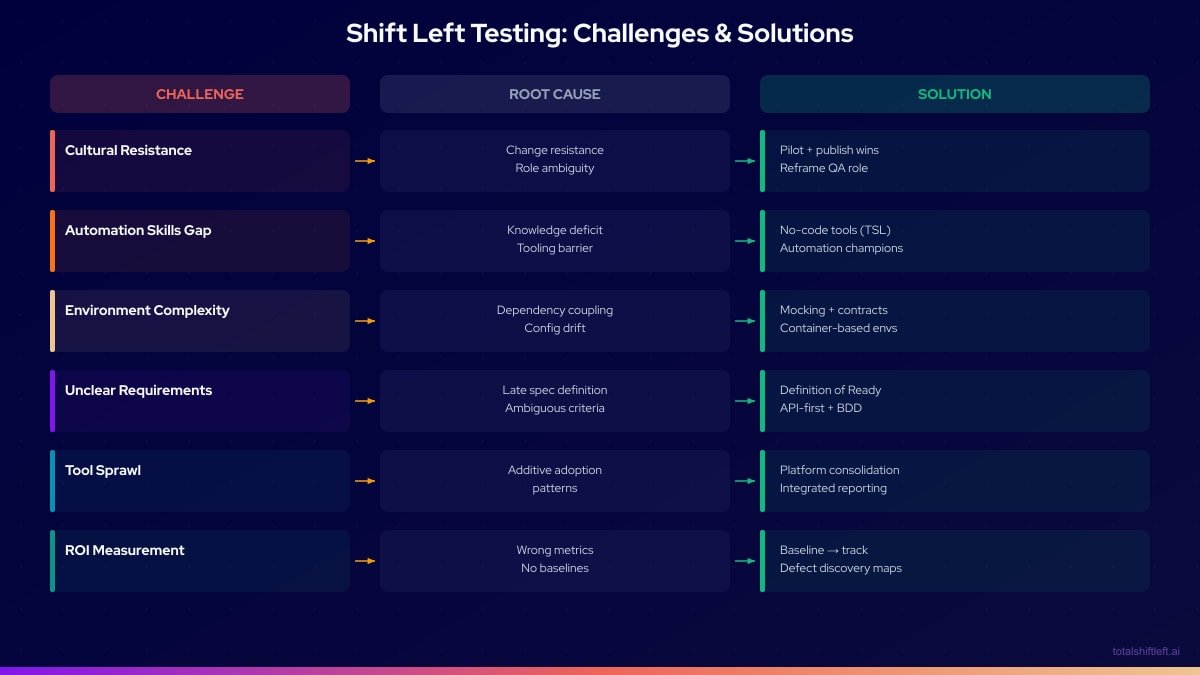
Challenge 1: Cultural Resistance
The Problem
Cultural resistance is the most common and most underestimated challenge in shift left adoption. It manifests differently across different roles:
- Developers may resist taking on testing responsibilities, viewing it as "QA's job" or as additional work that slows them down without providing proportional value.
- QA engineers may fear that automation and developer-owned testing will eliminate their roles or devalue their expertise.
- Engineering managers may resist the short-term productivity impact of teams learning new tools and practices.
- Product teams may resist the additional planning required to define testable acceptance criteria before development begins.
Cultural resistance often masquerades as practical objections: "We don't have time," "Our codebase isn't testable," "We tried automated testing before and it didn't work." These objections are worth taking seriously — they often contain real information about organizational readiness — but they should not be mistaken for insurmountable blockers.
The Solution
The most effective solution for cultural resistance is demonstrated value, not mandated process change. Mandates create compliance without conviction — teams go through the motions of shift left testing without committing to making it work. Demonstrated value creates genuine buy-in because teams can see the evidence themselves.
Step 1: Choose a willing pilot team. Find a team that is open to experimenting and has a problem that shift left testing can visibly address — perhaps a team dealing with repeated production incidents from API failures, or one whose release cycle is bottlenecked by a long manual regression phase.
Step 2: Implement quickly and show results. Use tools that provide immediate value with minimal friction, like Shift-Left API for API test generation from OpenAPI specs. The goal is to show tangible results — reduced pipeline failures, a production bug caught in CI, regression testing time reduced — within the first sprint.
Step 3: Publish the results internally. Share what happened: "Team X caught a breaking API change in CI that would have been a 4-hour production incident. Here is how." Make the benefit concrete and relatable.
Step 4: Redefine QA's role as quality architect. QA engineers who design quality systems, define test strategies, identify coverage gaps, and build automation infrastructure are more valuable — not less — in a shift left organization. Frame the role evolution explicitly and collaboratively.
Step 5: Make quality a team value, not a process mandate. The most resilient shift left cultures are those where quality is a shared value, not a compliance requirement. Leadership modeling — engineering managers writing tests, CTOs asking about coverage in architecture reviews — signals that quality commitment is genuine.
Challenge 2: Lack of Automation Skills
The Problem
Shift left testing requires automation. Manual testing, by definition, cannot be shifted left at scale — there are simply not enough human hours to run comprehensive tests on every commit and every pull request. Yet many engineering teams lack the automation engineering skills to build and maintain comprehensive test suites.
This challenge is particularly acute for:
- Teams that have historically relied on manual QA
- Organizations without dedicated automation engineers
- Teams using complex technology stacks or legacy systems with low testability
- Fast-growing teams where onboarding speed outpaces skills development
The automation skills gap creates a catch-22: teams need automation to shift left, but do not have the skills to build the automation they need.
The Solution
The most direct solution to the automation skills gap is using tools that minimize the amount of custom automation code that teams need to write. No-code and low-code testing platforms reduce the skill barrier significantly without sacrificing coverage or quality. Schema-aware test generation that reads your OpenAPI spec removes the need to hand-code assertions, which is where most of the automation-skill barrier actually sits.
Shift-Left API addresses this challenge directly for API testing — the most critical shift left testing layer for microservices teams. By importing an OpenAPI or Swagger specification, teams immediately get a comprehensive test suite covering all endpoints, HTTP methods, parameters, and response codes — without writing a single line of test code. Tests are generated automatically, configured for CI/CD execution, and ready to run in minutes.
The skills gap also shows up after generation — when someone has to work out why a run failed or what a project is missing. Shift-Left API's Project Assistant lets team members ask those questions in plain language ("which requirements have no passing test?", "why did last night's pack fail?") and answers from the project's own specs, requirements, tests and run history, with citations that open the item. It can also run a pack, generate or fix tests, or set up an auth profile, but only when the person accepts, under the same permissions and audit log as the equivalent button.
For teams that need to build broader automation skills, a structured approach works best:
- Start with the highest-leverage, lowest-skill techniques. API testing from specs (Shift-Left API), static analysis (SonarQube with default rule sets), and code coverage measurement are all high-value and low-skill-barrier. See our guide to the best no-code test automation tools in 2026 for platforms that lower the barrier further.
- Pair learning with doing. Designate an automation champion on each team — typically a QA engineer or a developer with interest in tooling — and give them dedicated time to build automation skills through a real implementation project, not just training.
- Adopt BDD to lower the test-writing barrier for non-technical contributors. Behavior-driven development tools like Cucumber allow QA engineers and product managers to define test scenarios in plain language (Gherkin), which developers then implement. This distributes test definition broadly while keeping implementation focused.
- Build an internal automation knowledge base. Document what works, with working examples. An internal wiki with real code snippets from your own codebase is far more useful than generic documentation.
Ready to shift left with your API testing?
Try our no-code API test automation platform free. Generate tests from OpenAPI, run in CI/CD, and scale quality.
Challenge 3: Test Environment Complexity
The Problem
Shift left testing, particularly integration testing, requires running code against its dependencies. In a microservices architecture, this means an individual service may depend on 5, 10, or 20 other services, databases, message queues, and external APIs. Creating a test environment that includes all of these dependencies — in a state that is consistent, reproducible, and available on demand in CI — is genuinely complex.
Common manifestations of this challenge include:
- Integration tests that only run reliably in a shared staging environment (which is always in use by someone)
- Test environments that take 20+ minutes to provision, making CI feedback loops unacceptably slow
- Environment configuration drift that makes tests pass locally but fail in CI
- External service dependencies that are unavailable, unreliable, or expensive to call in test contexts
- Test data management — ensuring tests have the right data in the right state before executing
The Solution
The core architectural solution to test environment complexity is service isolation through mocking and contract testing. Instead of requiring all dependent services to be running, teams use mocks to simulate the behavior of dependencies and contract tests to verify that the mocks accurately represent the real services.
Mock services for fast, isolated testing. Mock servers simulate the HTTP responses of dependent APIs, allowing integration tests to run without real service availability. Shift-Left API includes built-in mock server capabilities, making it straightforward to mock API dependencies for test isolation. WireMock and MockServer are strong alternatives for custom mock implementations.
Contract testing to validate mocks. Consumer-driven contract testing with tools like Pact verifies that mock expectations are aligned with actual service behavior. The consumer defines what responses it expects; the provider verifies that it can deliver those responses. This closes the loop between mocked and real behavior.
Containerization for environment reproducibility. Docker and Docker Compose enable teams to define test environments as code. Every CI run starts with an identical, fresh environment, eliminating configuration drift and "works on my machine" failures. Kubernetes-based test environment management (e.g., with ephemeral namespaces) scales this approach to complex microservices environments.
Test data management as code. Use database migrations and seed scripts to define test data state declaratively. Test suites should create and clean up their own data, rather than depending on a pre-existing data state that may have changed.
Challenge 4: Unclear Requirements
The Problem
Shift left testing starts at the requirements stage — tests cannot be defined before requirements are defined. When requirements are unclear, late, or frequently changing, testing cannot shift left effectively. Teams find themselves writing tests against assumptions that turn out to be wrong, or unable to define acceptance criteria before implementation is underway.
This challenge reflects a broader problem: if requirements arrive as part of a sprint ticket on the day development begins, the testing cannot have shifted left at all. The requirements themselves are the rightmost constraint.
The Solution
The solution to unclear requirements is a process change, not a tool change. Shift left testing requires investing in the definition process before implementation begins.
Adopt a Definition of Ready. Before any story or ticket can be picked up for development, it should meet a "Definition of Ready" that includes: clear acceptance criteria in the form of user stories or BDD scenarios, well-defined API contracts or schema specifications, identified edge cases and failure modes, and agreement on non-functional requirements (performance thresholds, security requirements).
Use specification-by-example and BDD. Behavior-driven development practices use concrete examples to make requirements unambiguous. "The API should return user details" is ambiguous. "When a GET request is made to /users/{id} with a valid user ID, the API returns a 200 response with the user's name, email, and role" is testable. The act of writing BDD scenarios surfaces ambiguities early, when they are cheap to resolve.
Let tooling read the requirements you already have. Requirements are rarely missing outright; they are scattered across a BRD, a spreadsheet and a backlog. Shift-Left API can extract requirements from several business documents at once — recording where each one came from, counting duplicates once, and holding conflicting statements for a person to resolve instead of guessing — and imports user stories from Jira, Azure DevOps, Gherkin or plain text. The conflicts it surfaces are exactly the ambiguities a Definition of Ready is meant to catch, found before a sprint starts rather than during it.
Shift the refinement process left. Many teams run sprint planning and refinement in the week a sprint begins. Moving refinement to happen at least one sprint ahead — so that stories are well-defined before they are scheduled for development — gives QA engineers and developers time to define tests before implementation starts.
Define API contracts before implementation. API-first development — where the OpenAPI/Swagger specification is defined and reviewed before any implementation begins — is a powerful shift left practice. The spec becomes the contract, the documentation, and the source of generated tests. Shift-Left API makes this especially powerful: once the spec is defined, tests are immediately available and can run against a mock server while the implementation is being built.
Challenge 5: Tool Sprawl
The Problem
Shift left testing involves multiple layers of testing across the development lifecycle: static analysis, unit tests, API tests, integration tests, contract tests, performance tests, security scans, and end-to-end tests. Without deliberate platform strategy, teams end up with a different tool for each layer, each with its own configuration, reporting format, CI integration, and maintenance burden.
Tool sprawl creates:
- High maintenance overhead as each tool requires separate expertise and configuration
- Fragmented visibility into overall quality — no unified view of test coverage and results
- Integration complexity as tools do not share data or communicate with each other
- Inconsistent developer experience — different tools, different commands, different reports
- License and cost management complexity
The Solution
The solution to tool sprawl is intentional platform consolidation, not elimination of testing layers. The goal is to cover every necessary testing type with the minimum number of well-integrated tools.
Audit your current tool landscape. List every testing tool in use, what it tests, who maintains it, how it integrates with CI/CD, and what it costs. Identify overlapping capabilities and tools that solve the same problem.
Establish a primary testing platform for each layer. For each testing layer — unit, API, contract, security, performance — choose one primary tool that meets the team's needs and commit to it. Resist the temptation to add secondary tools unless the primary one genuinely cannot address a specific need.
Prioritize platform tools over point solutions. Platforms that cover multiple testing needs with integrated reporting reduce sprawl naturally. Shift-Left API provides API test generation, test execution, mock servers, and analytics in a single platform — replacing multiple point solutions for the API testing layer. Two paid add-ons (both included in the Trial) extend that to layers that usually bring their own tools: API security testing generates OWASP-mapped checks beside the functional tests in the same project, and API load testing builds performance runs from those same tests — no second copy of endpoints, environments or credentials to maintain.
Standardize CI/CD integration. All tools should integrate with your CI/CD platform (GitHub Actions, GitLab CI, Jenkins) through standard mechanisms. Define a consistent test execution pattern across all tools: run, report, gate. This reduces the per-tool integration burden and creates a uniform experience. For step-by-step guidance, see how to build a CI/CD testing pipeline.
Centralize test reporting. Invest in a testing dashboard that aggregates results from all tools in a single view. TestRail, Allure Report, and similar tools can consume results from multiple testing frameworks and provide unified reporting. Visibility into the complete quality picture — not just individual tool outputs — is essential for data-driven quality decisions.
Challenge 6: Measuring ROI
The Problem
Shift left testing requires investment — in tools, in training, in time during the adoption period. Engineering leaders who champion this investment need to demonstrate its returns, but measuring the ROI of shift left testing is not straightforward.
Common measurement failures include:
- Tracking test count rather than defect outcomes (more tests ≠ better quality)
- Measuring code coverage without correlating it to defect escape rate
- Failing to establish baseline metrics before implementing shift left changes
- Not tracking the full cost of defects (time-to-fix plus customer impact plus response overhead)
- Attributing quality improvements to shift left testing without controlling for other variables
The Solution
Effective ROI measurement for shift left testing requires establishing baselines before implementation, tracking the right metrics during implementation, and attributing improvements to specific changes.
Establish pre-implementation baselines. Before adopting any new shift left practice, document: the number of production incidents per quarter attributed to code defects, the average time from defect introduction to detection, the engineering hours spent on rework and incident response, the defect escape rate (percentage of defects discovered in production vs. pre-production), and the current release frequency.
Track defect discovery by pipeline stage. The most direct measure of shift left effectiveness is where defects are discovered. A defect caught in unit tests costs approximately 10x less than one caught in production. Track the distribution of defect discovery across pipeline stages and watch it shift left over time as the testing investment matures.
Free PDF (10 pages)
Shift Left Testing Playbook
Move testing earlier in your SDLC with a proven adoption roadmap. Includes CI/CD architecture, tool stack recommendations, and metrics to track success.
Download FreeCalculate time savings from reduced rework. Every defect caught in CI instead of production represents avoided rework. If the average production incident costs 8 hours of engineering time (investigation, fix, deployment, verification) and your shift left investment catches 12 incidents per quarter in pre-production instead, that is 96 hours per quarter of recovered engineering capacity.
Connect to business metrics. Tie quality metrics to business outcomes where possible. Reduced production incidents translate to higher uptime. Higher uptime translates to lower churn (for SaaS) or higher transaction success rates (for e-commerce). These downstream connections make the ROI case more compelling for business stakeholders.
Shift-Left API's analytics dashboard provides built-in visibility into test run results, coverage trends, and API health over time — giving teams the data they need to demonstrate shift left ROI concretely.
Challenge Resolution Architecture
Tools That Help Overcome Shift Left Challenges
For a detailed comparison of platforms purpose-built for shift left adoption, see our best shift left testing tools guide.
| Challenge | Recommended Tools | How They Help |
|---|---|---|
| Automation Skills Gap | Shift-Left API, Katalon, Karate | No-code/low-code test generation |
| Environment Complexity | WireMock, MockServer, Docker, TSL Mocks | Service isolation through mocking |
| Contract Testing | Pact, Spring Cloud Contract | Validates mock accuracy against real services |
| Static Analysis | SonarQube, ESLint, Semgrep | Low-barrier shift left at code commit stage |
| ROI Measurement | Shift-Left API Analytics, Allure, TestRail | Unified visibility into quality metrics |
| CI/CD Integration | GitHub Actions, GitLab CI, Jenkins | Automated quality gate enforcement |
| BDD/Requirements | Cucumber, SpecFlow, Behave | Plain-language test specification |
Real Implementation Example: Overcoming Multiple Challenges Together
Problem
A 25-person engineering team at a B2B SaaS company faced multiple simultaneous shift left challenges when leadership mandated a quality improvement initiative. Developers were resistant, citing lack of time. The QA team of 3 was overwhelmed with manual regression testing and had no capacity to build automation. The test environment required 8 running services and took 30 minutes to provision in CI. API specs were often written after implementation was complete, making spec-driven testing impossible. The team was using 6 different testing tools with no unified reporting.
Solution and Sequencing
Rather than addressing all challenges simultaneously, the team prioritized:
Month 1 — Reduce friction, show wins. Introduced Shift-Left API for API testing (low skill barrier) and integrated it with GitHub Actions. Established API-first development for all new services — specs written before implementation. Published results internally after the first sprint: "We caught 3 bugs in CI that would have required staging investigation."
Month 2 — Tackle environment complexity. Dockerized test environments, reducing provisioning time from 30 minutes to under 3 minutes. Added WireMock configurations for the 5 most critical external dependencies. This unblocked integration testing in CI.
Month 3 — Consolidate tools. Audited the 6 existing tools. Deprecated 2 that were redundant with Shift-Left API capabilities. Standardized on 4 tools with clear, non-overlapping responsibilities. Implemented Allure for unified reporting.
Month 4 — Establish ROI baseline and measurement. With pre-adoption metrics documented (from a team retrospective analysis of the previous 6 months), began tracking defect discovery by stage, time-to-detect, and engineering hours on rework.
Results After 6 Months
- Developer resistance reduced significantly as team members saw tangible pipeline improvements
- CI pipeline time for API tests: 3 minutes (vs. 30-minute manual regression cycles)
- Defect escape rate reduced from 28% to 17% in 6 months
- API test coverage: from 40% of endpoints to 91% within 2 months
- QA team freed from 65% of manual regression work; redirected to exploratory testing and strategy
- Engineering hours on rework: estimated 30% reduction based on before/after defect counts
Common Mistakes in Addressing These Challenges
Mistake 1: Trying to solve all challenges at once. Teams that attempt simultaneous cultural change, tool adoption, environment migration, and process reform typically fail at all of them. Prioritize and sequence.
Mistake 2: Leading with mandates instead of pilots. "All developers must write tests" creates resentment without capability. A successful pilot followed by voluntary adoption creates genuine buy-in.
Mistake 3: Treating tool adoption as strategy completion. Buying a testing tool is not the same as implementing a shift left testing strategy. Tools are enablers; strategy requires process, culture, and metrics alongside tooling.
Mistake 4: Skipping baseline measurement. Teams that do not measure before they start cannot prove improvement. Even a rough retrospective baseline is better than nothing.
Mistake 5: Allowing flaky tests to persist. Flaky tests are infrastructure that undermines itself. Every flaky test reduces team confidence in the test suite, leading to ignored failures and, eventually, a quality regression.
Best Practices for Sustainable Shift Left Adoption
- Sequence challenge resolution by impact and feasibility. Address the highest-impact, lowest-effort challenges first to build momentum. Automation skill gaps addressed with no-code tools and cultural resistance addressed with visible wins are typically the highest-leverage starting points.
- Make the first pilot undeniably successful. Choose the pilot team and scope carefully. The first shift left win needs to be visible and compelling enough to drive voluntary adoption by other teams.
- Invest in platform-level quality infrastructure. Shared CI/CD pipelines, shared testing environments (as code), shared mock configurations, and shared reporting platforms reduce the per-team implementation burden and enable organizational scaling. A solid DevOps testing strategy defines this infrastructure at the organizational level.
- Define quality standards that apply to all teams. Consistency prevents the emergence of quality tiers within an organization. Define minimum test coverage standards, required CI quality gates, and mandatory test types that apply across all engineering teams.
- Review and improve continuously. Shift left maturity is not a destination. Review quality metrics quarterly, identify the highest-impact improvement opportunities, and implement them iteratively.
- Pair new practices with skills development. When introducing new testing tools or practices, provide structured learning opportunities — not just documentation, but hands-on workshops and pairing with more experienced practitioners.
Shift Left Challenge Resolution Checklist
- ✔ Cultural resistance addressed through pilot team wins and published results, not mandate
- ✔ Automation skills gap mitigated with no-code tools (Shift-Left API for API testing)
- ✔ Test environments containerized and mock servers configured for CI isolation
- ✔ Definition of Ready established, requiring testable acceptance criteria before sprint start
- ✔ Testing tool landscape audited and consolidated; unified reporting in place
- ✔ Pre-adoption baseline metrics documented; defect discovery by stage tracked
- ✔ Flaky test policy established — fix or delete within one sprint of identification
- ✔ QA engineer role reframed as quality architect; freed from manual regression cycles
See also: contract testing in our learn hub for the underlying concept.
Fix the two challenges that stop most adoptions
"Tests are too slow to run early" and "developers cannot run the dependencies locally" account for most stalled shift-left programmes. Both have concrete fixes. Speed first — split the suite so the pull request only waits for what it needs:
# .github/workflows/pr.yml — the fast lane is the only thing blocking a merge
jobs:
  fast:
    runs-on: ubuntu-latest
    timeout-minutes: 5
    strategy: { matrix: { shard: [1, 2, 3, 4] } }
    steps:
      - uses: actions/checkout@v4
      - run: pytest -m "not slow" --splits 4 --group ${{ matrix.shard }}
  slow:
    runs-on: ubuntu-latest
    steps: [{ uses: actions/checkout@v4 }, { run: pytest -m slow }]
    # reported, not required — merges do not wait for it
Then the environment problem: give every developer the real dependencies on their own machine, so "it needs staging" stops being a reason to defer the test:
# conftest.py — same containers locally and in CI, no shared staging
import pytest
from testcontainers.postgres import PostgresContainer
from testcontainers.redis import RedisContainer

@pytest.fixture(scope="session")
def infra():
    with PostgresContainer("postgres:16-alpine") as pg, RedisContainer() as rd:
        yield {"database_url": pg.get_connection_url(),
               "redis_url": rd.get_client().connection_pool.connection_kwargs}
Frequently asked questions about shift-left testing
What are the most common challenges in shift left testing adoption?
The most common shift left testing challenges are cultural resistance from developers and QA teams, lack of automation skills to build and maintain test suites, test environment complexity that makes early integration testing difficult, unclear or late requirements that prevent test definition, tool sprawl that creates fragmented quality infrastructure, and difficulty measuring ROI to justify ongoing investment.
How do teams overcome resistance to shift left testing?
Cultural resistance to shift left testing is best addressed through demonstrated value rather than mandated process change. Start with a single team pilot, measure and publish results (defect escape rate, time saved), involve both developers and QA engineers as designers of the new process, and ensure leadership actively champions the quality-as-shared-responsibility message.
How can teams implement shift left testing without deep automation expertise?
No-code and low-code testing platforms like Shift-Left API make shift left testing accessible without requiring specialized automation engineering skills. By automatically generating API test suites from OpenAPI/Swagger specifications, teams can achieve comprehensive coverage without writing test code from scratch. This dramatically lowers the skill barrier to shift left adoption.
How do you measure the ROI of shift left testing?
Measure shift left ROI by tracking defect discovery by pipeline stage (pre-production vs. production), mean time to detect and resolve defects, production incident rates over time, engineering hours spent on rework and incident response, and release frequency. Comparing these metrics before and after shift left investment provides concrete ROI evidence.
Sources and further reading
- DORA State of DevOps research — the multi-year dataset behind the four delivery metrics.
- NIST SP 800-218 (SSDF) — the secure software development practices auditors map to.
- Google Testing Blog — Google's engineering write-ups on test sizing and flakiness.
Key takeaways
- Every shift left testing challenge has a known solution. Cultural resistance yields to demonstrated value.
- Automation skill gaps yield to no-code tooling. Environment complexity yields to containerization and mocking.
- Unclear requirements yield to Definition of Ready and API-first practices.
- Tool sprawl yields to deliberate consolidation. ROI measurement challenges yield to baseline metrics and defect tracking by pipeline stage.
The teams that capture the full benefits of shift left testing — reduced costs, faster releases, fewer production incidents — are not the ones that avoid these challenges. They are the ones that anticipate them, address them systematically, and build on each resolved challenge to advance their quality maturity. Shift-Left API eliminates the automation skill gap for API testing immediately, giving teams a high-confidence starting point for their shift left journey. Start your free trial to generate comprehensive API tests from your existing OpenAPI/Swagger specifications and see shift left in action within hours.
Related: What Is Shift Left Testing? Complete Guide | Shift Left Testing Strategy | Benefits of Shift Left Testing | Best Shift Left Testing Tools | How to Build a CI/CD Testing Pipeline | DevOps Testing Strategy | No-code API testing platform | Start Free Trial
Continue learning
Go deeper in the Learning Center
Hands-on lessons with runnable code against our live sandbox.
Ready to shift left with your API testing?
Import your OpenAPI spec and get a runnable test suite, in our cloud or on your own infrastructure.