
Testing Kafka-Based Microservices: Complete Guide
Quick answer
Kafka microservices testing verifies that producers, consumers, and stream processors correctly serialize, route, process, and evolve schemas across asynchronous event pipelines — problems that don't surface with synchronous HTTP testing. The three-level approach is unit tests for serialization logic, Testcontainers-based integration tests against a real broker, and targeted end-to-end tests for multi-service event flows, backed by Schema Registry compatibility checks in CI.
Reviewed by Parveen Kumari
Kafka microservices testing verifies that event-driven services correctly produce, consume, and process messages across distributed streaming pipelines. It covers producer serialization, consumer processing logic, schema compatibility, offset management, and end-to-end event flow validation using tools like Testcontainers and EmbeddedKafka.
Kafka microservices testing is the practice of validating the correctness, reliability, and performance of services that communicate through Apache Kafka topics — ensuring that producers serialize and route messages correctly, consumers process events with proper offset management, schemas evolve without breaking downstream services, and end-to-end event flows complete within defined latency and ordering guarantees.
You deploy a new version of your payment service on Tuesday afternoon. By Wednesday morning, the analytics team reports that revenue dashboards have been blank for 12 hours. The root cause: a schema change in the payment-completed event broke Avro deserialization in the analytics consumer. No test caught it because the producer and consumer are owned by different teams, deployed independently, and connected only by a Kafka topic.
This failure pattern is endemic in event-driven architectures. Kafka decouples services at runtime, but it does not decouple failure modes at deployment time. A producer schema change, a partition key modification, or an offset management bug can cascade silently across every downstream consumer.
Kafka microservices testing addresses this gap. It verifies that producers, consumers, and streaming processors behave correctly both in isolation and as part of the broader event pipeline. When integrated into your CI/CD testing pipeline, Kafka tests catch breaking changes before they reach production — where silent data loss is far more expensive than a failed build.
This guide covers everything you need to test Kafka-based microservices in 2026: producer and consumer testing patterns, schema evolution validation, Testcontainers and EmbeddedKafka setup, end-to-end event flow verification, and integration with your broader microservices testing strategy.
In this guide
- What Is Kafka Microservices Testing?
- Why Kafka Testing Is Critical for Microservices
- Key Components of Kafka Testing
- Kafka Testing Architecture
- Tools for Testing Kafka Microservices
- Real-World Example: Order Event Pipeline Testing
- Kafka testing challenges and how to solve them
- Best Practices for Kafka Microservices Testing
- Kafka Testing Checklist
- Kafka testing FAQ
What Is Kafka Microservices Testing?
Kafka microservices testing is the systematic validation of services that communicate through Apache Kafka topics. Unlike synchronous HTTP-based communication, Kafka introduces asynchronous, decoupled message passing — which creates distinct testing challenges around serialization, ordering, offset management, and eventual consistency.
The Kafka Communication Model
In a Kafka-based architecture, services interact through three primary roles:
- Producers: Services that publish messages to Kafka topics
- Consumers: Services that subscribe to topics and process messages
- Stream Processors: Services that consume from one topic, transform data, and produce to another topic
Each role requires different testing strategies:
| Role | What to Test | Key Risks |
|---|---|---|
| Producer | Serialization, topic routing, partition keys, headers | Schema violations, wrong topic, missing fields |
| Consumer | Deserialization, business logic, offset commits, error handling | Processing failures, offset loss, poison pills |
| Stream Processor | Transformation logic, windowing, state stores, output correctness | State corruption, late event handling, topology errors |
| End-to-End | Complete event flow across multiple services | Event ordering, data consistency, latency |
How Kafka Testing Differs from REST API Testing
Traditional API testing deals with synchronous request-response cycles. Kafka testing introduces additional complexity:
- Asynchronous verification: You cannot assert on a response immediately. You must wait for a consumer to process the message and verify the outcome asynchronously.
- Ordering guarantees: Kafka guarantees ordering only within a partition. Tests must account for partition key assignment and multi-partition behavior.
- At-least-once delivery: Without idempotent consumers, tests must verify deduplication logic handles redelivery correctly.
- Schema coupling: Producer and consumer schemas must remain compatible across independent deployments.
Why Kafka Testing Is Critical for Microservices
Silent Data Loss
Unlike HTTP calls that return error codes immediately, Kafka failures can be silent. A producer serializing a message with a field removed does not get an error — the message is published successfully. The consumer fails to deserialize it and, depending on error handling, may skip the message, send it to a dead letter queue, or crash entirely. Without consumer-side testing, this data loss goes undetected.
Schema Evolution Breakage
Kafka services evolve independently. When the producer team adds a required field or renames an existing one, every consumer must be able to handle both the old and new schema. Schema Registry compatibility checks catch some issues, but they do not verify that consumer business logic correctly processes the new schema.
Offset Management Failures
Incorrect offset commits can cause consumers to reprocess messages (duplicate processing) or skip messages (data loss). Testing offset commit behavior under failure conditions — consumer crashes, rebalances, broker failures — is critical for data integrity.
Cross-Team Deployment Risks
In organizations with multiple teams producing and consuming from shared topics, a deployment by one team can break consumers owned by other teams. This is analogous to the problem that contract testing for microservices solves for HTTP APIs — but applied to event schemas.
Key Components of Kafka Testing
Producer Testing
Producer testing validates that your service publishes correctly formatted messages to the right topics:
What to verify:
- Message serialization matches the registered schema (Avro, Protobuf, or JSON Schema)
- Partition key assignment routes related messages to the same partition
- Message headers contain required metadata (correlation ID, timestamp, source service)
- Error handling works correctly when the broker is unavailable
- Transactional producers commit or abort atomically
Testing approach: Use Testcontainers or EmbeddedKafka to start a real broker, trigger the producer through its normal code path (e.g., an HTTP endpoint or a domain event), then consume from the target topic and assert on the published message.
Ready to shift left with your API testing?
Try our no-code API test automation platform free. Generate tests from OpenAPI, run in CI/CD, and scale quality.
Consumer Testing
Consumer testing validates that your service correctly processes messages from Kafka topics:
What to verify:
- Deserialization handles current and previous schema versions
- Business logic processes the message correctly (database writes, API calls, state updates)
- Offset commits happen after successful processing (not before)
- Poison pill messages (unparseable or malformed) route to the dead letter queue
- Consumer group rebalancing does not cause message loss or duplication
Schema Compatibility Testing
Schema compatibility testing ensures that producer schema changes do not break existing consumers:
What to verify:
- New schemas pass Schema Registry compatibility checks (BACKWARD, FORWARD, or FULL)
- Consumers can deserialize messages produced with the new schema
- Default values populate correctly for new fields added by producers
- Removed fields do not break consumer logic that depends on them
End-to-End Event Flow Testing
End-to-end testing validates the complete event pipeline across multiple services:
What to verify:
- A trigger event (e.g., order placed) propagates correctly through all downstream consumers
- Data consistency across services after the event pipeline completes
- Latency from production to consumption meets SLO targets
- Event ordering is preserved where required
Kafka Testing Architecture
A well-structured Kafka testing architecture operates at three levels:
**Leve
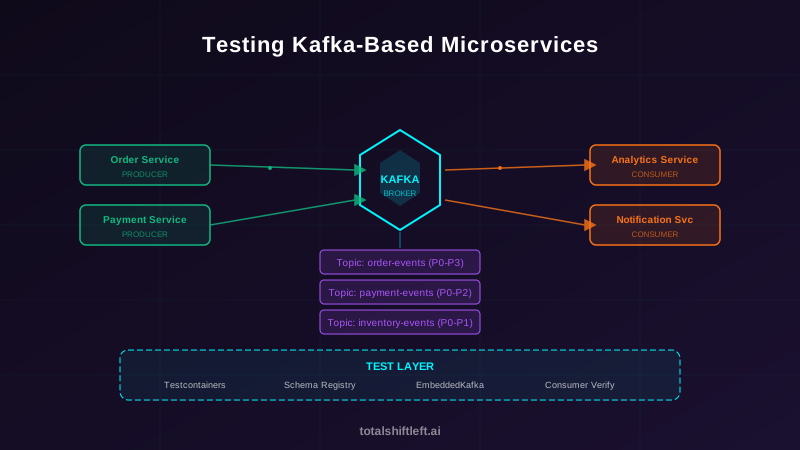
l 1: Unit Tests (No Broker)**
Test serialization logic, message builders, and consumer processing functions in isolation without a running Kafka broker. Use the kafka-streams-test-utils TopologyTestDriver for stream processing topology tests.
Level 2: Integration Tests (Testcontainers) Start a real Kafka broker (and optionally Schema Registry) using Testcontainers. Test the full produce-consume cycle within a single test class. This is where you verify serialization, deserialization, offset management, and error handling against a real broker.
Level 3: End-to-End Tests (Multi-Service) Deploy multiple services with a shared Kafka cluster in a test environment. Trigger a business event and verify the complete pipeline. Use this level sparingly — it is slow and brittle, but necessary for validating cross-service flows. A solid API testing strategy for microservices helps you determine the right ratio between these levels.
┌─────────────────────────────────────────────────────┐
│                   E2E Tests (5%)                     │
│         Multi-service event flow validation          │
├─────────────────────────────────────────────────────┤
│             Integration Tests (30%)                  │
│    Testcontainers: real broker, single service       │
├─────────────────────────────────────────────────────┤
│               Unit Tests (65%)                       │
│  Serialization, handlers, topology (no broker)       │
└─────────────────────────────────────────────────────┘
Tools for Testing Kafka Microservices
| Tool | Type | Best For | Language Support |
|---|---|---|---|
| Testcontainers | Integration testing | Real Kafka broker in Docker | Java, Python, Node.js, Go, .NET |
| EmbeddedKafka | Integration testing | Spring Boot Kafka applications | Java (Spring) |
| kafka-streams-test-utils | Unit testing | Kafka Streams topology testing | Java |
| MockSchemaRegistry | Schema testing | Schema compatibility without external registry | Java |
| k6 + xk6-kafka | Load testing | Kafka producer/consumer throughput testing | JavaScript (k6) |
| Kafdrop / AKHQ | Debugging | Visual topic inspection during test development | Web UI |
| Shift-Left API | API testing | Testing HTTP APIs that trigger Kafka events | No-code platform |
| Conduktor Testing | E2E testing | Full Kafka pipeline validation | GUI-based |
Testcontainers Setup Example
Testcontainers spins up a real Kafka broker in Docker for your integration tests. This gives you the most realistic testing environment while keeping tests isolated and reproducible:
@Testcontainers
class OrderEventProducerTest {

    @Container
    static KafkaContainer kafka = new KafkaContainer(
        DockerImageName.parse("confluentinc/cp-kafka:7.6.0")
    );

    @Test
    void shouldPublishOrderCreatedEvent() {
        // Configure producer with Testcontainers broker
        Properties props = new Properties();
        props.put(BOOTSTRAP_SERVERS_CONFIG, kafka.getBootstrapServers());
        props.put(KEY_SERIALIZER_CLASS_CONFIG, StringSerializer.class);
        props.put(VALUE_SERIALIZER_CLASS_CONFIG, JsonSerializer.class);

        // Trigger the producer through your service
        OrderService service = new OrderService(props);
        service.createOrder(new Order("item-123", 2, 49.99));

        // Consume and verify the published message
        ConsumerRecord<String, OrderCreatedEvent> record =
            consumeOneRecord("order-events", kafka.getBootstrapServers());

        assertThat(record.value().getItemId()).isEqualTo("item-123");
        assertThat(record.value().getQuantity()).isEqualTo(2);
        assertThat(record.key()).isNotNull(); // Partition key assigned
    }
}
Real-World Example: Order Event Pipeline Testing
Consider an e-commerce system where placing an order triggers a pipeline across four services:
- Order Service produces
order-createdevent - Inventory Service consumes
order-created, reserves stock, producesinventory-reserved - Payment Service consumes
inventory-reserved, processes payment, producespayment-completed - Notification Service consumes
payment-completed, sends confirmation email
Unit test layer: Each service tests its message handler in isolation. The Order Service tests that createOrder() builds a correct OrderCreatedEvent. The Inventory Service tests that its handler correctly reserves stock given a valid event.
Integration test layer: Each service runs against Testcontainers Kafka. The Inventory Service test publishes an order-created event, verifies the handler processes it, and checks that an inventory-reserved event appears on the output topic.
End-to-end test layer: A test environment runs all four services with a shared Kafka cluster. The test places an order through the Order Service API and then verifies — within a timeout — that a confirmation email was sent by the Notification Service. Expressing this saga as a multi-step integration test workflow — trigger the API call, poll for each downstream event, then assert the final state — keeps the whole chain in one maintainable test rather than scattered scripts. This validates the complete saga across all services.
Free 1-page checklist
API Testing Checklist for CI/CD Pipelines
A printable 25-point checklist covering authentication, error scenarios, contract validation, performance thresholds, and more.
Download FreeSchema compatibility layer: Before deploying any service, CI runs schema compatibility checks against the Schema Registry. If the Order Service modifies the order-created schema, the check verifies that the Inventory Service and Payment Service can still deserialize it.
Kafka testing challenges and how to solve them
| Challenge | Impact | Solution |
|---|---|---|
| Asynchronous assertion timing | Tests pass/fail based on timing, not correctness | Use polling assertions with configurable timeouts (Awaitility, eventually blocks) |
| Test isolation with shared topics | Tests interfere with each other when sharing topic names | Use unique topic names per test (UUID suffix) or isolated consumer groups |
| Schema Registry in tests | Requires separate container for schema validation | Use MockSchemaRegistry for unit tests, Testcontainers Schema Registry for integration |
| Slow Kafka container startup | Integration tests take 15-30s to start the broker | Use @Container with static fields to share containers across tests, or Singleton pattern |
| Testing consumer rebalancing | Hard to simulate rebalance in tests | Use multi-consumer test setups with programmatic partition assignment |
| Exactly-once verification | Difficult to prove no duplicates under failure | Track message IDs in a test database, simulate broker failures, verify counts |
| Cross-team schema coordination | Teams break each other's consumers | Implement schema compatibility as a CI gate using Schema Registry API |
Best Practices for Kafka Microservices Testing
- Use real Kafka brokers in integration tests. Mocking Kafka producers and consumers gives false confidence. Testcontainers provides a real broker with minimal overhead.
- Test schema compatibility in CI. Every schema change should pass compatibility checks against the Schema Registry before merging. Treat schema breaks like compile errors.
- Verify dead letter queue routing. Publish malformed messages (invalid schema, missing required fields) and verify they land in the DLQ with proper error metadata.
- Test consumer idempotency. Publish the same message twice and verify the consumer handles it correctly — whether through deduplication, upsert logic, or idempotent processing.
- Use unique topic names per test. Append a UUID to topic names in integration tests to prevent cross-test contamination when running tests in parallel.
- Test offset commit behavior under failure. Simulate consumer crashes after processing but before committing offsets. Verify that messages are reprocessed correctly on restart.
- Validate partition key assignment. If your business logic depends on ordering (e.g., all events for the same order go to the same partition), test that the partition key strategy is correct.
- Include Kafka tests in your CI/CD pipeline. Kafka integration tests should run on every pull request, not just nightly. Modern Testcontainers startup is fast enough for PR-level testing. This aligns with a proper DevOps testing strategy.
- Test with production-like message volumes. Unit tests with single messages do not catch issues that only appear under load — batching behavior, memory pressure, consumer lag.
- Monitor consumer lag in staging. Even after tests pass, monitor consumer lag in staging environments to catch performance regressions that tests may miss.
Kafka Testing Checklist
Producer Testing
- ✔ Messages serialize correctly using the registered schema
- ✔ Messages are published to the correct topic
- ✔ Partition keys are assigned correctly for ordering-sensitive events
- ✔ Message headers contain required metadata (correlation ID, timestamp)
- ✔ Transactional producers commit and abort correctly
- ✔ Error handling works when the broker is unavailable
Consumer Testing
- ✔ Consumers deserialize current and previous schema versions
- ✔ Business logic processes messages correctly
- ✔ Offset commits happen after successful processing
- ✔ Poison pill messages route to the dead letter queue
- ✔ Consumer group rebalancing does not cause message loss
- ✔ Idempotent processing handles duplicate messages
Schema Testing
- ✔ New schemas pass Schema Registry compatibility checks
- ✔ Default values populate correctly for new fields
- ✔ Consumers handle schema evolution (added/removed fields)
- ✔ Schema compatibility CI gate blocks breaking changes
End-to-End Testing
- ✔ Complete event pipeline triggers and completes within SLO
- ✔ Data consistency verified across all downstream services
- ✔ Event ordering preserved for partition-keyed messages
- ✔ Failure scenarios (service down, broker restart) handled gracefully
Kafka testing FAQ
How do you test Kafka producers in microservices?
Test Kafka producers by verifying message serialization, correct topic routing, partition key assignment, and schema compliance. Use EmbeddedKafka or Testcontainers to spin up a real Kafka broker in your test environment, then consume messages from the target topic and assert on message content, headers, and metadata.
What is the best way to test Kafka consumers?
Test Kafka consumers by publishing known messages to a test topic and verifying the consumer processes them correctly. Validate deserialization, business logic execution, offset commits, error handling, and dead letter queue routing. Testcontainers with a real Kafka broker provides the most realistic consumer testing.
How do you test Kafka schema evolution in microservices?
Test schema evolution by running compatibility checks against the Schema Registry before deploying changes. Use Avro, Protobuf, or JSON Schema with backward/forward compatibility modes. Write tests that produce messages with the new schema and verify existing consumers can still deserialize them correctly.
What tools are used for Kafka microservices testing?
Common tools include Testcontainers (real Kafka in Docker), EmbeddedKafka (in-process broker for Spring), kafka-streams-test-utils (topology testing), Schema Registry mock servers, and k6 or Gatling for Kafka load testing. Shift-Left API can validate the HTTP APIs that trigger Kafka event production.
How do you test exactly-once semantics in Kafka?
Test exactly-once semantics by enabling idempotent producers and transactional writes, then simulating failures (broker restarts, network partitions) during message production. Verify that consumers receive each message exactly once by checking message counts and deduplication logic after recovery.
Sources and further reading
- Apache Kafka documentation — the broker semantics async tests have to respect.
- Confluent Schema Registry — schema compatibility checks for event payloads.
- Testcontainers — throwaway real dependencies for integration tests.
Key takeaways
- Kafka-based microservices introduce testing challenges that traditional HTTP API testing does not address.
- Asynchronous message passing, schema evolution, offset management, and partition ordering all require deliberate testing strategies and specialized tooling.
- The organizations that test Kafka effectively follow a consistent pattern: unit tests for serialization and handler logic, integration tests against real brokers using Testcontainers, schema compatibility gates in CI, and targeted end-to-end tests for critical business flows.
- This layered approach catches the majority of Kafka-related failures before they reach production.
- If your microservices communicate through Kafka and your current testing strategy does not cover producer verification, consumer processing, and schema compatibility, you are operating with a significant blind spot.
- Start by adding Testcontainers to your integration test suite and schema compatibility checks to your CI pipeline.
Ready to strengthen your microservices testing strategy? Start your free trial with Shift-Left API to validate the HTTP APIs that trigger your Kafka event pipelines — catching issues before they propagate through your streaming architecture.
Related Articles: Microservices Testing: The Complete Guide | API Testing: The Complete Guide | Testing Message Queue Systems in Microservices | Contract Testing for Microservices | API Testing Strategy for Microservices | DevOps Testing Strategy
Ready to shift left with your API testing?
Try our no-code API test automation platform free.