
Testing Message Queue Systems in Microservices: Practical Guide
Quick answer
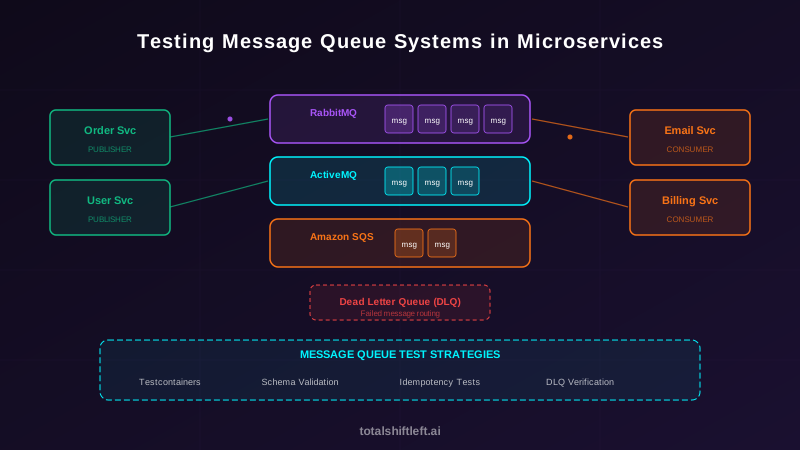
Message queue testing validates that services communicating through RabbitMQ, ActiveMQ, or SQS correctly publish, route, consume, and acknowledge messages while handling poison pills, broker outages, and duplicate delivery. The highest-value checks are dead letter queue routing, acknowledgment-mode behavior (auto-ack vs manual ack), and idempotency — publishing the same message twice should never produce duplicate side effects.
Reviewed by Smeet Gohel

Message queue testing in microservices validates that services communicating through brokers like RabbitMQ, ActiveMQ, and Amazon SQS correctly publish, route, consume, and acknowledge messages. It covers exchange configuration, routing key behavior, dead letter queue routing, message idempotency, and end-to-end async flow verification.
Message queue testing microservices is the practice of verifying that services communicating asynchronously through message brokers — including RabbitMQ, ActiveMQ, Amazon SQS, and Azure Service Bus — correctly produce, route, consume, and acknowledge messages while handling failure scenarios like poison pills, broker outages, and duplicate delivery.
Your team deploys a new version of the billing service at 3 PM. By 5 PM, customer support reports that users are receiving duplicate invoices. The investigation reveals that the new version changed the acknowledgment mode from manual to auto-ack — meaning messages were acknowledged on receipt rather than after successful processing. When the service restarted during deployment, messages in flight were lost, and the retry mechanism republished them.
This is a textbook message queue failure. The code change was small — a single configuration line — but it violated a fundamental contract between the publisher and consumer. No unit test caught it because the acknowledgment behavior only manifests when a real broker is involved.
Message queue testing is the discipline of systematically verifying these behaviors before they reach production. It validates publisher configuration, consumer acknowledgment, dead letter queue routing, message ordering, and idempotency across brokers like RabbitMQ, ActiveMQ, and Amazon SQS.
This guide covers the practical testing strategies that teams building microservices need in 2026 — from unit-level message validation to integration tests with real brokers to end-to-end async flow verification.
In this guide
- What Is Message Queue Testing in Microservices?
- Why Message Queue Testing Matters
- Key Components of Message Queue Testing
- Message Queue Testing Architecture
- Tools for Message Queue Testing
- Real-World Example: Async Order Processing Pipeline
- Message queue testing challenges and how to solve them
- Best Practices for Message Queue Testing
- Message Queue Testing Checklist
- Message queue testing FAQ
What Is Message Queue Testing in Microservices?
Message queue testing validates the correctness and reliability of asynchronous communication between microservices using message broker systems. Unlike Kafka-based microservices testing, which focuses on streaming and log-based architectures, message queue testing targets traditional queue-based brokers with different delivery semantics.
Message Queue vs. Event Streaming
| Characteristic | Message Queues (RabbitMQ, SQS) | Event Streaming (Kafka) |
|---|---|---|
| Consumption model | Messages removed after consumption | Messages retained in log |
| Consumer groups | Competing consumers on same queue | Consumer groups with offset tracking |
| Delivery guarantee | At-most-once or at-least-once (configurable) | At-least-once (default) |
| Ordering | FIFO per queue (mostly) | Ordered per partition |
| Routing | Exchange-based (topic, direct, fanout) | Topic-partition based |
| Dead letter handling | Dead letter exchange (DLX) | Custom DLQ topic |
| Use case | Task distribution, command messaging | Event sourcing, stream processing |
What Needs Testing in Message Queues
Message queue testing covers four layers:
- Publisher layer: Message serialization, exchange routing, publisher confirms, and retry logic
- Broker configuration layer: Exchange declarations, queue bindings, TTL settings, DLX configuration, and queue arguments
- Consumer layer: Deserialization, business logic, acknowledgment modes, rejection with requeue, and error handling
- Flow layer: End-to-end message flow from publisher to consumer, including dead letter routing and retry behavior. Modeling the publish-to-consume path as a chained integration test workflow lets a single test drive the entry-point API, wait for the message to be consumed, and verify the resulting state end to end.
Why Message Queue Testing Matters
Acknowledgment Misconfiguration
The single most common message queue bug is acknowledgment misconfiguration. Auto-ack means the broker considers the message delivered the instant the consumer receives it — if the consumer crashes during processing, the message is lost. Manual ack requires the consumer to explicitly acknowledge after successful processing, but forgetting to ack leaves messages stuck in the "unacknowledged" state, eventually consuming all prefetch capacity.
Dead Letter Queue Gaps
Dead letter queues are your safety net for messages that cannot be processed. If your DLQ configuration is incorrect — wrong routing key, missing DLX binding, or no DLQ consumer — failed messages disappear silently. Testing DLQ routing is one of the highest-value activities in message queue testing.
Message Serialization Drift
Publishers and consumers must agree on message format. When a publisher adds a new field or changes a data type, consumers that cannot handle the new format will fail. Unlike HTTP APIs with OpenAPI specs, message queues often lack formal schema contracts, making this drift harder to detect.
Ordering Violations
While most message queues provide FIFO ordering per queue, this guarantee breaks down with competing consumers, message retries, and priority queues. If your business logic depends on ordering — processing an order cancellation after the order creation — testing ordering behavior is essential.
Key Components of Message Queue Testing
Publisher Testing
Publisher testing validates that messages are correctly formatted and routed:
What to verify:
- Message body serializes correctly (JSON, Protobuf, or custom format)
- Routing keys match the intended queue bindings
- Message properties are set correctly (content type, correlation ID, reply-to, TTL)
- Publisher confirms (RabbitMQ) or send acknowledgments (SQS) are handled
- Retry logic activates when the broker is unreachable
Consumer Testing
Consumer testing validates message processing and acknowledgment:
What to verify:
- Messages deserialize correctly including backward-compatible formats
- Business logic executes correctly given valid messages
- Acknowledgment happens after successful processing (not before)
- Invalid messages trigger rejection and DLQ routing
- Prefetch count limits concurrent message processing appropriately
Ready to shift left with your API testing?
Try our no-code API test automation platform free. Generate tests from OpenAPI, run in CI/CD, and scale quality.
Dead Letter Queue Testing
DLQ testing validates the failure handling pipeline:
What to verify:
- Messages that fail processing N times route to the DLQ
- DLQ messages contain the original message body plus error metadata
- DLQ consumers can inspect, replay, or archive failed messages
- TTL-expired messages route to the DLQ correctly
- Rejected messages (basic.reject with requeue=false) reach the DLQ
Idempotency Testing
Idempotency testing validates that duplicate messages produce the correct outcome:
What to verify:
- Processing the same message twice produces the same result as processing it once
- Idempotency keys are stored and checked correctly
- Concurrent delivery of duplicate messages does not cause race conditions
- Idempotency key expiration handles messages outside the deduplication window
Message Queue Testing Architecture
The testing architecture for message queue systems follows the same pyramid principle used in broader API testing strategies:
Level 1: Unit Tests (No Broker) Test message serialization, routing key generation, and consumer handler logic in isolation. Mock the broker client to verify that your code calls the correct methods with the correct arguments.
Level 2: Integration Tests (Testcontainers) Start a real RabbitMQ, ActiveMQ, or LocalStack (for SQS) broker using Testcontainers. Verify the complete publish-consume cycle against a real broker. This is where you catch acknowledgment bugs, DLQ routing issues, and exchange binding problems.
**Level 3: End-to-End Tests (Multi-Se
rvice)** Deploy multiple services with a shared broker in a test environment. Trigger a business action and verify the complete async flow completes correctly.
┌───────────────────────────────────────────────┐
│              E2E Tests (5-10%)                 │
│    Multi-service async flow validation         │
├───────────────────────────────────────────────┤
│          Integration Tests (25-35%)            │
│   Testcontainers: real broker, full cycle      │
├───────────────────────────────────────────────┤
│            Unit Tests (60-70%)                 │
│  Serialization, handlers, routing (no broker)  │
└───────────────────────────────────────────────┘
Tools for Message Queue Testing
| Tool | Type | Best For | Broker Support |
|---|---|---|---|
| Testcontainers | Integration testing | Real broker in Docker for CI | RabbitMQ, ActiveMQ, Redis, Pulsar |
| LocalStack | AWS service emulation | SQS, SNS testing without AWS account | Amazon SQS, SNS |
| Spring AMQP Test | Unit testing | RabbitMQ publisher/consumer tests in Spring | RabbitMQ |
| Pact | Contract testing | Consumer-driven message contracts | Broker-agnostic |
| k6 | Load testing | Message throughput and latency testing | Via custom extensions |
| Shift-Left API | API testing | HTTP APIs that trigger async message flows | Platform-level |
| Toxiproxy | Fault injection | Simulating network issues between service and broker | Any TCP-based broker |
| RabbitMQ Management API | Debugging | Queue inspection, message counts, binding verification | RabbitMQ |
Testcontainers RabbitMQ Example
@Testcontainers
class OrderMessageConsumerTest {

    @Container
    static RabbitMQContainer rabbit = new RabbitMQContainer(
        DockerImageName.parse("rabbitmq:3.13-management")
    );

    @Test
    void shouldProcessOrderAndAcknowledge() {
        ConnectionFactory factory = new ConnectionFactory();
        factory.setUri(rabbit.getAmqpUrl());

        // Publish a test message
        try (Connection conn = factory.newConnection();
             Channel channel = conn.createChannel()) {
            channel.exchangeDeclare("orders", "direct", true);
            channel.queueDeclare("order-processing", true, false, false, null);
            channel.queueBind("order-processing", "orders", "order.created");

            String message = "{\"orderId\":\"ORD-123\",\"amount\":99.99}";
            channel.basicPublish("orders", "order.created", null, message.getBytes());
        }

        // Start consumer and verify processing
        OrderConsumer consumer = new OrderConsumer(rabbit.getAmqpUrl());
        consumer.start();

        await().atMost(5, SECONDS).untilAsserted(() -> {
            assertThat(consumer.getProcessedOrders()).contains("ORD-123");
        });
    }
}
Real-World Example: Async Order Processing Pipeline
Consider a SaaS platform where order processing flows through message queues:
- API Gateway receives HTTP POST
/ordersand publishesorder.createdto theordersexchange - Inventory Service consumes from
inventory-checkqueue, validates stock, publishesinventory.reserved - Payment Service consumes from
payment-processqueue, charges card, publishespayment.completed - Fulfillment Service consumes from
fulfillment-startqueue, initiates shipping
Publisher test: Verify the API Gateway publishes a correctly formatted order.created message with the right routing key when the HTTP endpoint is called. Use Testcontainers RabbitMQ and consume from the inventory-check queue to confirm the message arrives.
Consumer test: Publish a known order.created message to the inventory-check queue. Verify the Inventory Service checks stock, writes a reservation record, and publishes inventory.reserved. Also verify that an order for an out-of-stock item triggers a rejection message.
DLQ test: Publish a malformed message (invalid JSON, missing required fields) to the inventory-check queue. Verify it routes to the inventory-check-dlq after the configured retry count. Verify the DLQ message contains the original body and an error description header.
Idempotency test: Publish the same order.created message (same message ID) twice. Verify the Inventory Service creates only one reservation. This is critical for at-least-once delivery guarantees.
Message queue testing challenges and how to solve them
| Challenge | Impact | Solution |
|---|---|---|
| Broker startup time in CI | Slow test suites | Share Testcontainers across test classes using Singleton pattern; use reuse flag |
| Flaky async assertions | Tests pass/fail nondeterministically | Use Awaitility or polling assertions with generous timeouts; avoid Thread.sleep |
| Testing exchange topologies | Complex routing is hard to verify | Write dedicated topology tests that verify bindings and routing keys programmatically |
| Simulating broker failures | Cannot test reconnection logic easily | Use Toxiproxy between service and broker to inject latency, disconnect, and bandwidth limits |
| Message format evolution | Publisher changes break consumers | Adopt message contract testing with Pact or schema validation in CI |
| Competing consumer ordering | Order-dependent logic fails with multiple consumers | Test with single consumer for ordering-critical queues; use message grouping (JMS) or consistent hash exchange (RabbitMQ) |
| Testing TTL and expiry | Real-time TTL tests are slow | Set short TTLs (100ms) in tests and verify DLQ routing within a test-appropriate window |
Free 1-page checklist
API Testing Checklist for CI/CD Pipelines
A printable 25-point checklist covering authentication, error scenarios, contract validation, performance thresholds, and more.
Download FreeBest Practices for Message Queue Testing
- Always test against a real broker in integration tests. Mocking the AMQP client hides configuration bugs. Testcontainers makes running real RabbitMQ or ActiveMQ in CI trivial.
- Test dead letter queue routing for every consumer. Publish a message that triggers a processing failure and verify it arrives in the DLQ with correct error metadata. This is your production safety net.
- Verify acknowledgment behavior explicitly. Write a test that crashes the consumer after receiving but before acknowledging a message, then verify the message is redelivered on restart.
- Use message IDs for idempotency testing. Every message should carry a unique ID. Test that publishing the same ID twice does not cause duplicate side effects.
- Test exchange bindings declaratively. Do not assume exchanges and queues are configured correctly. Write tests that verify bindings exist using the RabbitMQ Management API or broker admin tools.
- Simulate slow consumers. Add artificial delays in consumer processing and verify that prefetch limits prevent the broker from overwhelming the service.
- Include message queue tests in your CI/CD pipeline. Async communication bugs are among the hardest to debug in production. Catching them in CI is orders of magnitude cheaper.
- Test message priority when using priority queues. Publish low-priority and high-priority messages and verify the consumer receives high-priority messages first.
- Validate message TTL expiration. Set a short TTL on test messages and verify they expire and route to the DLQ correctly.
- Monitor queue depth in staging. After tests pass, monitor queue depth and consumer lag in staging to catch throughput issues tests may miss.
Message Queue Testing Checklist
Publisher Testing
- ✔ Messages serialize correctly (JSON, Protobuf, custom format)
- ✔ Routing keys match intended queue bindings
- ✔ Message properties set correctly (correlation ID, content type, TTL)
- ✔ Publisher confirms handled (RabbitMQ) or send receipts verified (SQS)
- ✔ Retry logic activates when broker is unreachable
- ✔ Message IDs assigned for deduplication
Consumer Testing
- ✔ Messages deserialize correctly including backward-compatible formats
- ✔ Business logic executes correctly for valid messages
- ✔ Acknowledgment happens after successful processing
- ✔ Invalid messages trigger rejection and DLQ routing
- ✔ Prefetch count limits concurrent processing
- ✔ Consumer reconnects after broker restart
Dead Letter Queue Testing
- ✔ Failed messages route to DLQ after configured retry count
- ✔ DLQ messages contain original body plus error metadata
- ✔ TTL-expired messages route to DLQ
- ✔ Rejected messages (requeue=false) reach DLQ
- ✔ DLQ consumer can inspect and replay messages
Idempotency Testing
- ✔ Duplicate messages produce same outcome as single delivery
- ✔ Idempotency keys stored and checked correctly
- ✔ Concurrent duplicates do not cause race conditions
- ✔ Key expiration handles late duplicates appropriately
Message queue testing FAQ
How do you test message queues in microservices?
Test message queues in microservices by validating three areas: producer tests verify message serialization, routing key assignment, and exchange binding; consumer tests verify deserialization, business logic, acknowledgment, and error handling; integration tests use Testcontainers to spin up a real broker and verify the complete publish-consume cycle.
What is dead letter queue testing?
Dead letter queue (DLQ) testing validates that messages that cannot be processed successfully — due to deserialization errors, business rule violations, or repeated processing failures — are routed to a designated DLQ with proper error metadata. Tests verify that the DLQ contains the original message, the failure reason, retry count, and timestamp.
How do you test RabbitMQ in microservices?
Test RabbitMQ in microservices using Testcontainers to run a real RabbitMQ broker in Docker. Verify exchange declarations, queue bindings, routing key patterns, message TTL, dead letter exchange configuration, publisher confirms, and consumer acknowledgments. Test fanout, direct, and topic exchange routing independently.
How do you ensure message idempotency in tests?
Test message idempotency by publishing the same message (with the same message ID) multiple times and verifying the consumer produces the correct outcome exactly once. Check that database records are not duplicated, side effects are not repeated, and the idempotency key store correctly tracks processed message IDs.
What is the difference between Kafka and message queue testing?
Kafka testing focuses on partition ordering, offset management, consumer groups, and log retention, while message queue testing (RabbitMQ, ActiveMQ) focuses on exchange routing, acknowledgment modes, message TTL, priority queues, and dead letter exchanges. Kafka provides at-least-once delivery by default; message queues can provide at-most-once or at-least-once depending on acknowledgment configuration.
How do you test message ordering in queues?
Test message ordering by publishing a sequence of numbered messages and verifying the consumer processes them in the expected order. For standard queues, ordering is FIFO within a single consumer. For priority queues, verify that higher-priority messages are delivered first. For competing consumers, verify that ordering guarantees match your architecture's requirements.
Sources and further reading
- RabbitMQ documentation — queue and delivery semantics for message-based tests.
- AsyncAPI Specification — the event-driven equivalent of OpenAPI.
- Testcontainers — throwaway real dependencies for integration tests.
Key takeaways
- Message queue systems are the backbone of asynchronous communication in microservices architectures.
- RabbitMQ, ActiveMQ, and Amazon SQS each provide different delivery guarantees, routing capabilities, and failure handling mechanisms — and each requires targeted testing to ensure reliability.
- The teams that avoid message queue failures in production share a common approach: they test against real brokers using Testcontainers, they validate dead letter queue routing for every consumer, they verify acknowledgment behavior under failure conditions, and they test idempotency as a first-class concern.
- If your microservices use message queues and your current test suite only validates the happy path with mocked broker clients, you have a significant gap.
- The acknowledgment bugs, DLQ routing failures, and serialization drift issues will surface in production — where they are far more expensive to diagnose and fix.
Ready to strengthen your async microservices testing? Start your free trial with Shift-Left API to validate the HTTP APIs that trigger your message queue flows, ensuring correctness from the entry point through the entire async pipeline.
Related Articles: Microservices Testing: The Complete Guide | API Testing: The Complete Guide | Testing Kafka-Based Microservices | Contract Testing for Microservices | End-to-End Testing Strategies for Microservices | Microservices Reliability Testing Guide
Ready to shift left with your API testing?
Try our no-code API test automation platform free.