
End-to-End Testing for Microservices: What Works (2026)
Quick answer
End-to-end testing for microservices validates that a complete user journey — from the API gateway through backend services, databases, and message queues — works correctly as a whole, catching integration failures that unit and contract tests miss. Because E2E tests are slow and flaky, keep them to just 5-10% of your suite: cover 5-10 critical business flows, run them in ephemeral Kubernetes namespaces or Docker Compose, and use service virtualization (WireMock, Hoverfly) to stub unreliable third-party dependencies.
Reviewed by Sushant Joshi
End-to-end testing in microservices validates that complete user journeys spanning multiple services function correctly from entry point to final outcome. It verifies cross-service integration, data consistency, and business flow completion using synthetic transactions, ephemeral test environments, and CI/CD-integrated test suites.
End-to-end testing microservices is the practice of validating complete business flows that traverse multiple independently deployed services — verifying that the API gateway, backend services, databases, message queues, and external integrations work together correctly to fulfill user scenarios like order placement, payment processing, and account registration.
A development team at a ride-sharing company has 150 microservices, 12,000 unit tests, and 800 contract tests. All pass. Then a user reports that ride requests are silently failing — the app shows "searching for drivers" indefinitely. The investigation takes four hours. The root cause: the ride-matching service was updated to expect a new field in the location payload that the mobile gateway does not send. The contract tests between these services were not updated because the team assumed the field was optional.
This is the gap that end-to-end testing fills. Unit tests verify individual components. Contract tests verify pairwise service agreements. But neither verifies that the complete user journey — from the mobile app through the API gateway, the ride-matching service, the driver notification service, and back — works correctly end to end.
The challenge is that E2E tests in microservices are notoriously difficult: slow, flaky, expensive, and hard to maintain. Teams that try to test everything end-to-end burn out. Teams that skip E2E testing entirely discover integration failures in production.
The solution is a targeted E2E strategy: test only the most critical user journeys, invest in environment management, use service virtualization for external dependencies, and integrate E2E tests into CI/CD with intelligent retry and health-check gates. This guide covers exactly how to implement that strategy in 2026, building on the broader microservices testing approach that every team needs.
In this guide
- What Is End-to-End Testing for Microservices?
- Why E2E Testing Is Challenging in Microservices
- Key Components of E2E Testing
- E2E Testing Architecture
- Tools for E2E Microservices Testing
- Real-World Example: E-Commerce Checkout Flow
- End-to-end testing for microservices challenges and how to solve them
- Best Practices for E2E Microservices Testing
- E2E Testing Checklist
- End-to-end testing for microservices FAQ
What Is End-to-End Testing for Microservices?
End-to-end testing for microservices validates complete business flows that span multiple services. Unlike unit tests (which test a single function) or contract tests (which test a pairwise service agreement), E2E tests exercise the full request path from entry to exit.
The E2E Test Scope
A typical E2E test in microservices:
- Sends an HTTP request to the API gateway (or frontend)
- The request flows through authentication, business logic, and data services
- Services communicate via HTTP, gRPC, or message queues
- Databases, caches, and external APIs are accessed
- The test verifies the final response and any side effects (database records, queue messages, emails)
E2E Testing in the Testing Pyramid
E2E tests sit at the top of the testing pyramid — they provide the highest confidence that the system works as a whole, but they are the slowest, most expensive, and most fragile:
| Test Level | Scope | Speed | Stability | Coverage |
|---|---|---|---|---|
| Unit | Single function/class | Milliseconds | Very stable | Logic correctness |
| Contract | Service pair | Seconds | Stable | API compatibility |
| Integration | Service + dependencies | Seconds | Moderate | Service behavior |
| E2E | Full user journey | Minutes | Fragile | Business flow completion |
The key insight is that E2E tests should be the smallest layer of your testing strategy — covering only the flows where integration failures would have the highest business impact.
Where the boundary sits between a full journey test and an API test is worked through in end-to-end testing vs API testing.
Why E2E Testing Is Challenging in Microservices
Environment Complexity
Testing a user journey that touches 8 services requires all 8 services to be running, healthy, and correctly configured in the test environment. Each service may have its own database, cache, and configuration. Coordinating this environment is operationally expensive.
Asynchronous Processing
Many microservice flows include asynchronous steps — a message published to Kafka, a webhook callback, an email sent via a queue. E2E tests must handle these async steps with polling assertions rather than synchronous request-response verification. Testing these patterns overlaps with Kafka testing and message queue testing.
Test Data Management
E2E tests need realistic data across multiple databases. Creating, isolating, and cleaning up test data across services is significantly harder than managing test data for a single service.
Flakiness
E2E tests in microservices are inherently flakier than lower-level tests. Network timeouts, service startup delays, database connection issues, and async processing timing all contribute to nondeterministic test results.
Maintenance Burden
When 8 services are involved in a test, a change to any one of them can break the E2E test — even if the change is backward compatible. The maintenance burden scales with the number of services in the test path.
Key Components of E2E Testing
Synthetic Transactions
Synthetic transactions are automated E2E tests that run on a continuous schedule against staging or production:
What they verify:
- Critical user journeys complete successfully (login, search, purchase, checkout)
- Cross-service data consistency (order created in Order Service matches record in Fulfillment Service)
- Latency of complete flows stays within SLO targets
- External integration health (payment gateway, email provider)
How they work: A scheduler (cron, CloudWatch Events, or a CI pipeline) triggers the test suite every 5-15 minutes. Each test executes a full user journey via API calls, verifies the response, and reports success/failure to monitoring. Failed synthetic transactions trigger alerts.
Test Environment Management
E2E tests require a managed environment where all services are running:
Approaches:
- Docker Compose: Good for local development and small service counts (under 10 services)
- Kubernetes Ephemeral Namespaces: Spin up an isolated namespace per test run with all required services, then tear it down. Scales to large service counts.
- Shared Staging: A long-lived environment with all services deployed. Simpler to manage but prone to state contamination between test runs.
- Hybrid: Deploy only the changed service to a fresh namespace; use service virtualization for unchanged dependencies.
Ready to shift left with your API testing?
Try our no-code API test automation platform free. Generate tests from OpenAPI, run in CI/CD, and scale quality.
Service Virtualization
Service virtualization replaces hard-to-access dependencies with simulated versions:
When to use:
- Third-party APIs (payment gateway, shipping API, email provider) that are unreliable or expensive in test environments
- Services owned by other teams that are not available in your test environment
- Services with rate limits or usage costs that make real calls impractical
- External services where you need to test error scenarios (timeout, 500 error, rate limit)
Test Data Strategy
E2E tests need data across multiple services. The strategies are:
- Seed on setup, clean on teardown: Before each test run, seed required data (users, products, inventory) and clean it up after. Works for isolated environments.
- Dedicated test accounts: Use permanent test accounts with known data. Simpler but creates state dependencies between tests.
- Data factories: Programmatic data creation that generates unique test data for each run. Avoids collisions between parallel test runs.
E2E Testing Architecture
The architecture for E2E testing in microservices has three layers:
Layer 1: Test Orchestration A test runner (Playwright, k6, custom scripts) that executes user journeys via HTTP/gRPC calls. The orchestrator manages test data setup, executes the test scenario, waits for async operations to complete, and verifies the outcome. Chaining these steps as multi-step integration test workflows lets you pass data between calls and assert on each hop of a checkout or registration flow without hand-writing glue code.
Layer 2: Environment Management Infrastructure that provides the test environment — whether docker-compose, Kubernetes, or cloud-based. Th
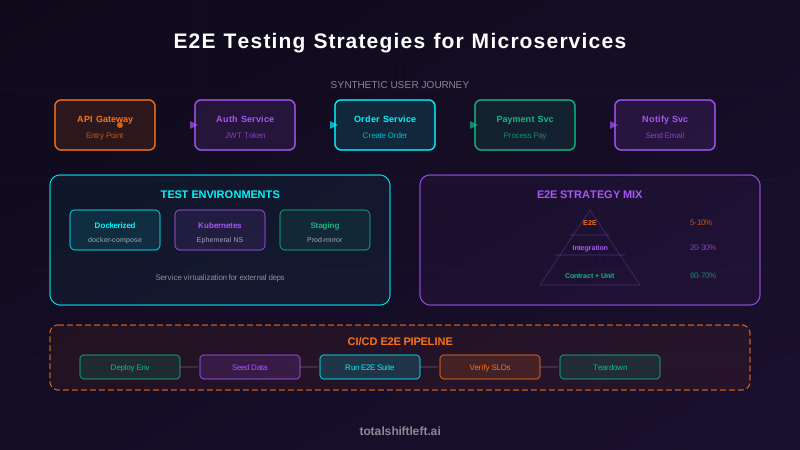
e environment manager handles service deployment, health checks, network configuration, and teardown.
Layer 3: Observability Distributed tracing (Jaeger, Zipkin), centralized logging, and test result reporting. When an E2E test fails, the trace shows exactly where in the service chain the failure occurred.
┌──────────────────────────────────────────────────────┐
│                 Test Orchestration                     │
│  Playwright / k6 / Custom — executes user journeys    │
├──────────────────────────────────────────────────────┤
│              Environment Management                    │
│  K8s Namespaces / Docker Compose / Cloud IaC          │
├──────────────────────────────────────────────────────┤
│                  Observability                         │
│  Distributed tracing, logging, test reports           │
└──────────────────────────────────────────────────────┘
Tools for E2E Microservices Testing
| Tool | Type | Best For | Scope |
|---|---|---|---|
| Playwright | Browser E2E | UI-driven user journey testing | Full stack |
| k6 | API E2E | API-level user journey scripts with load | API layer |
| Postman/Newman | API E2E | Sequential API test collections | API layer |
| Testcontainers | Environment | Docker-based service orchestration for tests | Integration/E2E |
| Tilt / Skaffold | Environment | Kubernetes dev environment management | E2E |
| WireMock | Service virtualization | Stubbing external HTTP dependencies | Integration/E2E |
| Hoverfly | Service virtualization | Capture-replay for realistic service simulation | E2E |
| Shift-Left API | API testing platform | Automated API test generation and execution | API E2E |
| Jaeger | Observability | Distributed tracing for E2E test debugging | All |
| Argo Workflows | Orchestration | CI/CD pipeline for complex E2E test flows | CI/CD |
k6 E2E User Journey Example
import http from 'k6/http';
import { check, group, sleep } from 'k6';

export default function () {
  let token;

  group('1. Authenticate', () => {
    const loginRes = http.post('https://staging.api.example.com/auth/login', JSON.stringify({
      email: 'test@example.com',
      password: 'test-password',
    }), { headers: { 'Content-Type': 'application/json' } });

    check(loginRes, { 'login successful': (r) => r.status === 200 });
    token = loginRes.json('token');
  });

  group('2. Create Order', () => {
    const orderRes = http.post('https://staging.api.example.com/orders', JSON.stringify({
      items: [{ productId: 'PROD-001', quantity: 2 }],
    }), { headers: { 'Authorization': `Bearer ${token}`, 'Content-Type': 'application/json' } });

    check(orderRes, {
      'order created': (r) => r.status === 201,
      'order has ID': (r) => r.json('orderId') !== undefined,
    });
  });

  group('3. Verify Order Status', () => {
    // Poll for async order processing completion
    let status = 'pending';
    let attempts = 0;
    while (status === 'pending' && attempts < 10) {
      sleep(2);
      const statusRes = http.get('https://staging.api.example.com/orders/latest/status', {
        headers: { 'Authorization': `Bearer ${token}` },
      });
      status = statusRes.json('status');
      attempts++;
    }
    check(status, { 'order confirmed': (s) => s === 'confirmed' });
  });
}
Real-World Example: E-Commerce Checkout Flow
An e-commerce platform identifies three critical E2E test scenarios:
Scenario 1: Happy Path Checkout
- Authenticate user via Auth Service
- Add items to cart via Cart Service
- Apply discount code via Promotion Service
- Submit order via Order Service (creates order, reserves inventory, initiates payment)
- Verify payment processed via Payment Service
- Verify order confirmation email sent via Notification Service
- Assert: order status is "confirmed", inventory decremented, payment captured, email delivered
Scenario 2: Out-of-Stock Handling
- Authenticate and add items to cart
- Submit order when inventory is zero
- Verify Order Service returns appropriate error
- Assert: no payment was initiated, inventory unchanged, user notified of stock issue
Scenario 3: Payment Failure Recovery
- Authenticate, add items, submit order
- Payment Service returns decline (simulated via service virtualization)
- Verify order status is "payment-failed"
- Assert: inventory reservation released, user notified, retry available
Environment setup: Each test run deploys the six services to an ephemeral Kubernetes namespace. The Payment Service uses WireMock to simulate the payment gateway. Test data is seeded via API calls in the test setup phase. The namespace is torn down after tests complete.
CI/CD integration: E2E tests run on every merge to main (not on every PR — too slow). A nightly full suite runs all three scenarios plus edge cases. Synthetic transactions run Scenario 1 every 10 minutes against staging.
End-to-end testing for microservices challenges and how to solve them
| Challenge | Impact | Solution |
|---|---|---|
| Slow test execution | Long CI/CD feedback loops | Parallelize independent scenarios; run E2E only on main branch merges, not PRs |
| Environment spin-up time | 5-10 min to deploy all services | Pre-built container images; cached base layers; deploy only changed services |
| Flaky async assertions | Nondeterministic pass/fail | Use polling with Awaitility; add health-check gates before test execution |
| Test data isolation | Tests contaminate each other | Unique test data per run (UUID-based users, orders); ephemeral databases |
| External dependency availability | Third-party API downtime breaks tests | Service virtualization with WireMock or Hoverfly for all external dependencies |
| Debugging failures across services | Hard to pinpoint which service failed | Distributed tracing (Jaeger); correlate trace IDs across test requests |
| Cost of ephemeral environments | Cloud costs for full environment per test | Shared staging for nightly runs; ephemeral only for critical paths; aggressive teardown |
Free 1-page checklist
API Testing Checklist for CI/CD Pipelines
A printable 25-point checklist covering authentication, error scenarios, contract validation, performance thresholds, and more.
Download FreeBest Practices for E2E Microservices Testing
- Test only critical business flows end-to-end. Resist the urge to E2E test everything. Identify the 5-10 user journeys where integration failure has the highest business impact and focus there.
- Use the testing pyramid as a guide. E2E tests should be 5-10% of your total test count. Push most validation down to unit, contract, and integration tests. See our API testing strategy for microservices for the right ratio.
- Invest in environment management. The biggest cost of E2E testing is environment complexity. Use ephemeral Kubernetes namespaces or docker-compose to create isolated, reproducible environments.
- Virtualize external dependencies. Third-party APIs are the number one cause of E2E test flakiness. Use WireMock or Hoverfly to stub payment gateways, email providers, and other external services.
- Add health-check gates before test execution. Do not start E2E tests until all services report healthy. Use readiness probes, health endpoints, and startup ordering to eliminate false failures from slow service startup.
- Use distributed tracing for debugging. Attach a unique trace ID to every E2E test request. When a test fails, the trace shows exactly which service call failed and why.
- Implement smart retries for flaky tests. Retry E2E tests once on failure before reporting a true failure. Track retry rates to identify systematically flaky tests that need fixing.
- Run E2E tests on merge to main, not on every PR. E2E tests are too slow for per-PR feedback. Run a lightweight smoke E2E on PRs and the full suite on main branch merges.
- Use synthetic transactions for production validation. After deployment, run synthetic transactions against production to verify the critical paths work with real infrastructure.
- Clean up test data and environments aggressively. Stale test data and orphaned environments cause cost overruns and flaky tests. Automate teardown as part of the test lifecycle.
E2E Testing Checklist
Test Design
- ✔ Critical business flows identified (5-10 scenarios)
- ✔ Test scenarios cover happy path, error paths, and edge cases
- ✔ Async steps handled with polling assertions (not fixed sleeps)
- ✔ Test data strategy defined (seed/clean, factories, dedicated accounts)
- ✔ External dependencies virtualized with WireMock or Hoverfly
Environment Management
- ✔ Ephemeral environments automated (K8s namespace, docker-compose)
- ✔ Health-check gates verify all services are ready before tests start
- ✔ Environment teardown automated after test completion
- ✔ Service configuration matches production (feature flags, env vars)
- ✔ Database schemas migrated and seeded correctly
CI/CD Integration
- ✔ E2E smoke suite runs on PR merge (fast feedback)
- ✔ Full E2E suite runs on main branch merges
- ✔ Nightly extended E2E suite covers all scenarios
- ✔ Test results reported with distributed trace links
- ✔ Flaky tests tracked and triaged regularly
Observability
- ✔ Distributed tracing enabled for all E2E test requests
- ✔ Centralized logging captures service-level errors during tests
- ✔ Test result dashboard shows pass/fail trends and flakiness rates
- ✔ Synthetic transactions run on schedule against staging/production
- ✔ Alerts fire when synthetic transactions fail
End-to-end testing for microservices FAQ
What is end-to-end testing in microservices?
End-to-end testing in microservices validates complete user journeys that span multiple services — from the API gateway through backend services, databases, and message queues to the final response. It verifies that independently deployed services work together correctly to fulfill business scenarios like order placement, user registration, or payment processing.
How many end-to-end tests should microservices have?
Keep E2E tests to 5-10% of your total test suite. Focus on critical business flows (checkout, registration, payment) and high-risk integration points. Most validation should happen at unit and contract test levels. A typical microservices system with 20 services might have 15-30 E2E test scenarios covering the most important user journeys.
What are synthetic transactions in microservices testing?
Synthetic transactions are automated test scripts that simulate real user journeys against production or staging environments on a continuous schedule. They execute critical business flows (login, search, purchase) every few minutes and alert when a flow fails or exceeds latency thresholds. They serve as both a testing and monitoring tool.
How do you manage test environments for microservices E2E testing?
Use ephemeral environments that spin up on demand for each test run using Kubernetes namespaces, docker-compose, or cloud infrastructure-as-code. Deploy only the services under test plus their direct dependencies. Use service virtualization to stub external dependencies. Tear down environments after tests complete to control costs.
What is service virtualization in E2E testing?
Service virtualization replaces external or hard-to-access dependencies with simulated versions that return realistic responses. In microservices E2E testing, it is used to virtualize third-party APIs (payment gateways, shipping providers), shared services owned by other teams, and services that are expensive or slow to deploy in test environments.
Why are end-to-end tests flaky in microservices?
E2E tests in microservices are flaky due to environment instability (services not fully ready), asynchronous processing delays (message queues, event buses), shared test data conflicts, network timeouts between services, and deployment timing issues. Mitigation strategies include health-check gates, polling assertions, isolated test data, and retry-aware test frameworks.
Sources and further reading
- Martin Fowler — Testing Strategies in a Microservice Architecture — the canonical breakdown of microservice test layers.
- Testcontainers — throwaway real dependencies for integration tests.
- Martin Fowler — The Practical Test Pyramid — the reference argument for test-layer proportions.
Key takeaways
- End-to-end testing in microservices is essential but expensive. The teams that succeed with E2E testing are not the ones that test every user journey — they are the ones that test the right journeys with the right infrastructure.
- The winning strategy is clear: identify 5-10 critical business flows, invest in ephemeral test environments, virtualize external dependencies, integrate E2E tests into CI/CD with health-check gates, and use synthetic transactions for ongoing production validation.
- Push everything else down to unit, contract, and integration tests where execution is faster and more reliable.
- If your team has no E2E tests for microservices, start with one: the most critical user journey in your system.
- Deploy the required services in docker-compose, write a test that exercises the full flow, and add it to your CI pipeline.
- That single test will catch integration failures that no amount of unit testing can find.
Ready to build your E2E testing strategy? Start your free trial with Shift-Left API to automate API-level E2E tests across your microservices architecture — with built-in service virtualization and CI/CD integration.
Related Articles: Microservices Testing: The Complete Guide | API Testing: The Complete Guide | Canary Testing in Microservices Deployments | Microservices Reliability Testing Guide | API Testing Strategy for Microservices | Contract Testing for Microservices
Ready to shift left with your API testing?
Try our no-code API test automation platform free.