
Microservices Reliability Testing: Uptime Guide (2026)
Quick answer
Microservices reliability testing verifies that distributed services meet their availability, latency, and error-rate SLOs under both normal traffic and induced failures, not just the happy path. It combines load testing with k6/Gatling threshold assertions, chaos engineering (LitmusChaos, Chaos Mesh) that kills pods and injects latency, circuit breaker verification, and failover testing — gated by how much of the monthly error budget a service has already consumed.
Reviewed by Sushant Joshi

Microservices reliability testing systematically verifies that distributed services meet their availability, latency, and error rate commitments under both normal traffic and adverse conditions. It combines load testing, chaos engineering, failover verification, and SLO validation to ensure consistent system uptime.
Microservices reliability testing is the discipline of verifying that services in a distributed architecture meet defined Service Level Objectives (SLOs) for availability, latency, and error rates — under normal traffic, peak load, dependency failures, and infrastructure disruptions — using techniques including load testing, chaos engineering, failover testing, and error budget validation.
A fintech company running 40 microservices on Kubernetes reports 99.99% availability on their status page. Then a single Redis cluster node fails during peak trading hours. The cache layer stops responding, causing the authentication service to fall back to database queries. The database connection pool exhausts within 30 seconds. The cascading failure takes down the entire platform for 47 minutes — blowing through their entire quarterly error budget in a single incident.
The post-mortem reveals that no one had ever tested what happens when Redis fails. The circuit breakers were configured but never verified. The fallback paths existed in code but had never executed under real load. The SLO dashboard showed green because it measured availability under normal conditions, not under failure conditions.
This is the gap that microservices reliability testing closes. It does not just verify that services work when everything is healthy — it verifies that services meet their availability commitments when dependencies fail, traffic spikes, and infrastructure degrades. It is the testing discipline that bridges the gap between having SLOs on a dashboard and actually meeting them.
This guide covers the reliability testing practices that engineering teams need in 2026: SLO-driven test design, chaos engineering, load testing, circuit breaker verification, failover testing, and integrating reliability gates into your CI/CD pipeline.
In this guide
- What Is Microservices Reliability Testing?
- Why Reliability Testing Is Essential
- Key Components of Reliability Testing
- Reliability Testing Architecture
- Tools for Microservices Reliability Testing
- Real-World Example: E-Commerce Platform Reliability
- Microservices reliability testing challenges and how to solve them
- Best Practices for Reliability Testing
- Reliability Testing Checklist
- Microservices reliability testing FAQ
What Is Microservices Reliability Testing?
Microservices reliability testing verifies that a distributed system maintains defined levels of availability, latency, and correctness across a range of operating conditions — not just the happy path.
The SRE Foundation
Reliability testing is rooted in Site Reliability Engineering (SRE) principles. The core concept is the Service Level Objective (SLO):
- SLI (Service Level Indicator): A measurable metric — e.g., the proportion of successful HTTP requests, p99 latency, or error rate
- SLO (Service Level Objective): A target for the SLI — e.g., 99.95% availability, p99 latency under 200ms
- Error Budget: The allowed failure margin — for 99.95% availability, the error budget is 21.6 minutes of downtime per month
Reliability testing validates that services stay within their error budgets under realistic conditions.
Reliability Testing vs. Functional Testing
| Aspect | Functional Testing | Reliability Testing |
|---|---|---|
| Question answered | Does it work correctly? | Does it keep working under stress? |
| Conditions tested | Normal inputs, expected state | Load, failures, degradation |
| Pass criteria | Correct output | Meets SLO targets |
| Failure injection | None | Deliberate (chaos engineering) |
| Duration | Seconds to minutes | Minutes to hours |
| Environment | Local or CI | Staging or production-like |
Reliability testing complements functional testing — you need both. A service that returns correct results but falls over at 2x normal traffic is functionally correct but unreliable. A broader microservices testing strategy integrates both dimensions, and chaining calls across services with multi-step integration test workflows lets you exercise the failure and failover paths that single-endpoint tests never reach.
Why Reliability Testing Is Essential
Cascading Failure Prevention
In microservices architectures, a single failing service can cascade through the dependency graph. Without reliability testing, teams discover these cascade paths in production — where the blast radius includes customers and revenue.
SLO Compliance Verification
Having SLOs defined on a dashboard is meaningless if you never test whether services actually meet them. Reliability testing turns SLOs from aspirational targets into verified commitments by running tests that measure SLIs under realistic conditions.
Deployment Confidence
Every deployment is a reliability risk. New code may introduce memory leaks, connection pool exhaustion, or increased latency under load. Reliability testing in CI/CD gives teams confidence that a deployment will not degrade system uptime. This directly supports a mature DevOps testing strategy.
Incident Reduction
Teams that practice reliability testing have fewer production incidents because they discover failure modes before users do. Chaos engineering, in particular, proactively finds weaknesses that would otherwise surface as customer-facing outages.
Key Components of Reliability Testing
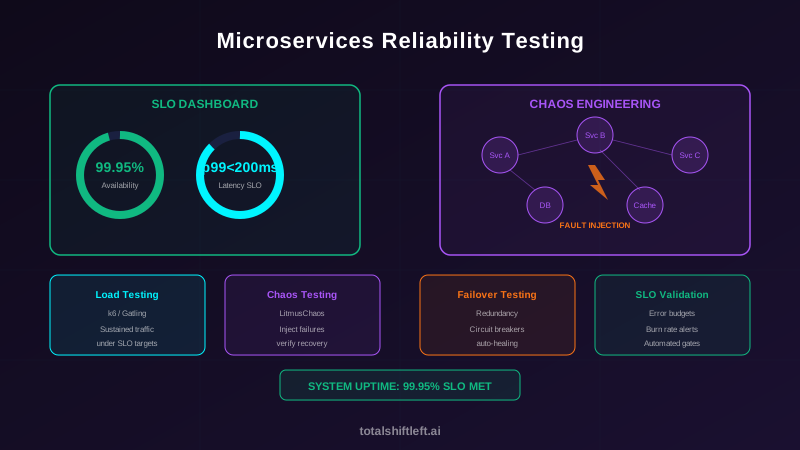
Load Testing
Load testing verifies that services meet SLOs under expected and peak traffic:
What to verify:
- Response latency stays within SLO at normal traffic (p50, p95, p99)
- Error rate stays below SLO threshold at normal and peak traffic
- Services handle 2-3x normal traffic without degradation (headroom testing)
- Connection pools, thread pools, and memory do not exhaust under sustained load
- Throughput scales linearly with additional replicas
Chaos Engineering
Chaos engineering deliberately injects failures to verify resilience:
Ready to shift left with your API testing?
Try our no-code API test automation platform free. Generate tests from OpenAPI, run in CI/CD, and scale quality.
What to verify:
- Service continues operating when a dependency fails (circuit breaker opens)
- System recovers automatically when the failed dependency returns
- Pod failures in Kubernetes trigger rescheduling without request drops
- Network latency injection does not cause timeout cascades
- CPU and memory pressure degrade gracefully (not catastrophically)
Failover Testing
Failover testing verifies that redundancy mechanisms work:
What to verify:
- Database failover completes within acceptable time and without data loss
- Load balancer removes unhealthy instances and routes to healthy ones
- Multi-region failover activates when the primary region is unavailable
- Retry logic with exponential backoff prevents thundering herd on recovery
- Graceful degradation returns partial results rather than errors
Circuit Breaker Testing
Circuit breaker testing verifies the protection mechanism against cascading failures:
What to verify:
- Circuit opens after the configured failure threshold (e.g., 50% errors in 10s window)
- Open circuit returns fallback response (cached data, default value, or error)
- Half-open state probes the downstream service correctly
- Circuit closes when the downstream service recovers
- Circuit breaker metrics are exposed for monitoring
SLO Validation Testing
SLO validation tests run as part of CI/CD and verify that the service meets its targets:
What to verify:
- Availability SLO: success rate exceeds target (e.g., 99.95%)
- Latency SLO: p99 response time stays below target (e.g., 200ms)
- Error rate SLO: error rate stays below threshold (e.g., 0.1%)
- Throughput SLO: service handles minimum required requests per second
Reliability Testing Architecture
Reliability testing operates across three environments:
CI/CD Pipeline (Automated)
- Load tests with SLO threshold assertions (k6 or Gatling)
- Circuit breaker unit tests
- Failover logic unit tests
- SLO validation against staging endpoints
Staging Environment (Scheduled)
- Full load tests at production traffic levels
- Chaos engineering experiments (LitmusChaos, Chaos Mesh)
- Multi-service failover scenarios
- Soak tests (sustained load over hours)
Production (Controlled)
- Canary analysis with SLO comparison (covered in canary testing for microservices)
- Synthetic monitoring with SLO dashboards
- Game day exercises (coordinated chaos experiments)
- Error budget burn rate monitoring
┌────────────────────────────────────────────┐
│          Production Reliability             │
│  Synthetic monitoring, error budget alerts  │
├────────────────────────────────────────────┤
│         Staging Reliability Tests           │
│  Chaos experiments, soak tests, failover    │
├────────────────────────────────────────────┤
│         CI/CD Reliability Gates             │
│  Load tests with SLO thresholds, k6/Gatling │
└────────────────────────────────────────────┘
Tools for Microservices Reliability Testing
| Tool | Type | Best For | Environment |
|---|---|---|---|
| k6 | Load testing | SLO threshold validation, CI/CD integration | CI/CD, Staging |
| Gatling | Load testing | High-concurrency Java/Scala load scenarios | CI/CD, Staging |
| LitmusChaos | Chaos engineering | Kubernetes-native fault injection | Staging, Production |
| Chaos Mesh | Chaos engineering | Kubernetes pod, network, and I/O chaos | Staging, Production |
| Gremlin | Chaos engineering | Enterprise chaos with safety controls | Staging, Production |
| Toxiproxy | Fault injection | Network-level fault injection for integration tests | CI/CD |
| Resilience4j | Circuit breakers | Java circuit breaker implementation and testing | Unit tests |
| Istio | Service mesh | Traffic management, fault injection, mTLS | Staging, Production |
| Shift-Left API | API testing | Validating API reliability under load | CI/CD |
| Prometheus + Grafana | Monitoring | SLO dashboards and error budget tracking | All environments |
k6 SLO Validation Example
import http from 'k6/http';
import { check, sleep } from 'k6';

export const options = {
  stages: [
    { duration: '2m', target: 100 },  // Ramp to normal load
    { duration: '5m', target: 100 },  // Sustain normal load
    { duration: '2m', target: 300 },  // Spike to 3x
    { duration: '3m', target: 100 },  // Return to normal
    { duration: '1m', target: 0 },    // Ramp down
  ],
  thresholds: {
    http_req_failed: ['rate<0.001'],         // SLO: <0.1% error rate
    http_req_duration: ['p(99)<200'],         // SLO: p99 < 200ms
    http_req_duration: ['p(95)<100'],         // SLO: p95 < 100ms
  },
};

export default function () {
  const res = http.get('https://staging.api.example.com/orders');
  check(res, {
    'status is 200': (r) => r.status === 200,
    'response time < 200ms': (r) => r.timings.duration < 200,
  });
  sleep(1);
}
Real-World Example: E-Commerce Platform Reliability
An e-commerce platform has three critical services with defined SLOs:
| Service | Availability SLO | Latency SLO (p99) | Error Budget (monthly) |
|---|---|---|---|
| Product Catalog | 99.95% | 150ms | 21.6 minutes |
| Order Service | 99.99% | 200ms | 4.3 minutes |
| Payment Service | 99.99% | 300ms | 4.3 minutes |
Load testing: k6 runs in CI on every deployment to staging. The test simulates normal traffic (500 RPS) and peak traffic (1500 RPS). If p99 latency exceeds the SLO or error rate exceeds the threshold, the deployment is blocked.
Chaos testing: Weekly scheduled chaos experiments in staging inject three failure types:
- Kill a random Product Catalog pod — verify the remaining pods absorb traffic without SLO breach
- Add 500ms latency between Order Service and Payment Service — verify the circuit breaker opens and returns a retry-later response
- Simulate Redis cluster failure — verify services fall back to database reads and meet degraded SLOs
Failover testing: Monthly game day exercises test database failover (PostgreSQL primary to replica), Redis cluster node failure, and multi-AZ failover. Each test measures recovery time and verifies SLOs are met during and after failover.
Error budget gate: The CI/CD pipeline checks the remaining error budget before allowing a deployment. If the Order Service has consumed more than 80% of its monthly error budget, deployments require manual SRE approval.
Microservices reliability testing challenges and how to solve them
| Challenge | Impact | Solution |
|---|---|---|
| Realistic load generation | Tests at wrong traffic levels miss issues | Use production traffic analysis to model test scenarios; replay production access logs |
| Chaos in production safety | Fear of causing real outages | Start with staging; use blast radius controls (single pod, single AZ); implement automatic rollback |
| SLO threshold calibration | Too strict = constant failures; too loose = false confidence | Base SLOs on historical production data; tighten gradually as reliability improves |
| Test environment fidelity | Staging differs from production | Use infrastructure-as-code to maintain parity; test with production-scale data volumes |
| Cost of load testing | High cloud costs for sustained load tests | Run full load tests on schedule (nightly/weekly); run lightweight SLO checks in every PR |
| Cross-service reliability | Individual SLOs met but end-to-end SLO breached | Test critical user journeys end-to-end with composite SLOs; measure from the user's perspective |
| Flaky reliability tests | Teams stop trusting results | Invest in deterministic test environments; use statistical significance for chaos experiment results |
Free 1-page checklist
API Testing Checklist for CI/CD Pipelines
A printable 25-point checklist covering authentication, error scenarios, contract validation, performance thresholds, and more.
Download FreeBest Practices for Reliability Testing
- Define SLOs before writing reliability tests. Without SLOs, you have no pass/fail criteria. Start with availability and latency SLOs for your three most critical services.
- Automate SLO validation in CI/CD. Every deployment should run a load test with SLO threshold assertions. If the service does not meet SLOs in staging, it should not deploy to production.
- Start chaos engineering in staging. Begin with simple experiments — kill a pod, add latency — and verify that monitoring alerts fire correctly. Graduate to production chaos only after staging experiments are routine.
- Test circuit breakers under real load. A circuit breaker that works in a unit test may behave differently under 1000 RPS. Test circuit breaker behavior during load tests.
- Measure error budgets, not just uptime. Error budgets give teams a framework for balancing reliability and velocity. If the budget is healthy, ship faster. If it is low, slow down and invest in reliability.
- Run soak tests for memory leaks. Short load tests miss memory leaks and connection pool exhaustion. Run sustained load tests for 2-4 hours in staging on a weekly schedule.
- Test graceful degradation, not just success. When a dependency fails, does your service return a cached response, a default value, or a useful error? Test the degraded path, not just the happy path.
- Verify retry and backoff behavior. Aggressive retries without backoff can cause thundering herd problems. Test that retry logic uses exponential backoff with jitter.
- Include reliability tests in your API testing strategy. API-level tests should include latency assertions and error rate thresholds, not just functional correctness.
- Conduct regular game days. Quarterly game day exercises where the team practices incident response with controlled failures build muscle memory for real incidents.
Reliability Testing Checklist
Load Testing
- ✔ Normal traffic load test with SLO threshold assertions
- ✔ Peak traffic (2-3x normal) load test
- ✔ Soak test (sustained load for 2-4 hours)
- ✔ Spike test (sudden traffic increase)
- ✔ Connection pool and thread pool exhaustion verification
- ✔ Auto-scaling trigger and response time validation
Chaos Engineering
- ✔ Pod/instance termination with traffic verification
- ✔ Network latency injection between critical services
- ✔ Dependency failure (database, cache, message broker)
- ✔ CPU and memory pressure injection
- ✔ DNS failure simulation
- ✔ Automatic recovery verification after fault removal
Circuit Breaker Testing
- ✔ Circuit opens after configured failure threshold
- ✔ Fallback response returned when circuit is open
- ✔ Half-open state probes downstream correctly
- ✔ Circuit closes when downstream recovers
- ✔ Circuit breaker metrics exposed for monitoring
SLO Validation
- ✔ Availability SLO met under normal and peak load
- ✔ Latency SLO (p95, p99) met under normal and peak load
- ✔ Error rate stays below SLO threshold
- ✔ Error budget gate blocks deployment when budget is low
- ✔ Composite SLOs validated for critical user journeys
Failover Testing
- ✔ Database failover completes within acceptable time
- ✔ Load balancer removes unhealthy instances
- ✔ Multi-AZ or multi-region failover activates correctly
- ✔ Retry logic uses exponential backoff with jitter
- ✔ Graceful degradation returns partial results
Microservices reliability testing FAQ
What is microservices reliability testing?
Microservices reliability testing is the practice of systematically verifying that distributed services meet defined availability, latency, and error rate targets (SLOs) under both normal and adverse conditions. It includes load testing, chaos engineering, failover testing, and SLO validation to ensure the system maintains acceptable uptime and performance.
How do you test SLOs in microservices?
Test SLOs by running load tests at expected traffic levels and measuring whether services meet availability (e.g., 99.95% success rate), latency (e.g., p99 under 200ms), and throughput targets. Automate SLO validation in CI/CD by running k6 or Gatling tests with threshold assertions that fail the pipeline if SLOs are breached.
What is chaos engineering for microservices?
Chaos engineering is the practice of deliberately injecting failures into a distributed system — such as killing pods, adding network latency, corrupting responses, or exhausting CPU — to verify that the system degrades gracefully and recovers automatically. Tools like LitmusChaos, Chaos Mesh, and Gremlin automate fault injection in Kubernetes environments.
How do you test circuit breakers in microservices?
Test circuit breakers by configuring a downstream dependency to fail (return 500s or timeout) and verifying that the circuit breaker opens after the configured failure threshold, returns fallback responses while open, and closes again after the downstream service recovers. Verify the half-open state correctly probes the downstream service.
What is error budget testing?
Error budget testing validates that a service operates within its allowed failure budget — the difference between 100% reliability and the SLO target. For a 99.9% SLO, the monthly error budget is 43.2 minutes of downtime. Tests verify that planned deployments, maintenance, and expected failure scenarios do not exceed this budget.
Sources and further reading
- Google SRE Workbook — Implementing SLOs — how to define SLOs and error budgets.
- Chaos Mesh — Kubernetes-native fault injection.
- Martin Fowler — Testing Strategies in a Microservice Architecture — the canonical breakdown of microservice test layers.
Key takeaways
- Microservices reliability testing is the bridge between defining SLOs and actually meeting them.
- Without it, SLOs are aspirational targets on a dashboard. With it, they are verified commitments backed by automated testing.
- The most reliable microservices teams follow a consistent pattern: they define SLOs for every critical service, they run load tests with threshold assertions in CI/CD, they practice chaos engineering in staging to discover failure modes before production, and they use error budgets to balance reliability investment with feature velocity.
- If your team has SLOs defined but has never verified them under load, under failure, or under degraded conditions, your reliability posture is based on hope rather than evidence.
- Start with a single k6 load test in CI with SLO thresholds, and build from there.
Ready to validate your microservices reliability? Start your free trial with Shift-Left API to automate API testing with built-in latency and error rate assertions that verify your SLOs on every deployment.
Related Articles: Microservices Testing: The Complete Guide | API Testing: The Complete Guide | Canary Testing in Microservices Deployments | End-to-End Testing Strategies for Microservices | Contract Testing for Microservices | DevOps Testing Strategy
Continue learning
Go deeper in the Learning Center
Hands-on lessons with runnable code against our live sandbox.
The network is unreliable. Here's how clients should retry, how servers should behave, and how to test both.
Happy paths prove your API works. Negative paths prove it doesn't break. Both matter.
Ready to shift left with your API testing?
Try our no-code API test automation platform free.