
Testing Ownership in DevOps Teams: Who Owns Quality?
Quick answer
In DevOps, testing ownership is shared but not undefined: developers own unit and integration tests for their own code, quality engineers own test strategy and automation architecture, operations owns production monitoring and synthetic checks, and product managers own acceptance criteria. A RACI matrix assigns explicit accountability for each testing activity, because "everyone owns quality" without structure defaults to no one owning it.
Reviewed by Parveen Kumari
Testing ownership in DevOps is a shared responsibility model where developers, quality engineers, operations, and product managers each contribute distinct quality activities throughout the software delivery lifecycle. The principle is that everyone owns quality in their role, with no single team serving as the sole quality gate.
The 2025 State of Testing report revealed that 67% of organizations attempting DevOps transformation struggle with the question of testing ownership. When testing was the QA team's job, ownership was clear. In DevOps, where quality is everyone's responsibility, teams frequently encounter confusion about who does what, gaps where no one takes ownership, and friction over testing responsibilities.
"Everyone owns quality" is a powerful principle, but without structure, it becomes "no one owns quality." The phrase works as a cultural aspiration. It fails as an operational model. Successful DevOps teams pair the principle of shared ownership with clear role definitions, automated enforcement, and accountability structures.
This guide defines the testing ownership model that works in practice. It specifies what developers own, what quality engineers own, what operations owns, and how these responsibilities interact without creating gaps or conflicts. Whether your team is transitioning from centralized QA to shared ownership or trying to fix a broken shared model, this is the operational blueprint for making DevOps testing culture work.
In this guide
- What Is Testing Ownership in DevOps?
- Why Testing Ownership Matters
- Key Components of Testing Ownership
- Testing Ownership Architecture: RACI Model
- Tools Supporting Testing Ownership
- Real-World Example: Fixing Broken Testing Ownership
- Common Challenges in Testing Ownership
- Best Practices for Testing Ownership in DevOps
- Testing Ownership Implementation Checklist
- Make ownership explicit in the repository
- Testing ownership FAQ
What Is Testing Ownership in DevOps?
Testing ownership in DevOps defines who is responsible for which quality activities across the software delivery lifecycle. It replaces the traditional model—where QA owns all testing—with a distributed model where each role contributes specific testing activities based on their expertise and position in the workflow.
The ownership model is built on three principles. First, the person closest to the code should write the first tests. Developers understand their code's behavior and write the most effective unit and integration tests. Second, strategic quality decisions should be made by quality specialists. Quality engineers have the training and perspective to design test strategies, identify risk areas, and build automation architectures. Third, production quality should be monitored by the people who operate the system. Operations and SRE teams have the infrastructure knowledge to build effective monitoring.
This does not mean rigid boundaries. Developers sometimes write end-to-end tests. Quality engineers sometimes write unit tests. Operations sometimes contributes test scenarios based on production incidents. The ownership model defines primary responsibility, not exclusive territory. Giving each squad its own isolated workspace for its tests and assets makes these ownership boundaries concrete in the tooling rather than relying on convention alone. The goal is clarity about who is accountable for what, not silos that prevent collaboration.
Testing ownership connects directly to the quality engineering model where QA professionals evolve from test executors into quality strategists who enable the entire team to test effectively.
Picking the runner first? Our comparison of continuous integration testing tools covers the CI systems, languages and licence models side by side.
Why Testing Ownership Matters
Diffusion of Responsibility Is the Default
When an organization declares "everyone owns quality" without defining specific responsibilities, the most common outcome is diffusion of responsibility. Developers assume QA will catch their bugs. QA assumes developers tested basic functionality. Operations assumes pre-production testing covers production scenarios. Each role assumes another role covers the gaps. The result is gaps everywhere.
Research in organizational psychology confirms this pattern: when responsibility is shared among a group without clear assignment, individuals contribute less effort than they would if individually responsible. Testing ownership structures counter this by assigning clear accountability while maintaining the shared principle.
Coverage Gaps Cause Production Incidents
Unowned testing areas create coverage gaps that cause production incidents. Common gaps include: API contract testing between microservices (developers test their service, no one tests the contracts), cross-service integration testing (each team tests their component, no one tests the integration), performance under production-like load (everyone assumes someone else runs load tests), and error handling paths (happy paths are tested, error scenarios are ignored).
A clear ownership model identifies these gap areas and assigns responsibility. DevOps testing best practices require explicit coverage ownership to prevent these common gaps.
Developer Productivity Depends on Fast Testing Feedback
When developers own their unit and integration tests, they get instant feedback on code quality. When testing is delegated to a separate team, feedback is delayed by hours or days. Fast feedback improves developer productivity because issues are caught while the code is fresh in the developer's mind, reducing context-switching costs.
Quality Engineer Impact Depends on Role Clarity
Quality engineers are most impactful when they focus on strategic activities: test strategy, automation architecture, coaching, and exploratory testing. When ownership is unclear, quality engineers get pulled into manual test execution, basic automation writing, and developer support work that prevents them from doing their highest-value activities.
Key Components of Testing Ownership
Developer Testing Responsibilities
Developers own the testing activities closest to their code:
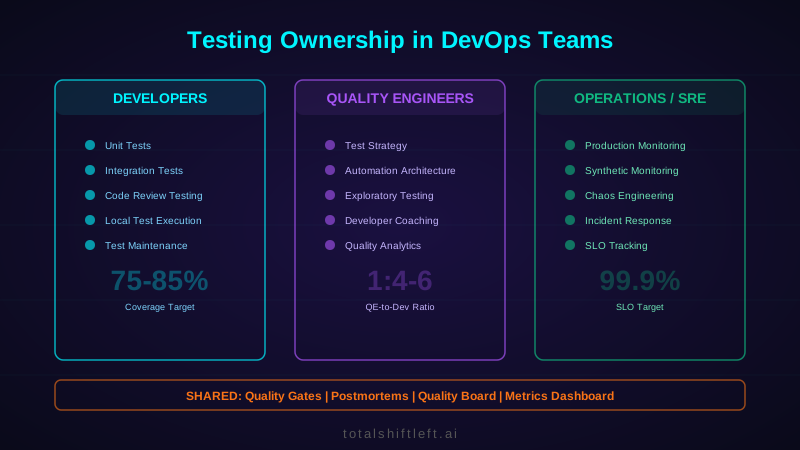
Unit Tests: Developers write and maintain unit tests for every module, class, and function they create. Unit tests are part of the definition of done for every user story. Coverage targets (typically 75-85%) are enforced through CI/CD quality gates.
Integration Tests: Developers write integration tests that verify their components interact correctly with adjacent components, databases, and external services. These tests use realistic configurations and validate data flow across boundaries.
Code Review Testing: Developers review test quality during code reviews, checking for meaningful assertions, edge case coverage, and test maintainability. Test code is held to the same review standards as production code.
Local Test Execution: Developers run unit and integration tests locally before pushing code. Pre-commit hooks can enforce this, but the cultural expectation is that developers verify their changes before sharing them.
Quality Engineer Testing Responsibilities
Quality engineers own strategic and architectural testing activities:
Test Strategy: Quality engineers define what to test at each pyramid level, identify high-risk areas requiring deeper coverage, design test data strategies, and determine quality gate thresholds. They make the strategic decisions that guide the team's testing investments.
Automation Architecture: Quality engineers design and maintain the test automation framework, including test runners, assertion libraries, mock services, test data factories, and reporting tools. They create the infrastructure that makes developer testing easy and effective.
Ready to shift left with your API testing?
Try our no-code API test automation platform free. Generate tests from OpenAPI, run in CI/CD, and scale quality.
Exploratory Testing: Quality engineers conduct exploratory testing sessions that probe beyond automated coverage. They test edge cases, evaluate error handling, assess user experience, and investigate areas flagged by production monitoring or risk analysis.
Coaching and Enablement: Quality engineers coach developers on testing practices through pairing, code review feedback, documentation, and workshops. They are responsible for raising the testing capability of the entire squad.
Quality Analytics: Quality engineers analyze testing data—coverage trends, defect patterns, flaky test rates, pipeline reliability—and translate insights into actionable improvement recommendations.
Operations Testing Responsibilities
Operations and SRE teams own production-facing quality activities:
Production Monitoring: Operations configures and maintains monitoring for application health, performance, error rates, and SLO compliance. Monitoring alerts serve as the final quality check that catches issues missed by pre-production testing.
Synthetic Monitoring: Operations runs synthetic transactions against production to verify critical user journeys continuously. These are production-running tests that validate system behavior under real conditions.
Chaos Engineering: Operations conducts controlled experiments (chaos testing) to verify system resilience under failure conditions. This validates that the system degrades gracefully when components fail.
Incident Response and Feedback: When production incidents occur, operations leads the incident response and collaborates with development and QA on postmortem analysis that identifies testing gaps.
Product Manager Testing Responsibilities
Product managers own quality at the requirements level:
Acceptance Criteria: Product managers write clear, testable acceptance criteria for every user story. These criteria define what "done" means and enable quality engineers to design appropriate test coverage.
User Acceptance Testing: Product managers validate that delivered features meet user needs through UAT sessions, prototype testing, and user feedba
ck analysis.
Testing Ownership Architecture: RACI Model
The RACI model (Responsible, Accountable, Consulted, Informed) clarifies testing ownership across roles:
Unit Testing: Developer (R/A), Quality Engineer (C), Tech Lead (I)
Integration Testing: Developer (R), Quality Engineer (A/C), Tech Lead (I)
API Contract Testing: Developer (R), Quality Engineer (A), Operations (C)
End-to-End Testing: Quality Engineer (R/A), Developer (C), Product Manager (I)
Performance Testing: Quality Engineer (R), Operations (A/C), Developer (C)
Security Testing: Quality Engineer (R), Security Team (A/C), Developer (I)
Exploratory Testing: Quality Engineer (R/A), Product Manager (C), Developer (I)
Production Monitoring: Operations (R/A), Quality Engineer (C), Developer (I)
Test Strategy: Quality Engineer (R/A), Tech Lead (C), Product Manager (C)
Automation Framework: Quality Engineer (R/A), Developer (C), Operations (C)
This model ensures every testing activity has a clear owner while maintaining the collaborative principle. The CI/CD testing pipeline enforces these ownership boundaries through automated quality gates.
Tools Supporting Testing Ownership
| Tool | Type | Best For | Open Source |
|---|---|---|---|
| Total Shift Left | API Test Automation | Shared API testing across developer and QA ownership | No |
| GitHub Actions | CI/CD | Enforcing quality gates and ownership boundaries | No |
| Jenkins | CI/CD | Pipeline orchestration with role-based stages | Yes |
| SonarQube | Code Quality | Developer-owned code quality with QA-defined standards | Yes |
| Playwright | E2E Testing | QA-owned end-to-end automation | Yes |
| Jest/Vitest | Unit Testing | Developer-owned unit test frameworks | Yes |
| k6 | Performance | Shared performance testing in pipeline | Yes |
| Datadog | Monitoring | Operations-owned production quality monitoring | No |
| Grafana | Dashboards | Shared quality metrics visualization | Yes |
| PagerDuty | Incident Mgmt | Operations-owned incident response coordination | No |
| Allure | Reporting | Shared test reporting across all ownership areas | Yes |
| TestRail | Management | QA-owned test strategy tracking and coverage analysis | No |
Real-World Example: Fixing Broken Testing Ownership
Problem: A logistics technology company (90 engineers, 6 squads) adopted DevOps and declared "everyone owns quality." Within 6 months, testing ownership had collapsed. Developers wrote minimal tests because they assumed QA would catch issues. QA engineers spent all their time on manual regression because they had no time for strategy or automation. Operations got paged for production incidents 4-5 times per week because neither development nor QA caught integration issues. Defect escape rate climbed to 30%. Average incident resolution took 6 hours because root cause analysis required multiple teams to coordinate.
Solution: They implemented a structured ownership model. They defined explicit RACI matrices for every testing activity. Developers were required to achieve 80% unit test coverage and write integration tests (enforced by quality gates in the CI/CD pipeline). Quality engineers were freed from manual regression through automation and redirected to test strategy, exploratory testing, and coaching. Operations implemented comprehensive monitoring with SLOs and synthetic checks. A cross-team "Quality Board" met weekly to review quality metrics, identify ownership gaps, and assign remediation owners. Each production incident postmortem was required to identify which ownership area had the gap and what systemic fix would prevent recurrence.
Results: Within 6 months, defect escape rate dropped from 30% to 7%. Production incidents decreased from 4-5 per week to 1-2 per month. Developer unit test coverage went from 25% to 82%. Quality engineers reported spending 70% of time on strategic activities (up from 15%). Operations page frequency dropped 85%. Mean time to resolution decreased from 6 hours to 40 minutes because clear ownership enabled faster root cause identification. Cross-team finger-pointing was replaced by collaborative postmortems.
Common Challenges in Testing Ownership
"Everyone Owns Quality" Means No One Owns Quality
Challenge: The principle of shared ownership, without structural support, leads to diffusion of responsibility. Critical testing areas fall through the cracks.
Solution: Pair the shared ownership principle with an explicit RACI matrix. Every testing activity must have at least one person or role marked as Accountable. Review the RACI matrix quarterly to identify gaps. Make the matrix visible and reference it during sprint planning and retrospectives.
Developers Writing Low-Quality Tests
Challenge: When developers are required to write tests, some meet coverage requirements with low-quality tests—tests that achieve coverage without meaningful assertions, tests that pass regardless of behavior, or tests that are fragile and break on any change.
Solution: Quality engineers review test quality during code reviews, not just coverage numbers. Establish test quality standards (meaningful assertions, edge case coverage, independence between tests). Use mutation testing tools that verify tests actually detect defects. Provide developer training on effective test design.
Quality Engineers Becoming Test Execution Resources
Challenge: Despite role definitions, quality engineers get pulled into manual test execution during crunch periods, preventing them from strategic work.
Solution: Protect quality engineer strategic time. When manual testing is needed, use cross-team rotation rather than defaulting to quality engineers. Track quality engineer time allocation and flag when execution exceeds 20% of their time. Automate remaining manual regression to eliminate the pull entirely.
Free YAML templates + guide
CI/CD Testing Pipeline Templates
Production-ready CI/CD pipeline templates for GitHub Actions and GitLab CI. Includes API testing, contract testing, and performance testing stages.
Download FreeOwnership Gaps Between Microservices
Challenge: In microservices architectures, each team owns their service's tests, but no one owns the tests between services—contract testing, integration testing, and end-to-end scenarios that cross service boundaries.
Solution: Assign cross-service testing ownership explicitly. Contract testing is co-owned by producer and consumer service teams. Integration testing for critical flows has designated owners. Quality engineers from multiple squads collaborate on end-to-end test suites. The shift-left testing approach includes moving contract validation into development.
Measuring Individual vs Team Quality Contribution
Challenge: In shared ownership models, measuring individual contributions to quality is difficult. This creates challenges for performance reviews and recognition.
Solution: Measure quality at the team level (defect escape rate, quality gate pass rate, incident frequency) and attribute it to the team rather than individuals. Use peer feedback for individual contributions. Track observable behaviors (test code review participation, coaching sessions conducted, postmortem action items completed) rather than trying to isolate individual quality impact.
Scaling Ownership Across Many Teams
Challenge: As organizations grow, maintaining consistent testing ownership across 20, 50, or 100 teams becomes difficult.
Solution: Standardize ownership patterns through shared pipeline templates that enforce minimum quality gates. Create a Quality Guild that maintains the organizational RACI standard. Allow teams to customize ownership within their squad while meeting organizational minimums. Regular cross-team quality audits identify teams that have drifted from ownership standards.
Best Practices for Testing Ownership in DevOps
- Define an explicit RACI matrix for all testing activities and review it quarterly
- Make developers responsible for unit and integration tests with enforced coverage gates
- Free quality engineers from manual regression so they focus on strategy, coaching, and exploration
- Assign operations ownership for production monitoring and synthetic testing
- Require product managers to write testable acceptance criteria for every story
- Enforce ownership boundaries through CI/CD pipeline automation, not process compliance
- Track quality metrics at the team level to reinforce shared ownership
- Conduct blameless postmortems that identify ownership gaps rather than individual failures
- Create a cross-team Quality Board that reviews ownership effectiveness monthly
- Establish clear escalation paths when ownership gaps are discovered
- Use test automation best practices to make developer testing frictionless
- Document ownership patterns and make them visible to new team members during onboarding
Testing Ownership Implementation Checklist
- ✔ RACI matrix defines ownership for every testing activity type
- ✔ Developers write unit tests as part of definition of done (75-85% coverage enforced)
- ✔ Developers write integration tests for their component interactions
- ✔ Quality engineers own test strategy and automation architecture for each squad
- ✔ Quality engineers conduct scheduled exploratory testing sessions (biweekly minimum)
- ✔ Quality engineers coach developers through pairing and code review
- ✔ Operations owns production monitoring with defined SLOs and alerting
- ✔ Operations runs synthetic monitoring for critical production paths
- ✔ Product managers write testable acceptance criteria for every user story
- ✔ CI/CD quality gates enforce ownership boundaries automatically
- ✔ Cross-service testing ownership is explicitly assigned
- ✔ Quality Board meets regularly to review ownership effectiveness and gap analysis
- ✔ Postmortem process includes ownership gap identification and remediation
- ✔ Quality metrics dashboard is visible to all team members and updated in real time
Take the next step. See how shift-left API testing platform applies these ideas to your workflow, or explore API testing in CI/CD for the broader picture.
See also: contract testing in our learn hub for the underlying concept.
Make ownership explicit in the repository
Ownership arguments end when the tooling names an owner. CODEOWNERS does it for review; a test-level annotation does it for failures:
# CODEOWNERS
/openapi.yaml               @acme/orders-team @acme/api-council
/tests/unit/                @acme/orders-team
/tests/contract/            @acme/orders-team @acme/consumers
/tests/e2e/                 @acme/qa-guild
/.github/workflows/         @acme/platform
/quality-policy.yaml        @acme/qa-guild @acme/platform
Then route failures automatically. A red build with no named owner is the state where "everyone owns quality" turns into nobody fixing it:
# scripts/route_failures.py — turn a failed run into a named assignee
import subprocess, xml.etree.ElementTree as ET, pathlib, re, json

owners = {}
for line in pathlib.Path("CODEOWNERS").read_text().splitlines():
    if line.strip() and not line.startswith("#"):
        path, *handles = line.split()
        owners[path.strip("/")] = handles

failures = [c.get("classname", "").replace(".", "/") + ".py"
            for c in ET.parse("results.xml").getroot().iter("testcase")
            if c.find("failure") is not None]

for f in sorted(set(failures)):
    owner = next((h for p, h in owners.items() if f.startswith(p)), ["@acme/qa-guild"])
    print(json.dumps({"test_file": f, "assign": owner}))
Testing ownership FAQ
Who owns testing in DevOps?
In DevOps, testing ownership is shared across the entire team. Developers own unit and integration tests for their code. Quality engineers own test strategy, automation architecture, and exploratory testing. Operations owns production monitoring and observability. Product managers own acceptance criteria. The principle is that everyone contributes to quality in their role—no single person or team is solely responsible.
How does shared testing ownership work in practice?
Shared testing ownership works through clear role definitions, automated enforcement, and cultural norms. Developers write tests as part of their definition of done. Quality engineers design test strategies and build automation frameworks. CI/CD quality gates enforce standards automatically. Code reviews include test quality assessment. Production incidents trigger shared postmortems that identify testing gaps.
What are the risks of shared testing ownership?
The main risks are diffusion of responsibility (everyone assumes someone else will handle it), inconsistent quality standards across teams, developers writing low-quality tests to meet coverage requirements, and quality engineers feeling their expertise is undervalued. These risks are mitigated through clear RACI matrices, quality gates, code review standards, and quality engineering leadership.
Should developers write their own tests in DevOps?
Yes. Developers should write unit tests and integration tests for their own code. They understand the code's behavior, edge cases, and failure modes better than anyone. Quality engineers should design the test strategy and framework, but developers should implement the tests for their features. This model produces higher-quality tests and faster feedback loops.
How do you prevent quality gaps in shared ownership models?
Prevent quality gaps by implementing automated quality gates that enforce minimum standards, assigning quality engineering ownership for test strategy per domain, conducting regular coverage gap analysis, running exploratory testing sessions, maintaining cross-team quality standards through a Quality Guild, and tracking quality metrics that reveal gaps before they cause production incidents.
Sources and further reading
- DORA State of DevOps research — the multi-year dataset behind the four delivery metrics.
- Google Testing Blog — Google's engineering write-ups on test sizing and flakiness.
- Accelerate / DORA four key metrics — the definitions behind lead time, deploy frequency, CFR and MTTR.
Key takeaways
- Testing ownership is the operational backbone of DevOps testing culture.
- Without clear ownership, shared responsibility degrades into shared neglect.
- With clear ownership, each role contributes its unique expertise to a quality system that is greater than the sum of its parts.
- The key is structure without rigidity. Define clear primary responsibilities.
- Enforce minimums through automation. Track quality at the team level. Create accountability through visibility and postmortem processes.
- And continuously refine the ownership model as your team, product, and technology evolve.
Start by documenting your current testing ownership—who actually does what today, not who should do what. Identify the gaps between current reality and the ownership model described here. Address the biggest gap first. Measure the impact. Then address the next gap. Testing ownership improves through iteration, not revolution.
Ready to give your team the testing infrastructure that supports shared ownership? Start your free trial of Total Shift Left and provide developers and quality engineers with codeless API testing that fits into every role's workflow.
Related: DevOps Testing: The Complete Guide | What Is Shift-Left Testing? | DevOps Testing Culture Explained | QA in DevOps: The Evolving Role | Quality Engineering vs Traditional QA | DevOps Testing Best Practices
Ready to shift left with your API testing?
Try our no-code API test automation platform free.