
Quality Engineering vs QA: What's the Difference?
Quick answer
Quality engineering is a proactive, prevention-focused discipline embedded throughout the delivery lifecycle using automation and cross-functional collaboration; traditional QA is a reactive, detection-focused phase where a separate team tests finished software before release. Organizations that make the transition typically see 60-80% reductions in defect escape rates and 3-5x improvements in deployment frequency, because catching a bug during development costs roughly $10 versus $1,000+ in production.
Reviewed by Sushant Joshi

Quality engineering is a proactive, prevention-focused discipline that embeds quality practices throughout the software delivery lifecycle using automation, analytics, and cross-functional collaboration. It contrasts with traditional QA, which is a reactive, detection-focused phase where a separate team tests completed software to find defects before release.
LinkedIn job postings for "Quality Engineer" increased 340% between 2022 and 2025, while postings for "QA Tester" declined 45% over the same period. This is not a statistical curiosity—it reflects a fundamental transformation in how organizations approach software quality.
Traditional QA—the model where a separate testing team validates completed software before release—served the industry well for decades. It worked when release cycles were quarterly, when software was installed on physical machines, and when manual testing was the only option. That model breaks when teams deploy daily, when software runs on distributed cloud infrastructure, and when test automation can execute thousands of checks in minutes.
Quality engineering emerged as the replacement model. It shifts the focus from finding defects to preventing them, from manual execution to automated validation, and from siloed testing to embedded quality practices. This guide provides a detailed comparison of both approaches, explains why the transition matters, and offers a practical roadmap for organizations moving from traditional QA to quality engineering.
In this guide
- What Is Quality Engineering vs Traditional QA?
- Why the Distinction Matters
- Key Components of Quality Engineering
- Quality Engineering vs QA: Architecture Comparison
- Tools Comparison: Traditional QA vs Quality Engineering
- Real-World Example: QA to Quality Engineering Transformation
- Common Challenges in Quality Engineering Adoption
- Best Practices for Transitioning to Quality Engineering
- Quality Engineering Transition Checklist
- The deliverable changes, not just the job title
- Quality engineering FAQ
What Is Quality Engineering vs Traditional QA?
Traditional QA is an organizational function where dedicated testers validate software quality after development is complete. The QA team receives builds, executes test cases (often manually), reports defects, verifies fixes, and provides a quality assessment that determines whether software is ready for release. QA is a phase in the delivery process—a gate between development and deployment.
Quality engineering is a discipline where quality practices are embedded throughout the entire delivery lifecycle. Quality engineers work within cross-functional teams, designing test strategies, building automation infrastructure, coaching developers on testing practices, analyzing quality data, and contributing to architecture decisions that improve testability. Quality is not a phase—it is a property of the process.
The distinction is analogous to the difference between quality inspection and quality manufacturing in physical production. Quality inspection examines finished products to find defects. Quality manufacturing designs the production process so that defects cannot occur. Both have value, but quality manufacturing is fundamentally more effective and efficient.
In software terms, traditional QA inspects the output. Quality engineering designs the process. A DevOps testing culture requires quality engineering because the speed of continuous delivery demands prevention over detection.
For the longer view of where this is going, the future of software testing in AI-driven development covers what changes when most code is generated.
If the gap is tooling rather than process, start with continuous integration testing tools and its comparison matrix.
Why the Distinction Matters
Cost of Defect Detection vs Prevention
The cost to fix a defect increases exponentially as it moves through the delivery lifecycle. A bug caught during development costs $10 to fix. The same bug caught in QA testing costs $100. In production, it costs $1,000 or more—factoring in incident response, customer impact, hotfix deployment, and reputation damage.
Traditional QA catches defects at the QA stage—after development and before release. Quality engineering catches defects during development or prevents them entirely through better design, automated checks, and shift-left testing practices. The economic advantage of prevention over detection is massive.
Speed of Delivery
Traditional QA creates a sequential bottleneck. Development completes work, hands it to QA, QA tests it, reports defects, development fixes them, QA retests. This cycle adds days or weeks to every release. When organizations try to deploy daily with traditional QA, the QA phase becomes either a bottleneck (slowing delivery) or a rubber stamp (providing false confidence).
Quality engineering eliminates this bottleneck by distributing quality activities across the delivery process. Developers test during development. Automated pipelines validate on every commit. Quality engineers focus on strategy and exploration rather than regression execution. There is no sequential handoff because quality activities run in parallel with development.
Talent Retention and Career Growth
QA professionals in traditional organizations often feel undervalued. They are viewed as a cost center, their career growth is limited, and their work (manual regression testing) is repetitive. This leads to high turnover and difficulty hiring.
Quality engineering elevates the role. Quality engineers have broader technical skills, more strategic impact, and higher compensation. They are valued contributors who make entire teams more effective. Organizations that offer quality engineering career paths attract and retain better talent.
Scalability
Traditional QA scales linearly: more features require more testers executing more test cases. This creates a cost structure that grows proportionally with development output. Quality engineering scales logarithmically: automation frameworks, shared testing infrastructure, and developer testing practices handle increased volume without proportional staffing increases.
Key Components of Quality Engineering
Prevention-Focused Mindset
Quality engineers prioritize defect prevention over defect detection. They participate in design reviews to identify testability issues early. They establish coding standards that reduce defect likelihood. They build automated checks that catch issues before they reach the main branch. Prevention is always cheaper and faster than detection.
Automation Architecture
Quality engineers design and maintain the automation infrastructure that the entire team uses. This includes test frameworks, CI/CD quality gates, test data management, mock services, and reporting systems. The automation architecture is treated as a product with its own backlog, quality standards, and maintenance schedule.
Data-Driven Quality Decisions
Quality engineers use data to guide quality investments. They analyze defect patterns to identify high-risk areas. They track test effectiveness metrics to eliminate low-value tests and add high-value ones. A shared analytics dashboard for test health and coverage trends gives them the single source of truth these decisions depend on. They use production telemetry to understand real-world failure modes. Decisions about what to test, how to test, and when to test are based on data rather than intuition.
Ready to shift left with your API testing?
Try our no-code API test automation platform free. Generate tests from OpenAPI, run in CI/CD, and scale quality.
Cross-Functional Collaboration
Quality engineers work within development teams, not alongside them. They participate in sprint planning, contribute to code reviews, pair with developers on testing, and collaborate with operations on production monitoring. This embedded model enables real-time quality influence rather than after-the-fact quality assessment.
Continuous Improvement
Quality engineering treats the quality process itself as something to be continuously improved. Regular retrospectives examine testing effectiveness. Postmortem analysis identifies quality gaps. Metrics track quality trends over time. The quality system is never "done"—it evolves with the product, the team, and the technology landscape.
Testability Advocacy
Quality engineers advocate for system designs that are easy to test. They influence architecture decisions to ensure that components can be tested in isolation, that interfaces are well-defined, and that observability is built into the system. Testability is a design requirement, not an afterthought.
Quality Engineering vs QA: Architecture Comparison
Traditional QA Architecture: Development produces builds. Builds are deployed to a QA environment. QA team executes test cases (manual and automated). Defects are logged in a tracking system. Developers fix defects. QA retests. Release decision is made based on QA approval. The flow is linear and sequential.
Quality Engineering Architecture: Quality practices are integrated at every stage. Developers run unit and integration tests locally. Pre-commit hooks enforce code quality standards. CI pipelines run automated tests on every push. Quality gates block progression for failures. Quality engineers conduct exploratory testing in parallel. Production monitoring validates quality post-deployment. Feedback loops connect production data to test priorities. The flow is parallel and continuous.
The architectural difference reflects the fundamental philosophical difference. Traditional QA is a checkpoint. Quality eng
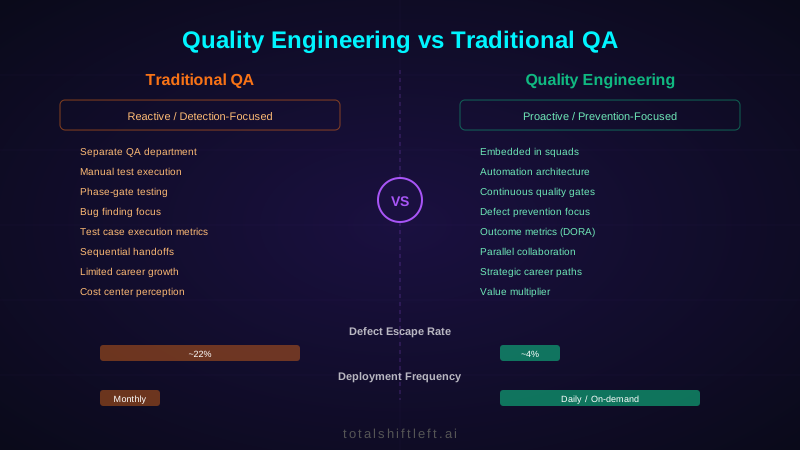
ineering is a continuous process. The DevOps testing pipeline is the infrastructure that makes quality engineering possible at scale.
Tools Comparison: Traditional QA vs Quality Engineering
| Tool | Type | Traditional QA Use | Quality Engineering Use | Open Source |
|---|---|---|---|---|
| Total Shift Left | API Testing | Manual API validation | Automated API testing in CI/CD | No |
| Selenium | UI Testing | Manual test script execution | Automated regression in pipeline | Yes |
| Playwright | E2E Testing | Not typically used | CI-integrated cross-browser testing | Yes |
| Jira | Management | Bug tracking and test cases | Quality metrics dashboards | No |
| SonarQube | Code Quality | Not typically used | Automated code quality gates | Yes |
| Jenkins | CI/CD | Not typically used | Quality gate orchestration | Yes |
| k6 | Performance | Periodic manual load tests | Continuous performance benchmarks | Yes |
| Postman | API Testing | Manual API exploration | Automated API contract testing | No |
| TestRail | Test Management | Test case execution tracking | Test strategy and coverage analysis | No |
| Grafana | Monitoring | Not typically used | Quality metrics and production monitoring | Yes |
| Cypress | Testing | Not typically used | Developer-written component tests | Yes |
| Allure | Reporting | Manual report generation | Automated test reporting in CI/CD | Yes |
Real-World Example: QA to Quality Engineering Transformation
Problem: A healthcare SaaS company (150 engineers, 10 squads) had a 20-person QA team performing manual regression testing for a HIPAA-compliant platform. Each release required 4 weeks of manual testing. The QA team maintained 12,000 manual test cases. Developers wrote zero automated tests. Defect escape rate to production was 22%, with compliance-critical bugs reaching users twice per quarter. Releases were monthly, and the business demanded weekly releases to compete.
Solution: They transitioned to quality engineering over 12 months. Phase 1 (months 1-3): redistributed QA engineers into squads, implemented mandatory unit test coverage gates (70% minimum), and launched an automation training program. Phase 2 (months 4-6): quality engineers built an automation framework using Total Shift Left for API testing and Playwright for UI testing, automating the top 2,000 regression scenarios. Phase 3 (months 7-9): added DevOps testing best practices including security scanning (required for HIPAA), performance benchmarks, and production monitoring. Phase 4 (months 10-12): eliminated remaining manual regression testing, established quality engineering career ladder, and implemented continuous quality dashboards.
Results: Release frequency increased from monthly to weekly (4x improvement). Defect escape rate dropped from 22% to 4%. Compliance-critical production bugs went from 8 per year to zero. Manual test case count dropped from 12,000 to 200 (exploratory scenarios only). Automated test count grew to 8,500. QA team satisfaction scores increased 45%. Three former manual testers became senior quality engineers leading automation initiatives. Total testing cost decreased 35% despite higher tool investment because manual testing labor was eliminated.
Common Challenges in Quality Engineering Adoption
Organizational Resistance to Role Change
Challenge: QA managers resist the embedded model because it reduces their team size and organizational influence. Developers resist testing responsibility because they view it as "QA's job."
Solution: Frame the transition as role elevation, not elimination. QA managers become quality engineering directors with broader scope. Show concrete examples of quality engineers at companies like Google, Netflix, and Spotify who have higher impact and compensation than traditional QA roles. Address developer resistance by making testing easy (good frameworks, clear examples, pairing support).
Skill Gap Between Manual Testing and Quality Engineering
Challenge: Manual testers may lack programming, CI/CD, and automation skills required for quality engineering.
Solution: Invest in structured training with dedicated learning time (20% of work hours). Start with codeless tools like Total Shift Left that reduce the programming barrier. Pair manual testers with experienced automation engineers. Celebrate incremental progress. Set realistic timelines—full transition takes 6-12 months per person. Not every manual tester will become a quality engineer, and that is acceptable—provide alternative career paths.
Measuring Quality Engineering ROI
Challenge: Traditional QA is measured by bugs found and test cases executed—easily quantifiable metrics. Quality engineering's value (prevention, coaching, infrastructure) is harder to measure.
Solution: Measure quality engineering through outcome metrics: defect escape rate reduction, deployment frequency increase, change failure rate decrease, MTTR improvement, and developer testing velocity. Track the cost savings from eliminated manual testing. Use DevOps quality metrics that demonstrate business impact rather than activity counts.
Maintaining Consistency Across Teams
Free YAML templates + guide
CI/CD Testing Pipeline Templates
Production-ready CI/CD pipeline templates for GitHub Actions and GitLab CI. Includes API testing, contract testing, and performance testing stages.
Download FreeChallenge: When quality engineers are embedded in different squads, testing practices can diverge, creating inconsistency.
Solution: Establish organization-wide quality standards enforced through shared pipeline templates. Create a Quality Guild for cross-team alignment. Maintain shared automation frameworks and testing libraries. Conduct periodic cross-team quality audits. Balance team autonomy with organizational consistency.
Legacy Test Suite Migration
Challenge: Organizations with large manual test suites face the question of what to automate, what to keep manual, and what to discard.
Solution: Do not automate all existing test cases—many are redundant, obsolete, or low-value. Analyze production defect data to identify which test areas provide the most value. Automate high-value, frequently-executed scenarios first. Convert unique edge cases to exploratory testing charters. Discard tests that duplicate other coverage. Expect to eliminate 40-60% of existing test cases during the transition.
Best Practices for Transitioning to Quality Engineering
- Start with a pilot squad to prove the model before scaling across the organization
- Invest in automation training before demanding automation—skills come before output
- Embed quality engineers within squads as peers, not as subordinates to development leads
- Build automation frameworks that reduce testing friction for developers (one-command test execution)
- Establish quality gates gradually—start with unit test coverage, add dimensions over time
- Measure transition success through outcome metrics (defect escape rate, deployment frequency), not activity metrics
- Create a quality engineering career ladder with clear levels, responsibilities, and compensation bands
- Maintain a Quality Guild for cross-team coordination, standards alignment, and knowledge sharing
- Preserve exploratory testing as a core quality engineering activity—automation does not replace human judgment
- Treat the transition as a 12-18 month organizational change, not a tool migration
- Invest in test automation best practices that ensure sustainable, maintainable automation
- Communicate the vision repeatedly—culture change requires constant reinforcement
Quality Engineering Transition Checklist
- ✔ Leadership has committed to quality engineering transformation with budget and timeline
- ✔ Quality engineering role is defined with clear job descriptions, levels, and compensation
- ✔ Pilot squad has been selected and quality engineer is embedded
- ✔ Automation training program is funded and scheduled with dedicated learning time
- ✔ CI/CD pipeline includes quality gates for unit test coverage
- ✔ Automation framework is built and documented for team use
- ✔ Developers write unit tests as part of definition of done
- ✔ Manual regression testing is being progressively automated
- ✔ Quality metrics dashboard tracks defect escape rate and deployment frequency
- ✔ Quality Guild meets regularly for cross-team alignment
- ✔ Exploratory testing is preserved and scheduled as a quality engineering activity
- ✔ Production monitoring feeds quality improvement priorities
- ✔ Legacy test suite has been analyzed and low-value tests discarded
- ✔ Quality engineering career ladder is published and communicated to the team
Take the next step. See how shift-left API testing platform applies these ideas to your workflow, or explore API testing in CI/CD for the broader picture.
See also: contract testing in our learn hub for the underlying concept.
The deliverable changes, not just the job title
Traditional QA delivers a verdict on a build. Quality engineering delivers the mechanism that makes the verdict automatic — the same judgement, expressed as a gate anyone can run:
# .github/workflows/quality.yml — the QE deliverable
name: Quality gate
on: pull_request
jobs:
  gate:
    runs-on: ubuntu-latest
    steps:
      - uses: actions/checkout@v4
        with: { fetch-depth: 0 }

      # what a QA sign-off used to assert, now asserted per pull request
      - name: No breaking contract change
        run: |
          git show origin/${{ github.base_ref }}:openapi.yaml > /tmp/base.yaml
          oasdiff breaking /tmp/base.yaml openapi.yaml --fail-on ERR

      - name: Coverage has not regressed
        run: pytest --cov=app --cov-fail-under=80

      - name: No known-vulnerable dependency
        run: pip-audit --strict

      - name: Performance budget holds
        run: k6 run --quiet load.js   # thresholds in the script fail the run
Nothing in that list is a new activity. Each line is something a QA function already did — moved from a person doing it once per release to a gate doing it once per change.
Quality engineering FAQ
What is the difference between quality engineering and QA?
Quality engineering is a proactive, prevention-focused discipline that embeds quality practices throughout the software delivery lifecycle using automation, analytics, and cross-functional collaboration. Traditional QA is a reactive, detection-focused phase where a separate team tests completed software to find defects before release. Quality engineering prevents defects; QA finds them.
Is quality engineering replacing QA?
Quality engineering is not eliminating QA professionals—it is transforming the role. Manual testers are evolving into quality engineers who design test strategies, build automation frameworks, coach developers, and analyze quality data. The demand for quality engineering skills is higher than ever, but the activities and skills required have fundamentally changed.
What skills do quality engineers need?
Quality engineers need programming proficiency (Python, JavaScript, Java), test automation framework expertise, CI/CD pipeline knowledge, API testing skills, performance testing capability, security testing awareness, data analysis ability, and strong communication skills for coaching developers and influencing product decisions.
How do you transition from traditional QA to quality engineering?
Transition by investing in automation skills development, embedding QA professionals within cross-functional squads, shifting focus from test execution to test strategy, implementing CI/CD quality gates, measuring quality engineering impact through team-level metrics, and creating clear career paths for quality engineers with higher compensation and broader responsibilities.
What is the ROI of quality engineering vs traditional QA?
Quality engineering delivers higher ROI through prevention rather than detection. Organizations that transition from traditional QA to quality engineering typically see 60-80% reduction in defect escape rates, 3-5x improvement in deployment frequency, 50-70% reduction in manual testing costs, and improved developer productivity because quality issues are caught earlier when they are cheaper to fix.
Can small teams adopt quality engineering practices?
Yes. Small teams can adopt quality engineering practices by starting with automated testing in CI/CD pipelines, implementing code quality gates, making developers responsible for unit testing, using codeless testing tools to reduce automation skill requirements, and gradually expanding quality practices as the team grows. Quality engineering principles scale down effectively.
Sources and further reading
- ISTQB Glossary — the standard vocabulary for test terms.
- DORA State of DevOps research — the multi-year dataset behind the four delivery metrics.
- Google Testing Blog — Google's engineering write-ups on test sizing and flakiness.
Key takeaways
- The transition from traditional QA to quality engineering is not optional for organizations pursuing DevOps maturity.
- Traditional QA was designed for a world of infrequent releases and waterfall delivery.
- Quality engineering is designed for a world of continuous delivery, distributed systems, and rapid iteration.
- The transition requires investment in people, tools, and organizational structure.
- It takes 12-18 months for most organizations to complete. But the outcomes—faster delivery, fewer defects, better talent retention, and lower quality costs—make it one of the highest-ROI transformations an engineering organization can undertake.
- Start with a clear-eyed assessment of where your organization stands. Identify the biggest quality bottleneck.
Pilot quality engineering practices with one team. Measure the results. Scale what works. The evidence from thousands of organizations confirms that quality engineering outperforms traditional QA on every meaningful metric.
Ready to accelerate your quality engineering transformation with modern API testing? Start your free trial of Total Shift Left and empower your quality engineers with codeless automation that integrates directly into your CI/CD pipeline.
Related: DevOps Testing: The Complete Guide | What Is Shift-Left Testing? | QA in DevOps: The Evolving Role | DevOps Testing Culture Explained | Testing Ownership in DevOps | Shift-Left vs Shift-Right Testing
Ready to shift left with your API testing?
Try our no-code API test automation platform free.