
QA in DevOps: The Evolving Role of Test Engineers (2026)
Quick answer
QA in DevOps has shifted from a separate gatekeeping phase to quality engineers embedded within cross-functional squads at roughly a 1:4-6 ratio to developers. Instead of manually executing regression tests, they split time across strategy (30%), automation-framework building (40%), and exploratory testing plus developer coaching (30%). The 2025 World Quality Report found 72% of organizations are transforming QA this way, though only 31% have fully adapted.
Reviewed by Rishi Gaurav

QA in DevOps refers to the transformed role of test engineers within continuous delivery environments, where quality professionals evolve from manual gatekeepers into strategic quality engineers who design test architectures, build automation frameworks, and enable entire teams to own quality throughout the software delivery lifecycle.
The 2025 World Quality Report found that 72% of organizations are actively transforming their QA functions to align with DevOps practices, yet only 31% report that their QA teams have fully adapted to the new model. This gap represents one of the most significant people challenges in modern software engineering.
For decades, QA was a clearly defined role: testers received completed software, tested it against requirements, filed bugs, and gave a go/no-go recommendation. This model worked when release cycles were measured in months. It collapses entirely when teams deploy multiple times per day.
The question is not whether QA belongs in DevOps—it absolutely does. The question is what QA looks like in DevOps. This guide maps the complete transformation: what changes, what stays, what skills matter, and how individual QA professionals can navigate this evolution to build more impactful careers. If you are a QA engineer feeling uncertain about your future, a manager restructuring your team, or a developer trying to understand what your QA colleagues should be doing, this is your roadmap.
In this guide
- What Is QA in DevOps?
- Why the QA Role Evolution Matters
- Key Components of Modern QA in DevOps
- QA in DevOps: Role Architecture
- Tools for Modern QA Engineers in DevOps
- Real-World Example: QA Transformation at a SaaS Company
- Common Challenges in QA Role Evolution
- Best Practices for QA in DevOps
- QA in DevOps Transformation Checklist
- What the role produces now
- QA in DevOps FAQ
What Is QA in DevOps?
QA in DevOps is the practice of embedding quality assurance expertise within continuous delivery teams to ensure that quality is built into software from the start rather than inspected at the end. It represents a fundamental shift from quality assurance (verifying after the fact) to quality engineering (designing for quality proactively).
In a DevOps context, QA professionals are not a separate team that receives handoffs. They are integrated members of cross-functional squads who participate in planning, development, and deployment. Their primary value shifts from finding bugs to preventing them, from executing tests to designing test strategies, and from manual validation to automation architecture.
The transformation affects every aspect of the role. Reporting structures change from QA managers to engineering leads. Success metrics shift from bugs found to defect escape rates and quality velocity. Daily activities shift from manual test execution to automation development, test strategy design, and developer coaching. The DevOps testing culture requires this embedded model to function effectively.
This does not mean manual testing disappears. Exploratory testing, usability assessment, and edge-case discovery remain valuable activities that require human judgment. But repetitive regression testing—the activity that consumed 60-80% of traditional QA time—is fully automated in mature DevOps organizations.
For the tool landscape underneath this, see continuous integration testing tools — what each one integrates with and where it fits in the pipeline.
Why the QA Role Evolution Matters
Velocity Without Quality Is Technical Debt
DevOps enables organizations to deploy faster. Without evolved QA practices, faster deployment simply means accumulating technical debt and production incidents faster. The 2025 DORA data shows that elite performers achieve both high deployment frequency and low change failure rates. This requires quality practices that match the speed of delivery, and that requires QA professionals who can operate at that speed.
The Manual Testing Bottleneck Breaks DevOps
Traditional QA creates a fundamental bottleneck in DevOps pipelines. If every change requires manual testing before deployment, the pipeline can only move as fast as the testing team can execute. A team of 5 manual testers supporting 30 developers will always be a bottleneck. The solution is not more testers—it is a different type of testing led by evolved QA professionals who build automation that scales.
Quality Engineers Are Force Multipliers
A single quality engineer who builds a test automation framework and coaches 8 developers on testing practices has more impact than 5 manual testers executing regression tests. The evolved QA role is a force multiplier: one quality engineer makes an entire squad better at quality, rather than one tester validating one squad's output. This leverage effect is why organizations that successfully transform QA roles see disproportionate quality improvements.
The Skills Gap Is a Competitive Advantage
Organizations that develop quality engineering talent gain a significant competitive advantage because the talent supply is limited. Most QA professionals were trained for manual testing. The transition to quality engineering requires new technical skills, new mental models, and organizational support. Companies that invest in this transition attract and retain better talent while competitors struggle with QA bottlenecks.
Key Components of Modern QA in DevOps
Embedded Squad Model
Quality engineers are embedded within cross-functional squads alongside developers, product managers, and designers. They participate in sprint planning, contribute to technical design, and pair with developers on testing. This eliminates the handoff delays and communication gaps that plague centralized QA models.
The typical ratio is 1 quality engineer per 4-6 developers. This is significantly lower than traditional QA staffing ratios (often 1:2 or 1:3) because the quality engineer's role is amplification rather than execution. They design tests that developers implement, build frameworks that the team uses, and coach practices that the team follows.
Test Strategy Ownership
Quality engineers own the test strategy for their squad's domain. This includes determining what to test at each level of the test pyramid, identifying risk areas that require deeper coverage, designing test data strategies, and defining quality gates for the CI/CD pipeline. They make strategic decisions about testing investments that maximize defect detection with minimal pipeline overhead.
Automation Architecture
Rather than writing every test themselves, quality engineers design and build the automation infrastructure that the entire team uses. This includes test frameworks, helper libraries, test data factories, mock services, and reporting dashboards. They establish coding standards for test code, review test implementations, and maintain the health of the test suite.
Developer Coaching
One of the most impactful activities for quality engineers is coaching developers on testing practices. This includes pairing sessions on test design, code review feedback on test quality, lunch-and-learn sessions on testing patterns, and creating documentation that helps developers write better tests. This coaching function scales testing capability across the team far more effectively than having QA write all the tests.
Ready to shift left with your API testing?
Try our no-code API test automation platform free. Generate tests from OpenAPI, run in CI/CD, and scale quality.
Exploratory Testing
While automation handles regression testing, quality engineers conduct exploratory testing that requires human creativity and domain knowledge. They probe edge cases, evaluate user experience, test error handling paths, and assess behavior under unexpected conditions. Exploratory testing finds categories of bugs that automated tests miss because automated tests only verify what they are explicitly programmed to check.
Quality Analytics
Quality engineers analyze testing data to identify trends, gaps, and improvement opportunities. They track defect escape rates, test coverage trends, flaky test patterns, and testing cycle times. Role-specific persona dashboards help here by surfacing the metrics each audience cares about — engineers see flaky-test and coverage detail while leadership sees escape-rate trends. They use this data to make evidence-based recommendations about where to invest testing effort and which areas of the codebase need more coverage.
QA in DevOps: Role Architecture
The modern QA role in DevOps operates across three distinct modes:
Strategic Mode (30% of time): Test strategy design, quality metrics analysis, tool evaluation, automation architecture decisions, and sprint planning participation. This is the highest-leverage activity where quality engineers shape how the entire team approaches quality.
Building Mode (40% of time): Automation framework development, test infrastructure improvements, CI/CD pipeline integration, and creating reusable testing tools and libraries. This produces the assets that enable the team to test effectively.
Discovery Mode (30% of time): Exploratory testing, bug investigation, root cause analysis, developer coaching, and knowledge sharin
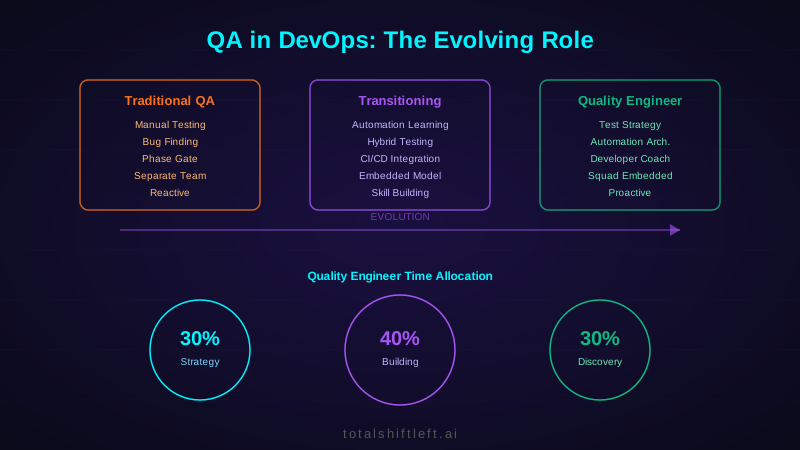
g. This combines human judgment with technical expertise to find issues that automation cannot detect.
The time allocation varies by team maturity. Teams early in their DevOps journey need more building and coaching time. Mature teams shift more time toward strategy and exploration. The key principle is that test execution—the activity that consumed most traditional QA time—is almost entirely automated and requires minimal ongoing QA attention.
This three-mode model integrates with the broader testing ownership model where developers, QA, and operations each contribute distinct testing capabilities.
Tools for Modern QA Engineers in DevOps
| Tool | Type | Best For | Open Source |
|---|---|---|---|
| Total Shift Left | API Test Automation | Codeless API testing and automation framework | No |
| Playwright | E2E Testing | Cross-browser automation with modern architecture | Yes |
| Cypress | Component/E2E Testing | Developer-friendly testing with built-in debugging | Yes |
| Postman | API Testing | API exploration and basic test automation | No |
| k6 | Performance Testing | Developer-centric load testing with scripting | Yes |
| Allure | Test Reporting | Rich test reports with history and analytics | Yes |
| Grafana | Observability | Quality dashboards and monitoring | Yes |
| SonarQube | Code Quality | Static analysis and code coverage tracking | Yes |
| TestRail | Test Management | Test case organization and execution tracking | No |
| Selenium | UI Automation | Cross-browser web testing at scale | Yes |
| JMeter | Performance Testing | Load and performance testing at scale | Yes |
| BrowserStack | Cross-Browser | Cloud-based browser and device testing | No |
Real-World Example: QA Transformation at a SaaS Company
Problem: A B2B SaaS company (120 engineers, 8 squads) had a centralized QA team of 12 manual testers. Each release required 3 weeks of manual regression testing. QA was consistently 2-3 sprints behind development. Developers had zero test coverage expectations and viewed QA as a service that caught their bugs. Defect escape rate to production was 28%, and customer-reported bugs were rising quarterly.
Solution: Over 6 months, they restructured QA into a quality engineering function. They redistributed 10 of 12 QA engineers into squads (1-2 per squad), retrained them on automation using Total Shift Left for API testing and Playwright for UI testing. The remaining 2 QA engineers formed a Quality Platform team responsible for testing infrastructure, CI/CD pipeline quality gates, and cross-team standards. Developers were given test coverage requirements (75% unit, 60% integration) enforced by CI/CD quality gates. Quality engineers conducted weekly testing workshops to upskill developers. They implemented shift-left testing practices that moved API contract validation into development.
Results: After 8 months, regression testing time dropped from 3 weeks to 45 minutes (fully automated). Defect escape rate fell from 28% to 6%. Developer test coverage increased from 15% to 72%. Release frequency went from monthly to twice-weekly. Quality engineers reported higher job satisfaction because they worked on strategic, creative challenges instead of repetitive manual testing. Two former manual testers became the team's most productive automation engineers.
Common Challenges in QA Role Evolution
Skills Gap Between Manual and Automation
Challenge: QA professionals trained in manual testing often lack the programming skills required for automation engineering. Learning to code, understanding CI/CD pipelines, and building automation frameworks represents a significant skill gap.
Solution: Provide structured learning paths with dedicated time (minimum 20% of work hours) for skills development. Pair manual testers with experienced automation engineers. Start with low-code automation tools like Total Shift Left that reduce the programming barrier while building familiarity with automation concepts. Celebrate incremental progress—the transition takes 6-12 months for most professionals.
Role Ambiguity Creates Anxiety
Challenge: When the QA role changes, team members feel uncertain about expectations, career paths, and job security. This anxiety can cause resistance to change and talent attrition.
Solution: Define the quality engineer role explicitly with clear job descriptions, career ladders, and compensation bands. Communicate that the transformation is about role elevation, not elimination. Show concrete examples of quality engineers at other organizations who have higher impact and compensation than traditional QA roles. Provide individual development plans for each team member.
Developers Resisting Test Ownership
Challenge: Developers may resist writing tests, viewing it as "QA's job." This resistance undermines the embedded model because quality engineers cannot scale testing alone.
Solution: Quality engineers should start by making testing easy. Build frameworks that reduce test writing friction. Provide templates and examples. Pair with developers to write their first tests together. Demonstrate how testing catches issues that would otherwise become 3 AM production pages. Make the DevOps testing strategy collaborative rather than prescriptive.
Free YAML templates + guide
CI/CD Testing Pipeline Templates
Production-ready CI/CD pipeline templates for GitHub Actions and GitLab CI. Includes API testing, contract testing, and performance testing stages.
Download FreeMeasuring Quality Engineer Impact
Challenge: Traditional QA metrics (bugs found, test cases executed) do not capture the value of quality engineers who focus on prevention, coaching, and infrastructure.
Solution: Measure quality engineering impact through team-level metrics: defect escape rate trends, automation coverage growth, pipeline reliability, developer testing velocity, and mean time to identify root causes. Quality engineers who coach well should see their squad's quality metrics improve even when the quality engineer is on vacation.
Balancing Embedded and Centralized Functions
Challenge: Fully embedding QA engineers in squads can create inconsistent practices across teams and duplicate tooling efforts.
Solution: Create a Quality Platform or Quality Guild that provides shared infrastructure, standards, and cross-team coordination while keeping quality engineers embedded in squads for day-to-day work. The guild meets regularly to align practices, share patterns, and maintain shared tooling. This hybrid model preserves both squad autonomy and organizational consistency.
Best Practices for QA in DevOps
- Embed quality engineers within squads rather than maintaining a centralized QA team
- Invest in automation skills development with dedicated learning time and mentorship programs
- Shift QA focus from test execution to test strategy, automation architecture, and developer coaching
- Maintain exploratory testing as a core quality engineer activity—automation cannot replace human creativity
- Build quality dashboards that track defect escape rate, automation coverage, and testing cycle time
- Establish clear career paths for quality engineers with defined levels and compensation bands
- Create a Quality Guild for cross-team knowledge sharing and standards alignment
- Automate all regression testing within the first 6 months of DevOps transformation
- Start quality engineer coaching programs with developers during sprint pairing sessions
- Use test automation best practices to ensure sustainable, maintainable test suites
- Track quality engineer impact through team-level metrics rather than individual test execution counts
- Celebrate quality improvements publicly to reinforce the value of the quality engineering function
QA in DevOps Transformation Checklist
- ✔ Quality engineers are embedded within cross-functional squads with 1:4-6 QA-to-developer ratio
- ✔ Manual regression testing is fully automated and runs in the CI/CD pipeline
- ✔ Quality engineers have dedicated time (minimum 20%) for skills development and learning
- ✔ Clear career ladder exists for quality engineering roles with defined levels and compensation
- ✔ Quality engineers participate in sprint planning and technical design sessions
- ✔ Automation framework is owned and maintained by quality engineers with team contribution
- ✔ Exploratory testing sessions are scheduled regularly (minimum biweekly per squad)
- ✔ Developer test coaching happens through pairing, code review, and workshops
- ✔ Quality Guild or Community of Practice meets regularly for cross-team alignment
- ✔ Quality dashboards track defect escape rate, coverage trends, and pipeline reliability
- ✔ Test code undergoes the same review standards as production code
- ✔ Quality engineers split time across strategy (30%), building (40%), and discovery (30%)
- ✔ Individual development plans exist for each QA professional transitioning to quality engineering
Take the next step. See how shift-left API testing platform applies these ideas to your workflow, or explore API testing in CI/CD for the broader picture.
See also: contract testing in our learn hub for the underlying concept.
What the role produces now
The clearest description of how the role changed is what a test engineer commits. It is less often a test case and more often the shared harness other engineers use — for example a fixture that gives every team a correctly authenticated client and a clean database, in one line:
# platform/testing/fixtures.py — published as an internal package
import pytest, requests
from testcontainers.postgres import PostgresContainer

@pytest.fixture(scope="session")
def database():
    """Every team gets the same disposable, migrated database."""
    with PostgresContainer("postgres:16-alpine") as pg:
        run_migrations(pg.get_connection_url())
        yield pg.get_connection_url()

@pytest.fixture
def api(database, idp):
    """An authenticated client whose token is minted, never stored."""
    token = idp.mint(scopes=["orders:read", "orders:write"], ttl_seconds=300)
    s = requests.Session()
    s.headers["Authorization"] = f"Bearer {token}"
    s.base_url = start_app(database)
    return s
The product teams then write ordinary tests against it, and the quality bar moves for everyone at once rather than one team at a time — which is the actual difference between QA-as-a-gate and QA-as-a-platform.
QA in DevOps FAQ
What is the role of QA in DevOps?
In DevOps, QA engineers evolve from manual gatekeepers into quality engineers who design test strategies, build automation frameworks, coach developers on testing practices, and analyze quality metrics. They are embedded within cross-functional squads rather than working in a separate QA department.
Is QA still relevant in DevOps?
QA is more relevant than ever in DevOps, but the role has fundamentally changed. Instead of manually testing every feature, QA professionals focus on test architecture, automation strategy, risk-based testing, exploratory testing, and enabling the entire team to own quality. The demand for quality engineers has increased as DevOps adoption grows.
What skills do QA engineers need for DevOps?
QA engineers in DevOps need automation programming skills (Python, JavaScript, Java), CI/CD pipeline knowledge, API testing expertise, performance testing capabilities, container and cloud infrastructure understanding, security testing awareness, and soft skills like coaching and cross-team collaboration.
How does the QA role differ between traditional and DevOps teams?
In traditional teams, QA is a phase at the end of development where testers validate completed features. In DevOps teams, QA is an ongoing activity where quality engineers are embedded in squads, contribute to test automation from sprint start, and focus on preventing defects rather than finding them after the fact.
What is the career path for QA engineers in DevOps?
QA engineers in DevOps can progress from test engineer to senior quality engineer, then to quality architect or quality engineering manager. Lateral moves into site reliability engineering (SRE), developer experience, or engineering management are common. The quality engineer role commands higher salaries than traditional QA roles due to broader technical requirements.
Sources and further reading
- DORA State of DevOps research — the multi-year dataset behind the four delivery metrics.
- Google Testing Blog — Google's engineering write-ups on test sizing and flakiness.
- ISTQB Glossary — the standard vocabulary for test terms.
Key takeaways
- The evolution of QA in DevOps is not a threat to testing professionals—it is an elevation.
- Quality engineers in DevOps environments have more impact, more autonomy, more career growth, and higher compensation than traditional manual testers.
- But the transition requires intentional investment in skills development, organizational restructuring, and cultural change.
- The organizations that navigate this transition successfully gain a lasting competitive advantage: they can deliver software faster, with higher quality, and with more engaged quality professionals.
- The organizations that cling to traditional QA models will continue to suffer from the bottlenecks, handoff delays, and quality gaps that plague waterfall-era testing.
- Whether you are a QA professional charting your career path or a leader restructuring your quality organization, the direction is clear.
Invest in quality engineering skills, embed quality professionals within delivery teams, and build the automation infrastructure that makes quality everyone's job.
Ready to empower your QA team with modern automation capabilities? Start your free trial of Total Shift Left and give your quality engineers the codeless API testing platform that accelerates their DevOps transformation.
Related: DevOps Testing: The Complete Guide | What Is Shift-Left Testing? | DevOps Testing Culture Explained | Quality Engineering vs Traditional QA | Testing Ownership in DevOps | Test Automation Best Practices
Ready to shift left with your API testing?
Try our no-code API test automation platform free.