
Why Postman Collections Are Not Enough for CI/CD Pipelines (2026)
Quick answer
Postman collections hit five structural limitations in CI/CD: no coverage tracking against the API spec (Newman reports pass/fail, not what's untested), collection drift as the collection and live API diverge, unmaintainable JavaScript test scripts with no code reuse, missing quality gates beyond a binary exit code, and growing environment and authentication configuration overhead. Spec-driven platforms fix all five by generating tests directly from the OpenAPI spec.
Reviewed by Parveen Kumari
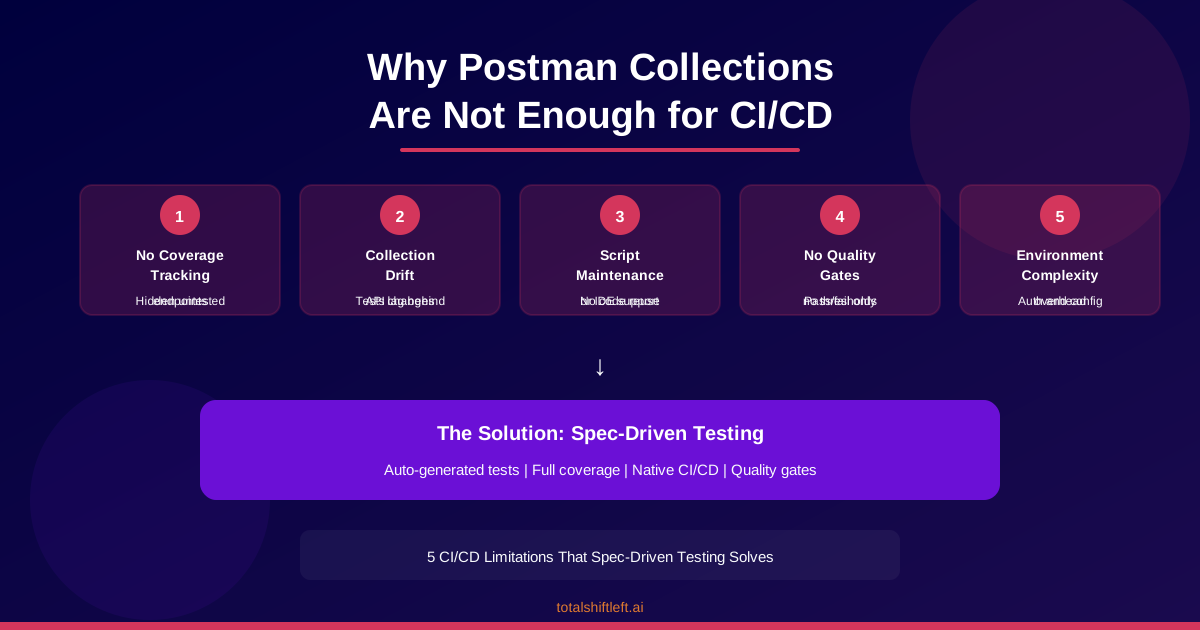
Postman collections CI/CD limitations include no coverage tracking, collection drift from the live API, unmaintainable test scripts, missing quality gates, and environment configuration complexity. These five structural gaps prevent teams from achieving reliable automated API testing in their delivery pipelines.
For the head-to-head with the git-native option specifically, see Bruno vs Postman — the storage model is the whole argument.
For what a schema assertion can and cannot prove before a release, see Pact vs Postman for contract testing.
In this guide
- What Postman collections in CI/CD means and how it works
- Why CI/CD-native testing matters for API quality
- The five key limitations of collections in pipelines
- How Newman fits into pipeline architecture
- Tools comparison: Newman vs spec-driven pipelines
- Real team experience replacing Newman
- Common challenges when transitioning
- Best practices for CI/CD API testing
- Your CI/CD readiness checklist
Postman is the most widely used API development tool for good reason. It makes exploring APIs, building requests, and sharing collections with your team straightforward and intuitive. But when teams attempt to use Postman collections as their CI/CD testing strategy, they encounter structural limitations that no amount of scripting can overcome. Running a collection in a pipeline and having a CI/CD-native testing strategy are fundamentally different things.
This is not a criticism of Postman as a development tool. It is a recognition that the collection-based model was designed for interactive use, not for automated pipeline execution at scale. Understanding these limitations helps teams make informed decisions about their API testing strategy and when to adopt spec-driven alternatives.
What Are Postman Collections in CI/CD?
Postman collections in CI/CD refers to the practice of running Postman request collections in delivery pipelines using Newman, the Postman command-line collection runner. Newman takes an exported collection JSON file, executes the HTTP requests defined within it, runs the embedded JavaScript test scripts, and outputs results as console text or structured reports.
The typical setup involves exporting a collection from the Postman GUI, storing the JSON file in version control, adding a Newman execution step to the pipeline configuration, passing environment files with deployment-specific variables, and interpreting the exit code (zero for all tests passing, non-zero for failures) as the pipeline gate.
This approach brings Postman tests into CI/CD, but it does not make them CI/CD-native. The distinction matters because CI/CD-native testing tools are built specifically for pipeline execution with features like coverage tracking, quality gate evaluation, and automatic synchronization with API definitions that Newman was never designed to provide.
Why CI/CD-Native API Testing Matters
Automated Quality Assurance on Every Build
Modern delivery pipelines run on every commit or pull request. The testing that runs in these pipelines must be automated, reliable, and provide actionable metrics. Manual testing processes that work well in a GUI do not automatically translate to effective automated pipeline gates.
Coverage Visibility Prevents Production Incidents
The Consortium for IT Software Quality (CISQ) research consistently shows that inadequate testing coverage is a leading contributor to production defects. Teams need to know not just whether their tests pass, but what percentage of their API surface is actually tested. This visibility is foundational to API test coverage strategies that prevent defects from reaching production.
Quality Gates Enforce Standards
Mature CI/CD pipelines do not just check whether tests pass. They evaluate quality gate metrics like pass rate thresholds, coverage minimums, schema compliance rates, and response time baselines. These gates ensure that code quality meets defined standards before deployment proceeds.
Pipeline Reliability Requires Stable Test Infrastructure
Flaky tests erode team confidence in the pipeline. Test infrastructure that requires manual maintenance introduces instability because human processes fail to keep pace with automated deployment frequency. CI/CD-native testing tools minimize manual touchpoints that introduce reliability risks.
The other half of reliability is what happens after a red build. A Newman log lists failing assertions one by one, and someone has to work out whether ten failures are ten problems or one expired token. Shift-Left API's run failure analysis groups a failed run into a handful of causes and gives each a verdict — test defect, data issue, environment problem or suspected product bug — reading what the server actually returned, so a gateway error page or a login redirect is not mistaken for an API regression. Fixes for every test sharing a cause are proposed together and applied only when someone accepts them.
The Five CI/CD Limitations of Postman Collections
Limitation 1: No Coverage Tracking Against Your Spec
When Newman runs a collection, it reports which tests passed and which failed. What it cannot tell you is which endpoints have no tests at all. If your API has 150 endpoints and your collection tests 40 of them, Newman reports a 100% pass rate. That metric is misleading because 110 endpoints with zero test coverage could harbor defects that slip to production undetected.
Coverage tracking requires mapping test results against your API specification to determine what percentage of endpoints, methods, status codes, and parameters are actually tested. Postman has no mechanism to do this because collections are independent artifacts with no awareness of the full API surface. Building custom tooling to bridge this gap is exactly the kind of infrastructure overhead CI/CD automation should eliminate.
Spec-driven platforms like Shift-Left API calculate coverage automatically because they generate tests from the spec itself. Every endpoint, method, parameter combination, and response code is accounted for in the coverage dashboard.
Limitation 2: Collection Drift
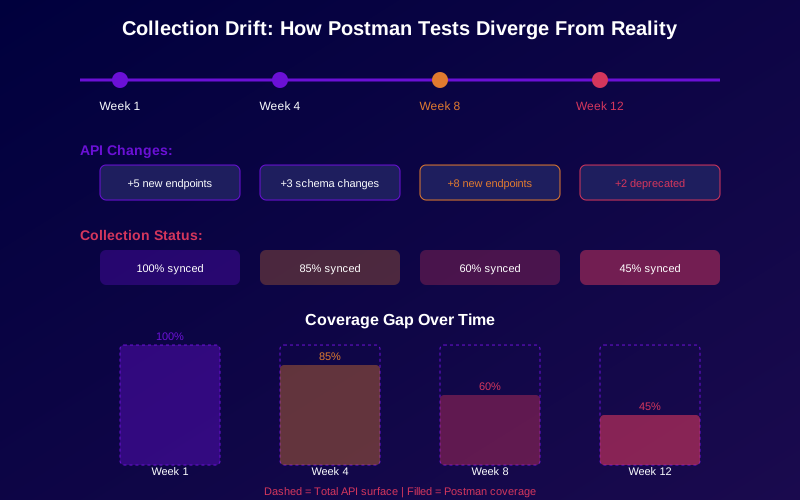
Collection drift is the most insidious problem with collection-based testing. Your Postman collection is a separate artifact from your API code and specification. It must be maintained independently, and that synchronization inevitably breaks down.
When a developer adds a new endpoint, someone must manually add corresponding requests to the collection. When a request body schema changes, someone must update the collection. When an endpoint is deprecated, someone must remove it. In practice, this synchronization fails within weeks of establishing the initial collection.
Collection drift is especially dangerous because it is invisible. Tests keep passing against outdated behavior while the actual API has moved on. The team sees green builds and assumes quality is high, when in reality the tests no longer reflect the API they claim to validate. The Postman vs OpenAPI comparison examines this drift problem in depth.
Limitation 3: Script Maintenance Burden
Postman test scripts are JavaScript snippets written within the Postman UI or embedded in collection JSON. At small scale, this approach is manageable. At scale, these scripts become a significant maintenance liability that consumes disproportionate QA effort.
No code reuse patterns. Pre-request and test scripts do not support imports or modules. Shared validation logic must be duplicated across requests or stored as stringified code in collection-level variables, creating maintenance nightmares when common patterns need updating across dozens of requests.
Ready to shift left with your API testing?
Try our no-code API test automation platform free. Generate tests from OpenAPI, run in CI/CD, and scale quality.
No IDE support. Scripts embedded in collection JSON do not benefit from linting, type checking, autocomplete, or debugging tools. Bugs in test logic are harder to catch before execution and harder to diagnose after failures.
No standard testing patterns. Unlike established frameworks like Pytest, JUnit, or Mocha, Postman scripts lack standardized patterns for setup, teardown, parameterization, and data-driven testing. Each script is an isolated island of custom logic.
Parameterization is where the gap shows first: Newman can iterate over a single data file, but the script still has to know which column feeds which field. In a spec-driven platform it is a property of the run instead — Shift-Left API's data-driven testing, for example, runs any test or workflow across a CSV, Excel, JSON, database or API data set with per-iteration results, and INVALID_* columns produce the negative variants without a second script.
Version control friction. Collection JSON files are monolithic. A single request change produces diffs spanning hundreds of lines, making code review effectively impossible and merge conflicts frequent when multiple team members edit collections simultaneously.
Limitation 4: No Quality Gates
Newman exits with a non-zero code when tests fail, which can block a pipeline deployment. But a binary pass/fail result is not a quality gate.
Quality gates evaluate composite metrics against configurable thresholds: test pass rate above 95%, endpoint coverage above 80%, schema compliance at 100%, average response times within SLA boundaries. Newman calculates none of these metrics natively.
Implementing quality gates on top of Newman requires building custom post-processing scripts that parse Newman output, calculate derived metrics, compare values against configured thresholds, and control pipeline flow accordingly. This is non-trivial infrastructure that must be maintained alongside your collections, environments, and test scripts. For teams that need real quality gates, the CI/CD integration page explains how spec-driven tools provide this capability without custom scripting. In Shift-Left API, a CI runner executes a test pack, writes JUnit XML plus a JSON summary, and gates the build on pass rate; GitHub Actions, Jenkins and Azure DevOps have first-party integrations, and other CI systems call the same runner through the public REST API.
Limitation 5: Environment and Authentication Complexity
Postman environments work seamlessly within the GUI. In CI/CD, they become another layer of configuration overhead that grows with your deployment topology.
Environment files must be exported separately from collections, stored securely (they often contain API keys, tokens, and credentials), passed to Newman as command-line arguments, and kept synchronized with actual environment configurations. When you add a new variable in the Postman workspace, you must also update the exported environment file used in CI/CD, creating yet another synchronization point that can drift.
Authentication is particularly challenging. OAuth flows that work seamlessly in the Postman GUI with built-in token management require custom pre-request scripts for token acquisition, caching, and refresh when running through Newman. Multi-step authentication, certificate-based auth, and federated identity flows all need custom scripting tightly coupled to infrastructure that varies across environments.
Moving off Newman doesn't mean rebuilding that auth from scratch: Shift-Left API's Postman collection import maps a collection's API Key, Basic, Bearer, Digest, NTLM, Hawk, JWT Bearer, OAuth 1.0 and OAuth 2.0 settings into reusable auth profiles, preserving collection → folder → request inheritance. The same import now creates one test per request, carries assertions across (compiling them from the collection's own scripts where a check cannot be mapped directly), keeps variable captures, and lists anything it left out. Once imported, OAuth 2.0 works the way it does in the Postman GUI — Postman's grant types plus Device Code, "Get New Access Token", automatic refresh — and the same auth profile applies to tests, packs, workflows and scheduled runs, with no pre-request token script to maintain.
The Newman Bridge: Pipeline Architecture
Understanding how Newman fits into pipeline architecture reveals why these limitations are structural rather than fixable with better scripting.
Newman operates as a bridge between the Postman GUI world and the CI/CD world. It translates collection JSON into HTTP requests, runs embedded scripts, and produces output. But it is a one-way, read-only bridge: it can execute what Postman produces, but it cannot enhance it with pipeline-native capabilities.
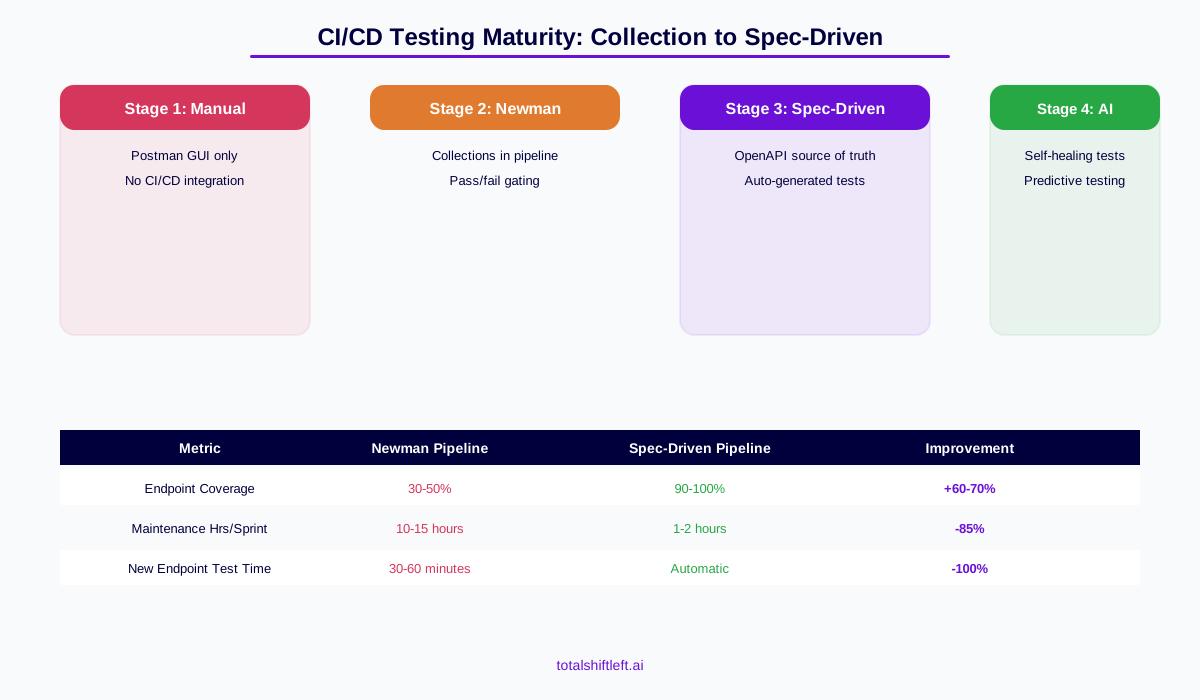
The typical Newman pipeline flow is: export collection JSON from workspace, store in version control, install Newman in pipeline, load collection and environment files, execute requests sequentially, evaluate embedded script assertions, output pass/fail exit code. At no point in this architecture does the pipeline know the full API surface, measure coverage against a specification, evaluate composite quality metrics, or detect when the collection has fallen behind the actual API.
Spec-driven pipeline architecture differs fundamentally: the OpenAPI specification serves as the single source of truth, the platform generates tests automatically from the spec, execution produces coverage maps and quality metrics, and the pipeline evaluates configurable thresholds before allowing deployment. This architecture addresses all five limitations because it is built around the API definition rather than a manually maintained artifact.
Tools Comparison: Newman vs Spec-Driven
| CI/CD Capability | Newman (Postman) | Spec-Driven Platform |
|---|---|---|
| Pipeline execution | CLI with collection JSON | Native API/CLI integration |
| Test source | Exported collection file | OpenAPI specification |
| Coverage tracking | Not available | Endpoint/method/status mapping |
| Quality gates | Exit code only (0 or 1) | Configurable metric thresholds |
| Spec synchronization | Manual collection updates | Automatic test regeneration |
| Schema validation | Custom scripts per request | Built-in contract testing |
| Report format | Console text, HTML, JUnit | Native JUnit XML |
| Environment management | Exported JSON files | Platform configuration |
| New endpoint testing | Build request + write scripts | Add to spec, auto-generate |
| Drift detection | Not possible | Automatic via spec comparison |
For teams evaluating broader alternatives, see the best Postman alternatives comparison.
Postman collections in CI/CD in practice: a worked example
Problem: A logistics SaaS company used Postman collections with Newman in their Azure DevOps pipeline for 18 months. Their API grew from 35 to 130 endpoints during that period. Collections covered approximately 38% of the current API surface, focused on the original 35 endpoints that existed when testing began. New endpoints added by feature teams rarely received corresponding collection updates. Newman reported consistent 97% pass rates, which stakeholders interpreted as high API quality. In reality, 80 endpoints had zero test coverage, and the team experienced an average of 3 production API incidents per month from untested endpoints.
Solution: The team audited their Postman collections against their OpenAPI specification, confirming the 38% coverage gap. They imported the validated spec into a spec-driven platform, generated a comprehensive test suite, and ran both Newman and spec-driven tests in parallel for three sprints. They configured quality gates requiring 85% endpoint coverage and 90% pass rate.
Free Interactive spreadsheet + guide
Test Automation ROI Calculator
Quantify the ROI of test automation for your team. Input your team size, bug rates, and fix times — get projected savings in hours and dollars.
Download FreeResults: The initial spec-driven test run revealed 42 test failures across previously untested endpoints, including 7 schema violations and 12 unexpected error responses that had been silently affecting API consumers. Endpoint coverage increased from 38% to 93% in the first sprint. Production API incidents dropped from 3 per month to fewer than 1 per month over the following quarter. The QA engineer who spent 50% of sprint time maintaining collections redirected that effort to exploratory testing and test strategy improvement. The team removed the Newman pipeline step after confirming coverage parity in the parallel validation period.
Postman collections in CI/CD challenges and how to solve them
Challenge: Management trusts the Newman pass rate. When Newman shows 97% pass rate for months, convincing stakeholders that coverage is insufficient requires data. Run a coverage audit mapping collection requests against your full API spec. The gap between tested and untested endpoints makes the case objectively.
Challenge: Large existing investment in Postman scripts. Teams with hundreds of scripted tests feel invested in the collection approach. The migration path is parallel execution, not immediate replacement. You can preserve that work by importing existing Postman collections into the spec-driven platform, then run both approaches side by side and let coverage metrics and defect-detection data drive the transition. See the migration guide for the step-by-step process.
Challenge: No complete OpenAPI specification. Many APIs lack formal specs, making spec-driven testing seem impossible. Generating a spec from code annotations (Swagger generators exist for every major framework) or building one incrementally starting with high-traffic endpoints is typically a 1-2 week investment that unlocks long-term automation value across documentation, client generation, and testing.
Challenge: Pipeline configuration complexity. Teams with mature Newman setups have environment files, secrets management, and conditional execution logic built around Newman. Migrating requires mapping these configurations to the new platform. Spec-driven tools with native CI/CD integrations typically simplify rather than complicate pipeline configuration.
Challenge: Postman is embedded in team culture. Developers use Postman daily for exploration and debugging. The key insight is that keeping Postman for interactive use while replacing Newman with spec-driven testing for CI/CD is not contradictory. They serve complementary purposes.
Best Practices for CI/CD API Testing
- Separate exploration tools from pipeline tools. Use Postman for interactive debugging and a spec-driven platform for automated pipeline testing. These are different use cases.
- Require coverage metrics in your pipeline. Binary pass/fail is insufficient for mature delivery. Pipeline gates should evaluate what percentage of your API surface is actually tested.
- Treat the OpenAPI spec as the testing source of truth. An accurate spec pays dividends across documentation, client generation, mocking, and test automation.
- Configure quality gates with graduated thresholds. Start with achievable targets (70% coverage, 85% pass rate) and increase as the team matures and addresses test failures.
- Automate regression testing on every build. Generated tests should run on every commit, not just scheduled nightly builds.
- Monitor for collection drift if still using Newman. Periodically compare your collection endpoints against the live API spec to quantify the gap.
- Run parallel during any transition. Never remove Newman until spec-driven tests demonstrate equal or better coverage and defect detection in your actual pipeline.
- Budget time for spec accuracy. An inaccurate spec produces inaccurate tests. Lint and validate before importing.
CI/CD API Testing Readiness Checklist
- Newman reports show consistent high pass rates but production incidents persist
- Your Postman collections have not been audited against the current API spec
- More than 20% of API endpoints lack corresponding collection requests
- Test scripts are duplicated across requests with no code reuse mechanism
- Environment files require manual synchronization with deployment configurations
- Pipeline gates only evaluate pass/fail with no coverage threshold
- Collection JSON diffs are too large for meaningful pull request review
- New endpoints frequently ship without corresponding test updates
- QA spends more time maintaining collections than investigating defects
- Your team maintains an OpenAPI specification for documentation or client generation
If four or more of these apply, your CI/CD pipeline has outgrown the Newman model and would benefit from spec-driven testing.
See also: postman alternatives in our learn hub for the underlying concept.
Where the collection stops being enough
Newman runs a collection in CI perfectly well. The limit is not the runner — it is that a collection only contains the requests someone remembered to save:
# .github/workflows/api-tests.yml — this part works fine
- run: npx newman run collection.json \
         -e staging.postman_environment.json \
         --reporters cli,junit --reporter-junit-export results.xml
- uses: actions/upload-artifact@v4
  if: always()
  with: { name: newman-results, path: results.xml }
What it cannot tell you is what it did not test. Compare the collection against the spec and the gap is usually the point — every operation with no request behind it is untested and invisible:
# operations in the spec
yq -r '.paths | to_entries[] | .key as $p | .value | keys[]
       | ascii_upcase + " " + $p' openapi.yaml | sort > /tmp/spec.txt

# operations the collection actually exercises
jq -r '.. | .request? // empty
       | (.method) + " " + (.url.path | "/" + join("/"))' collection.json \
  | sed -E 's/\/:[a-zA-Z]+/\/{id}/g' | sort -u > /tmp/collection.txt

comm -23 /tmp/spec.txt /tmp/collection.txt
# every line here is an endpoint your CI run reported as green without touching
To see how Shift-Left API compares with Postman, read the Postman vs Shift-Left API page.
Frequently asked questions about Postman collections in CI/CD
Can I run Postman collections in a CI/CD pipeline?
Yes, using the Newman CLI. Newman executes collection requests and embedded test scripts in headless mode. However, it introduces significant limitations: no coverage tracking against your API spec, manual collection maintenance, no quality gates beyond binary pass/fail exit codes, and growing environment configuration complexity. These limitations become critical as your API surface grows past 20-30 endpoints.
What is the alternative to Postman collections for CI/CD testing?
Spec-driven testing platforms generate tests directly from your OpenAPI specification, eliminating collection drift, providing automatic coverage tracking, and integrating with CI/CD pipelines with native quality gates. The spec becomes the single source of truth for test generation, and spec changes are detected when you re-import the spec and held for review.
Why do Postman collections drift from the actual API?
Collections are manually maintained independently from API code and specifications. When developers add endpoints, change schemas, or deprecate operations, the collection must be updated in a separate manual process. This synchronization breaks down because there is no automated mechanism to detect or enforce it, and the API evolves faster than manual collection updates.
What are CI/CD quality gates and why does Newman lack them?
Quality gates evaluate composite pipeline metrics against configurable thresholds: pass rate above 95%, endpoint coverage above 80%, schema compliance at 100%. Newman provides only a binary exit code based on test assertions. Building quality gate logic on top of Newman requires custom scripts to parse output, calculate metrics, and control pipeline flow, adding maintenance burden on top of collection maintenance.
How long does it take to replace Newman with spec-driven testing?
Most teams complete the transition in 1-2 sprints. The first sprint covers spec validation, import, test generation, and parallel execution alongside Newman. The second sprint validates that spec-driven coverage meets or exceeds Newman coverage, configures quality gates, and removes the Newman pipeline step once data confirms parity.
Sources and further reading
- Newman — the CLI runner that executes Postman collections in CI.
- Postman Learning Center — Postman's own documentation for collections and scripts.
- OpenAPI Specification — the normative spec for describing HTTP APIs.
Key takeaways
- Postman collections serve their purpose as an API development and exploration tool.
- The five limitations described in this guide are not flaws in Postman but rather the natural consequence of using a tool designed for interactive use as a CI/CD testing strategy.
- Running collections in a pipeline through Newman and having pipeline-native API testing are fundamentally different capabilities.
- When your team needs coverage visibility, quality gate evaluation, automatic spec synchronization, maintainable test infrastructure, and manageable environment configuration, the collection-based model cannot deliver.
- Spec-driven testing addresses each of these limitations by using the OpenAPI specification as the source of truth for test generation, coverage tracking, and pipeline integration.
Ready to move beyond Newman? Start a free 15-day trial and import your OpenAPI spec to see your real API coverage in minutes. Working solo? Get the free Citizen Developer Edition — single-user. Check our pricing plans for teams ready to level up their CI/CD testing.
Ready to shift left with your API testing?
Try our no-code API test automation platform free.