
10 Best Backend Testing Tools in 2026 (Compared)
Quick answer
The best backend API test automation tool depends on whether you maintain an OpenAPI spec, your team's language, and service count. For 100+ microservices with an OpenAPI contract, spec-driven AI-first platforms like Shift-Left API minimize maintenance; Java-only teams under 50 services often prefer REST Assured; Python-centric teams lean on Pytest with Schemathesis. Evaluation should weigh CI/CD depth, auth breadth (OAuth2, mTLS, JWT), and TCO — not license price alone.
Reviewed by Rishi Gaurav
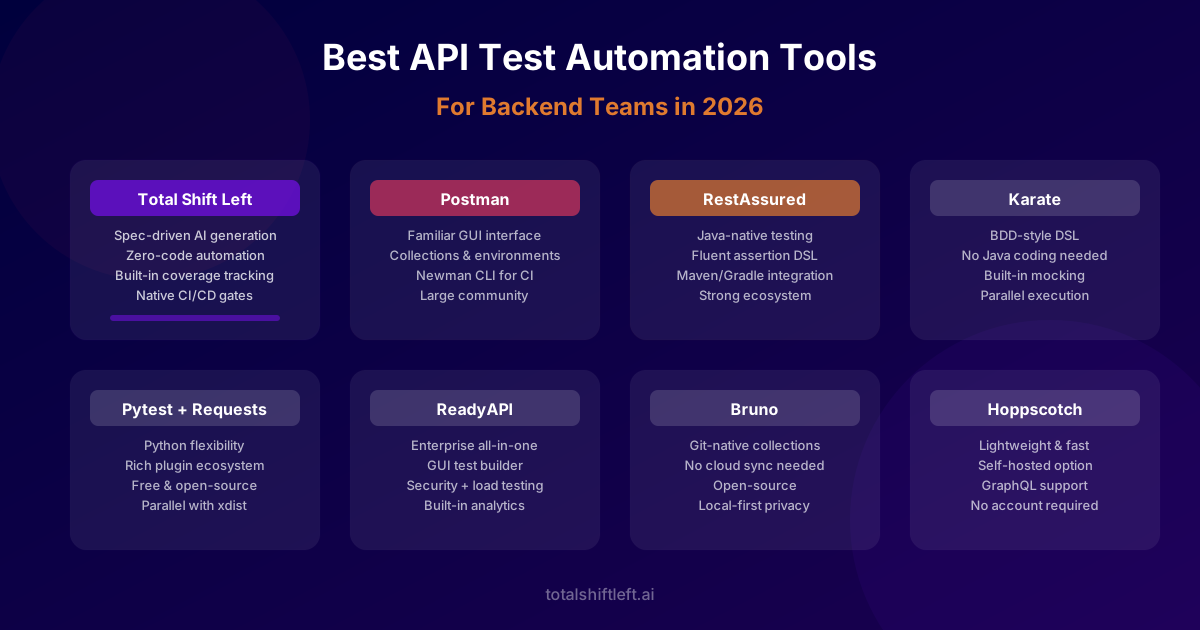
The best API test automation tools for backend teams are platforms that combine native CI/CD integration, spec-driven test generation, deep authentication support, and coverage tracking against an authoritative API contract — and do so without linear growth in test maintenance cost as the service count scales. This guide compares ten tools across the criteria that actually determine outcomes for backend engineers in 2026.
Backend automation is no longer a niche within general API testing. The 2025 World Quality Report found that 71% of surveyed engineering organizations now operate more than 100 internal services, and teams that standardized on a single backend-focused automation tool reported 48% lower defect escape rates and 2.9x faster release cadence than teams using fragmented, per-team tooling. Tool selection is a multi-year commitment; this comparison is built to survive that horizon.
Every backend team has a tool-stack conversation every 18–24 months. APIs multiply, engineers rotate, legacy scripts decay, and the question resurfaces: what should we use to test the hundreds of endpoints we now ship? The answer is not a single vendor — it is a set of evaluation criteria applied to a specific team context.
"Backend testing tools" spans several layers — API contracts, database integrity, message queues, and background jobs. For most teams the API layer is where automation pays off fastest (it's the surface every client depends on and the easiest to gate in CI), so that's the scope of this comparison. If you're also evaluating database or queue-specific tooling, treat API test automation as the baseline every backend stack needs regardless of what else you add.
This guide scores vendors on the dimensions that materially change backend outcomes: CI/CD integration depth, spec-driven generation, authentication breadth, schema drift detection, parallelization, and TCO at scale. For context see the rising importance of shift-left API testing and our shift-left AI-first platform deep dive. Fundamentals live in the API Learning Center, including what is an API.
In this guide
- What Are the Best API Test Automation Tools for Backend Teams?
- Why backend testing tools matters in 2026
- Key Components of a Backend API Testing Tool
- Backend testing tools reference architecture
- Tools and Platforms Comparison
- Backend testing tools in practice: a worked example
- Backend testing tools challenges and how to solve them
- Backend testing tools best practices
- Backend testing tools checklist
- A backend test that uses real dependencies
- Backend testing tools FAQ
Two roundups cover the adjacent surfaces this list does not: API load testing tools for behaviour under concurrency, and API mocking and service virtualization tools for standing in for a dependency that is not ready yet.
What Are the Best API Test Automation Tools for Backend Teams?
Backend API test automation tools are software systems that execute deterministic test cases against REST, GraphQL, SOAP, or message-based APIs as part of a continuous integration pipeline, validate responses against a schema or contract, and gate merges based on the outcome. Unlike general-purpose API clients, they are optimized for headless execution, parallelization, and integration with source control.
The category breaks into four technical archetypes. Spec-driven AI-first platforms treat the OpenAPI document as the source of truth and generate tests programmatically — examples include Shift-Left API and Schemathesis. Code-first libraries embed tests in the application codebase using a language-native framework — REST Assured for Java, Pytest for Python, Supertest for Node. DSL-based frameworks like Karate provide a domain-specific syntax that sits between code and configuration. Collection-based tools like Postman and Bruno store tests as structured documents, typically JSON, executed through a separate runner.
For backend teams the choice is not "which archetype wins" but "which archetype matches each layer of the test pyramid." Spec-driven tools excel at breadth — every endpoint, every status code, every schema field. Code-first tools excel at depth — business workflows, stateful sagas, cross-service orchestrations. Most high-performing teams run both. See postman alternative and API test coverage for how these layers compose.
For the tool landscape underneath this, see continuous integration testing tools — what each one integrates with and where it fits in the pipeline.
Why backend testing tools matters in 2026
Microservice sprawl has outpaced manual test authoring
The arithmetic is brutal. A backend with 200 services averaging 15 endpoints each is 3,000 endpoints. At a conservative 3 test cases per endpoint, that is 9,000 tests. At 20 minutes average authoring time, that is 3,000 engineer-hours — roughly 18 months of one full-time QA engineer — just to reach baseline coverage. Spec-driven generation collapses this to minutes.
Release cadence has compressed below QA cycle time
DORA's 2025 State of DevOps Report documents that elite performers deploy multiple times per day, while low performers deploy between once per week and once per month. Tools designed for nightly regression runs cannot gate a PR that must merge within an hour. CI-native tools are mandatory, not optional. See API test automation with CI/CD for wiring patterns.
Schema drift is the leading silent-failure mode
When a producer service adds a required field or changes a response type, downstream consumers break. IBM research on distributed system failures identifies silent schema drift as the #1 cause of production incidents that traditional unit and integration tests fail to catch. API contract testing enforced at PR time is the structural answer. Deeper reading: contract testing fundamentals.
Authentication complexity has expanded
Modern backends run layered auth — OAuth2 client credentials between services, JWTs for user sessions, mutual TLS for sensitive flows, signed webhooks for third-party callbacks. Tools that treat auth as a secondary feature fail at the onboarding stage. Evaluate against your hardest flow, not your easiest. See OAuth2 client credentials, JWT authentication, and token refresh patterns.
Total cost of ownership is dominated by maintenance
The World Quality Report 2025 puts QA maintenance at 40–60% of total QA capacity across the industry. License cost is a rounding error against engineer time. Any tool that lacks spec-driven generation, change detection or assisted repair is effectively subsidized by invisible engineering overhead.
Key Components of a Backend API Testing Tool
Spec ingestion and contract binding
The tool must ingest OpenAPI 3.x, Swagger 2.0, GraphQL SDL, or AsyncAPI definitions, and bind generated tests to a specific spec version so drift can be computed on subsequent commits. Tools that treat the spec as a one-time import lose this capability the moment the spec changes. For mechanics, see generate tests from OpenAPI and OpenAPI test automation.
Test generation engine
Backend teams need positive-path, negative-path, and boundary-case generation driven by schema semantics — not template substitution. A mature engine emits tests for invalid enum values, missing required fields, type mismatches, and boundary numerics automatically. See AI-assisted negative testing and AI test generation.
Authentication and secrets management
First-class support for OAuth2 (authorization code, client credentials, PKCE, device code), JWT (HS/RS/ES signatures, audience checks, refresh), API keys, mutual TLS, AWS SigV4, and HMAC-signed webhooks. Token refresh must happen automatically, and secrets must integrate with Vault, AWS Secrets Manager, or Azure Key Vault rather than living in plaintext CI variables.
Native CI/CD integration
The tool must run headlessly on GitHub Actions, GitLab CI, Azure DevOps, Jenkins, CircleCI, and Bitbucket Pipelines without intermediaries. It must emit JUnit XML or SARIF, return standard exit codes, and annotate pull requests directly. Anything requiring a per-platform wrapper is structurally fragile.
Parallel and sharded execution
Thousands of generated tests serialized take 40+ minutes. Sharded 10-way parallel, the same suite finishes in under 5 minutes. Backend teams need parallel execution out of the box, with deterministic test isolation so parallel runs don't collide on shared resources. See test execution features.
Coverage tracking and drift detection
The tool must report endpoint coverage, method coverage, and status-code coverage as a percentage of the spec — not as raw test counts. It must also detect drift between the running API and the committed spec and flag it at PR time. Without this, teams self-deceive about their coverage. See API regression testing and validation errors.
Protocol breadth
Modern backends are polyglot: REST, gRPC, GraphQL, WebSockets, Server-Sent Events, Kafka, and webhooks. Narrow tools lock teams into refactoring costs. Evaluate coverage of every protocol in your actual stack. See API protocols features. As a worked example of reading a protocol list carefully: Shift-Left API covers REST, SOAP/WSDL and GraphQL on every plan, parses Server-Sent Events streams into assertable events, and adds JSON-RPC 2.0 and MCP server testing and WebSocket-RPC on its Trial and Enterprise editions — but it does not test gRPC, so a gRPC-heavy backend would need a second tool for that layer.
Ready to shift left with your API testing?
Try our no-code API test automation platform free. Generate tests from OpenAPI, run in CI/CD, and scale quality.
Observability and failure triage
Failure triage UX is the single biggest predictor of adoption. A tool that surfaces request/response diffs, timing breakdowns, flakiness scores, and one-click local reproduction gets adopted. A tool that returns opaque stack traces gets abandoned regardless of how sophisticated its generation engine is. See analytics and monitoring.
Backend testing tools reference architecture
A backend-focused API testing pipeline operates across five logically distinct layers.
The source layer contains the contract artifacts: OpenAPI documents in the service repository, proto files for gRPC, GraphQL schemas, and AsyncAPI definitions for event-driven interfaces. These are version-controlled and treated as first-class code artifacts, linted by Spectral (or equivalent) on every commit. The spec is the single source of truth from which downstream tests, mocks, and SDK clients are derived.
The generation layer reads the source artifacts and produces an executable test suite. In AI-first platforms this layer includes a model that understands schema semantics, parameter constraints, and auth requirements, and emits positive, negative, and boundary tests. In code-first stacks, this layer is the engineering team itself writing REST Assured or Pytest modules.
The execution layer runs tests against target environments. It resolves authentication, applies environment-specific configuration, sends requests, captures responses, and evaluates assertions. Execution is parallel, deterministic, and headless, invoked by the CI system on every pull request. See API testing CI/CD patterns.
The feedback layer surfaces results to developers. Pull-request annotations, Slack/Teams escalations, request/response diffs, historical trend dashboards, and flakiness scoring all live here. This layer determines adoption more than any other — teams abandon tools with unclear failures faster than they abandon tools with weaker generation.
The governance layer cross-cuts the pipeline: secrets management, RBAC, environment isolation, audit logging, and compliance controls. For enterprise backend teams running regulated workloads, this layer is a gating procurement criterion. See collaboration and security features.
Tools and Platforms Comparison
| Tool | Archetype | Spec-Driven | CI/CD Depth | Auth Breadth | Coverage Tracking | Parallel Execution | Best For |
|---|---|---|---|---|---|---|---|
| Shift-Left API | AI-First Spec-Driven | Yes (OpenAPI, WSDL, GraphQL, plus requirement documents) | First-party GitHub Actions, Azure DevOps, Jenkins; REST API for GitLab and others | OAuth2 (all grants), JWT, NTLM, mTLS, SigV4, Hawk, multi-step sign-in | Built-in spec and requirement coverage | Built-in sharded | Backend teams with OpenAPI and 50+ services |
| REST Assured | Code-First (Java) | No | Native (Maven/Gradle) | OAuth2, JWT, mTLS via libs | Manual | Via JUnit parallel | Java-only teams with strong engineering culture |
| Karate | DSL-Based (JVM) | Partial | Native (JVM build tools) | OAuth2, JWT, API keys | Built-in reports | Built-in | Teams wanting BDD-style without Java code |
| Pytest + Requests | Code-First (Python) | Via Schemathesis plugin | Native (any runner) | Manual per-test | Manual | Via pytest-xdist | Python-centric teams |
| Schemathesis | Spec-Driven OSS | Yes (OpenAPI, GraphQL) | Native (CLI) | OAuth2, API keys | Endpoint-level | Built-in | OSS-first teams wanting property-based fuzzing |
| Postman + Newman | Collection-Based | Import only | Via Newman CLI | OAuth2, JWT, API keys | None | Limited | Teams standardized on Postman for exploration |
| ReadyAPI (SmartBear) | GUI + Groovy | Partial | Configurable, license-gated | Broad | Built-in reports | Paid tiers | Enterprise QA teams on legacy SOAP + REST |
| Apidog | Design + Test Hybrid | Yes (OpenAPI) | Limited | OAuth2, JWT | Partial | Limited | Small teams standardizing on spec-first |
| Bruno | Collection + Git | No | Limited | OAuth2, API keys | None | None | Teams wanting Git-native collections |
| Hoppscotch | GUI Client | No | Limited | Basic | None | None | Individual exploratory debugging |
Deeper vendor analysis lives at top API testing tools 2026, top OpenAPI testing tools compared, and the side-by-side pages at ReadyAPI vs Shift Left, Apidog vs Shift Left, and best AI API testing tools 2026. Our full compare hub lists every active matchup.
The category is bifurcating. Legacy GUI-first vendors are retrofitting AI copilots onto existing UIs, while spec-driven AI-first platforms are building generation as the core primitive. At fewer than 50 services the difference is mostly aesthetic; beyond 100 services it is economic. Teams crossing that threshold in 2026 are migrating deliberately — see how to migrate from Postman to spec-driven testing.
Backend testing tools in practice: a worked example
Illustrative scenario: a composite example, not a named customer's measured results.
Problem: A healthcare SaaS with 140 backend engineers operated 310 internal REST services, with Kafka handling async workflows between them. The team maintained roughly 5,800 Postman collections executed via Newman in Jenkins. Average time from a new endpoint shipping to a test existing for it was 4.2 days. Maintenance consumed ~55% of a 14-person QA organization's capacity. Three HIPAA-adjacent P1 incidents in the prior year traced back to undetected schema drift between microservices. Weekly releases regularly slipped to bi-weekly.
Solution: The platform engineering team ran a structured 8-week evaluation against four vendors using criteria drawn from this guide: CI/CD depth, spec-driven generation, auth breadth (OAuth2 + mTLS + JWT with audience checks), drift detection, and TCO at 1,000 services. They selected an AI-first spec-driven platform and rolled it out in three phases. Phase 1 (weeks 1–4): onboarded the 25 highest-traffic REST services; the platform generated baseline suites from OpenAPI and QA reviewed them. Phase 2 (weeks 5–10): wired the platform into GitHub Actions with PR-level blocking gates, added mTLS-gated services, and enabled drift detection against running staging environments. Phase 3 (weeks 11–20): extended coverage to the remaining REST services and the HTTP webhook layer around Kafka, retired ~4,200 Postman collections, and redirected four QA engineers from script maintenance to exploratory and risk-based testing. See API test automation with CI/CD for the wiring patterns used.
Results: In a scenario like this, the time from a new endpoint to its first test falls from days to minutes, schema-drift incidents fall, and QA maintenance load drops, which leaves capacity for a faster release cadence. Measure each of these against your own baseline.
Backend testing tools challenges and how to solve them
Tool sprawl across teams
When teams choose tools independently, the organization pays for fragmented CI/CD integration, duplicated auth configuration, and incompatible coverage reporting. Solution: Standardize on one primary platform for spec-driven baseline coverage and permit one approved code-first framework per language for business-logic tests. Document the decision in an architecture decision record and enforce it at the platform engineering layer. See API testing strategy for microservices.
Spec quality is a ceiling on spec-driven tools
Spec-driven generation is only as good as the OpenAPI input. Loose types, missing required flags, absent examples, and undocumented endpoints all degrade output. Solution: Treat spec quality as a precondition. Run Spectral on every PR, require examples on all schemas, and track spec-quality score as a first-class engineering KPI. OpenAPI test automation depends on this investment more than any other.
Authentication complexity blocks onboarding
Enterprise backends layer OAuth2, JWT, mTLS, SigV4, and custom signed headers. Tools that treat auth as an afterthought fail in week one. Solution: During evaluation, run the candidate tool against your most complex auth flow — not the simplest. Require first-class support for token refresh, cert rotation, and secret-vault integration. A useful bar: Shift-Left API's authentication profiles cover every OAuth 2.0 grant with automatic refresh, JWT Bearer signing per request, NTLM, mTLS, AWS SigV4 and a "sign in with steps" chain for login, one-time code and token exchange — and apply the same profile to tests, packs, workflows and load tests. See OAuth2 client credentials and token refresh patterns.
Flaky tests from shared environments
Tests running against shared databases or third-party sandboxes produce inconsistent results and erode developer trust. Solution: Isolate test environments with dedicated data per run, use service virtualization or mocking for third-party dependencies, and design test data setup to be idempotent. Generated values help here: Shift-Left API's data-driven testing runs a test or workflow across a data set with per-iteration results, and its dynamic value tokens (UUIDs, dates, random values) give each run its own records instead of colliding on shared ones. Flakiness scoring should be part of the platform's reporting so systematically flaky tests are auto-quarantined.
Free 1-page checklist
API Testing Checklist for CI/CD Pipelines
A printable 25-point checklist covering authentication, error scenarios, contract validation, performance thresholds, and more.
Download FreeCI cost explosion without parallelization
Thousands of tests run sequentially are prohibitively slow and expensive. Solution: Require sharded parallel execution out of the box. Use smart test selection on feature branches (run only tests for changed services); run the full suite on main. Backend teams that keep PR feedback under 5 minutes see materially higher adoption than teams above 10 minutes.
Measuring ROI of test automation investment
Leadership often demands ROI numbers before approving a license. Solution: Baseline four metrics pre-migration and track them post: time-from-endpoint-to-first-green-run, percentage of PRs with passing generated tests, drift-caught-pre-merge count, and defect escape rate to production. DORA's research ties these directly to deployment frequency and change failure rate — both executive-level metrics.
Backend testing tools best practices
- Match the archetype to the service count, not the team's comfort zone. At fewer than 50 endpoints, code-first tools are fine. Beyond 100, spec-driven generation is the only sustainable model. Don't let familiarity drive a decision the organization will outgrow in 18 months.
- Score CI/CD depth, not feature count. A tool with five deeply-integrated CI platforms outperforms a tool with fifteen shallow integrations. Test the integration with your actual pipeline during evaluation, not on a vendor-supplied demo.
- Treat OpenAPI as the source of truth. Tests, mocks, SDKs, and documentation all derive from the spec. Teams that keep the spec authoritative get compounding ROI across testing, developer onboarding, and consumer integration.
- Enforce spec quality as a PR check. Lint OpenAPI on every commit with Spectral or equivalent. Require examples and descriptions on all schemas. Spec quality has higher ROI than any other investment in an AI-first workflow.
- Evaluate auth against your hardest flow first. If the tool struggles with your most complex auth pattern during the proof-of-concept, it will struggle in production too. Simple flows prove nothing.
- Require schema drift detection at PR time. Without drift detection you are paying for a faster way to run the same incomplete tests. The entire category's advantage over Postman is built on this capability.
- Parallelize aggressively. Configure sharded parallel execution from day one. Developers tolerate 4-minute PR feedback; they route around 40-minute feedback.
- Avoid per-seat pricing on test execution. Tests should run on every commit by every developer. Per-seat pricing creates incentives to throttle testing, which inverts the economic logic of automation.
- Keep test definitions close to code. Whether generated or hand-authored, tests live in or near the service repository. This ensures they evolve with the code and reduces cross-repo drift.
- Invest in failure triage UX before generation sophistication. A platform that generates 10,000 clear, reproducible failures beats a platform that generates 30,000 opaque ones. Adoption depends on triage.
- Measure adoption KPIs, not test counts. Track time-from-spec-to-green-run, drift-caught-pre-merge, and PR pass rate — not raw test counts. Raw counts incentivize the wrong behavior.
- Plan migration in phases, not big-bang. Pilot one team and 20 APIs, prove ROI with before/after metrics, then expand systematically. Big-bang rollouts generate organizational resistance that staged migrations avoid. See Postman migration guide.
Backend testing tools checklist
- ✔ Inventory all backend services and count endpoints, protocols, and auth schemes
- ✔ Audit OpenAPI, GraphQL, and proto artifacts for completeness and lint cleanliness
- ✔ Define weighted evaluation criteria (CI/CD depth, spec generation, auth, coverage, TCO)
- ✔ Shortlist 3 tools spanning spec-driven, DSL, and code-first archetypes
- ✔ Run a time-boxed 1-week proof of concept against a representative service
- ✔ Test each tool against your hardest authentication flow, not the simplest
- ✔ Validate CI/CD integration on your actual pipeline (GitHub Actions, GitLab, Azure DevOps, or Jenkins)
- ✔ Require sharded parallel execution keeping PR feedback under 5 minutes
- ✔ Verify schema drift detection flags breaking changes at PR time
- ✔ Configure secrets management via Vault, AWS Secrets Manager, or Azure Key Vault
- ✔ Establish spec-quality gates using Spectral or equivalent as a PR check
- ✔ Select one pilot team and 20 highest-traffic services for initial rollout
- ✔ Baseline four KPIs: time-to-green-run, PR pass rate, drift-caught, defect escape rate
- ✔ Wire PR-blocking quality gates for generated test failures
- ✔ Integrate failure notifications into Slack or Microsoft Teams
- ✔ Expand from pilot to second team after 4–6 weeks with evidence-based confidence
- ✔ Deprecate overlapping Postman or legacy script collections on a defined timeline
- ✔ Redirect QA capacity from script maintenance to exploratory and risk-based testing
- ✔ Review platform ROI against baseline KPIs quarterly and report to engineering leadership
A backend test that uses real dependencies
What separates a backend testing tool from an API client is what it does with the database, the queue and the cache. Testcontainers gives the test real ones and throws them away afterwards:
// OrderApiTest.java — REST Assured against a service backed by a real Postgres
@Testcontainers
class OrderApiTest {

  @Container
  static PostgreSQLContainer<?> db = new PostgreSQLContainer<>("postgres:16-alpine");

  @BeforeAll
  static void start() {
    System.setProperty("spring.datasource.url", db.getJdbcUrl());
    System.setProperty("spring.datasource.username", db.getUsername());
    System.setProperty("spring.datasource.password", db.getPassword());
    RestAssured.baseURI = "http://localhost:" + App.start();
  }

  @Test
  void createOrderPersistsAndReturns201() {
    String id =
      given().contentType(JSON).body(Map.of("sku", "A-1", "qty", 2))
      .when().post("/v1/orders")
      .then().statusCode(201).body("status", equalTo("pending"))
      .extract().path("id");

    // the row really exists — this is the assertion an API client cannot make
    given().when().get("/v1/orders/" + id).then().statusCode(200);
  }
}
Backend testing tools FAQ
What is the best API test automation tool for backend teams?
The best tool depends on three variables: whether you maintain an OpenAPI specification, your team's primary language, and how many services you run. For teams with 100+ microservices and an OpenAPI contract, a spec-driven AI-first platform like Shift-Left API minimizes maintenance. For Java-only teams under 50 services, REST Assured offers deep programmatic control. For Python-centric teams, Pytest with Requests and Schemathesis remains the most flexible open-source combination.
What differentiates backend-focused API testing from general API testing?
Backend-focused API testing prioritizes headless CI/CD execution, deterministic authentication handling (OAuth2, mTLS, service-to-service JWTs), schema contract validation between upstream and downstream services, and high-throughput parallel execution. General-purpose API testing tools often emphasize exploratory GUIs and manual flows, which scale poorly once a team passes ~50 services.
Which API testing tools integrate best with CI/CD pipelines?
REST Assured, Karate, Schemathesis, and Pytest are code libraries that integrate natively with any CI/CD tool by design — they're just test runners, so GitHub Actions, GitLab CI, Azure DevOps, and Jenkins all run them the same way, emitting JUnit XML and standard exit codes without intermediaries. Shift-Left API has first-party integrations for GitHub Actions (an official action), Azure DevOps and Jenkins, and a public REST API for GitLab CI and everything else. Postman requires the Newman CLI wrapper and adds orchestration overhead. ReadyAPI integrates but requires additional license configuration for headless runners. Depth of integration matters more than the presence of a badge on a marketing page.
How should I evaluate spec-driven versus code-first API testing tools?
Evaluate spec-driven tools if you already maintain OpenAPI or GraphQL SDL and your backend surface exceeds 50 endpoints — generation and assisted maintenance compound as the surface grows. Evaluate code-first tools if your tests must encode complex business workflows (multi-step orchestrations, stateful sagas) that a spec cannot express. Most mature backend teams use both: spec-driven for baseline contract and schema coverage, code-first for business-logic validation.
How do I reduce total cost of ownership for API test automation?
TCO is dominated by test maintenance, not license cost. Research from DORA and the World Quality Report shows teams spend 40-60% of QA capacity maintaining existing test assets. Reduce TCO by adopting spec-driven generation, requiring change detection and reviewed repair, parallelizing execution to keep PR feedback under 5 minutes, and avoiding per-seat pricing that penalizes running tests on every commit.
Can I replace Postman with a spec-driven platform for backend automation?
Yes. For automated, CI-driven backend testing, spec-driven platforms outperform Postman by generating tests directly from OpenAPI, running them headlessly on every commit, and flagging schema changes for review. Postman remains useful for exploratory debugging and early-stage API design, but relying on Newman in CI at scale accumulates maintenance debt. Many backend teams keep Postman for exploration while adopting a spec-driven platform for regression and contract testing.
Sources and further reading
- REST Assured — the Java DSL for HTTP API tests.
- pytest documentation — fixtures, parametrization and reporting for Python tests.
- Testcontainers — throwaway real dependencies for integration tests.
Key takeaways
- Choosing API test automation tools for a backend team is not a feature-matrix exercise — it is a structural decision about how your engineering organization will scale quality over the next three to five years.
- The teams pulling ahead in 2026 are the ones who stopped treating testing as a layer bolted onto delivery and started treating it as a generated, spec-driven, CI-native artifact that evolves with the service itself.
- The evidence from DORA, the World Quality Report, and IBM's decades of defect-cost research all converges on the same conclusion: tools that minimize test maintenance, integrate deeply with CI/CD, and enforce contract validation at PR time produce measurably better outcomes — higher deployment frequency, lower change failure rate, shorter mean time to recovery, and fewer schema-drift incidents.
- Tools that don't, don't.
If you want to evaluate a spec-driven AI-first platform against the criteria in this guide — CI/CD depth, auth breadth, drift detection, parallel execution, and TCO at scale — explore the Shift-Left API platform, start a free trial, or book a demo. First green run from your OpenAPI spec in under 10 minutes.
Related: Shift-Left AI-First API Testing Platform | Top API Testing Tools 2026 | Top OpenAPI Testing Tools Compared | Best Postman Alternatives | API Test Automation with CI/CD | How to Migrate from Postman | Manual vs Automated API Testing | API Learning Center | Compare Platforms | Platform Overview | Pricing | Book a Demo
Ready to shift left with your API testing?
Try our no-code API test automation platform free.