
Manual API Testing vs Automated Testing: Side-by-Side Comparison, Economics, and Migration Path (2026)
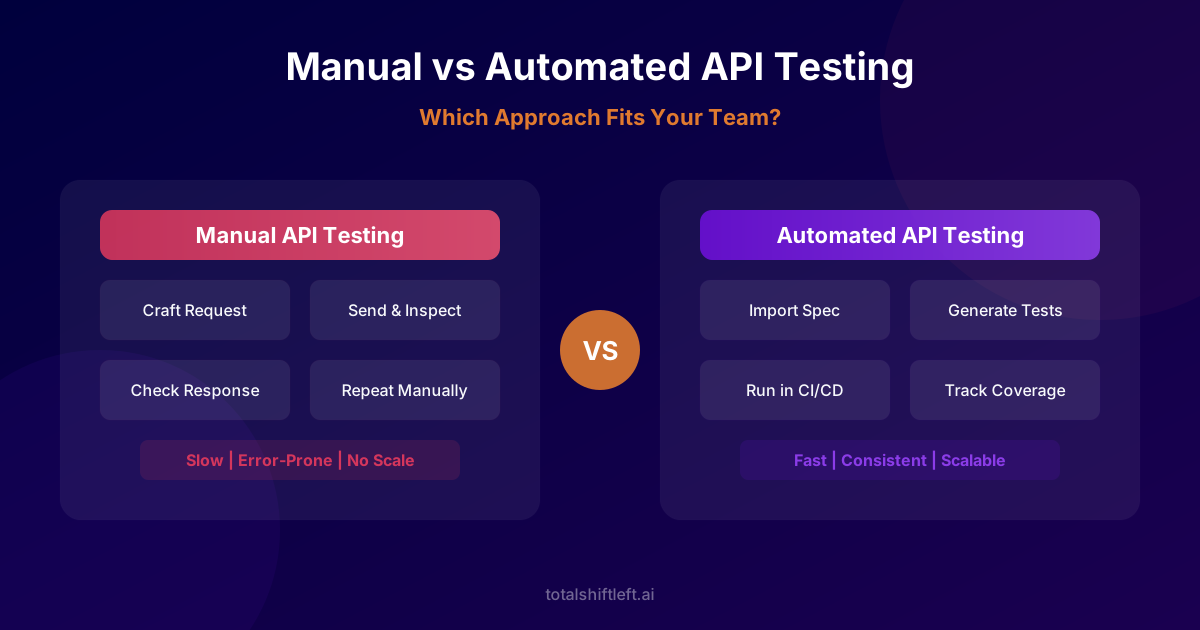
**Manual API testing vs automated testing** is the largest lever backend teams have over release velocity and production incident rate. Manual puts a human in the loop for every request and assertion; automated encodes expectations as executable artifacts that run on every commit. The two share a goal but have fundamentally different economics, coverage, and failure modes.
The data is unambiguous. World Quality Report 2025 found teams running automated API regression on every PR ship 3.4x more frequently with 62% fewer production API incidents. IBM and NIST research shows defects caught in development cost 5-15x less than in QA and 30-100x less than in production. DORA ranks automated testing as a top predictor of elite delivery performance. Yet in 2026, ~47% of engineering teams still run pre-release regression manually through Postman.
Table of Contents
- Introduction
- What Is Manual vs Automated API Testing?
- Why This Matters Now for Engineering Teams
- Key Components of Manual and Automated API Testing
- Reference Architecture
- Tools and Platforms
- Real-World Example
- Common Challenges
- Best Practices
- Implementation Checklist
- FAQ
- Conclusion
Introduction
Every backend team starts with manual API testing — Postman or cURL, request, send, eyeball the response. It works at five endpoints. It breaks at five hundred, where a mid-sized SaaS sits in 2026.
This is not a question of one approach replacing the other. It is a question of where each belongs and where the break-even sits now that AI-first platforms have collapsed the authoring cost that once justified manual-only shops. This guide covers the full side-by-side — definitions, coverage, economics, tooling, failure modes, and a staged migration path — with citations to IBM, NIST, DORA, and the World Quality Report. For fundamentals, the API Learning Center covers what is an API and request/response anatomy.
What Is Manual vs Automated API Testing?
Manual API testing is a human constructing HTTP requests by hand, sending them to an endpoint, and visually verifying the response. The tester sets headers, tokens, params, and body; inspects status, payload, and timing; and records pass or fail in a note or ticket. Canonical tools: Postman, Insomnia, Bruno, cURL. The artifact left behind is tester memory and, at best, a saved collection.
Automated API testing encodes the same expectations as executable code or declarative definitions that run without human intervention. Tests are authored once, stored in version control, and executed on every commit, pull request, schedule, and deploy. Assertions cover status, schema, field values, response-time SLOs, headers, and business invariants. Output is structured: JUnit XML, SARIF, HTML dashboards, or PR annotations.
The fundamental difference is not speed — it is persistence and determinism. Manual knowledge decays with team turnover; automated suites do not. Human attention wanders under time pressure; assertions do not. Manual coverage is what a tester remembered to check; automated coverage is everything the suite encodes, every run, forever. This is why shift-left testing frameworks lean on automation — only executable tests can run inside a pull request in under five minutes. Modern spec-driven and AI-first automation further generates the tests from an OpenAPI spec, removing the authoring burden that made automation expensive. See generate tests from OpenAPI.
Why This Matters Now for Engineering Teams
Microservice sprawl has outpaced human testing capacity
A mid-sized SaaS now runs 200-500 internal APIs. At 20 tests per endpoint and 1.5 minutes each, a full regression pass on 300 endpoints costs 150 engineering hours. No team runs that weekly, so most skip it — and regressions ship. Automation runs the same suite in single-digit minutes. See API testing strategy for microservices.
Release cadence has compressed past manual-QA cycles
DORA finds elite performers deploy on-demand, often multiple times per day. A 48-hour manual sign-off cycle is structurally incompatible with that cadence. Automated gates in CI/CD are the only model that scales.
Schema drift is a leading incident driver
When a producer changes a response shape, consumers break. Manual testing has no reliable way to catch this — humans don't compare every response byte-for-byte against a committed schema. Automated contract testing does. See API schema validation: catching drift and contract testing.
Defect-cost economics demand early detection
IBM and NIST have reproduced the same finding for three decades: defects caught in development cost 5-15x less than in QA and 30-100x less than in production. Manual testing, by running late, lands on the expensive side of that curve.
AI-first generation has changed the economics of authoring
The historical argument for manual testing was partly economic — hand-writing automation is slow. AI-first platforms that generate tests from OpenAPI and self-heal on drift collapse authoring cost to near zero, pushing the break-even point to any endpoint living longer than a sprint.
Key Components of Manual and Automated API Testing
Request construction
Manual: the tester types headers, auth, params, and body into a GUI. Automated: requests are defined in code or generated from an OpenAPI spec, with env variables resolving base URLs and credentials at runtime. See request/response anatomy.
Assertion and validation
Manual assertion is what the tester notices — usually status and a scan of the body. Automated assertion is exhaustive: status, full schema, field values, response time, headers, and cross-field invariants. Schema validation against OpenAPI is impractical manually on every response. See validation errors.
Test data management
Manual uses whatever data the tester remembers. Automated suites use data factories, parameterized fixtures, or AI-generated negative data covering boundaries, malformed payloads, and adversarial inputs systematically.
Authentication handling
Manual: paste a token or log in through the UI. Automated: the suite resolves OAuth2 client credentials, JWT tokens, mTLS, and API keys from a vault with token refresh handled transparently.
Execution frequency and trigger
Manual runs when a human decides — typically before release, often skipped under pressure. Automated runs on every commit, pull request, and schedule. That frequency delta is why automation catches regressions within minutes of the change that caused them.
Reporting and traceability
Manual produces notes and screenshots. Automated produces structured reports — pass/fail counts, coverage maps, response-time trends, flakiness scores, and integrations into Slack and Teams.
Coverage tracking
Manual "coverage" is a spreadsheet that is always out of date. Automated coverage is computed continuously against spec and code, auditable at any time — decisive for SOC 2, ISO 27001, and PCI-DSS compliance programs.
Feedback loop into development
Manual results arrive as a ticket hours or days after the change. Automated results arrive as a PR annotation minutes after push, while the developer still has context. The shorter the loop, the cheaper the fix — a first-order claim in DORA's metrics and the foundation of the shift-left argument.
Ready to shift left with your API testing?
Try our no-code API test automation platform free. Generate tests from OpenAPI, run in CI/CD, and scale quality.
Reference Architecture
A modern API testing workflow is best understood as a five-layer stack that contrasts sharply between manual and automated modes.
At the source layer sit artifacts defining what should be tested: the OpenAPI spec, the codebase, auth config, and environment definitions. Manually this is implicit — the tester "knows" what to test. Automated workflows treat these as first-class inputs.
The authoring layer is where tests come into existence. Manually, the tester authors each request in Postman, one by one. Scripted automation has engineers writing Karate, RestAssured, or Pytest. AI-first automation generates positive, negative, and boundary tests directly from the spec — coverage no human team could author economically.
The execution layer runs tests against target environments. Manually: a human clicking Send. Automatically: a headless, parallel, deterministic runner inside CI/CD that resolves auth, sends requests, and evaluates assertions.
The validation layer evaluates outcomes. Manually: eyeball the response. Automatically: machine-evaluate status, full schema, field values, response-time SLOs, and cross-request invariants. This is where automation's coverage advantage compounds.
The feedback layer surfaces results. Manually: a ticket or a spreadsheet. Automatically: a PR annotation, coverage dashboard, flakiness score, and one-click local reproduction. Quality of this layer determines adoption; see our collaboration and analytics features.
Cross-cutting both modes is the governance layer: secrets, environment isolation, audit logs, and RBAC. Manual workflows handle this informally; automated workflows centralize it — a prerequisite for any regulated environment.
Tools and Platforms
| Tool / Platform | Mode | Best For | Key Strength | CI/CD-First? |
|---|---|---|---|---|
| Postman | Manual + light automation | Exploratory testing, API learning | Collaboration UI, collection sharing | No |
| Insomnia | Manual | Individual developers, GraphQL | Clean UI, open-source core | Limited |
| Bruno | Manual, file-based | Git-native manual testing | Collections in version control | Partial |
| cURL | Manual scripting | One-off probes, shell pipelines | Ubiquitous, scriptable | Limited |
| RestAssured | Scripted automation | Java teams embedding tests in code | JUnit/TestNG native integration | Yes |
| Karate | Scripted automation | DSL-loving engineering teams | Gherkin-style syntax, BDD assertions | Yes |
| Pytest + Requests | Scripted automation | Python teams | Full programmatic flexibility | Yes |
| ReadyAPI (SmartBear) | Scripted automation | Enterprise SOAP + REST, load testing | Deep protocol support | Yes |
| Schemathesis | Property-based OSS | Spec-driven fuzzing | Auto-case generation from OpenAPI | Yes |
| Total Shift Left | AI-first shift-left platform | End-to-end spec-to-CI automation | AI test generation, self-healing, native CI/CD | Yes |
The tooling landscape bifurcates into three camps. Manual-first tools (Postman, Insomnia, Bruno, cURL) optimize for a human operator. Scripted automation (RestAssured, Karate, Pytest) optimizes for engineers willing to write and maintain code. Spec-driven and AI-first platforms optimize for teams who want coverage without authoring. Detailed comparisons: best API test automation tools compared, top OpenAPI testing tools compared, ReadyAPI vs Shift Left, Apidog vs Shift Left, and best AI API testing tools 2026. See also our general compare page and integrations.
Real-World Example
Problem: A 90-engineer B2B logistics SaaS ran 160 microservice APIs with a 6-person QA team maintaining ~2,400 Postman collections. Pre-release regression took 3 full business days across two testers. Ship cadence was bi-weekly and slipped often. Over the prior year, seven P1 incidents traced to regressions the manual pass missed — mostly schema drift testers had no systematic way to notice. QA leadership estimated ~28% coverage of the full API surface per pass.
Solution: The team adopted a staged hybrid model over 14 weeks. Phase 1 (weeks 1-3): audited collections, inventoried endpoints, and linted specs with Spectral. Phase 2 (weeks 4-6): onboarded a spec-driven AI-first platform, generating baseline suites for the top 30 APIs. Phase 3 (weeks 7-10): wired into GitHub Actions in warning mode, then enforcing mode after two sprints. Phase 4 (weeks 11-14): migrated the remaining 130 APIs, retired 1,800 Postman collections, and redirected QA to exploratory testing and contract validation. See the CI/CD step-by-step guide.
Results: Commit-to-full-regression feedback dropped from ~72 hours to under 8 minutes. Effective coverage rose from 28% to 94% of the documented API surface. Schema-drift P1s fell from 7 in the prior year to 0 in the following two quarters. QA headcount stayed flat, but 65% of QA hours were redirected to exploratory security testing, which surfaced 11 previously unknown authorization defects. Cadence moved from bi-weekly to twice-weekly. On DORA's four keys, the team moved from "High" to "Elite" on deploy frequency and lead time within two quarters.
Common Challenges
Flaky tests erode confidence in the automated suite
Tests that pass sometimes and fail other times destroy pipeline signal; engineers start ignoring failures. Solution: Isolate environments, use deterministic data, retry only on explicit infrastructure transience, and score flakiness over time to quarantine chronically unreliable cases. See analytics.
Spec drift causes false-positive failures
When the OpenAPI spec diverges from the running API, spec-driven tests fail on correct code and teams learn to distrust them. Solution: Enforce spec-first development, lint with Spectral on every PR, and run contract validation on every build. See drift detection.
Authentication complexity blocks CI onboarding
Enterprise APIs use OAuth, JWT rotation, mTLS, or multi-step auth that breaks naively in automation. Solution: Centralize auth in the platform vault with OAuth2 client credentials, JWT handling, and token refresh. Test against your most complex flow during procurement, not the simplest.
Team resistance to abandoning manual workflows
Testers accustomed to Postman-first flows may resist automation. Solution: Run a time-boxed pilot, demonstrate regression-time and defect-catch deltas with real numbers, and explicitly redirect QA to higher-value work rather than eliminating roles. See how to migrate from Postman.
Maintenance burden on hand-authored suites
Karate, RestAssured, and Pytest suites accumulate maintenance debt as APIs evolve. Solution: Prefer AI-first generation with self-healing for any service whose spec changes more than monthly. See AI test maintenance.
Free 1-page checklist
API Testing Checklist for CI/CD Pipelines
A printable 25-point checklist covering authentication, error scenarios, contract validation, performance thresholds, and more.
Download FreeCI cost and wall-clock time balloon as the suite grows
Sequential execution across thousands of tests costs too much or takes too long for PR feedback. Solution: Require sharded parallel execution, smart test selection on branches, and full-suite execution on main. Keep PR feedback under 5 minutes.
Best Practices
- Automate anything you test more than once. With AI-first generation collapsing authoring cost, the historical break-even is gone. Any endpoint living beyond a single sprint deserves automated coverage.
- Keep manual testing for exploration and creativity. Reserve humans for unknown-unknown discovery: security probing, usability judgment, business-rule edges, and debugging production incidents where human intuition outperforms assertions.
- Run the automated suite on every pull request, not nightly. Nightly defeats the shift-left economic argument. Feedback inside the PR is what makes defects cheap.
- Enforce quality gates, not just reports. Dashboards nobody reads prevent no defects. Gates that block merge on failure enforce quality structurally.
- Track coverage against the spec, not just code. Code coverage tells you which lines ran; spec coverage tells you which API behaviors are validated — the metric that actually predicts production incidents.
- Generate from OpenAPI first, then customize. Start with auto-generated baseline tests for breadth, then add hand-crafted assertions for business-logic depth on high-stakes flows.
- Version tests alongside code. Tests live in the same repo, branched and merged with features. This keeps them current and makes failures trivially bisectable.
- Centralize environment and auth. OAuth clients, JWT signers, API keys, and env config live in a vault — not scattered across CI variables or individual Postman workspaces.
- Parallelize aggressively. Sharded execution turns a 40-minute suite into a 4-minute PR check. Developers tolerate 4 minutes; they do not tolerate 40.
- Measure adoption KPIs, not just pass rate. Track time-to-first-green-run, drift-caught-pre-merge, and percent of merges with passing generated tests. These predict business impact.
- Redeploy QA capacity deliberately. Automation should not fire testers; it should move them upstream into strategy, exploratory testing, and security review where judgment matters.
- Keep humans in the loop for high-stakes assertions. Payment, auth, and compliance endpoints get hand-reviewed assertions on top of AI-generated baselines. AI covers breadth; humans cover depth where failure is unacceptable.
Implementation Checklist
- ✔ Inventory every endpoint currently tested manually and every Postman collection in use
- ✔ Document assertion types, expected responses, and ownership for each endpoint
- ✔ Audit OpenAPI specifications for completeness — examples, descriptions, required fields
- ✔ Lint all specs with Spectral (or equivalent) as a pull-request check
- ✔ Validate each OpenAPI spec against actual runtime behavior to surface drift
- ✔ Select a spec-driven or AI-first testing platform that fits your CI stack
- ✔ Onboard a pilot team and 10-30 APIs for baseline generation
- ✔ Generate automated test suites from the spec for the pilot services
- ✔ Review AI-generated output with dev and QA to prune noise and add business-logic depth
- ✔ Configure authentication (OAuth2, JWT, API keys, mTLS) in the platform vault
- ✔ Wire the platform into CI/CD (GitHub Actions, GitLab, Azure DevOps, Jenkins, CircleCI)
- ✔ Run in warning mode for one to two sprints to stabilize and remove flakiness
- ✔ Enforce merge-blocking quality gates once signal is clean
- ✔ Configure sharded parallel execution to keep PR feedback under 5 minutes
- ✔ Enable contract and schema drift detection against running services
- ✔ Integrate failure notifications and diffs into Slack or Microsoft Teams
- ✔ Establish adoption KPIs: time-to-first-green-run, drift-caught-pre-merge, PR pass rate
- ✔ Expand from pilot to remaining services after 4-8 weeks of proven results
- ✔ Redirect manual-testing effort to exploratory, security, and API-design review
FAQ
When should I use manual API testing instead of automated testing?
Manual API testing is the right choice for exploratory testing of new or undocumented endpoints, ad-hoc debugging of production incidents, one-off security probing, evaluating third-party APIs before integration, and creative edge-case hunting where human judgment outperforms scripted assertions. Once an endpoint is stable and will be validated more than once, automation delivers more consistent, faster, and cheaper results, and the hybrid model — automation for regression plus manual for exploration — consistently outperforms either approach alone.
What does automated API testing catch that manual testing misses?
Automated testing systematically catches schema drift against the OpenAPI specification, regressions across every endpoint on every build, performance degradation over time, contract violations between microservices, negative-path failures on invalid inputs, authentication and authorization edge cases, and response-time SLO breaches. These defect classes are structurally impossible to catch manually at scale because they require running the full suite on every change. IBM and NIST research shows defects caught in development cost 5-15x less to fix than those caught in QA and 30-100x less than those caught in production.
How long does it take to transition from manual to automated API testing?
With spec-driven and AI-first tools that generate tests from an OpenAPI specification, teams reach baseline coverage in days rather than months. A typical five-phase migration — audit, spec quality, baseline generation, CI/CD wiring, and manual-effort redirection — runs 8 to 16 weeks for a team with 50-300 endpoints, depending on spec quality and authentication complexity. Teams relying on hand-written Karate or RestAssured scripts typically take 2-4x longer than teams using AI-first generation.
Can manual and automated API testing be used together?
Yes, and the most effective teams do exactly this. Automation handles regression, schema validation, contract testing, performance baselines, and CI/CD quality gates, while manual testing focuses on exploratory testing, creative security probing, debugging production incidents, and usability review of new APIs before they ship. The World Quality Report consistently finds that hybrid teams outperform pure-manual and pure-automated teams on both defect-escape rate and release cadence.
What is the cost difference between manual and automated API testing?
For an API surface with 200 endpoints and a 20-test suite per endpoint, a full manual regression pass takes roughly 100 engineering hours (4,000 tests at 1.5 minutes each). Automated suites complete the same coverage in under 10 minutes on sharded CI. Over a year of weekly releases that is approximately 5,000 saved engineering hours, and automation catches regressions that manual passes statistically miss on more than 35 percent of runs due to tester fatigue and time-boxing.
Does AI-first automation change the manual vs automated tradeoff?
Yes, significantly. The historical case for manual testing rested partly on the cost of authoring and maintaining automated scripts. AI-first platforms that generate tests from OpenAPI and self-heal on schema drift collapse that authoring and maintenance cost to near zero, which pushes the break-even point for automation dramatically earlier in an API's lifecycle. In 2026 the threshold for "this endpoint deserves automation" is effectively any endpoint that will exist longer than one sprint.
Conclusion
Manual API testing is not dying — it is being repositioned. It remains the best tool for exploration and incident debugging. But as the default for regression, it is structurally incompatible with 2026 economics: microservices in the hundreds, cadence in days, and defect-cost curves that punish late detection by one to two orders of magnitude.
The hybrid model wins. Automation covers every endpoint on every PR with deep assertions, schema checks, and contract validation. Manual testing covers the exploratory frontier where human judgment outperforms scripted logic. AI-first generation platforms have removed the last economic objection to automation at scale, making "this endpoint deserves automation" true for any endpoint living longer than a sprint.
To see a spec-driven, AI-first alternative to manual regression — ingesting your OpenAPI spec, generating positive, negative, and boundary tests, running them in CI, and self-healing on schema change — explore the Total Shift Left platform, start a free trial, or book a demo. First green run in under 10 minutes; try the live sandbox at demo.totalshiftleft.ai.
Related: Shift-Left AI-First API Testing Platform | AI-Driven API Test Generation | Best API Test Automation Tools Compared | Best Postman Alternatives | How to Migrate from Postman to Spec-Driven Testing | API Test Automation with CI/CD | API Schema Validation | The Rising Importance of Shift-Left API Testing | API Learning Center | Platform | Pricing | Free Trial
Ready to shift left with your API testing?
Try our no-code API test automation platform free.