
Codeless API Testing Automation: Complete Guide (2026)
Quick answer
Codeless API testing automation lets QA engineers, analysts, and developers design, run, and maintain API test suites through visual workflows and spec imports — OpenAPI, Swagger, or Postman collections — instead of writing code. Platforms auto-generate baseline tests, expose drag-and-drop assertions and data parameterization, and self-heal when specs change; teams combining codeless with AI-first generation report a 47% reduction in test-maintenance hours.
Reviewed by Rishi Gaurav

Codeless API testing automation is a quality-engineering discipline that lets QA engineers, business analysts, and developers design, execute, and maintain API test suites through visual workflows, specification imports, and rule-builders — with no JavaScript, Python, or Java code required. Modern codeless platforms ingest OpenAPI, Swagger, or Postman collections, auto-generate baseline tests, and expose drag-and-drop steps for requests, assertions, data, environments, and CI/CD gating.
The category has moved from niche to mainstream. The World Quality Report 2025 found 68% of mid-sized engineering organizations now run at least part of their API regression suite on codeless platforms, and teams combining codeless authoring with AI-first generation report a 47% reduction in test-maintenance hours and 2.9x faster time-to-first-green-run than scripted frameworks.
APIs are the connective tissue of every modern digital product. The typical mid-sized SaaS company in 2026 operates 200 to 500 internal APIs, and the consumer-visible surface is only a fraction. Testing all of them by hand, or with scripts only senior engineers can author, is no longer viable.
Codeless API testing automation closes the gap. It lets QA engineers, analysts, and product owners author and maintain tests directly, without waiting on a shrinking pool of automation engineers. Combined with a shift-left AI-first API testing platform, the authoring barrier disappears: the platform generates the baseline, humans refine it visually.
This guide covers what codeless API testing is, why it matters, the reference architecture, the tools landscape, and how to implement it. For fundamentals, start with our API Learning Center — especially what is an API and request/response anatomy. For platform capabilities, see the platform overview or the live demo environment.
In this guide
- What Is Codeless API Testing Automation?
- Why codeless API testing matters in 2026
- Key Components of a Codeless API Testing Platform
- Codeless API testing reference architecture
- Codeless API testing tools compared
- Codeless API testing in practice: a worked example
- Codeless API testing challenges and how to solve them
- Codeless API testing best practices
- Codeless API testing checklist
- Codeless API testing FAQ
- From spec to a running suite without writing a test
What Is Codeless API Testing Automation?
Codeless API testing automation is the practice of defining, running, and maintaining automated API tests without hand-written code.
"Codeless" does not mean "no logic." Logic is expressed visually — drag-and-drop step builders, schema-aware assertion pickers, data tables, environment matrices — rather than in a programming language. The platform compiles those visual definitions into an executable test at run time.
"API testing" covers functional validation (right status, shape, data), contract validation against the OpenAPI spec, authentication flows (OAuth2, JWT, mTLS), data-driven permutations, negative-path cases, and performance smoke checks.
"Automation" means the suite runs without a human clicking through it — on schedule, on every commit via CI/CD, on demand, or via deployment event.
Codeless is not the same as AI-first. AI-first describes the generation engine; codeless describes the authoring surface. The strongest platforms are both: AI generates the baseline from the spec, humans refine visually. Compare approaches at Total Shift Left's marketing site or the platform comparison hub.
Teams evaluating automation platforms often end up comparing these against robotic process automation; API test automation vs RPA sets out where each one genuinely applies.
Why codeless API testing matters in 2026
The QA talent gap has closed the scripted-only era
Scripted automation demanded engineers who could write Java, JavaScript, or Python well enough to maintain thousands of cases. That talent is scarce. Codeless redistributes authoring to the broader QA population, collapsing the bottleneck described in the rise of no-code API test automation platforms.
Release cadence has outrun manual QA
Weekly and daily deploys are the new default. A four-hour manual regression pass is incompatible with a 20-minute merge-to-deploy cycle. Codeless automation running in CI — per API test automation with CI/CD — is the only way to keep pace.
Microservice sprawl overwhelms script maintenance
A 300-API estate with 20 tests each is 6,000 cases. At 30 minutes of authoring and 10 minutes of monthly maintenance per test, that is a full-time five-person team. Codeless plus AI generation cuts that load by roughly 80%, per AI-driven API test generation.
Contract drift is a leading incident driver
When the backend adds a required field or changes a type, consumers break. Without enforced contract testing at PR time, production finds out first. Codeless platforms with schema-diff detection catch this automatically.
DORA metrics favor teams who test everywhere, early
The 2025 DORA report correlates elite-performer status with testing that runs on every commit. Shift-left testing frameworks deliver this when authoring is codeless enough that the entire team — not just specialists — can contribute.
Key Components of a Codeless API Testing Platform
Specification import and endpoint discovery
The platform ingests OpenAPI 3.x, Swagger 2.0, Postman collections, GraphQL SDL, and AsyncAPI. It can introspect a running service to discover undocumented endpoints and flag them as coverage gaps. This is the source of truth for OpenAPI test automation and aligns with the workflow in generate tests from OpenAPI.
Visual request builder
A drag-and-drop canvas for constructing HTTP requests — method, path, headers, query parameters, body (JSON, form, multipart, XML). Templates pull directly from the spec so testers pick from valid shapes rather than authoring from scratch. See the test execution feature page for deeper detail.
Rule-based assertion library
Assertions are defined through pickers, not code: "status code equals 200," "response body matches schema User," "response time under 500 ms," "header X-Rate-Limit-Remaining is numeric." The library extends to JSONPath extractions, regex matches, and schema-aware diffing. For edge cases, see validation errors.
Data-driven parameterization
Every step can be parameterized against a CSV, a data table, a database query, or a dynamic generator. A single visually-authored flow covers dozens of permutations, which is how codeless suites match scripted coverage without matching scripted authoring effort.
AI-assisted generation and negative path synthesis
Best-in-class platforms do not ask humans to draw every flow. They read the spec, auto-generate positive-, negative-, and boundary-path cases, and drop them onto the canvas for review. Learn more at AI-assisted negative testing and the AI test generation feature.
Authentication and environment management
OAuth2 (authorization code, client credentials, PKCE), JWT, API keys, mTLS, and custom header schemes are built in — not a scripted afterthought. Environments (dev/staging/prod-like) are configured once and swapped per run. Reference the learn pages on JWT authentication, OAuth2 client credentials, and token refresh patterns.
Self-healing and schema drift detection
When the spec changes, the platform diffs the new against the old and updates affected tests automatically. Non-breaking additions heal silently; breaking changes surface as review items. Background: AI test maintenance and API schema validation.
Ready to shift left with your API testing?
Try our no-code API test automation platform free. Generate tests from OpenAPI, run in CI/CD, and scale quality.
CI/CD, reporting, and collaboration
Native integrations for GitHub Actions, GitLab CI, Azure DevOps, Jenkins, and CircleCI; JUnit/SARIF output; PR annotations; Slack and Teams hooks; shared libraries of reusable steps. See the integrations page and the collaboration and security feature.
Codeless API testing reference architecture
A codeless API testing platform operates as a five-layer pipeline spanning authoring, generation, execution, feedback, and governance.
At the authoring layer, users interact with a visual canvas. They import specs, drag steps, pick assertions from rule menus, and parameterize with data tables. What they build is stored as a structured JSON document describing the test — never as code. This design is what makes tests portable, diffable in version control, and eligible for AI-assisted mutation.
The generation layer sits alongside authoring and fills the canvas without human effort. When a new spec is ingested, the AI engine reads every endpoint, infers intent from path names and schema shapes, and emits a baseline suite covering positive, negative, and boundary paths. Users review and refine — they do not start from blank. This is the crossover point between codeless and AI-first architecture.
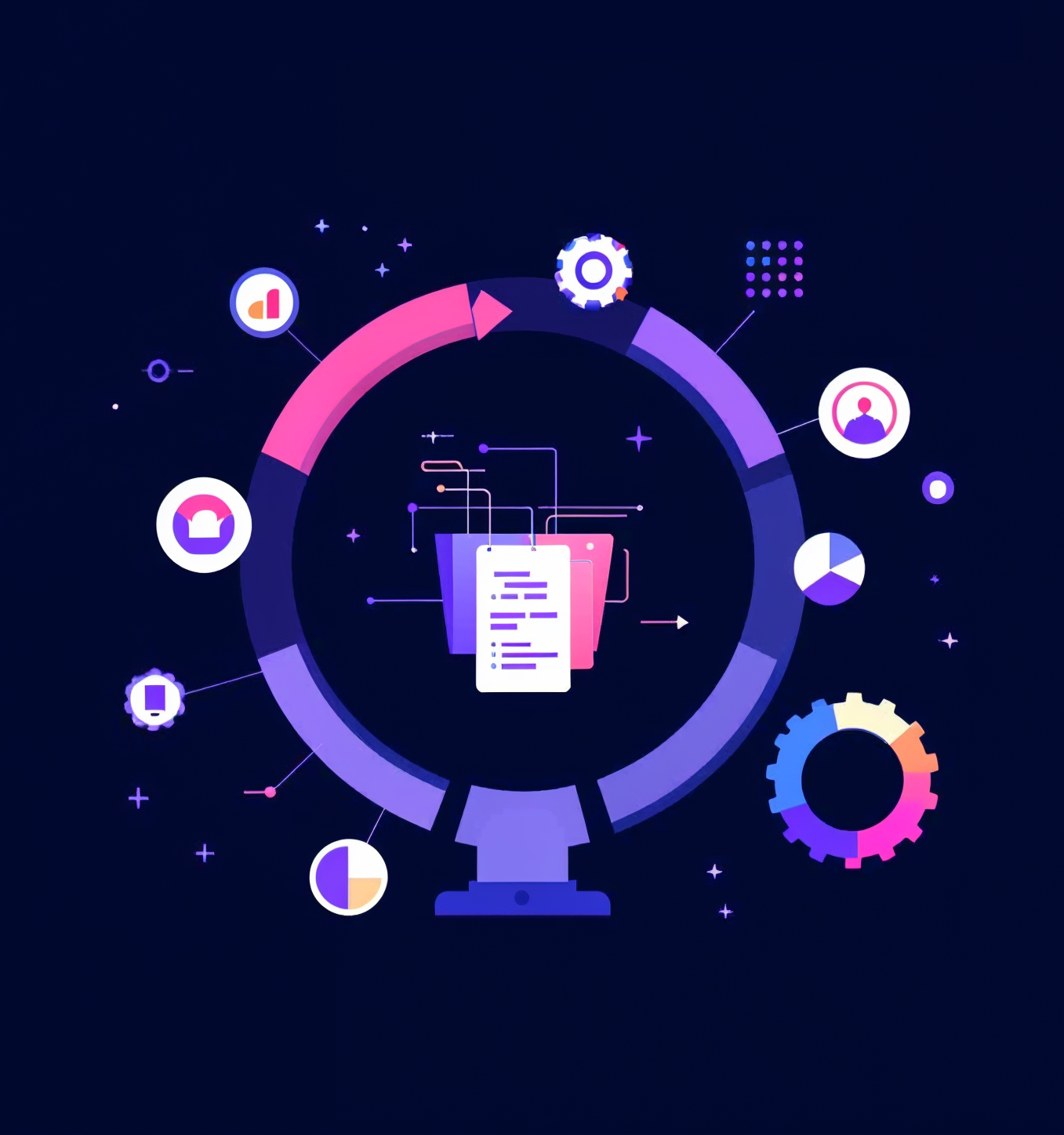
The execution layer compiles the structured test documents into a runnable plan, resolves auth and environment variables, and dispatches requests in parallel against the target environment. It captures responses, evaluates assertions, and streams results back. Execution is headless and deterministic — identical whether triggered from the UI, a schedule, or a CI pipeline.
The feedback layer surfaces results where developers work: PR annotations with failure diffs, historical trend charts, flakiness scoring, one-click local reproduction, and Slack/Teams escalation. Quality of feedback, not quality of authoring, determines long-term adoption — a pattern detailed in the analytics and monitoring feature page.
Cross-cutting every layer is governance: RBAC, audit logs, secret management, data isolation per run, and environment quarantines. Enterprise platforms treat governance as first-class; hobbyist tools treat it as afterthought. Cross-reference API testing strategy for microservices.
Codeless API testing tools compared
| Platform | Type | Best For | Key Strength |
|---|---|---|---|
| Total Shift Left | AI-First Codeless Platform | End-to-end spec-to-CI automation | True AI generation + visual authoring + self-healing + native CI/CD |
| Postman | Collection-Based (Partial Codeless) | Exploratory and manual testing | Collaboration and visual request UX |
| ReadyAPI (SmartBear) | Hybrid Codeless + Scripted | Enterprise SOAP + REST with load testing | Deep protocol support, legacy-friendly |
| Apidog | Design + Test Hybrid | Small-to-mid teams standardizing on spec-first | Unified design/mock/test workflow |
| Katalon Studio | Codeless + Record/Playback | Mixed UI + API teams | Broad automation surface |
| Testim | AI-Assisted Codeless | Cross-browser plus some API coverage | Visual authoring with AI healing |
| BlazeMeter | Codeless + Performance | Performance and functional mix | Strong load and scale execution |
| Stoplight | API Design Platform | Design-first teams | Strong spec editing, lighter on execution |
Deeper comparisons live at best API test automation tools compared, top OpenAPI testing tools compared, and the Postman alternative hub. For vendor-specific side-by-side reviews see ReadyAPI vs Shift Left, Apidog vs Shift Left, and best AI API testing tools 2026. Broader market context and case studies are on the Total Shift Left marketing blog.
The category is bifurcating. Legacy tools are bolting codeless veneers onto scripted cores; newer platforms are built codeless-first with AI generation as the primary authoring action. The two produce materially different onboarding curves and maintenance economics at scale.
Codeless API testing in practice: a worked example
Problem: A mid-sized insurance SaaS with 140 engineers operated 210 internal microservices and 38 public APIs. A nine-person QA team maintained 3,500 scripted tests in REST Assured and Karate. Authoring time per new endpoint was 38 minutes, 70% of QA capacity was consumed by script maintenance, and three automation specialists handling complex auth flows were a persistent bottleneck. Release cadence had slipped from bi-weekly to monthly.
Solution: The organization adopted a codeless, AI-first platform in three phases. Phase 1 (weeks 1-3): onboarded 18 high-traffic APIs; the platform auto-generated baselines from OpenAPI specs and QA reviewed visually — no code written. Phase 2 (weeks 4-8): wired the platform into Azure DevOps so every PR ran the suite with sharded parallel runs under four minutes. Self-healing absorbed 81% of spec changes silently. Phase 3 (weeks 9-16): migrated the remaining 230 APIs, retired 2,900 legacy scripts, and redirected the three specialists to platform-engineering ownership. See the integrations page for CI wiring.
Results: Time from "endpoint defined" to "covered by passing tests" fell from 2.5 days to 14 minutes (99.6% reduction). Script-maintenance hours dropped from 62% to 11% of QA capacity. Contract-drift incidents fell from four in the prior quarter to zero over the next two. Release cadence moved from monthly back to weekly. QA NPS on "confidence contributing to automation" rose from 34 to 81.
Codeless API testing challenges and how to solve them
Specs are incomplete or low quality
Codeless generation is only as good as the input. Specs missing required markers, examples, or descriptions produce permissive and false-positive-prone tests. Solution: Treat OpenAPI quality as a precondition. Run Spectral (or equivalent) linting as a PR check, require examples on every schema, and track spec-completeness as a KPI. Reinforce with API schema validation.
Testers distrust auto-generated cases
Engineers who have never seen AI-authored coverage assume it is shallow or wrong. Solution: Start with one team and a small, well-specified API surface. Have QA review each generated case alongside the spec in a structured walkthrough. Credibility is earned in the first three or four well-generated suites; after that, adoption becomes self-sustaining. Reference material: future of API testing: AI automation.
Codeless hits a ceiling on exotic logic
Some flows — cryptographic signing, custom protocol handshakes, complex stateful sagas — resist pure visual expression. Solution: Choose a platform that supports escape hatches (small scripted steps embedded in codeless flows) for the 5-10% of cases that need them, while keeping 90%+ of the suite codeless. See API protocols coverage for supported surfaces.
CI cost and duration balloon without parallelization
A 400-test suite run sequentially is a 40-minute PR blocker. Solution: Require sharded parallel execution out of the box, smart test selection on feature branches, and full-suite execution on main only. Wiring pattern: API test automation with CI/CD and the CI/CD solution page.
Existing Postman or scripted investment cannot migrate overnight
Organizations have years of investment in collections and scripts. Solution: Run codeless and legacy in parallel during transition. Start codeless on new endpoints only; migrate existing assets opportunistically as they require maintenance. The how to migrate from Postman to spec-driven testing guide details a staged path.
Free 1-page checklist
API Testing Checklist for CI/CD Pipelines
A printable 25-point checklist covering authentication, error scenarios, contract validation, performance thresholds, and more.
Download FreeGovernance and security gaps in lightweight tools
Many codeless tools were built for individuals, not enterprises. Missing SSO, audit logs, or secret vaulting becomes a blocker at scale. Solution: Procure with a security checklist — SSO/SAML, RBAC, audit trail, encrypted secret storage, SOC 2 evidence. See collaboration and security and the help center for setup references.
Codeless API testing best practices
- Start from the spec, not the UI. Every codeless test should trace back to an endpoint in a committed OpenAPI or GraphQL schema. This keeps documentation, mocks, SDKs, and tests in lockstep.
- Let AI generate the baseline, then refine visually. Do not ask humans to draw every step. A well-trained generation engine produces 70-90% of useful coverage in seconds; human effort belongs on the 10-30% that matters most.
- Treat spec quality as the highest-ROI investment. Lint on every PR, require examples, track completeness. Every hour spent improving specs multiplies across every generated test — see patterns in OpenAPI test automation.
- Shift tests into the pull request. A codeless suite run nightly is a lagging indicator; run on every commit as a merge gate. The economic argument for shift-left collapses when feedback lags.
- Parameterize everything reusable. Auth tokens, environment URLs, tenant IDs, and user roles belong in data tables and variable scopes, not inlined into individual tests.
- Build a shared step library. Login flows, standard header sets, common assertion bundles — author once, reuse across hundreds of tests. This is where codeless scales.
- Configure self-healing explicitly. Silent heal on additive non-breaking changes (new optional fields, new endpoints). Always surface removed or type-changed semantics for human review.
- Parallelize aggressively. Target a 5-minute PR feedback ceiling. Sharded execution across 8-16 workers makes a 400-test suite tractable.
- Measure adoption, not just coverage. Track time-to-first-green-run, percent of PRs with passing generated tests, drift-caught-pre-merge, and mean time to reproduce locally. See the analytics feature.
- Keep human review on high-stakes assertions. Payments, authentication, and compliance-critical flows get explicit human-authored assertions on top of AI-generated baselines. Breadth from AI, depth from humans.
- Retire legacy scripts on a deadline. Set a sunset date for duplicate scripted tests once codeless coverage is green for 30 days. Without a deadline, the legacy suite compounds maintenance forever.
- Invest in failure triage UX. Clear diffs, one-click local reproduction, readable assertion messages, and regression testing analytics matter more for long-term adoption than generation sophistication.
Codeless API testing checklist
- ✔ Inventory all APIs, current test assets (Postman, scripted, manual), and ownership
- ✔ Assess OpenAPI spec coverage and quality across every service
- ✔ Introduce Spectral (or equivalent) linting as a required PR check
- ✔ Evaluate two to three codeless platforms against your most complex auth and edge cases
- ✔ Select one pilot team and 10-20 APIs with high traffic and stable specs
- ✔ Ingest pilot specs and allow the platform to auto-generate baseline suites
- ✔ Walk through generated tests alongside the spec with QA and dev reviewers
- ✔ Build a shared library of reusable steps (login, common headers, assertion bundles)
- ✔ Configure environments (dev, staging, prod-like) and secret vaults
- ✔ Wire the platform into CI/CD (GitHub Actions, GitLab, Azure DevOps, or Jenkins)
- ✔ Enable PR-level pass/fail gates that block merges on generated test failures
- ✔ Configure self-healing thresholds — silent heal versus review-required
- ✔ Enable schema drift detection against running services
- ✔ Shard parallel execution to keep PR feedback under five minutes
- ✔ Integrate failure notifications into Slack or Microsoft Teams
- ✔ Establish KPIs: time-to-first-green-run, drift-caught-pre-merge, PR pass rate, MTTR
- ✔ Expand from pilot to second team after four to six weeks of proven results
- ✔ Deprecate overlapping legacy scripts and Postman collections on a defined timeline
- ✔ Conduct a quarterly review of platform ROI against baseline metrics
Codeless API testing FAQ
What is codeless API testing automation?
Codeless API testing automation is a discipline and tooling category that lets testers design, run, and maintain API test suites through visual workflows, spec imports, and rule-builders instead of writing code. A codeless platform ingests OpenAPI, Swagger, or Postman collections, generates baseline tests automatically, and exposes drag-and-drop steps for request construction, assertions, data parameterization, and environment switching — so QA engineers, business analysts, and product owners can contribute without JavaScript, Python, or Java experience.
Is codeless API testing as powerful as scripted automation?
Modern codeless platforms cover the vast majority of functional API testing scenarios — positive and negative paths, schema validation, auth flows, data-driven runs, and CI/CD gating — at parity with scripted tools. Scripted frameworks retain an edge only for highly custom logic, exotic protocols, or deeply embedded performance harnesses. For 90%+ of regression, contract, and smoke testing in a typical SaaS stack, codeless is functionally equivalent and dramatically faster to adopt.
How does codeless API testing integrate with CI/CD?
Codeless platforms expose headless runners and native plugins for GitHub Actions, GitLab CI, Azure DevOps, Jenkins, and CircleCI. Tests authored in the UI execute identically in the pipeline, emit JUnit XML or SARIF, and block merges on failure. Leading platforms also support sharded parallel execution so a 400-test suite completes in under five minutes on a pull request.
Who benefits most from codeless API testing automation?
QA engineers gain the largest productivity boost — they stop writing boilerplate scripts and focus on test strategy and exploratory work. Business analysts and product owners can validate API behavior directly. Developers recover hours previously spent helping QA debug flaky scripts. Engineering leaders get coverage metrics and release confidence without expanding QA headcount linearly with API growth.
Does codeless mean no skill required?
No. Codeless removes the syntactic barrier but preserves the analytic one. Effective codeless testers still need to understand HTTP semantics, authentication flows, schema design, and risk modeling. The value of codeless is that it lets domain experts apply that knowledge directly rather than translating it through a general-purpose programming language.
How is codeless different from AI-first API testing?
Codeless describes the authoring interface — visual, drag-and-drop, rule-based. AI-first describes the generation engine — the AI authors tests from specs rather than templates. The two are complementary: a best-in-class platform is both AI-first (so tests are generated, not authored) and codeless (so the small portion of human-authored logic is visual, not scripted). Together they eliminate the scripting bottleneck end to end.
From spec to a running suite without writing a test
Codeless does not mean no artifact — it means the artifact is generated. These three commands take an OpenAPI document to a running, reportable suite with no test code authored by hand:
# 1. validate the spec is good enough to generate from
npx @stoplight/spectral-cli lint openapi.yaml --fail-severity error

# 2. derive and run cases for every operation, including negative ones
schemathesis run openapi.yaml \
  --url "$STAGING_URL" \
  --checks all \
  --report junit --report-junit-path results.xml

# 3. publish the result where the team already looks
npx junit-viewer --results=results.xml --save=report.html
The maintenance model is the real difference: when the spec changes, step 2 produces a different suite. Nothing is edited, so nothing rots.
Sources and further reading
- OpenAPI Specification — the normative spec for describing HTTP APIs.
- Schemathesis documentation — property-based testing driven straight from an OpenAPI spec.
- Prism mock server — spec-driven mocking used for parallel development.
Key takeaways
- Codeless API testing automation is not a simplification of "real" testing — it is a redistribution of who can do it and how fast.
- When every QA engineer, analyst, and product owner can author, run, and maintain API tests directly from a spec, coverage expands without headcount and the scripting bottleneck that has capped QA for a decade finally clears.
- The path forward is staged: audit your API and test landscape, invest in OpenAPI quality, pilot one team with a codeless AI-first platform, wire it into CI/CD, measure adoption, then expand.
- Organizations completing this loop in 2026 report time-from-endpoint-to-covered collapsing from days to minutes, drift incidents trending to zero, and QA capacity redirected from maintenance to risk strategy.
If you want to see a codeless, AI-first API testing platform end to end — ingesting your OpenAPI spec, generating positive, negative, and boundary tests visually, running them in your CI pipeline, and self-healing on every schema change — explore the Total Shift Left platform, start a free trial, or book a live demo. First green run in under 10 minutes, no scripts required.
Related: How to Automate API Testing Without Writing Code | The Rise of No-Code API Test Automation Platforms | Shift-Left AI-First API Testing Platform | AI-Driven API Test Generation | API Test Automation with CI/CD | Best API Test Automation Tools Compared | Best Postman Alternatives | Shift-Left Testing Framework | API Learning Center | Codeless API testing platform | Total Shift Left home | Start Free Trial | Book a Demo
Continue learning
Go deeper in the Learning Center
Hands-on lessons with runnable code against our live sandbox.
Turn an OpenAPI spec into hundreds of tests in minutes. Here's what the AI actually does well — and where it still needs you.
An API is how two pieces of software talk to each other. Here's what that actually means — with runnable examples.
Ready to shift left with your API testing?
Try our no-code API test automation platform free.