
DevOps Testing Maturity Model: Assess & Improve (2026)
Quick answer
A DevOps testing maturity model assesses testing capability across five progressive levels — Initial (ad hoc manual testing), Managed (basic automation), Defined (standardized processes), Measured (metrics-driven quality gates), and Optimized (AI-driven continuous quality). Score six dimensions — automation, CI/CD integration, test data, environments, metrics, and culture — from 1 to 5 each; the lowest score, not the average, determines your real quality ceiling.
Reviewed by Rishi Gaurav

A DevOps testing maturity model is a structured framework that evaluates an organization's testing capabilities across five progressive levels — from ad hoc manual testing to AI-driven continuous quality — providing a clear roadmap for identifying gaps, setting improvement priorities, and benchmarking progress against industry standards.
Every engineering organization believes it tests well. Few can prove it. When deployment pipelines break, production incidents spike, or release cycles stretch from days to weeks, the root cause is rarely a lack of effort. It is a lack of structured maturity in how testing is planned, executed, measured, and improved.
A DevOps testing maturity model gives teams a mirror. It replaces gut feelings about quality with a structured assessment that reveals exactly where an organization stands and what it takes to reach the next level. Rather than asking whether your team tests enough, the model asks whether your testing practices are repeatable, automated, measured, and continuously optimized.
The concept is not new — maturity models have existed in software engineering since the 1980s. What has changed is the context. Modern DevOps testing demands that quality be embedded in every pipeline stage, owned by every team member, and validated continuously. A maturity model built for this reality must evaluate not just automation coverage but also culture, metrics, tooling integration, and feedback loops.
This guide walks through all five maturity levels, provides a self-assessment framework you can use immediately, maps the tools appropriate for each stage, and shares a real-world case study of an organization that moved from Level 2 to Level 4 in eighteen months. Whether you are building a testing center of excellence or optimizing an existing pipeline, this model gives you the structure to do it methodically.
In this guide
- What Is a DevOps Testing Maturity Model?
- Why Testing Maturity Matters
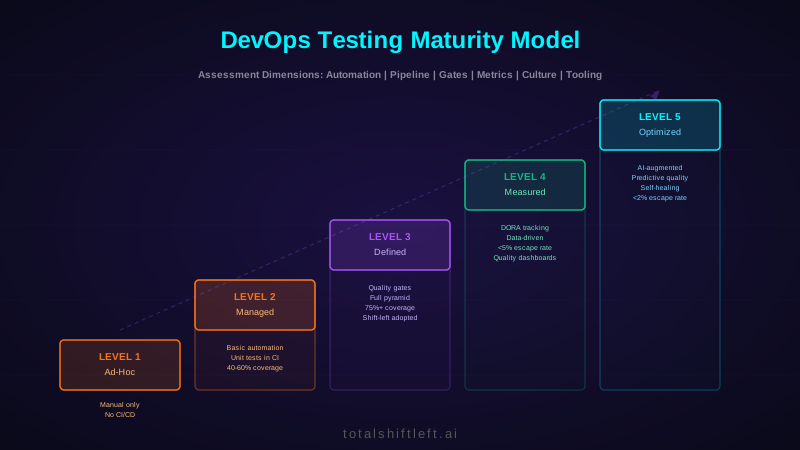
- The Five Maturity Levels
- Self-Assessment Framework
- Tools for Each Maturity Level
- DevOps testing maturity in practice: a worked example
- DevOps testing maturity challenges and how to solve them
- DevOps testing maturity best practices
- DevOps Testing Maturity Checklist
- Score the level from the repository, not from a survey
- Frequently asked questions about DevOps testing maturity
What Is a DevOps Testing Maturity Model?
A DevOps testing maturity model is an evaluation framework that classifies an organization's testing capabilities into discrete levels, each representing a progressively higher degree of automation, integration, measurement, and optimization. It serves three purposes: diagnosing the current state, defining the target state, and mapping the path between them.
Unlike generic capability maturity models, a DevOps testing maturity model is specifically designed for teams practicing continuous delivery. It evaluates testing not as a standalone discipline but as an integrated component of the delivery pipeline. The dimensions it measures — automation depth, pipeline integration, test data management, environment provisioning, metrics collection, and cultural adoption — reflect the realities of modern software delivery.
The model recognizes that maturity is not uniform. A team might have excellent unit test automation (Level 4) but poor test data management (Level 1). The assessment captures these imbalances, which is critical because the weakest dimension typically determines the overall quality ceiling. You cannot achieve continuous quality in DevOps if your test environments are manually provisioned even when your automation scripts are world-class.
Maturity models also function as communication tools. They give engineering leaders a shared vocabulary for discussing quality investments with executives, aligning cross-functional teams on priorities, and tracking improvement over time. When a VP of Engineering says the team is at Level 2 and the goal is Level 4 by Q4, everyone understands the scope of that ambition.
For the tool landscape underneath this, see continuous integration testing tools — what each one integrates with and where it fits in the pipeline.
Why Testing Maturity Matters
Testing maturity directly correlates with delivery performance. Organizations at higher maturity levels deploy more frequently, experience fewer production failures, and recover faster from incidents. The relationship is not coincidental — it is causal. Mature testing practices catch defects earlier, reduce rework, and build the confidence teams need to ship fast.
Consider the economics. A defect caught in a unit test costs minutes to fix. The same defect caught in staging costs hours. In production, it costs days and potentially revenue. Organizations at Level 1 find most defects in production. Organizations at Level 4 find most defects before code reaches the main branch. The cost difference across hundreds of defects per quarter is enormous.
Maturity also affects team velocity and morale. Engineers in low-maturity environments spend significant time on manual regression testing, debugging flaky tests, and waiting for environment provisioning. Engineers in high-maturity environments write code, push it through automated quality gates, and get feedback in minutes. The latter ship features; the former fight fires.
For organizations pursuing a shift-left testing transformation, the maturity model provides the structure to make that shift incrementally rather than attempting a disruptive overhaul. Each level builds on the previous one, creating a sustainable improvement trajectory.
The Five Maturity Levels
Level 1: Initial (Ad Hoc Manual Testing)
At Level 1, testing is reactive and unstructured. There are no documented test plans, no automation, and no consistent process. Individuals test based on personal experience rather than organizational standards. Defects are found in production, and releases are stressful events requiring manual verification of every critical path.
Characteristics of Level 1 include test cases stored in spreadsheets or personal notes, manual execution of all test scenarios before every release, no CI/CD pipeline integration, test environments that are shared and frequently broken, no quality metrics beyond bug counts, and a culture where testing is the QA team's problem rather than a shared responsibility.
Organizations at this level typically deploy monthly or quarterly, with each release requiring a multi-day test cycle. The change failure rate is high, often exceeding 30%, because manual testing cannot keep pace with development velocity.
Level 2: Managed (Basic Automation)
Level 2 introduces automation for the most repetitive and critical test scenarios. Teams have a CI server running unit tests on every build, some integration tests exist, and there is a basic understanding of which tests to automate. However, automation is siloed — individual developers or a dedicated automation engineer maintain scripts without organizational standards.
At this level, unit test coverage typically reaches 40-60%, but coverage is uneven across services. Integration tests exist but run in a separate stage and are often flaky. Test automation best practices are understood by some team members but not codified as team standards. Test data is manually seeded, and environment provisioning still requires tickets and waiting.
The jump from Level 1 to Level 2 is the fastest maturity improvement because basic automation yields immediate returns. A team that adds unit tests to its CI pipeline reduces the manual regression burden overnight. This early success creates momentum for further investment.
Level 3: Defined (Standardized Processes)
Level 3 represents the inflection point where testing transitions from an individual activity to an organizational capability. Testing processes are documented, standardized, and consistently applied across teams. Automation covers unit, integration, and API layers. Quality engineering practices replace traditional QA handoffs.
At this level, teams maintain automation coverage above 70%, use test pyramids to allocate effort across layers, implement contract testing for service boundaries, and run security scans as part of the pipeline. Test data management moves from ad hoc seeding to reusable fixtures or synthetic data generation. Environment provisioning is partially automated through infrastructure-as-code.
Ready to shift left with your API testing?
Try our no-code API test automation platform free. Generate tests from OpenAPI, run in CI/CD, and scale quality.
The key differentiator at Level 3 is repeatability. Any team member can execute the full test suite, understand the results, and diagnose failures. Testing is no longer dependent on a single expert. Teams at this level typically deploy weekly and have change failure rates between 10-15%.
Level 4: Measured (Metrics-Driven Optimization)
Level 4 adds quantitative management to the standardized processes of Level 3. Teams track DevOps testing metrics systematically — test coverage, execution time, flake rate, defect escape rate, mean time to detection, and pipeline pass rate. Decisions about testing investment are data-driven rather than opinion-based.
Quality gates enforce standards automatically. A pull request cannot merge if coverage drops below the threshold, if performance baselines regress, or if security vulnerabilities are introduced. Feedback loops are tight — developers see test results within minutes of pushing code, and trends are visible on team dashboards.
At this level, organizations begin implementing advanced practices: risk-based test selection that runs only the tests affected by a change, parallel test execution that keeps pipeline times under ten minutes, canary deployments that validate changes in production with real traffic, and chaos engineering that proactively discovers failure modes.
The jump to Level 4 is the hardest because it requires infrastructure for metrics collection, dashboards for visualization, and cultural buy-in to make data the basis for quality decisions. Technical maturity alone is insufficient — leadership must champion metrics-driven quality.
Level 5: Optimized (AI-Driven Continuous Quality)
Level 5 represents the frontier of testing maturity. Testing is not just automated and measured — it is continuously optimized through AI and machine learning. Self-healing tests that automatically repair themselves when an endpoint changes keep suites green without manual intervention. Predictive analytics identify high-risk code changes before tests run. Test generation fills coverage gaps without manual intervention.
Organizations at Level 5 treat quality as a product. Dedicated platform teams build and maintain the testing infrastructure, providing self-service capabilities to product teams. Test creation, execution, maintenance, and analysis are all augmented by intelligent t
ooling. The testing pipeline is a product that internal teams consume.
At this level, deployment frequency is measured in deployments per day, change failure rates fall below 5%, and mean time to recovery is measured in minutes. Testing is invisible to developers in the best sense — it runs everywhere, catches everything, and never slows anyone down.
Fewer than 10% of organizations operate at Level 5, but it represents the direction the industry is heading as AI-powered testing tools mature.
Self-Assessment Framework
Use this scoring framework to evaluate your organization across six dimensions. Rate each dimension from 1 (Initial) to 5 (Optimized), then calculate the average to determine your overall maturity level.
| Dimension | Level 1 | Level 2 | Level 3 | Level 4 | Level 5 |
|---|---|---|---|---|---|
| Test Automation | No automation; all manual | Unit tests in CI; <50% coverage | Unit + integration + API; >70% coverage | Risk-based selection; parallel execution | AI-generated tests; self-healing |
| CI/CD Integration | No pipeline | Basic CI with test stage | Multi-stage pipeline with gates | Quality gates enforce thresholds | Predictive pipeline optimization |
| Test Data | Manual seeding | Shared fixtures | Synthetic data generation | On-demand data provisioning | AI-driven data scenarios |
| Environments | Shared, manually provisioned | Scripted setup | Infrastructure-as-code | Ephemeral per-PR environments | Self-scaling, production-mirror |
| Metrics | Bug counts only | Coverage reports | Dashboard with 5+ metrics | Trend analysis and alerting | Predictive quality analytics |
| Culture | QA team owns testing | Developers write unit tests | Shared ownership documented | Data-driven quality decisions | Quality is a product |
Scoring: Add your six dimension scores and divide by six. Round to the nearest whole number to get your overall level. The lowest individual score highlights your most critical improvement area — start there.
Tools for Each Maturity Level
Selecting the right tools for your maturity level prevents over-investment in capabilities you cannot yet leverage and under-investment in foundations you need. This table maps representative tools to each level.
| Category | Level 1-2 | Level 3 | Level 4 | Level 5 |
|---|---|---|---|---|
| Test Frameworks | JUnit, pytest, Jest | Cypress, Playwright, REST Assured | Custom frameworks, Karate DSL | AI test generators, Total Shift Left |
| CI/CD | Jenkins, GitHub Actions (basic) | GitLab CI, CircleCI (multi-stage) | Argo CD, Spinnaker (advanced) | AI-optimized pipelines |
| Test Data | SQL scripts, CSV fixtures | Faker libraries, factory patterns | Synthetic data platforms | ML-generated edge cases |
| Environments | Shared VMs | Docker Compose | Kubernetes namespaces, Terraform | Self-provisioning platforms |
| Monitoring | Manual log review | ELK stack, Datadog (basic) | Full observability stack | AIOps, predictive alerting |
| API Testing | Postman (manual) | Newman, REST Assured | Contract testing (Pact) | AI-driven API testing |
The key principle is to master the tools at your current level before introducing tools designed for higher levels. A team struggling with basic CI integration will not benefit from AI-powered test generation. Build the foundation first.
DevOps testing maturity in practice: a worked example
A mid-sized fintech company with 120 engineers across 15 teams decided to systematically improve their testing maturity after a series of production incidents eroded customer trust. Their initial assessment scored an overall 2.1 — firmly at Level 2 with pockets of Level 3 capability in a few teams.
Starting state (Level 2.1): Unit test coverage averaged 45% across services. Integration tests existed but ran in a shared staging environment that was broken 30% of the time. No team tracked quality metrics beyond whether builds passed. Deployments happened biweekly with a 25% change failure rate. Test data was manually managed, and creating a test environment required filing an infrastructure ticket with a three-day SLA.
Phase 1 — Months 1-6 (Reaching Level 3): The platform team standardized CI pipelines across all services using shared templates. Every pipeline included unit tests, integration tests, and security scanning. They introduced infrastructure-as-code for test environments, reducing provisioning from three days to fifteen minutes. A testing guild was formed with representatives from each team to define automation standards and share practices. Coverage climbed to 72%.
Phase 2 — Months 7-12 (Reaching Level 3.5): Contract testing was introduced at service boundaries. Synthetic test data generation replaced manual seeding. The team built quality dashboards tracking coverage, flake rate, defect escape rate, and pipeline duration. Teams began using the dashboards in sprint retrospectives to identify testing bottlenecks. Deploy frequency moved from biweekly to weekly.
Phase 3 — Months 13-18 (Reaching Level 4): Quality gates were enforced in CI — no merge without 80% coverage, no deployment without passing contract tests, no release without security scan clearance. Risk-based test selection reduced pipeline times from 45 minutes to 12 minutes. Ephemeral environments spun up per pull request. The change failure rate dropped to 8%. Teams deployed multiple times per week. The overall assessment score reached 3.9.
The transformation required investment in platform engineering (two dedicated engineers), tooling (approximately $150K annually), and cultural change (testing guild, blameless post-mortems, quality metrics in OKRs). The return was measurable: 70% reduction in production incidents, 4x increase in deployment frequency, and a 60% decrease in time spent on manual regression testing.
DevOps testing maturity challenges and how to solve them
Challenge: Flaky tests erode trust in automation. Teams at Level 2-3 frequently encounter test flakiness that causes builds to fail intermittently. Engineers learn to ignore failures and re-run pipelines until they pass. The solution is to quarantine flaky tests immediately, track flake rate as a key metric, and dedicate a percentage of each sprint to flake remediation. A test that fails intermittently is worse than no test because it teaches the team to ignore failures.
Free YAML templates + guide
CI/CD Testing Pipeline Templates
Production-ready CI/CD pipeline templates for GitHub Actions and GitLab CI. Includes API testing, contract testing, and performance testing stages.
Download FreeChallenge: Cultural resistance to shared quality ownership. Developers accustomed to handing code to QA resist writing tests. The solution is not mandates but incentives — make test coverage visible in code reviews, celebrate teams that achieve quality milestones, and ensure that leaders model the behavior by discussing quality metrics alongside feature delivery.
Challenge: Environment bottlenecks block testing. Shared test environments create queues and conflicts. Infrastructure-as-code and containerization solve this at Level 3. Ephemeral per-PR environments solve it at Level 4. The investment pays for itself in reduced waiting time and fewer environment-related false failures.
Challenge: Metrics without action. Organizations at early Level 4 collect metrics but do not act on them. Dashboards exist but nobody looks at them. The solution is to embed metrics into existing ceremonies — sprint reviews, deployment checklists, and incident post-mortems. Metrics must drive decisions, not just decorate walls.
Challenge: Over-automating at the wrong layer. Teams sometimes invest heavily in end-to-end UI automation while neglecting unit and integration tests. Align your automation with the test pyramid — heavy investment at the base (unit tests), moderate in the middle (integration and API tests), and selective at the top (end-to-end tests).
DevOps testing maturity best practices
Assess before you act. Run the self-assessment framework with your team before making any investment decisions. The results will likely surprise you — teams consistently overestimate their maturity by one full level. An honest baseline prevents wasted effort.
Improve the weakest dimension first. Your overall quality is constrained by your lowest-scoring dimension. An organization with Level 4 automation but Level 1 test data management will still suffer from unreliable test results. Address the bottleneck before advancing the strengths.
Set level-appropriate goals. Aim for one level of improvement per 6-12 months. Trying to jump from Level 1 to Level 4 in a single initiative leads to abandoned transformations. Each level builds the foundation for the next.
Invest in platform engineering. From Level 3 onward, testing infrastructure becomes a product. Dedicated platform engineers who build self-service testing capabilities create leverage across all product teams. This is more effective than training every developer to be a testing infrastructure expert.
Make testing a first-class engineering activity. Allocate sprint capacity for test improvement just as you would for feature work. Organizations that treat testing as overhead that competes with features never advance beyond Level 2. The teams that reach Level 4 budget 15-20% of engineering capacity for quality engineering.
Adopt shift-left practices incrementally. Shift-left testing is not a single action but a continuous process of moving quality validation earlier. At Level 2, shift unit tests into the CI pipeline. At Level 3, add pre-commit hooks and PR-level quality gates. At Level 4, implement risk analysis at the design stage.
Benchmark externally. Use the DORA metrics and industry reports to understand where your organization stands relative to peers. Internal improvement is meaningless if the industry is moving faster. External benchmarks provide urgency and context.
DevOps Testing Maturity Checklist
Level 1 to Level 2
- ✔ Set up a CI server that runs builds on every commit
- ✔ Write unit tests for all new code with a minimum 50% coverage target
- ✔ Automate the most critical regression scenarios
- ✔ Establish a shared test repository accessible to all team members
- ✔ Document the team's definition of done to include passing tests
- ✔ Assign ownership for test automation to at least one team member
Level 2 to Level 3
- ✔ Standardize CI pipeline templates across all teams and services
- ✔ Achieve 70%+ unit test coverage across the codebase
- ✔ Implement integration and API test automation
- ✔ Adopt infrastructure-as-code for test environment provisioning
- ✔ Introduce synthetic test data generation to replace manual seeding
- ✔ Form a testing guild or community of practice
- ✔ Document testing standards and share them in an internal knowledge base
Level 3 to Level 4
- ✔ Deploy quality dashboards tracking coverage, flake rate, escape rate, and pipeline duration
- ✔ Enforce automated quality gates that block merges and deployments
- ✔ Implement risk-based test selection to optimize pipeline times
- ✔ Provision ephemeral test environments per pull request
- ✔ Introduce contract testing at service boundaries
- ✔ Embed quality metrics in sprint reviews and team OKRs
- ✔ Reduce pipeline execution time to under fifteen minutes
Level 4 to Level 5
- ✔ Adopt AI-powered test generation to fill coverage gaps
- ✔ Implement self-healing test automation for UI and API tests
- ✔ Deploy predictive quality analytics to identify high-risk changes
- ✔ Build a self-service testing platform for product teams
- ✔ Achieve deployment-on-demand with sub-5% change failure rate
- ✔ Integrate chaos engineering and resilience testing into the pipeline
- ✔ Establish continuous quality feedback loops from production to development
Take the next step. See how shift-left API testing platform applies these ideas to your workflow, or explore API testing in CI/CD for the broader picture.
See also: contract testing in our learn hub for the underlying concept.
Score the level from the repository, not from a survey
Maturity self-assessments drift optimistic. These checks read the actual state of a repository and produce the same answer every time, which makes the level comparable across teams and across quarters:
#!/usr/bin/env bash
# maturity-scan.sh — evidence-based level scoring for one repository
score=0
has() { [ -e "$1" ] && return 0 || return 1; }

# level 1 — tests exist and run automatically
has tests && grep -rq "on:.*pull_request" .github/workflows && score=1

# level 2 — quality is a gate, not a report
grep -rq "cov-fail-under\|--fail-on ERR\|fail-severity error" .github/workflows && score=2

# level 3 — the contract is versioned and diffed
has openapi.yaml && grep -rq "oasdiff" .github/workflows && score=3

# level 4 — security and performance run per change, not per quarter
grep -rq "zap-api-scan\|schemathesis --checks all" .github/workflows &&
  grep -rq "k6 run\|jmeter" .github/workflows && score=4

# level 5 — production signal feeds back into the gate
grep -rq "check-slo\|error_budget\|canary" .github/workflows && score=5

echo "maturity level: $score/5"
Frequently asked questions about DevOps testing maturity
What is a DevOps testing maturity model?
A DevOps testing maturity model is a framework that assesses an organization's testing capabilities across five progressive levels: Initial (ad hoc manual testing), Managed (basic automation), Defined (standardized processes), Measured (metrics-driven optimization), and Optimized (AI-driven continuous quality). It helps teams identify gaps and prioritize improvements.
How do you assess testing maturity?
Assess testing maturity by evaluating capabilities across six dimensions: test automation coverage, CI/CD integration depth, test data management, environment provisioning, quality metrics tracking, and testing culture. Score each dimension on a 1-5 scale, then calculate the overall maturity level. Use the assessment to identify the weakest areas for targeted improvement.
What are the 5 levels of testing maturity?
Level 1 Initial: ad hoc manual testing with no standards. Level 2 Managed: basic test automation with some CI integration. Level 3 Defined: standardized processes, comprehensive automation, shift-left practices. Level 4 Measured: metrics-driven with quality gates and continuous feedback. Level 5 Optimized: AI-augmented testing with predictive quality and self-healing tests.
How long does it take to improve testing maturity?
Moving up one maturity level typically takes 6-12 months of focused effort. The jump from Level 1 to Level 2 is usually fastest (3-6 months) because basic automation provides immediate returns. The jump from Level 3 to Level 4 is hardest because it requires cultural change and metrics infrastructure. Most organizations can reach Level 4 within 18-24 months.
What is the most common testing maturity level?
According to industry surveys, most organizations operate at Level 2 (Managed) or early Level 3 (Defined). About 60% of teams have basic automation but lack standardized processes. Only 8-12% of organizations reach Level 4 or above, where testing is fully metrics-driven and integrated into every stage of delivery.
Sources and further reading
- DORA State of DevOps research — the multi-year dataset behind the four delivery metrics.
- ISTQB Glossary — the standard vocabulary for test terms.
- Accelerate / DORA four key metrics — the definitions behind lead time, deploy frequency, CFR and MTTR.
Key takeaways
- A DevOps testing maturity model is not an academic exercise. It is a practical tool that transforms vague aspirations about quality into concrete, measurable actions.
- By assessing your current level honestly, identifying the weakest dimensions, and following a structured improvement path, you can systematically build the testing capabilities that enable fast, reliable software delivery.
- The journey from Level 1 to Level 5 is not a sprint — it is a multi-year investment in people, processes, and tools.
- But every level you advance delivers compounding returns: fewer production incidents, faster feedback loops, higher developer satisfaction, and ultimately better software for your users.
- Start with the self-assessment. Share the results with your team. Pick the lowest-scoring dimension and build a plan to improve it by one level in the next quarter.
- That single step puts you on the path from ad hoc testing to continuous quality — and every step after that gets easier because you are building on a stronger foundation.
DevOps Testing Complete Guide | Shift-Left Testing Guide | DevOps Testing Metrics | Quality Engineering vs Traditional QA | Building a Testing Center of Excellence | Continuous Quality in DevOps | DevOps Testing Strategy | How DevOps Teams Build Testing Pipelines | Test Automation Best Practices
Ready to shift left with your API testing?
Try our no-code API test automation platform free.