
Building a Testing Center of Excellence: Enterprise Guide (2026)
Quick answer
A Testing Center of Excellence (TCoE) is a centralized team that sets quality standards, automation frameworks, and tooling for engineering organizations too large to coordinate quality ad hoc — typically structured hub-and-spoke, with a small central team owning standards and embedded quality engineers executing them per team. In 2026, an AI-driven TCoE shifts the central team's charter from "write shared test frameworks" to "own the spec-quality standard AI generation depends on," since coverage now scales with spec quality rather than headcount.
Reviewed by Sushant Joshi

A Testing Center of Excellence (TCoE) is a centralized organizational unit that establishes quality standards, builds shared testing infrastructure, develops automation frameworks, provides testing expertise, and drives continuous quality improvement across all engineering teams in an enterprise. It operates as a service center that enables squads to test effectively rather than a centralized testing bottleneck.
A 2025 Forrester study found that enterprises with a functioning Testing Center of Excellence reduce defect escape rates by 62% and testing costs by 38% compared to organizations with decentralized, uncoordinated testing practices. Yet only 28% of enterprises have established a TCoE, and fewer than half of those consider it effective.
The gap between potential and reality stems from a fundamental misunderstanding of what a TCoE should be. Many organizations model their TCoE after traditional centralized QA departments—creating a bottleneck that slows delivery rather than an enablement function that accelerates it. The effective modern TCoE is not a testing department. It is a platform team for quality.
This guide provides the complete blueprint for building a TCoE that works in 2026: the organizational structure, charter, service model, staffing approach, tooling strategy, and ROI framework. It is designed for VP-level leaders evaluating whether to build a TCoE, quality directors tasked with building one, and quality architects designing the technical foundations. Whether your organization has 100 engineers or 5,000, the principles scale.
In this guide
- What Is a Testing Center of Excellence?
- Why Build a Testing Center of Excellence?
- Key Components of a Testing Center of Excellence
- TCoE Architecture: Hub-and-Spoke Model
- AI-Driven Testing Center of Excellence
- Tools for a Testing Center of Excellence
- Real-World Example: Building a TCoE from Scratch
- Build the TCoE in-house or engage a setup partner
- Common Challenges in Building a TCoE
- Best Practices for Testing Centers of Excellence
- Testing Center of Excellence Implementation Checklist
- Publish the standard as a golden-path template
- Testing center of excellence FAQ
What Is a Testing Center of Excellence?
A Testing Center of Excellence is an organizational unit that centralizes quality strategy, standards, infrastructure, and expertise while distributing quality execution to individual teams. It operates on the platform team model: the TCoE builds and maintains shared capabilities that product teams consume to deliver quality software.
The TCoE does not test software—product teams do that. The TCoE creates the conditions that make testing effective across the organization. It builds the automation frameworks that teams use. It defines the quality standards that teams follow. It manages the testing tools that teams rely on. It provides the training that develops testing skills. It tracks the metrics that measure quality outcomes.
This distinction is critical. A TCoE that tests software is a centralized QA department by another name—it will create the same bottlenecks that DevOps is designed to eliminate. A TCoE that enables testing is a force multiplier that makes every team better at quality without creating dependencies or bottlenecks.
The TCoE model evolved from the realization that certain quality capabilities benefit from centralization (standards, frameworks, infrastructure) while others benefit from distribution (test design, execution, strategy). The TCoE centralizes what should be centralized and distributes what should be distributed. This aligns with the broader DevOps testing culture where quality is everyone's responsibility but quality enablement is a specialized function.
For the reporting layer above this — which numbers to put in front of engineering leadership and which ones get gamed — see API quality metrics that matter.
Where a platform team owns the harness rather than the tests, testing strategy for platform engineering covers the golden-path model.
If the gap is tooling rather than process, start with continuous integration testing tools and its comparison matrix.
Why Build a Testing Center of Excellence?
Inconsistent Quality Across Teams Is Expensive
Without centralized standards, each team invents its own testing approach. Some teams achieve excellent quality; others do not. The inconsistency creates problems: shared components receive uneven testing, integration points between teams have gaps, and quality metrics are incomparable across teams. A TCoE establishes the baseline that ensures consistent minimum quality across the organization.
Duplicated Infrastructure Wastes Resources
Without a TCoE, multiple teams independently build automation frameworks, set up testing tools, create test data management systems, and establish CI/CD quality gates. This duplication wastes engineering effort that could be spent on product development. A TCoE builds shared infrastructure once and enables all teams to use it—reducing total cost while improving quality consistency.
Knowledge Silos Prevent Best Practice Sharing
A team that discovers an effective testing pattern rarely shares it with other teams. Testing knowledge stays siloed within squads. New teams start from scratch rather than building on proven approaches. A TCoE breaks these silos by collecting, curating, and distributing testing best practices across the organization. The testing ownership model works better when a TCoE coordinates cross-team quality practices, and it holds better when discussion happens on the work itself — threaded comments on tests and requirements keep the reasoning behind a decision next to the test it affects.
Maturity Stagnation Requires Dedicated Investment
Many organizations reach testing maturity Level 2-3 and stall. Further progress requires dedicated investment in frameworks, metrics, and culture that product teams cannot justify individually. A TCoE provides the dedicated focus and investment needed to push organizational maturity to Level 4 and beyond.
Key Components of a Testing Center of Excellence
Governance and Standards
The TCoE defines organization-wide quality standards: minimum test coverage thresholds, quality gate requirements, test code review standards, security testing requirements, and performance benchmarks. These standards are documented, communicated, and enforced through shared CI/CD pipeline templates.
Standards are defined collaboratively with input from product teams to ensure they are practical and valuable rather than bureaucratic. The TCoE proposes standards, teams provide feedback, and leadership approves. Standards are reviewed quarterly and adjusted based on effectiveness data.
Shared Automation Frameworks
The TCoE builds and maintains shared test automation frameworks that product teams use. These frameworks reduce the effort required to write tests by providing abstractions for common operations: API test helpers, UI interaction libraries, test data factories, mock service builders, and assertion libraries.
Frameworks are designed for extensibility—teams can customize and extend them for their domain without forking the core. The TCoE maintains framework quality through code reviews, automated testing, and documentation. Framework updates are versioned and backward-compatible.
Tool Management
The TCoE evaluates, selects, procures, and manages testing tools for the organization. This centralization reduces tool sprawl (where every team uses different tools), negotiates better license terms, ensures tool integration with the CI/CD pipeline, and provides organization-wide tool support and training.
Tool selection follows a rigorous evaluation process: business requirements, technical evaluation, proof of concept, pilot with one team, and organization-wide rollout. The TCoE maintains a testing tool catalog that teams reference when selecting tools for their domain.
Training and Coaching
The TCoE develops and delivers testing skills training for all engineering roles. Programs include: testing fundamentals for new developers, automation framework training for quality engineers, advanced test design workshops, and leadership briefings on quality metrics. Training is delivered through multiple channels: workshops, documentation, video tutorials, and embedded coaching.
Coaching is the most impactful training modality. TCoE quality architects spend time embedded with product teams, helping them apply standards and frameworks to their specific domains. This hands-on support accelerates adoption far more effectively than classroom training alone.
Quality Metrics and Reporting
The TCoE owns the organization's quality metrics infrastructure. It defines which metrics to track, builds the data pipelines that collect metrics, creates dashboards that visualize metrics, and produces reports that inform leadership decisions. The DevOps quality metrics framework provides the measurement foundation.
Metrics are presented at three levels: team dashboards (real-time pipeline and testing data), management dashboards (weekly quality trends by team), and executive dashboards (monthly organizational quality outcomes and ROI) — the kind of role-specific views that persona dashboards are designed to deliver.
Testing Infrastructure
The TCoE manages shared testing infrastructure: CI/CD pipeline templates, test environment provisioning, test data management, mock service platforms, and test reporting systems. This infrastructure-as-a-service model enables product teams to focus on testing rather than infrastructure management.
Infrastructure is designed for self-service—teams can provision test environments, create test data sets, and configure pipeline stages without TCoE involvement. The TCoE maintains, scales, and improves the infrastructure while teams consume it independently.
TCoE Architecture: Hub-and-Spoke Model
The most effective TCoE architecture is a hub-and-spoke model:
Hub (Central TCoE Team): A team of 4-8 quality specialists who own shared frameworks, standards, infrastructure, metrics, and training. The hub does not test products—it builds the capabilities that product teams use for testing. Hub roles include: TCoE Director, Quality Architects (framework development), Quality Analysts (metrics and reporting), and Training Leads.
Spokes (Embedded Quality Engineers): Quality engineers embedded within product squads who apply TCoE standards and frameworks to their domain. Spokes are funded by and report to their product teams, but they participate in the TCoE community and follow TCoE standards. The spoke model ensures domain expertise and team integration while maintaining organizational consistency.
Ready to shift left with your API testing?
Try our no-code API test automation platform free. Generate tests from OpenAPI, run in CI/CD, and scale quality.
Quality Guild (Coordination Layer): A cross-team community of practice that includes hub members and all spoke engineers. The Guild meets biweekly to share patterns, discuss challenges, review standards, and coordinate cross-team initiatives. The Guild is the connective tissue between the centralized hub and the distributed spokes.
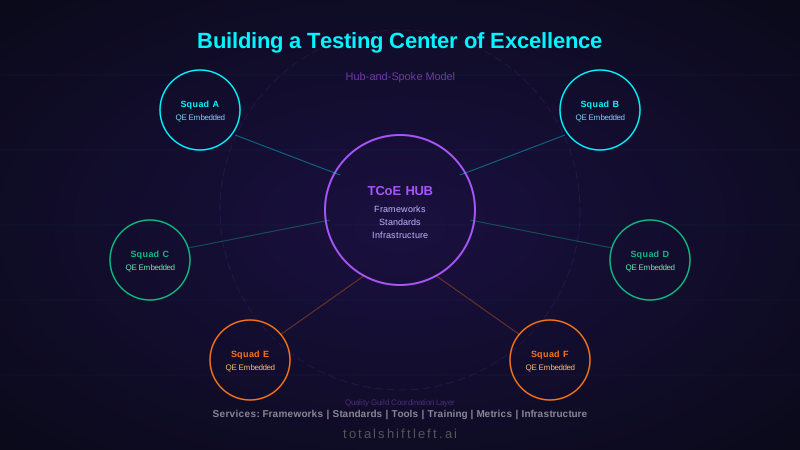
This model avoids the two failure modes of TCoE design: pure centralization (bottleneck) and pure distribution (inconsistency). The hub provides consistency and shared investment. The spokes provide domain expertise and team integration. The Guild provides communication and coordination.
AI-Driven Testing Center of Excellence
AI-generated test suites change what the hub is actually for. In a pre-AI TCoE, the hub's highest-leverage work is building and maintaining shared test frameworks — the thing that scales quality across teams. Once AI generation is doing that authoring work directly from specs, the hub's charter shifts to three things instead:
Own the spec-quality standard. Coverage now scales with how well-defined the OpenAPI spec is, not with how many test engineers you employ. The hub's job becomes defining and enforcing spec-quality gates (required response schemas, parameter constraints, examples) as a PR check across every team — the single highest-leverage intervention in an AI-driven TCoE.
Own the breaking-change and governance policy. Self-healing engines need an explicit policy for what heals silently versus what requires human review. That policy is exactly the kind of cross-team standard a TCoE hub should own centrally rather than letting each spoke team improvise its own threshold.
Redirect spoke capacity toward exploratory and risk-based testing. As AI generation absorbs the mechanical authoring work, embedded quality engineers move from writing test scripts to the judgment-heavy work AI doesn't do well: exploratory testing, risk assessment, and domain-specific business-logic assertions on high-stakes flows.
The hub-and-spoke structure itself doesn't change — the hub still sets standards, the spokes still apply domain expertise, the Guild still coordinates. What changes is which artifacts the hub owns: fewer shared test frameworks, more spec-quality gates and generation policy.
Tools for a Testing Center of Excellence
| Tool | Type | Best For | Open Source |
|---|---|---|---|
| Total Shift Left | API Testing | Organization-wide codeless API test automation platform | No |
| Playwright | E2E Framework | Shared cross-browser end-to-end automation framework | Yes |
| Jenkins | CI/CD | Pipeline templates with standardized quality gates | Yes |
| GitHub Actions | CI/CD | Cloud-native shared pipeline configurations | No |
| SonarQube | Code Quality | Organization-wide code quality standards enforcement | Yes |
| Grafana | Dashboards | Quality metrics dashboards at all organizational levels | Yes |
| Allure | Reporting | Standardized test reporting across all teams | Yes |
| TestRail | Management | Organization-wide test strategy and coverage tracking | No |
| k6 | Performance | Shared performance testing framework and benchmarks | Yes |
| Snyk | Security | Centralized dependency vulnerability management | No |
| Backstage | Developer Portal | TCoE service catalog and documentation portal | Yes |
| Confluence | Documentation | Testing standards, guides, and knowledge base | No |
Real-World Example: Building a TCoE from Scratch
Problem: An enterprise insurance company (600 engineers, 40 squads) had no centralized quality function. Each squad maintained its own testing tools, frameworks, and standards. Testing quality varied dramatically: some squads had 90% automation; others relied entirely on manual testing. The company experienced an average of 15 production incidents per month, with 4 causing customer-facing outages. Total testing tool spend was $2.8M annually across 12 different tool vendors with significant license overlap. New teams took 3-4 months to establish basic testing capabilities.
Solution: They established a TCoE over 12 months. Phase 1 (months 1-3): hired a TCoE Director and 2 Quality Architects. Conducted organization-wide testing maturity assessment. Defined initial quality standards (coverage thresholds, quality gate requirements). Selected and standardized on 5 core testing tools (replacing 12). Phase 2 (months 4-6): built shared automation frameworks for API testing (Total Shift Left) and UI testing (Playwright). Created CI/CD pipeline templates with standardized quality gates. Launched training program for all quality engineers. Phase 3 (months 7-9): deployed quality metrics infrastructure (Grafana dashboards, automated DORA tracking). Established Quality Guild with biweekly meetings. Embedded TCoE architects with lowest-maturity teams for intensive coaching. Phase 4 (months 10-12): launched self-service test environment provisioning. Created testing tool catalog on Backstage portal. Published comprehensive testing standards documentation. Conducted second maturity assessment to measure progress.
Results: After 12 months: production incidents dropped from 15/month to 4/month (73% reduction). Customer-facing outages dropped from 4/month to less than 1/month. Organization-wide test automation coverage increased from an average of 45% to 78%. Tool spend decreased from $2.8M to $1.6M (43% reduction through consolidation). New team onboarding for testing dropped from 3-4 months to 2-3 weeks. Average maturity score increased from 2.3 to 3.4 across all dimensions. Estimated annual savings: $3.2M in incident costs + $1.2M in tool consolidation = $4.4M against $1.4M TCoE investment (3.1x ROI).
Build the TCoE in-house or engage a setup partner
Most organisations reach this question about two months in, once the charter is written and it becomes clear that standing up a TCoE requires a skill set the existing QA team does not have: framework architecture, tooling consolidation across a dozen incumbent vendors, and the political work of getting forty squads to adopt a shared standard. There are three viable models.
Build in-house. You hire or reassign a small core team and grow the capability internally. It is the slowest route — typically nine to eighteen months to reach a functioning hub — and it depends entirely on already having, or being able to hire, a test architect who has done this before. Its advantage is permanence: the knowledge stays, and the standards are shaped by people who understand the organisation's constraints from the inside.
Engage a TCoE setup partner. Specialist QA consultancies run this as a defined engagement, usually three to six months, delivering the framework, the tooling decisions, the governance model, and the initial automation suites, then transitioning operation to your team. It is faster and front-loads experience you would otherwise buy through mistakes. The risk is the one every outsourced capability carries: if the transition is not planned from day one, you end up renting a TCoE rather than owning one.
Hybrid — partner-assisted, internally owned. A named internal owner holds the charter and the decisions from the start; the partner supplies architecture, framework build, and coaching capacity alongside them. In practice this is what works most often for enterprises that already have QA engineers but lack a test architect, because it buys speed without buying dependency.
What a TCoE setup engagement should cover
Scopes vary widely between providers, so it is worth being explicit about the deliverables. A complete engagement covers:
- Assessment — current-state maturity across teams, tool inventory and license overlap, automation coverage, and the actual cost of the status quo
- Charter and operating model — hub-and-spoke boundaries, what the hub owns versus what squads own, and the intake process for support
- Framework and standards — the shared automation framework, coding standards, test data strategy, and environment strategy
- Tooling consolidation — a rationalised tool stack with a migration plan off the duplicates, which is usually where the engagement pays for itself
- Pipeline integration — quality gates wired into CI/CD, not a separate testing phase
- Metrics and reporting — the dashboard leadership will actually look at, and the baseline to measure against
- Enablement and transition — coaching, documentation, and a dated handover plan with named internal owners
If a proposal omits the last item, treat that as the finding rather than a detail to negotiate later.
How to evaluate a TCoE services provider
Five questions separate providers who will leave you with a capability from those who will leave you with a dependency:
- Who owns the standards at the end? The answer should be your named internal owner, with a date. Anything vaguer is a retainer in disguise.
- Is the framework portable? If it is built on a proprietary layer only the partner's engineers can maintain, the exit cost is unbounded. Insist on standard, widely-used tooling and your own repositories.
- What is the transition plan? Ask for it as a dated artefact in the proposal, not a phase to be defined later.
- How do they handle tooling consolidation? A partner with a reseller relationship to a testing vendor has an interest in the outcome. Ask directly.
- What does the metrics baseline look like on day one? A partner who does not measure the starting state cannot demonstrate improvement, and neither can you when leadership asks.
Where offshore capacity fits
Cost is the usual reason to look offshore, but the more durable argument for a TCoE specifically is coverage: a distributed team can run regression cycles and triage failures outside the primary timezone's working hours, which shortens feedback for the squads rather than just lowering rate cards. That only holds if the standards, framework, and quality gates are already defined — offshoring an undefined process reliably produces an expensive undefined process. Sequence the charter and framework first, then scale execution capacity against them.
Total Shift Left works with enterprise teams on exactly this pattern: an AI-driven TCoE where the hub defines standards and spec-driven test generation supplies the automation layer, with offshore QA engineering capacity operating against those standards rather than inventing its own. The platform side handles the generated API test coverage; the engagement side supplies the architecture and the people. Teams weighing this against a purely internal build should read the enterprise testing strategy guide for how the TCoE fits a broader quality operating model, and contact us to discuss a specific assessment.
Free YAML templates + guide
CI/CD Testing Pipeline Templates
Production-ready CI/CD pipeline templates for GitHub Actions and GitLab CI. Includes API testing, contract testing, and performance testing stages.
Download FreeCommon Challenges in Building a TCoE
Becoming a Bottleneck Instead of an Enabler
Challenge: The TCoE starts receiving requests to "test this for us," reverting to a centralized QA model. Product teams stop testing because they expect the TCoE to do it.
Solution: Define the TCoE charter explicitly: the TCoE enables testing, it does not execute testing. Refuse requests to test specific features—redirect teams to frameworks and standards instead. Measure TCoE success by team-level quality metrics, not by tests executed by the TCoE. If teams cannot test independently using TCoE-provided tools, the TCoE has a framework or training gap to address.
Framework Adoption Resistance
Challenge: Product teams resist adopting shared frameworks because they prefer their existing tools, distrust centrally-mandated solutions, or find the frameworks too rigid for their needs.
Solution: Design frameworks for extensibility—teams should be able to customize without forking. Pilot with a willing team first and demonstrate clear value before mandating adoption. Involve team representatives in framework design decisions. Provide migration support and dedicated onboarding time. Make the framework genuinely easier to use than building from scratch.
Justifying TCoE Investment to Leadership
Challenge: A TCoE requires dedicated headcount and budget without directly producing features. Leadership may view it as overhead that slows delivery.
Solution: Build the business case with hard numbers. Calculate current quality costs: incident response time, testing tool duplication, onboarding delays, manual testing labor, and production incident revenue impact. Project TCoE savings against these costs. Use DevOps testing strategy ROI frameworks. Most TCoE implementations achieve 2-4x ROI within the first year through tool consolidation and incident reduction alone.
Maintaining Relevance as Teams Mature
Challenge: As teams reach higher maturity levels, they need less TCoE support. The TCoE risks becoming irrelevant if it does not evolve.
Solution: Evolve TCoE services with team maturity. Early-stage teams need frameworks and training. Mature teams need advanced capabilities: AI-assisted testing, chaos engineering, production traffic testing, and cross-team integration testing. The TCoE should always be 1-2 maturity levels ahead of the most advanced product teams, providing capabilities they need next.
Balancing Standards with Team Autonomy
Challenge: Overly prescriptive standards frustrate teams and stifle innovation. Overly flexible standards provide no value.
Solution: Define mandatory minimums (must-haves) and recommended practices (should-haves). Mandatory minimums are enforced through pipeline automation: coverage thresholds, security scanning, basic quality gates. Recommended practices are shared through documentation and coaching but not enforced. Teams can exceed minimums in any way they choose. Review the boundary between mandatory and recommended annually.
Retaining TCoE Talent
Challenge: TCoE roles require senior quality architects who are in high demand. Competitive compensation and interesting work are essential for retention.
Solution: Position TCoE roles as senior technical positions with competitive compensation. Ensure TCoE engineers work on challenging, impactful problems. Provide conference speaking opportunities, open-source contribution time, and innovation sprints. Create career paths within the TCoE that include principal architect and director roles.
Best Practices for Testing Centers of Excellence
- Define the TCoE charter explicitly as an enablement function, not a testing execution function
- Use the hub-and-spoke model: centralized frameworks and standards, distributed quality engineers
- Start with a maturity assessment to identify the highest-impact TCoE services
- Build shared automation frameworks that are extensible and easy to adopt
- Consolidate testing tools to reduce costs and improve consistency
- Invest heavily in training and coaching—tools without skills are worthless
- Create a Quality Guild that connects all quality engineers across the organization
- Track TCoE ROI through cost savings (tool consolidation, incident reduction) and quality outcomes
- Design for self-service—teams should consume TCoE services independently
- Evolve services as teams mature—the TCoE should always provide next-level capabilities
- Maintain a testing standards document that is reviewed and updated quarterly
- Implement shift-left testing as a core TCoE standard across all teams
Testing Center of Excellence Implementation Checklist
- ✔ TCoE charter defines scope as enablement (not test execution) with clear service catalog
- ✔ Hub-and-spoke organizational model with central team and embedded quality engineers
- ✔ Organization-wide testing maturity assessment completed to baseline current state
- ✔ Quality standards defined collaboratively and enforced through CI/CD pipeline templates
- ✔ Shared automation framework built, documented, and adopted by pilot team
- ✔ Testing tool catalog consolidated with standardized tools replacing duplicate vendors
- ✔ Training program launched covering testing fundamentals, automation, and advanced practices
- ✔ Quality Guild established with regular cross-team meetings and knowledge sharing
- ✔ Quality metrics infrastructure deployed with dashboards at team, management, and executive levels
- ✔ Self-service test environment provisioning available to all teams
- ✔ TCoE ROI tracked and reported to leadership quarterly
- ✔ TCoE service catalog published and accessible to all engineering teams
- ✔ Framework adoption measured across teams with support provided to lagging teams
- ✔ TCoE services evolution roadmap defined based on team maturity progression needs
Take the next step. See how shift-left API testing platform applies these ideas to your workflow, or explore API testing in CI/CD for the broader picture.
See also: contract testing in our learn hub for the underlying concept.
Publish the standard as a golden-path template
A TCoE that ships documents produces documents. A TCoE that ships a template every team can adopt in an afternoon produces adoption — this is the artifact, a reusable workflow the product teams call in one line:
# .github/workflows/api-quality.yml in the TCoE's own repository
name: API quality (golden path)
on:
  workflow_call:
    inputs:
      spec:          { type: string, default: openapi.yaml }
      coverage-floor:{ type: number, default: 80 }
    secrets:
      staging-url:   { required: true }
jobs:
  quality:
    runs-on: ubuntu-latest
    steps:
      - uses: actions/checkout@v4
      - run: npx @stoplight/spectral-cli lint ${{ inputs.spec }} --fail-severity error
      - run: schemathesis run ${{ inputs.spec }} --url ${{ secrets.staging-url }} --checks all
      - run: ./coverage.sh --floor ${{ inputs.coverage-floor }}
Every product team then opts in with four lines, and the TCoE can raise the bar centrally without opening 60 pull requests:
# .github/workflows/ci.yml in each product repository
jobs:
  api-quality:
    uses: acme/platform-workflows/.github/workflows/api-quality.yml@v2
    secrets: { staging-url: ${{ secrets.STAGING_URL }} }
Testing center of excellence FAQ
What is a Testing Center of Excellence?
A Testing Center of Excellence (TCoE) is a centralized organizational unit that establishes quality standards, builds shared testing infrastructure, develops automation frameworks, provides testing expertise, and drives continuous quality improvement across all engineering teams. It operates as a service center that enables squads to test effectively rather than a centralized testing bottleneck.
How do you structure a Testing Center of Excellence?
Structure a TCoE with a hub-and-spoke model: a central team (4-8 people) owns shared frameworks, standards, and infrastructure, while quality engineers embedded in squads apply these standards locally. The central team provides services (framework development, tool management, training), and embedded engineers provide domain-specific quality practices.
What services does a Testing Center of Excellence provide?
A TCoE provides six core services: test automation framework development and maintenance, quality standards and governance, testing tools evaluation and management, training and coaching programs, quality metrics and reporting, and testing infrastructure management. These services are delivered as self-service capabilities that teams consume independently.
How much does a Testing Center of Excellence cost?
A typical TCoE for a 200-500 person engineering organization costs $800K-1.5M annually for the central team (4-8 people plus tooling). This investment typically delivers 3-5x ROI through reduced manual testing costs, fewer production incidents, faster release cycles, and improved developer productivity. Embedded quality engineers are funded by their respective squads.
When should an organization build a Testing Center of Excellence?
Build a TCoE when: the organization has 100+ engineers across 8+ teams, testing practices are inconsistent across teams, duplicate testing infrastructure is being built independently, quality metrics are not tracked organization-wide, or testing maturity assessments show Level 2-3 with stalled progress. Organizations below 100 engineers can achieve similar outcomes with a Quality Guild.
Should we build a TCoE in-house or use a TCoE setup service?
There are three models. Building in-house is the slowest route — typically nine to eighteen months — and depends on already having a test architect who has done it before, but the knowledge stays permanently. Engaging a specialist TCoE setup partner compresses it to three to six months and front-loads experience you would otherwise buy through mistakes, at the risk of renting a capability rather than owning one if the transition is not planned from day one. The hybrid model — a named internal owner holding the charter and the decisions from the start, with partner-supplied architecture and coaching capacity alongside them — is what works most often for enterprises that already have QA engineers but lack a test architect.
How do you evaluate a TCoE services provider?
Ask five questions: who owns the standards at the end (it should be a named internal owner, with a date); is the framework portable or built on a proprietary layer only the partner's engineers can maintain; is there a dated transition plan in the proposal rather than a phase to be defined later; does the partner have a reseller relationship with any testing vendor they recommend; and what does the metrics baseline look like on day one. A proposal that omits an enablement and transition deliverable is the finding, not a detail to negotiate later.
What is the difference between a TCoE and a QA department?
A QA department executes tests. A TCoE enables testing. A QA department is a bottleneck that tests code written by others. A TCoE is a service center that builds the frameworks, standards, and training that enable all teams to test effectively. A TCoE scales quality practices; a QA department scales testing labor.
Sources and further reading
- DORA State of DevOps research — the multi-year dataset behind the four delivery metrics.
- ISTQB Glossary — the standard vocabulary for test terms.
- Google Testing Blog — Google's engineering write-ups on test sizing and flakiness.
Key takeaways
- A Testing Center of Excellence is the organizational infrastructure that scales quality across an enterprise.
- It provides the standards, frameworks, tools, training, and metrics that individual teams cannot efficiently build on their own.
- When designed as an enablement function rather than a testing execution function, the TCoE eliminates quality inconsistency, reduces testing costs, and accelerates maturity improvement across all teams.
- The keys to TCoE success are clear charter (enable, do not execute), appropriate structure (hub-and-spoke), and continuous evolution (services that grow with team maturity).
- Organizations that get these three elements right achieve significant ROI within the first year and build a sustainable quality culture that compounds in value over time.
- Start with a maturity assessment to understand where your organization stands.
Define the TCoE charter based on the highest-impact gaps. Build the core team. Deploy the first shared framework. Measure the results. The path from assessment to impact is shorter than most organizations expect—the TCoE model works because it addresses the most common quality bottlenecks with proven solutions.
Ready to provide your Testing Center of Excellence with a powerful API testing platform? Start your free trial of Total Shift Left and give your teams the codeless API test automation that scales across the enterprise.
Related: DevOps Testing: The Complete Guide | What Is Shift-Left Testing? | DevOps Testing Maturity Model | DevOps Testing Culture Explained | Quality Engineering vs Traditional QA | DevOps Testing Best Practices
Ready to shift left with your API testing?
Try our no-code API test automation platform free.