
Resilience Testing for Distributed Systems: Complete Guide (2026)
Quick answer
Resilience testing systematically validates that a distributed system's protective mechanisms — circuit breakers, retry policies, timeouts, bulkheads, and fallbacks — actually work under realistic failure conditions and that the system recovers afterward, rather than just verifying those patterns exist in code. It differs from chaos testing by being deterministic and targeted: resilience testing proves known mechanisms function correctly, while chaos testing exploratorily hunts for unknown weaknesses in production-like systems.
Reviewed by Rishi Gaurav

Resilience testing for distributed systems is the systematic practice of validating that a system maintains acceptable functionality when individual components fail. It goes beyond verifying that resilience patterns exist in the code — it proves they work under realistic failure conditions and that the system recovers correctly after failures resolve.
Resilience testing validates that the protective mechanisms in a distributed system — circuit breakers, retry policies, timeouts, bulkheads, fallbacks, and rate limiters — function correctly when components fail, and that failures remain contained rather than cascading across service boundaries.
A team ships a new recommendation service behind a circuit breaker. They configure the breaker to open after 5 consecutive failures, with a 30-second recovery window. In their mental model, this protects the product page from recommendation service outages. Six months later, the recommendation service starts returning HTTP 200 responses with empty bodies due to a database migration error. The circuit breaker never opens — the responses are technically successful. The product page renders with a blank recommendation section for three days before anyone notices.
The circuit breaker was implemented. It was configured. It was never tested against the failure mode that actually occurred. This is the gap that resilience testing fills — not whether you have resilience patterns, but whether those patterns protect against the failures that actually happen.
Distributed systems fail in ways that monoliths never do. Network partitions, partial failures, cascading timeouts, split-brain scenarios, and resource contention create failure modes that are invisible to functional testing. Resilience testing systematically validates that your system handles these modes correctly. It is a core practice alongside chaos testing and fault injection testing — but with a specific focus on proving that the protective mechanisms you have built actually work.
In this guide
- What Is Resilience Testing?
- Why Resilience Testing Is Essential for Distributed Systems
- Key Components of Resilience Testing
- Resilience Testing Architecture
- Resilience Testing Tools Comparison
- Real-World Example: E-Commerce Resilience Validation
- Resilience testing challenges and how to solve them
- Resilience testing best practices
- Resilience Testing Checklist
- Resilience testing FAQ
What Is Resilience Testing?
Resilience testing validates that a system maintains acceptable behavior during and after component failures. It focuses on three properties:
Fault tolerance: The system continues to function (possibly in a degraded mode) when one or more components fail. A product page that loads without recommendations is fault-tolerant. A product page that returns a 500 error because the recommendation service is down is not.
Failure containment: A failure in one component does not propagate to other components. If the recommendation service goes down, only recommendations are affected — not the product catalog, not the shopping cart, not the checkout flow. Containment is achieved through patterns like circuit breakers, bulkheads, and timeouts.
Recovery: After the failed component is restored, the system returns to normal operation within a defined time window. Connection pools refill, circuit breakers close, caches warm, and queues drain. A system that survives a failure but never fully recovers is not resilient.
Resilience testing differs from other testing practices in its focus:
- Functional testing asks: "Does the system produce the correct output for a given input?"
- Performance testing asks: "Does the system meet latency and throughput requirements under load?"
- Resilience testing asks: "Does the system maintain acceptable behavior when components fail?"
These are complementary practices. A system can pass all functional and performance tests while failing resilience tests — because those tests never introduce failures.
Why Resilience Testing Is Essential for Distributed Systems
Distributed Systems Have Exponential Failure Modes
A monolith with 10 components has 10 possible component failures. A microservices architecture with 10 services communicating over the network has far more: each service can fail independently, each network link can degrade independently, and combinations of partial failures create emergent behaviors that no single service owner anticipates. Resilience testing systematically covers these failure combinations.
Resilience Patterns Have Configuration Complexity
A circuit breaker has at least five configuration parameters: failure threshold, success threshold, timeout duration, half-open request limit, and which response codes count as failures. A retry policy has backoff base, backoff multiplier, max retries, jitter range, and retry conditions. A timeout has the duration value and the cancellation behavior. Across a system with 20 services, each with 3-5 downstream dependencies, the configuration surface is enormous. Every parameter combination represents a potential misconfiguration that resilience testing can catch.
Integration Points Are the Primary Failure Surface
In a microservices architecture, the most fragile points are not within services but between them. Network calls fail, time out, return unexpected data, or succeed intermittently. Each integration point needs validated resilience: correct timeout, appropriate retry policy, circuit breaker with proper thresholds, and a fallback that provides meaningful degraded service. Exercising these paths with multi-step integration test workflows lets you drive a request across the full service chain and assert how each hop behaves when a downstream dependency degrades.
SLA Compliance Requires Evidence
Enterprise customers, regulatory bodies, and internal SLAs require demonstrable evidence that systems can tolerate failures. Resilience testing produces this evidence: documented experiments showing that the system maintained 99.9% availability during a simulated database outage, or that checkout latency stayed below 2 seconds while the payment gateway was degraded.
Key Components of Resilience Testing
Circuit Breaker Testing
Circuit breakers are the most critical resilience pattern in microservices. Testing must validate the complete lifecycle:
Closed state: The breaker allows all requests through. Verify it accurately counts failures against the configured threshold.
Open state: After reaching the failure threshold, the breaker rejects requests immediately without calling the downstream service. Verify the rejection is fast (no network call) and returns the correct fallback response.
Half-open state: After the recovery timeout, the breaker allows a limited number of test requests through. Verify it transitions back to closed on success or re-opens on failure.
Configuration validation: Test that the failure threshold, recovery timeout, and failure-counting criteria match the service's SLA requirements. A breaker that opens after 50 failures when the SLA requires it to open after 5 is badly misconfigured.
# Example: Circuit breaker validation test
def test_circuit_breaker_opens_after_threshold():
    breaker = CircuitBreaker(failure_threshold=5, recovery_timeout=30)

    # Simulate 5 consecutive failures
    for i in range(5):
        with pytest.raises(ServiceUnavailableError):
            breaker.call(lambda: raise_http_error(503))

    # Verify breaker is open - should reject without calling service
    assert breaker.state == "OPEN"
    with pytest.raises(CircuitOpenError):
        breaker.call(lambda: success_response())

def test_circuit_breaker_recovers_after_timeout():
    breaker = CircuitBreaker(failure_threshold=5, recovery_timeout=30)
    trip_breaker(breaker)

    # Advance time past recovery timeout
    time.sleep(31)

    # Verify half-open allows test request
    assert breaker.state == "HALF_OPEN"
    result = breaker.call(lambda: success_response())
    assert breaker.state == "CLOSED"
Ready to shift left with your API testing?
Try our no-code API test automation platform free. Generate tests from OpenAPI, run in CI/CD, and scale quality.
Retry Policy Testing
Retries are essential but dangerous. Testing must validate:
- Backoff timing: Verify exponential backoff with jitter produces the expected delay distribution
- Max retry limit: Confirm the policy stops retrying after the configured maximum
- Idempotency: Verify retried requests include idempotency keys to prevent duplicate processing
- Retry conditions: Confirm the policy only retries on transient errors (5xx, timeouts) and not on client errors (4xx)
- Interaction with circuit breakers: Verify that retries count toward the circuit breaker failure threshold
Timeout Testing
Timeouts prevent slow dependencies from tying up resources indefinitely. Testing validates:
- Cascading timeouts: In a chain A → B → C, verify that A's timeout is less than or equal to B's timeout plus processing time. If B waits 30 seconds for C but A times out after 5 seconds, A's timeout is correctly protecting its resources.
- Cancellation behavior: Verify that when a timeout fires, the underlying connection is released and resources are freed — not just the response is abandoned.
- Timeout values vs. SLA: Verify that timeout values align with service-level objectives. A 60-second timeout on a service that must respond in 2 seconds is not protecting anything.
Bulkhead Testing
Bulkheads isolate resources so that a failure in one area does not exhaust resources used by another. Testing validates:
- Thread pool isolation: Calls to dependency A use a separate thread pool from calls to dependency B. When A exhausts its pool, B continues working.
- Connection pool isolation: Each downstream dependency has its own connection pool with appropriate limits.
- Semaphore isolation: Concurrent calls to each dependency are limited to prevent a slow dependency from consuming all available threads.
Fallback Testing
Fallbacks provide degraded but functional responses when the primary path fails. Testing validates:
- Fallback correctness: The degraded response is actually useful (cached data, default values, reduced functionality) rather than an error wrapped in a success response
- Fallback freshness: Cached fallback data is not stale beyond acceptable limits
- Fallback performance: The fallback path is fast — it should not introduce its own latency
Resilience Testing Architecture
Resilience testing operates at three levels, each catching different c
ategories of issues:
Unit-level resilience tests validate individual resilience patterns in isolation. Test circuit breaker state transitions, retry timing, and timeout behavior using mocked dependencies. These run in milliseconds and belong in every CI pipeline.
Integration-level resilience tests validate resilience patterns against realistic failure scenarios. Use Toxiproxy to inject network failures between real service instances running in containers (via Testcontainers). These run in seconds to minutes and should run on every pull request for critical services.
System-level resilience tests validate end-to-end resilience across the full service mesh. Use Gremlin or Litmus to inject failures in staging or production environments and verify system-wide behavior. These run as scheduled experiments.
┌─────────────────────────────────────────────────────────┐
│              Resilience Testing Pyramid                   │
│                                                          │
│                    ┌──────────┐                          │
│                    │  System  │  Scheduled               │
│                    │  Level   │  (Gremlin/Litmus)        │
│                    └────┬─────┘                          │
│                   ┌─────┴──────┐                         │
│                   │Integration │  Per PR / Per Deploy    │
│                   │   Level    │  (Toxiproxy/WireMock)   │
│                   └─────┬──────┘                         │
│              ┌──────────┴───────────┐                    │
│              │     Unit Level       │  Every Build       │
│              │  (Mocks/In-process)  │  (ms execution)    │
│              └──────────────────────┘                    │
│                                                          │
│  Speed:    Fast ◄─────────────────────────► Slow         │
│  Scope:    Narrow ◄───────────────────────► Broad        │
│  Realism:  Low ◄──────────────────────────► High         │
└─────────────────────────────────────────────────────────┘
Resilience Testing Tools Comparison
| Tool | Resilience Focus | Test Level | CI/CD Speed | K8s Support | Best For |
|---|---|---|---|---|---|
| Resilience4j | Circuit breakers, retries, bulkheads | Unit / Integration | Fast | N/A (library) | JVM service resilience patterns |
| Polly | Circuit breakers, retries, fallbacks | Unit / Integration | Fast | N/A (library) | .NET service resilience patterns |
| Toxiproxy | Network fault injection | Integration | Fast | Yes (proxy) | CI pipeline network failure simulation |
| WireMock | API response simulation | Integration | Fast | Yes | Upstream failure simulation |
| Gremlin | Full-spectrum fault injection | System | Slow (real infra) | Yes | Enterprise resilience validation |
| Litmus | K8s workload disruption | System | Medium | Yes (CRDs) | Kubernetes resilience experiments |
| Testcontainers | Disposable test infrastructure | Integration | Medium | No (Docker) | Realistic integration testing |
| Shift-Left API | API contract + resilience | Integration | Fast | Yes (CI) | OpenAPI-driven resilience validation |
The most effective approach combines library-level tools (Resilience4j/Polly) for unit tests with Toxiproxy for integration tests and Gremlin/Litmus for system-level experiments. See our testing tools guide for a broader comparison.
Real-World Example: E-Commerce Resilience Validation
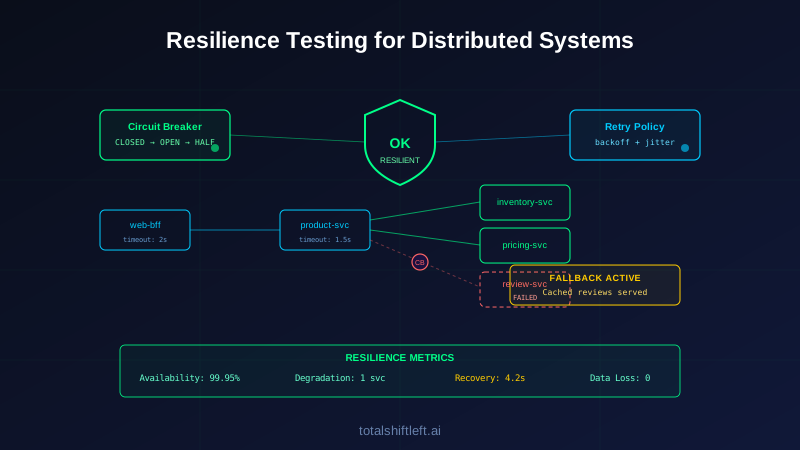
A retail platform runs a seasonal load test combined with resilience testing before Black Friday. The architecture includes: web-bff → product-service → inventory-service + pricing-service + review-service. The team needs to validate that the product page remains functional when individual backend services fail.
Scenario 1: Review service failure under load
With 5,000 concurrent users browsing products, the team kills the review-service. Expected behavior: product pages load without the review section, within the normal latency budget.
Results:
- The circuit breaker on
product-service→review-serviceopened correctly after 3 failures (200ms). - Product pages loaded in 180ms (within the 300ms SLA) without review data.
- The fallback returned a cached review summary from the last successful call.
- Issue found: The cached review data had no TTL — after 24 hours of
review-serviceoutage, product pages would show stale review counts. Fix: 1-hour TTL with "reviews unavailable" fallback after expiry.
Scenario 2: Pricing service latency spike
The team injects 3-second latency into pricing-service responses using Toxiproxy while maintaining 5,000 concurrent users.
Results:
- The
product-servicetimeout for pricing calls was set to 5 seconds — meaning product pages took 3+ seconds to load (SLA violation). - The circuit breaker never opened because the calls were succeeding (just slowly).
- The bulkhead for pricing calls allowed 50 concurrent requests — under load, this was insufficient, causing pricing request queuing.
- Fixes: Reduced pricing timeout to 1 second, added latency-based circuit breaker threshold, increased pricing bulkhead to 200 concurrent requests.
Scenario 3: Inventory service returns malformed data
The team configures WireMock to return inventory responses with a changed field name (quantity renamed to qty) for 30% of requests, simulating a partial deployment of a breaking change.
Results:
- The
product-servicethrew a deserialization exception and returned a 500 toweb-bff. - The circuit breaker opened after the threshold, but 30% intermittent failures meant it repeatedly cycled between open and closed.
- Fix: Added defensive deserialization with fallback to "check availability" message, and added contract tests between inventory and product services.
Free 1-page checklist
API Testing Checklist for CI/CD Pipelines
A printable 25-point checklist covering authentication, error scenarios, contract validation, performance thresholds, and more.
Download FreeResilience testing challenges and how to solve them
Challenge: Defining "Acceptable" Degradation
Teams struggle to specify what behavior is acceptable during a failure. Is showing stale data acceptable? For how long? Is removing a feature from the page acceptable? Which features?
Solution: Define degradation policies per service dependency before implementing resilience patterns. For each dependency, document: (1) what the page/flow looks like when the dependency is unavailable, (2) how long stale/cached data is acceptable, (3) which SLIs must be maintained during degradation. These policies become the acceptance criteria for resilience tests.
Challenge: Testing Resilience Pattern Interactions
Individual patterns may work correctly in isolation but interact badly. A retry policy that retries 3 times, combined with a circuit breaker threshold of 10, means the breaker needs 4 failed requests (each retried 3 times = 12 attempts) to open — not 10.
Solution: Test resilience patterns in combination, not just individually. Create integration tests that simulate a sustained failure and verify the end-to-end behavior: how many total requests fail before the breaker opens, how long recovery takes, and what the consumer experiences during each phase.
Challenge: Resilience Configuration Drift
Resilience configuration (timeout values, breaker thresholds, retry limits) is set once and rarely reviewed. As traffic patterns, dependencies, and SLAs change, the configuration drifts out of alignment.
Solution: Codify resilience configuration in version-controlled files alongside service code. Include resilience configuration validation in CI — verify that timeout values are less than SLA targets, retry counts are reasonable for the expected failure duration, and breaker thresholds align with traffic volume. Review resilience configuration quarterly alongside service dependency maps.
Challenge: Quantifying Resilience Test Coverage
Unlike functional testing where code coverage provides a metric, there is no standard metric for resilience test coverage. Teams struggle to know whether they have tested enough failure scenarios.
Solution: Use a resilience coverage matrix. For each service, list its dependencies on one axis and failure modes (unavailable, slow, error, malformed) on the other. Mark each cell as tested or untested. Target 100% coverage of the "unavailable" and "slow" failure modes for all dependencies, then expand to error and malformed responses.
Resilience testing best practices
- Test resilience patterns at every level — Unit tests for pattern logic, integration tests for pattern configuration, system tests for pattern interactions; each level catches different bugs
- Define degradation policies before implementing resilience — Know what "acceptable degraded behavior" looks like for every dependency before writing circuit breakers and fallbacks
- Validate timeout cascades across service chains — Map the full call chain and verify that timeout values decrease at each hop; a downstream timeout longer than an upstream timeout is always a bug
- Test circuit breaker state transitions explicitly — Do not just verify the breaker opens; test closed → open, open → half-open, half-open → closed, and half-open → open transitions
- Combine resilience tests with load tests — Resilience patterns that work at low traffic may fail under production load; inject faults during load tests for realistic validation
- Monitor resilience pattern behavior in production — Emit metrics for circuit breaker state changes, retry counts, fallback invocations, and timeout frequencies; alert on anomalies
- Use feature flags for graceful degradation — Implement the ability to manually disable non-critical features when dependencies fail, and test these flags regularly
- Test recovery as rigorously as failure — Verify that circuit breakers close, connection pools refill, caches warm, and performance returns to baseline after failures resolve
- Automate resilience regression tests — When a resilience bug is found in production, add a regression test that injects the exact failure condition; this prevents the same class of failure from recurring
- Review resilience configuration quarterly — Traffic patterns, dependency SLAs, and system topology change; resilience configuration must evolve with them
Resilience Testing Checklist
- ✔ Circuit breaker tested for open, half-open, and closed state transitions
- ✔ Circuit breaker failure threshold validated against service SLA requirements
- ✔ Retry policy tested with correct exponential backoff and jitter
- ✔ Retry idempotency keys verified for all retried operations
- ✔ Timeout values validated against downstream SLAs for every dependency
- ✔ Timeout cascade verified across multi-hop service chains
- ✔ Bulkhead isolation confirmed — failure in one dependency does not affect others
- ✔ Fallback responses validated for correctness and acceptable freshness
- ✔ Recovery validated — system returns to steady state after fault removal
- ✔ Resilience patterns tested under production-level load
- ✔ Resilience configuration stored in version control alongside service code
- ✔ Degradation policies documented for every external dependency
- ✔ Resilience coverage matrix maintained with tested vs. untested failure modes
- ✔ Chaos testing experiments scheduled for system-level validation
- ✔ API resilience validated with Shift-Left API against OpenAPI specifications
Resilience testing FAQ
What is resilience testing for distributed systems?
Resilience testing is the systematic validation that a distributed system maintains acceptable functionality and performance when individual components fail. It verifies that resilience patterns — circuit breakers, retries, timeouts, bulkheads, and fallbacks — work correctly under realistic failure conditions, and that the system recovers to normal operation after failures resolve. Unlike functional testing, which verifies correct behavior under normal conditions, resilience testing verifies acceptable behavior under adverse conditions.
What resilience patterns should be tested in microservices?
The essential patterns to test are circuit breakers (verify they open at the correct threshold, reject requests while open, and close after recovery), retry policies (validate exponential backoff with jitter, max retry limits, and idempotency key inclusion), timeouts (ensure they cascade correctly across service chains and align with SLA targets), bulkheads (confirm resource isolation prevents cascade failures across dependencies), fallbacks (verify degraded responses are correct, useful, and within acceptable freshness), and rate limiters (validate they protect services under unexpected load spikes).
How do you measure resilience in a distributed system?
Resilience is measured through four dimensions: availability (percentage of requests that succeed during a component failure), degradation scope (how many services or features are affected by a single component failure), recovery time (how long until the system returns to steady-state performance after the failure resolves), and data integrity (whether any data was lost, duplicated, or corrupted during the failure period). These metrics should be collected during every resilience test and compared against defined SLA targets.
What is the difference between resilience testing and chaos testing?
Resilience testing validates that specific resilience mechanisms (circuit breakers, retries, fallbacks) function correctly under controlled failure conditions. It is deterministic, targeted, and runs primarily in CI/CD and staging environments. Chaos testing is a broader discipline that injects failures into production or production-like systems to discover unknown weaknesses through exploratory, hypothesis-driven experimentation. Resilience testing verifies known patterns work; chaos testing discovers unknown failure modes. Both are essential and complementary — see our chaos testing guide for the full methodology.
When should resilience testing be integrated into CI/CD?
Resilience tests should run on every pull request for critical services. Unit-level circuit breaker, timeout, and retry tests execute in milliseconds and add negligible overhead to CI. Integration-level resilience tests using Toxiproxy and WireMock execute in seconds and should run as part of the integration test suite. System-level resilience tests involving multiple services should run after deployment to staging. Production chaos experiments should run on a scheduled cadence — weekly or bi-weekly for mature teams, monthly for teams starting their resilience practice.
Sources and further reading
- Chaos Mesh — Kubernetes-native fault injection.
- Toxiproxy — a TCP proxy for simulating latency and partitions.
- Google SRE Workbook — Implementing SLOs — how to define SLOs and error budgets.
Key takeaways
- Resilience testing is the practice that transforms resilience patterns from aspirational code into validated protection.
- Every microservices architecture has circuit breakers, retries, timeouts, and fallbacks — but without systematic testing, these mechanisms are untested code paths with unknown behavior under real failure conditions.
- The approach is systematic: start with unit-level tests for individual resilience patterns, add integration-level tests using Toxiproxy and WireMock for realistic failure simulation, and schedule system-level experiments using Gremlin or Litmus for production-like validation.
- Define degradation policies before implementing resilience, test pattern interactions under load, and maintain a resilience coverage matrix to track gaps.
Build confidence in your distributed system's resilience. Try Shift-Left API free to validate API contracts and fault handling against your OpenAPI specifications — establishing the foundation for comprehensive resilience testing.
Ready to shift left with your API testing?
Try our no-code API test automation platform free.