
Chaos Testing for Microservices: Build Resilient Systems (2026)
Quick answer
Chaos testing for microservices deliberately injects failures — killing service instances, adding network latency, corrupting responses — into a distributed system to verify it degrades gracefully rather than cascading into an outage. It follows a five-step scientific method (define steady state, hypothesize, inject, observe, learn) using tools like Chaos Monkey, Gremlin, and Litmus, with blast-radius controls and automatic abort conditions keeping experiments safe.
Reviewed by Parveen Kumari

Chaos testing for microservices is the disciplined practice of deliberately injecting failures into distributed systems to verify they degrade gracefully under adverse conditions. It transforms unknown vulnerabilities into documented, tested failure modes — turning unpredictable outages into predictable, recoverable events.
Chaos testing microservices means systematically breaking parts of your distributed system — killing service instances, injecting network latency, corrupting responses, exhausting resources — to prove that your resilience mechanisms actually work when they need to.
A team deploys their payment service on a Friday afternoon. Everything passes integration tests. Canary metrics look clean. At 2:47 AM Saturday, the Redis cache cluster loses a node. The payment service has no fallback — it retries indefinitely, saturates the connection pool, and cascades into a full checkout outage that lasts four hours. The postmortem reveals a missing circuit breaker that no one tested because no one ever killed the cache during testing.
This is the problem chaos testing solves. Not whether your system works when everything is healthy — your CI pipeline already validates that. The question is whether your system survives when things go wrong. In microservices architectures with dozens or hundreds of services, network boundaries, and shared infrastructure, the failure surface is enormous. Traditional testing covers the happy path. Chaos testing covers the path that wakes your on-call engineer at 3 AM.
Netflix pioneered this discipline in 2011 with Chaos Monkey, and it has since become a standard practice at organizations operating distributed systems at scale. This guide covers how to implement chaos testing for microservices in 2026 — from first principles to production-grade experiments. For broader context on testing distributed architectures, see our microservices testing complete guide.
In this guide
- What Is Chaos Testing for Microservices?
- Why Chaos Testing Matters for Distributed Systems
- Key Components of Chaos Testing
- Chaos Testing Architecture
- Chaos Testing Tools Comparison
- Real-World Example: E-Commerce Platform Chaos Testing
- Chaos testing challenges and how to solve them
- Chaos testing best practices
- Chaos Testing Readiness Checklist
- Chaos testing FAQ
What Is Chaos Testing for Microservices?
Chaos testing — formally called chaos engineering — is the discipline of experimenting on a distributed system to build confidence in its ability to withstand turbulent conditions in production. The term was formalized by Netflix engineers in the Principles of Chaos Engineering manifesto.
The process follows a scientific method:
- Define steady state — Establish the normal behavior of your system using measurable metrics (request success rate, p99 latency, throughput).
- Hypothesize — Predict what will happen when a specific failure occurs. For example: "If the recommendation service dies, the product page will render without recommendations within 200ms."
- Inject failure — Introduce the fault: kill the service, add latency, partition the network.
- Observe — Compare actual behavior against steady state and the hypothesis.
- Learn — If the system deviated from the hypothesis, you found a weakness. Fix it, then re-run the experiment.
Chaos testing is not random destruction. It is controlled, hypothesis-driven experimentation. Every experiment has a defined blast radius, abort conditions, and rollback plan. The goal is learning, not breaking things for the sake of it.
In a microservices context, chaos testing targets the specific failure modes that emerge from distributed architecture: network partitions between services, cascading failures through service dependencies, message queue backlogs in event-driven architectures, and resource exhaustion under load.
Why Chaos Testing Matters for Distributed Systems
Hidden Failure Modes Are Invisible to Traditional Testing
Unit tests verify function behavior. Integration tests verify service interactions. End-to-end tests verify user flows. None of these verify what happens when the database connection pool is exhausted, DNS resolution takes 30 seconds, or a downstream service returns garbage data instead of a clean error. These failures are not bugs in your code — they are emergent properties of distributed systems.
Resilience Mechanisms Rot Without Exercise
Circuit breakers, retry policies, fallback handlers, and bulkheads are only useful if they work when needed. Teams implement these patterns, ship them, and never validate them under real failure conditions. A circuit breaker with an incorrect threshold or a retry policy with no jitter is worse than no resilience mechanism at all — it creates a false sense of safety.
Cascading Failures Are the Primary Outage Driver
In a microservices architecture, a single service failure rarely stays contained. A slow dependency ties up threads, which exhausts the connection pool, which causes timeouts in upstream services, which triggers a cascade that takes down the entire request path. Chaos testing maps these cascade paths and validates that isolation mechanisms — circuit breakers, bulkheads, timeouts — actually contain the blast radius. Understanding these cascade dynamics is central to any API testing strategy for microservices.
Confidence for Deployment Velocity
Teams that run chaos experiments regularly deploy more frequently with fewer incidents. When you have empirical evidence that your system survives the loss of any single component, you can deploy with confidence rather than anxiety. This is a direct enabler of the shift-left testing philosophy — catching resilience gaps before they reach production.
Key Components of Chaos Testing
Steady-State Definition
Before injecting any failure, you must define what "normal" looks like in measurable terms. This is your steady state:
- Request success rate: Percentage of requests returning 2xx responses (e.g., 99.95%)
- Latency percentiles: p50, p95, p99 response times (e.g., p99 < 500ms)
- Throughput: Requests per second at current load
- Error budget: Maximum acceptable deviation during an experiment
Without a quantified steady state, you have no way to determine whether a chaos experiment revealed a problem or produced expected degradation.
Fault Injection Methods
Chaos testing uses several categories of fault injection, each targeting different failure modes:
Infrastructure faults: Kill VM instances, terminate containers, exhaust CPU/memory/disk, reboot nodes. These test whether your orchestration layer (Kubernetes, ECS) recovers workloads correctly.
Ready to shift left with your API testing?
Try our no-code API test automation platform free. Generate tests from OpenAPI, run in CI/CD, and scale quality.
Network faults: Add latency, drop packets, partition networks, corrupt DNS responses. These test whether your services handle degraded connectivity without cascading.
Application faults: Return HTTP 500 errors from specific endpoints, inject malformed responses, add processing delays. These test whether consuming services handle upstream failures gracefully. This ties directly into fault injection testing practices.
State faults: Corrupt cache entries, fill message queues, introduce clock skew. These test whether your system handles data-layer anomalies.
Blast Radius Controls
Every chaos experiment must have bounded impact:
- Scope: Which services, instances, or percentage of traffic are affected
- Duration: How long the fault persists before automatic removal
- Abort conditions: Metrics thresholds that trigger immediate rollback (e.g., error rate > 5%)
- Rollback mechanism: Automated process to remove the injected fault
Observability Stack
Chaos testing without observability is reckless. You need real-time visibility into:
- Distributed traces showing request flow across services
- Metrics dashboards showing latency, error rates, and saturation
- Logs aggregated across all affected services
- Alerting to detect when experiments breach safety thresholds
Chaos Testing Architecture
A typical chaos testing architecture for microservices consists of four layers:
Experiment Orchestration Layer: The chaos platform (Gremlin, Litmus, custom tooling) that defines, schedules, and controls experiments. It communicates with agents deployed alongside your services.
Fault Injection Layer: Agents or sidecars that execute fault injection at the infrastructure, network, or application level. In Kubernetes environ
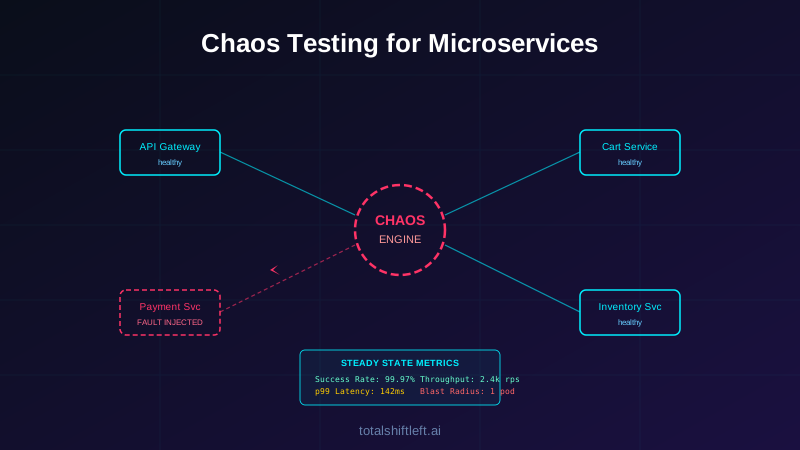
ments, this often uses sidecar containers or DaemonSets.
Observation Layer: Your monitoring stack (Prometheus/Grafana, Datadog, New Relic) collects metrics during experiments. Distributed tracing (Jaeger, Zipkin) shows how failures propagate across service boundaries.
Safety Layer: Automated abort controllers that monitor steady-state metrics and terminate experiments when safety thresholds are breached.
┌─────────────────────────────────────────────────┐
│              Experiment Control Plane             │
│  ┌──────────┐  ┌──────────┐  ┌───────────────┐  │
│  │ Scheduler│  │Hypothesis│  │ Abort Control │  │
│  └────┬─────┘  └────┬─────┘  └──────┬────────┘  │
│       └──────────────┼───────────────┘           │
└──────────────────────┼───────────────────────────┘
                       │
        ┌──────────────┼──────────────┐
        ▼              ▼              ▼
  ┌───────────┐  ┌───────────┐  ┌───────────┐
  │ Service A │  │ Service B │  │ Service C │
  │ + Agent   │  │ + Agent   │  │ + Agent   │
  │ + Sidecar │  │ + Sidecar │  │ + Sidecar │
  └───────────┘  └───────────┘  └───────────┘
        │              │              │
        └──────────────┼──────────────┘
                       ▼
              ┌─────────────────┐
              │  Observability  │
              │  (Metrics/Traces│
              │   /Logs/Alerts) │
              └─────────────────┘
Chaos Testing Tools Comparison
| Tool | Type | Target | Kubernetes Native | Production Safe | Best For |
|---|---|---|---|---|---|
| Chaos Monkey | Instance termination | VMs / Containers | No (Spinnaker) | Yes | Random instance kills |
| Gremlin | Full-spectrum SaaS | Infra / Network / App | Yes | Yes (enterprise controls) | Enterprise teams needing managed chaos |
| Litmus | CNCF project | Kubernetes workloads | Yes (CRDs) | Yes | Kubernetes-native chaos |
| Toxiproxy | Network proxy | TCP connections | No | Yes | Network fault simulation in CI |
| AWS FIS | Cloud-native | AWS resources | Via EKS | Yes | AWS-specific chaos experiments |
| Chaos Mesh | CNCF sandbox | Kubernetes workloads | Yes (CRDs) | Yes | K8s pod/network/IO chaos |
| Pumba | Container chaos | Docker containers | Partial | Yes | Docker-level fault injection |
| Shift-Left API | API-level testing | API endpoints | Yes (via CI) | Yes | API resilience validation with OpenAPI |
For teams building their API testing toolchain for microservices, the choice depends on your infrastructure platform and the fault types you need to simulate.
Real-World Example: E-Commerce Platform Chaos Testing
Consider a mid-size e-commerce platform with the following services: api-gateway, product-service, cart-service, payment-service, inventory-service, and notification-service. The team wants to validate that a payment-service outage does not prevent customers from browsing and adding items to their cart.
Steady state: Product pages load in < 300ms (p99). Cart operations succeed at 99.9%. Overall error rate < 0.1%.
Hypothesis: If payment-service becomes unavailable, product browsing and cart operations continue normally. Checkout displays a user-friendly error message. No cascade failures propagate to other services.
Experiment:
# Litmus ChaosEngine definition
apiVersion: litmuschaos.io/v1alpha1
kind: ChaosEngine
metadata:
  name: payment-service-kill
spec:
  appinfo:
    appns: ecommerce
    applabel: app=payment-service
  chaosServiceAccount: litmus-admin
  experiments:
    - name: pod-delete
      spec:
        components:
          env:
            - name: TOTAL_CHAOS_DURATION
              value: "300"
            - name: CHAOS_INTERVAL
              value: "60"
            - name: FORCE
              value: "false"
Results: The experiment revealed three issues:
- The
cart-servicecalledpayment-serviceduring price validation — an undocumented dependency. When payment was down, cart additions failed with a 500 error instead of using cached pricing. - The circuit breaker on the
api-gatewayhad a threshold set to 10 failures, but the health check interval was 30 seconds — meaning 10 requests failed before the breaker opened. - The
notification-servicequeued payment confirmation events with no TTL, causing a memory spike whenpayment-servicerecovered and flushed the queue.
Each finding became a fix: the cart-service added a price cache fallback, the circuit breaker threshold was tuned, and the notification queue got a TTL policy. Subsequent chaos runs confirmed all three fixes held.
Chaos testing challenges and how to solve them
Challenge: Organizational Resistance to Breaking Things
Teams fear chaos testing because intentionally breaking production systems feels irresponsible. Leadership worries about customer impact.
Free 1-page checklist
API Testing Checklist for CI/CD Pipelines
A printable 25-point checklist covering authentication, error scenarios, contract validation, performance thresholds, and more.
Download FreeSolution: Start in staging environments. Run experiments during low-traffic windows. Present chaos testing as insurance — the cost of a controlled experiment is far less than the cost of an uncontrolled outage. Show metrics: teams practicing chaos engineering report 60% fewer severe incidents.
Challenge: Insufficient Observability
Without comprehensive monitoring, chaos experiments produce ambiguous results. You cannot determine whether the system handled a failure gracefully if you cannot see what happened.
Solution: Invest in observability before chaos testing. You need distributed tracing, service-level metrics, and centralized logging at minimum. If you cannot answer "what is the p99 latency of service X right now?" you are not ready for chaos experiments.
Challenge: Blast Radius Escalation
An experiment intended to affect one service cascades and impacts the entire system, causing a real outage during a chaos test.
Solution: Implement automatic abort conditions. Monitor steady-state metrics in real time during experiments. Start with the smallest possible blast radius (one instance, one availability zone) and expand gradually. Every experiment should have a kill switch. This connects directly to resilience testing principles for distributed systems.
Challenge: Experiment Maintenance
As the system evolves, chaos experiments become stale. New services are added without corresponding experiments. Failure modes change as architecture evolves.
Solution: Integrate chaos experiments into your CI/CD pipeline. Treat experiment definitions as code, stored alongside service code. When a new service is added, require a baseline chaos experiment as part of the definition of done. Review and update experiments quarterly.
Chaos testing best practices
- Start with a game day — Run your first chaos experiments as a scheduled team event with everyone watching dashboards, before automating anything
- Define hypotheses before injecting faults — Never run a chaos experiment without a written prediction of what should happen; otherwise you learn nothing
- Automate steady-state validation — Use automated checks that compare experiment metrics against baseline; manual observation does not scale
- Run experiments in CI/CD — Use tools like Toxiproxy and Testcontainers to inject faults during integration tests in your pipeline
- Increase blast radius gradually — Start with a single instance in staging, then expand to multiple instances, then to production with traffic percentage limits
- Document every experiment — Record the hypothesis, fault injected, blast radius, results, and remediation for each experiment in a shared runbook
- Test your abort mechanisms — Verify that your safety controls actually stop experiments when thresholds are breached; a broken kill switch is the worst possible failure
- Combine with contract testing — Use contract tests to verify API agreements, back them with API tests generated straight from each service's OpenAPI spec, and chaos tests to verify resilience when those agreements are broken
- Make chaos testing part of the definition of done — Every new service should ship with at least one chaos experiment validating its primary failure mode
- Share findings across teams — Chaos experiment results often reveal systemic issues that affect multiple services; publish findings in internal engineering channels
Chaos Testing Readiness Checklist
- ✔ Steady-state metrics defined for all critical services (latency, error rate, throughput)
- ✔ Distributed tracing deployed across service mesh (Jaeger, Zipkin, or equivalent)
- ✔ Centralized logging aggregating all service logs
- ✔ Alerting configured for key SLIs with appropriate thresholds
- ✔ Circuit breakers implemented on all inter-service calls
- ✔ Retry policies configured with exponential backoff and jitter
- ✔ Timeout values set for every external dependency call
- ✔ Chaos testing tool selected and agents deployed (Gremlin, Litmus, or Chaos Mesh)
- ✔ Experiment abort conditions defined with automatic rollback
- ✔ Runbook template created for documenting experiment results
- ✔ First game day scheduled with team-wide participation
- ✔ Staging environment validated as representative of production topology
- ✔ Blast radius controls tested and verified
- ✔ Incident response process updated to handle chaos experiment escalation
- ✔ API resilience validated with Shift-Left API for OpenAPI-driven test coverage
Chaos testing FAQ
What is chaos testing in microservices?
Chaos testing in microservices is the practice of deliberately injecting failures — such as killing service instances, adding network latency, or corrupting responses — into a distributed system to verify that it degrades gracefully. The goal is to find weaknesses before they cause real production outages. It follows a scientific method: define steady state, form a hypothesis, inject a fault, observe the result, and learn from the outcome.
How is chaos testing different from traditional testing?
Traditional testing verifies that a system works correctly under expected conditions. Chaos testing verifies that a system survives unexpected conditions — network partitions, node failures, disk exhaustion, and dependency outages. It tests the failure path rather than the happy path. Traditional tests ask "does this function return the right value?" Chaos tests ask "what happens to the entire system when this component disappears?"
What tools are used for chaos testing microservices?
The most widely adopted tools include Netflix Chaos Monkey for random instance termination, Gremlin for controlled fault injection across infrastructure, network, and application layers, Litmus for Kubernetes-native chaos experiments using custom resources, Toxiproxy for network-level fault simulation in CI pipelines, and AWS Fault Injection Simulator for cloud-native experiments. The choice depends on your infrastructure platform, team size, and whether you need managed or self-hosted tooling.
Is chaos testing safe for production environments?
Yes, when implemented correctly. Production chaos testing uses blast radius controls to limit the scope of each experiment, automatic rollback triggers that terminate experiments when safety thresholds are breached, and gradual escalation from staging to limited production traffic to full production. Start with non-production environments, establish steady-state metrics, define abort conditions, and run experiments during low-traffic windows before expanding scope.
How do you start chaos testing microservices?
Start by mapping your system's critical paths and identifying the failures that would cause the most damage. Run your first experiment in a staging environment — kill a single non-critical service instance and observe whether the system recovers automatically. Measure the recovery time. If the system does not recover, you have found your first resilience gap. Fix it, re-run the experiment, and gradually expand scope to more critical services and more complex failure scenarios.
Sources and further reading
- Chaos Mesh — Kubernetes-native fault injection.
- LitmusChaos — chaos experiments as Kubernetes custom resources.
- AWS Fault Injection Service — managed fault injection for AWS workloads.
Key takeaways
- Chaos testing for microservices is not optional for teams operating distributed systems at scale.
- Every microservices architecture has hidden failure modes — undocumented dependencies, misconfigured circuit breakers, missing fallbacks, resource leaks under pressure.
- The only question is whether you discover them through controlled experiments or through 3 AM production outages.
- The path forward is methodical: define your steady state, start with small experiments in staging, fix what breaks, expand scope gradually, and integrate chaos experiments into your CI/CD pipeline.
- The tools are mature — Chaos Monkey, Gremlin, Litmus, and Toxiproxy cover every infrastructure platform and fault type.
- The practice is proven — organizations running regular chaos experiments report dramatically fewer severe incidents.
Start building resilience into your microservices today. Try Shift-Left API free to validate your API contracts and resilience patterns against your OpenAPI specifications — the foundation that makes chaos testing actionable.
Ready to shift left with your API testing?
Try our no-code API test automation platform free.