
Service Dependency Testing: Prevent Cascade Failures
Quick answer
Service dependency testing systematically validates how a microservice behaves when its upstream or downstream dependencies become unavailable, slow, return errors, or violate their schema — ensuring failures stay contained rather than cascading through the system. It combines dependency mapping (via distributed tracing and static analysis), blast-radius analysis, and service virtualization with tools like WireMock and Toxiproxy to test circuit breakers, timeouts, and fallbacks before a single failure takes down a third of the platform.
Reviewed by Smeet Gohel

Service dependency testing is the systematic practice of validating how microservices behave when their dependencies fail, degrade, or change. It maps the relationships between services, identifies cascade failure paths, and verifies that isolation mechanisms — circuit breakers, bulkheads, timeouts, and fallbacks — prevent a single service failure from propagating across the system.
Service dependency testing validates that each microservice handles dependency failures (unavailability, latency, errors, schema changes) correctly, and that failures remain contained within defined blast radius boundaries rather than cascading through the service graph.
A logistics platform operates 35 microservices. The route-optimization service depends on a third-party geocoding API. One Tuesday, the geocoding API starts intermittently returning HTTP 429 (rate limited) responses. The route-optimization service retries aggressively — three retries per request with no backoff. The retries triple the request volume to the geocoding API, deepening the rate limiting. The retry storm consumes all available threads in route-optimization, causing it to stop responding to health checks. Kubernetes kills the pods and restarts them. The new pods immediately resume the retry storm. Within 12 minutes, the route-optimization service is in a crash loop, and every service that depends on route data — dispatch, tracking, ETAs — is returning errors.
A single third-party dependency returning 429 errors took down a third of the platform. The root cause was not the rate limiting — it was the untested interaction between the retry policy and the dependency failure mode. Service dependency testing exists to find and fix these interactions before they cause cascading production failures.
Understanding and testing service dependencies is foundational to microservices testing and ties directly into resilience testing and chaos testing practices.
In this guide
- What Is Service Dependency Testing?
- Why Dependency Testing Prevents Outages
- Key Components of Dependency Testing
- Dependency Testing Architecture
- Dependency Testing Tools Comparison
- Real-World Example: Order Processing Dependency Failure
- Service dependency testing challenges and how to solve them
- Service dependency testing best practices
- Service Dependency Testing Checklist
- Service dependency testing FAQ
What Is Service Dependency Testing?
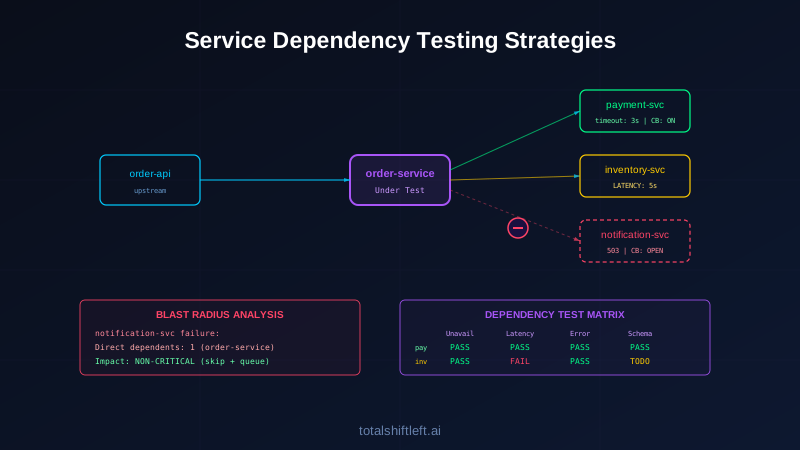
Service dependency testing validates the behavior of a microservice at the boundaries where it interacts with other services. Every outgoing HTTP call, gRPC request, message queue publish, database query, and cache lookup is a dependency — and each one is a potential failure point.
Dependency testing covers four failure categories:
Unavailability: The dependency is completely unreachable. Connection refused, DNS resolution failure, or network partition. Test: Does the service fail gracefully? Does it return a degraded response? Does the circuit breaker open?
Latency: The dependency responds, but slowly. This is often more dangerous than unavailability because the calling service ties up threads waiting for responses. Test: Does the timeout fire? Does the service shed load? Does latency propagate to upstream callers?
Error responses: The dependency returns error status codes (5xx, 429, 408). Test: Does the retry policy activate correctly? Does the circuit breaker count these as failures? Does the fallback return useful data?
Schema violations: The dependency returns a successful response with unexpected structure — missing fields, changed types, new required fields. Test: Does the deserialization handle the change gracefully? Does the service use defensive parsing? This intersects directly with contract testing.
Each service in a microservices architecture has multiple dependencies, and each dependency can fail in each of these ways. The dependency testing matrix (services x dependencies x failure modes) defines the scope of work.
Why Dependency Testing Prevents Outages
Cascade Failures Are the Leading Cause of Distributed System Outages
Studies of production incidents at large-scale organizations consistently show that cascade failures — where a single component failure propagates through the system — cause the majority of severe outages. A cascade occurs when Service A fails, causing Service B (which depends on A) to exhaust resources waiting for A, causing Service C (which depends on B) to fail, and so on. Dependency testing identifies and breaks these cascade paths.
Undocumented Dependencies Create Hidden Risk
In mature microservices architectures, the actual dependency graph rarely matches the documented one. Services accumulate dependencies over time — a "quick" call to another service added during a sprint, a shared cache, an implicit dependency through a message queue. These undocumented dependencies are the most dangerous because they have no resilience mechanisms. Dependency mapping and testing surfaces these hidden connections.
Third-Party Dependencies Are Outside Your Control
Every microservices architecture depends on external services — payment gateways, geocoding APIs, email providers, cloud infrastructure APIs. These dependencies fail in ways you cannot predict and cannot fix. The only defense is validating that your services handle their failures gracefully. Dependency testing with service virtualization lets you simulate every failure mode a third-party dependency can exhibit.
Deployment Independence Requires Dependency Isolation
The primary benefit of microservices — independent deployment — only works if services are isolated from their dependencies. If deploying Service A breaks Service B because B has an untested assumption about A's response format, you do not have independent deployment. Dependency testing validates this isolation. This connects to a sound API testing strategy for microservices.
Key Components of Dependency Testing
Dependency Mapping
Before testing dependencies, you must know what they are. Dependency mapping produces a complete graph of service-to-service relationships:
Runtime discovery uses distributed tracing (Jaeger, Zipkin) and service mesh telemetry (Istio, Linkerd) to observe actual traffic patterns. This captures dependencies that exist in practice, including undocumented ones.
Static analysis scans service code for outgoing HTTP clients, gRPC stubs, message queue producers, and database connection strings. This captures dependencies that exist in code, even if they are not currently active.
Configuration analysis examines service mesh routing rules, API gateway configurations, and environment variables to identify configured endpoints.
The output is a dependency graph with metadata:
order-service
├── payment-gateway (external, critical, timeout: 5s)
│   ├── Failure mode: 5xx errors, rate limiting
│   └── Fallback: queue for retry
├── inventory-service (internal, critical, timeout: 2s)
│   ├── Failure mode: unavailable, slow
│   └── Fallback: cached stock levels
├── notification-service (internal, non-critical, timeout: 1s)
│   ├── Failure mode: unavailable
│   └── Fallback: skip notification, queue for retry
└── pricing-service (internal, critical, timeout: 1.5s)
    ├── Failure mode: stale data, unavailable
    └── Fallback: cached pricing
Blast Radius Analysis
For each service, map the transitive impact of its failure:
- Direct dependents: Services that call this service directly
- Transitive dependents: Services that depend on the direct dependents
- Affected user flows: End-to-end user journeys that traverse this service
- Criticality classification: Critical (blocks user action), degraded (reduces functionality), cosmetic (minor UI impact)
Services with large blast radius need the most rigorous dependency testing.
Ready to shift left with your API testing?
Try our no-code API test automation platform free. Generate tests from OpenAPI, run in CI/CD, and scale quality.
Service Virtualization
Service virtualization creates controllable stand-ins for dependencies, enabling isolated testing without deploying the full environment:
Response simulation: Return predefined responses for specific request patterns. WireMock and Mountebank excel at this.
Failure simulation: Return errors, add latency, drop connections, or return malformed data. Toxiproxy handles network-level simulation; WireMock handles protocol-level simulation.
Stateful simulation: Maintain state across requests to simulate realistic multi-step interactions (e.g., create a resource, then query it). Hoverfly and custom WireMock extensions support this.
Record and replay: Capture real traffic and replay it in test environments. This creates realistic virtual services without manual stub definition. A built-in mock server for standing in dependencies lets you exercise each failure mode without deploying the real upstream service.
Cascade Failure Testing
Cascade failure testing verifies that dependency isolation mechanisms actually prevent propagation:
- Deploy services A, B, and C where A depends on B and B depends on C
- Kill service C
- Verify B's circuit breaker opens and B returns a degraded response
- Verify A receives B's degraded response and continues functioning
- Verify recovery: restore C, confirm B's breaker closes, confirm A returns to full functionality
This is fault injection testing applied specifically to the dependency graph.
Dependency Testing Architecture
A comprehensive dependency testing setup operates at three levels:
Service-level isolation tests test a single service with all dependencies virtualized. The service runs in a container; dependencies are WireMock stubs or Toxiproxy proxies. Each test configures a specific dependency failure scenario and verifies the service's response. This is the most common and most valuable form of dependency testing.
Dependency chain tests test a chain of 2-3 services with the terminal dependency virtualized. Service A calls the real Service B, which calls a virtualized Service C. This tests the interaction between resilience mechanisms across service boundaries. Testcontainers provides the infrastructure.
**Full me
sh tests** test the complete service mesh with selected services disrupted. Run in staging environments using Gremlin or Litmus. These tests verify system-wide dependency isolation and are typically run on a schedule rather than per-commit.
┌─────────────────────────────────────────────────────────┐
│          Service-Level Isolation Test                     │
│                                                          │
│  ┌──────────────┐     ┌────────────────────────┐        │
│  │              │     │  WireMock / Toxiproxy   │        │
│  │  Service     │────▶│  ┌──────────────────┐  │        │
│  │  Under Test  │     │  │ Dep A: 200 OK    │  │        │
│  │              │────▶│  │ Dep B: 503 Error  │  │        │
│  │              │     │  │ Dep C: 3s latency │  │        │
│  └──────────────┘     │  └──────────────────┘  │        │
│         ▲              └────────────────────────┘        │
│         │                                                │
│    Test Assertions:                                      │
│    - Returns degraded response (not 500)                 │
│    - Circuit breaker opened for Dep B                    │
│    - Response time < timeout for Dep C                   │
│    - Dep A data present in response                      │
└─────────────────────────────────────────────────────────┘
Dependency Testing Tools Comparison
| Tool | Purpose | Dependency Types | Failure Simulation | CI/CD Speed | Best For |
|---|---|---|---|---|---|
| WireMock | HTTP stub server | REST, SOAP | Errors, latency, malformed | Fast | API dependency virtualization |
| Mountebank | Multi-protocol stubs | HTTP, TCP, SMTP | Errors, latency, proxy | Fast | Multi-protocol dependencies |
| Toxiproxy | Network proxy | Any TCP | Latency, bandwidth, reset | Fast | Network-level failure simulation |
| Hoverfly | HTTP proxy/stub | HTTP | Record/replay, errors | Fast | Stateful dependency simulation |
| Testcontainers | Disposable infra | Databases, queues | Start/stop, network | Medium | Realistic integration testing |
| Pact | Contract verification | HTTP, messaging | Schema violations | Fast | Consumer-driven dependency contracts |
| Gremlin | Fault injection | Any | Full-spectrum | Slow | Production dependency testing |
| Shift-Left API | API testing | REST (OpenAPI) | Contract violations, errors | Fast | OpenAPI-driven dependency validation |
For CI pipelines, the combination of WireMock (API stubs) + Toxiproxy (network faults) + Testcontainers (infrastructure) covers the majority of dependency testing needs. See our microservices testing tools comparison for broader context.
Real-World Example: Order Processing Dependency Failure
An order processing system has the following dependency chain: order-api → order-service → payment-service → fraud-check-service (external). The team needs to validate that a fraud-check-service outage does not cascade to order submission failures.
Test setup: All services run in Docker via Testcontainers. The fraud-check-service is virtualized with WireMock. Toxiproxy sits between payment-service and the WireMock stub.
Scenario 1: Fraud check timeout
Toxiproxy adds 10-second latency to the fraud check connection. The payment-service has a 3-second timeout configured.
// Testcontainers + Toxiproxy setup
ToxiproxyContainer toxiproxy = new ToxiproxyContainer("ghcr.io/shopify/toxiproxy:2.7.0");
ToxiproxyContainer.ContainerProxy fraudProxy = toxiproxy.getProxy(fraudCheckWireMock, 8080);

// Add 10s latency
fraudProxy.toxics().latency("fraud-slow", ToxicDirection.DOWNSTREAM, 10_000);

// Submit order — should succeed with async fraud check
OrderResponse response = orderApi.submitOrder(testOrder);
assertThat(response.status()).isEqualTo("PENDING_FRAUD_CHECK");
assertThat(response.responseTimeMs()).isLessThan(5000);
Expected: payment-service times out on fraud check, marks the order as "pending fraud check," and returns success to order-service. The fraud check is queued for async retry.
Actual: The timeout worked correctly, but the async retry queue was configured with no dead-letter queue. After 3 failed retries, the fraud check event was silently dropped. Orders were processed without fraud screening for 48 hours during the last outage. Fix: Added dead-letter queue with monitoring alerts.
Scenario 2: Fraud check service returns 403 (authentication expired)
WireMock returns HTTP 403 for all requests, simulating an expired API key.
Expected: payment-service detects the authentication error, does not retry (not a transient error), alerts operations, and falls back to rule-based fraud scoring.
Actual: The retry policy retried on all non-2xx responses, including 403. Three retries per request, 500 requests per minute = 1,500 requests per minute hitting a service that was rejecting them for authentication. The circuit breaker opened after 30 seconds, but during that window, the retry storm logged 750 error entries, triggering a log-volume alert that obscured the real issue. Fix: Exclude 4xx from retry conditions; add specific handling for 401/403.
Scenario 3: Payment service cascading to order-api
With the fraud check failing and payment-service falling back to async processing, verify that order-api receives a timely response.
Expected: order-api receives a response within 5 seconds (its SLA) regardless of downstream failures.
Free 1-page checklist
API Testing Checklist for CI/CD Pipelines
A printable 25-point checklist covering authentication, error scenarios, contract validation, performance thresholds, and more.
Download FreeActual: Confirmed. The timeout chain cascaded correctly: fraud-check timeout (3s) < payment-service processing (0.5s) + timeout = 3.5s < order-service timeout (4s) < order-api timeout (5s). No cascade.
Service dependency testing challenges and how to solve them
Challenge: Discovering All Dependencies
In large microservices architectures, services accumulate dependencies over time. Configuration files, feature flags, and conditional code paths create dependencies that are not always active, making them easy to miss.
Solution: Combine three discovery methods: (1) distributed tracing in production to capture runtime dependencies, (2) static code analysis to find HTTP clients and connection strings, and (3) periodic dependency graph review as part of architecture reviews. Treat undocumented dependencies as high-risk — they likely have no resilience mechanisms.
Challenge: Testing Transitive Dependencies
Service A depends on Service B, which depends on Service C. Testing A's behavior when C fails requires either deploying all three services or accurately simulating B's degraded behavior when C fails.
Solution: Use a two-phase approach. First, test Service B's behavior when C fails (service-level isolation test). Document B's degraded response format. Then, test Service A with a WireMock stub that reproduces B's degraded response. This is faster and more deterministic than deploying the full chain. Reserve full-chain tests for scheduled staging experiments.
Challenge: Third-Party Dependency Simulation
External APIs have complex behavior — rate limiting, authentication, pagination, webhook callbacks — that is difficult to reproduce in test stubs.
Solution: Use record-and-replay tools (Hoverfly, VCR) to capture real third-party interactions and replay them in tests. Augment recorded responses with failure scenarios: inject 429 responses at realistic intervals, simulate authentication expiry, and test with response payloads from different API versions.
Challenge: Keeping Dependency Tests Synchronized with Reality
As services evolve, dependency stubs in tests become stale. The WireMock stub returns a response format that the real service no longer produces, causing tests to pass against an outdated contract.
Solution: Use contract testing (Pact or OpenAPI-based) to keep stubs synchronized. When the provider's contract changes, consumer tests using stubs based on that contract fail, signaling that the stubs need updating. Shift-Left API automates this by generating test stubs from OpenAPI specifications.
Service dependency testing best practices
- Map all dependencies before testing — You cannot test what you do not know exists; invest in dependency discovery through tracing, code analysis, and architecture reviews before writing dependency tests
- Classify dependencies by criticality — Distinguish critical dependencies (must work for the feature to function) from non-critical dependencies (feature degrades but remains usable); invest testing effort proportionally
- Test the four failure modes for every dependency — Unavailability, latency, error responses, and schema violations; this coverage matrix is the minimum for any dependency
- Use service virtualization in CI, real services in staging — WireMock and Toxiproxy in CI for fast feedback; real service chains in staging for realistic validation
- Validate timeout cascades across the full call chain — Map every call chain and verify timeout values decrease at each hop; a downstream timeout greater than an upstream timeout always causes problems
- Test retry + circuit breaker interactions — Verify that retries count toward circuit breaker thresholds and that the combined behavior matches expectations under sustained failure
- Simulate third-party rate limiting — Many cascades start with rate limiting from external APIs; test that your services handle 429 responses with appropriate backoff
- Monitor dependency health in production — Emit metrics for every dependency call: latency, error rate, circuit breaker state, retry count, fallback invocations; alert on anomalies before they cascade
- Document blast radius for every service — Maintain a living document showing which user flows are affected by each service's failure; review quarterly
- Automate dependency graph generation — Use service mesh telemetry or distributed tracing to auto-generate dependency graphs; manual documentation always drifts
Service Dependency Testing Checklist
- ✔ Dependency graph generated from distributed tracing and code analysis
- ✔ All dependencies classified by criticality (critical, degraded, cosmetic)
- ✔ Blast radius documented for every service (affected flows and dependents)
- ✔ Four failure modes tested per dependency (unavailable, slow, error, schema)
- ✔ Circuit breaker configured and tested for every critical dependency
- ✔ Retry policy validated (backoff, jitter, max retries, retry conditions)
- ✔ Timeout values validated against SLA for every dependency call
- ✔ Timeout cascade verified across multi-hop call chains
- ✔ Fallback responses tested for correctness and acceptable staleness
- ✔ Third-party dependency failure simulated (rate limiting, auth expiry, schema change)
- ✔ Service virtualization stubs synchronized with provider contracts
- ✔ Cascade failure test executed for critical dependency chains
- ✔ Recovery validated — system returns to steady state after dependency restoration
- ✔ Dependency health metrics and alerts configured in production
- ✔ API dependencies validated with Shift-Left API against OpenAPI specifications
Service dependency testing FAQ
What is service dependency testing?
Service dependency testing is the practice of systematically validating how a microservice behaves when its upstream or downstream dependencies fail, degrade, or change. It covers testing the service's response to dependency unavailability (connection refused, DNS failure), latency spikes (slow responses tying up threads), error responses (5xx errors, rate limiting), and schema changes (missing fields, changed types). The goal is ensuring failures remain contained within defined blast radius boundaries rather than cascading across the service graph.
How do you prevent cascade failures in microservices?
Cascade failures are prevented through a layered defense: circuit breakers stop calls to failing services and return fast fallback responses, bulkheads isolate resources per dependency so one failing dependency does not exhaust resources needed by others, timeouts prevent slow dependencies from tying up threads indefinitely, fallbacks provide degraded but functional responses when dependencies fail, and back-pressure mechanisms signal upstream services to reduce load when a service is under stress. Each mechanism must be tested under realistic failure conditions using fault injection tools.
What is service virtualization in dependency testing?
Service virtualization creates simulated versions of dependent services that behave like the real ones — returning realistic responses for expected requests, simulating latency and error conditions, and reproducing complex multi-step interactions. Tools like WireMock, Mountebank, and Hoverfly allow teams to test against dependencies without requiring them to be deployed, enabling isolated testing of dependency failure scenarios in CI pipelines. This is faster, more deterministic, and more cost-effective than deploying full environments for every test run.
How do you map service dependencies for testing?
Service dependencies are mapped through a combination of runtime discovery (distributed tracing from Jaeger or Zipkin reveals actual traffic patterns), service mesh telemetry (Istio or Linkerd metrics show real-time dependency connections), static code analysis (scanning for HTTP clients, gRPC stubs, and connection strings), and configuration analysis (examining API gateway routing rules and environment variables). The output should document direct dependencies, transitive dependencies, criticality levels, timeout values, and failure modes for each connection.
What is the blast radius of a service failure?
The blast radius is the complete set of services, features, and user flows affected when a specific service fails. Mapping blast radius requires tracing all direct dependents (services that call the failing service), transitive dependents (services that depend on the direct dependents), and affected user journeys. A service with a large blast radius — many dependents or critical-path dependents — requires more rigorous dependency testing, stronger isolation mechanisms, and more investment in resilience patterns. Blast radius analysis should be updated whenever the service topology changes.
Sources and further reading
- Pact documentation — the consumer-driven contract testing toolchain.
- Toxiproxy — a TCP proxy for simulating latency and partitions.
- Martin Fowler — Testing Strategies in a Microservice Architecture — the canonical breakdown of microservice test layers.
Key takeaways
- Service dependency testing is where resilience theory meets reality. Every microservices architecture has dependencies — internal services, external APIs, databases, caches, message queues — and every dependency is a potential cascade failure path.
- The only way to prevent cascades is to test each dependency boundary systematically: map the dependencies, classify their criticality, simulate their failure modes, and verify that isolation mechanisms contain the blast radius.
- Start with dependency mapping — you likely have dependencies you do not know about.
- Then implement the four-failure-mode test for every critical dependency: unavailable, slow, error, and schema violation.
- Use WireMock and Toxiproxy in CI for fast feedback, and Gremlin or Litmus in staging for system-level validation.
Stop discovering dependency failures in production. Try Shift-Left API free to validate your API dependencies against OpenAPI specifications and generate dependency failure tests automatically.
Ready to shift left with your API testing?
Try our no-code API test automation platform free.