
Fault Injection Testing: Techniques, Tools & Examples
Quick answer
Fault injection testing — also called failure injection testing — deliberately introduces failures (killed processes, network latency, dropped connections, resource exhaustion) into a running system to verify it degrades gracefully instead of cascading into an outage. Run it at the network layer with Toxiproxy or a service mesh, at the process/ infrastructure layer with Gremlin, Chaos Mesh, LitmusChaos, or AWS Fault Injection Simulator, and always start in staging before production.
Reviewed by Rishi Gaurav

Fault injection testing is the practice of deliberately introducing failures into a software system to verify that it handles adverse conditions correctly. Rather than waiting for production incidents to reveal weaknesses, fault injection proactively exposes broken error paths, missing fallbacks, and incorrect timeout configurations before they cause real outages.
Fault injection testing is a technique that systematically introduces controlled faults — network latency, service crashes, malformed responses, resource exhaustion — into a system to validate that error-handling code, retry logic, circuit breakers, and fallback mechanisms function as designed.
Your monitoring dashboard shows green across every service. All integration tests pass. The deployment rolls out without a hitch. Then at 4:17 PM, a third-party payment gateway starts responding with 503 errors. Your payment service retries aggressively — no backoff, no jitter. Within 90 seconds, the retry storm saturates the connection pool. The circuit breaker never opens because the failure threshold was configured for HTTP 500s, not 503s. The checkout flow is dead for 47 minutes.
The retry logic existed. The circuit breaker existed. Neither worked because neither was ever tested against the actual failure mode that occurred. This is the gap that fault injection testing fills. It takes the resilience mechanisms you have built — retries, timeouts, circuit breakers, fallbacks, bulkheads — and proves whether they work under the specific failure conditions they were designed to handle.
Fault injection is one of the core techniques within chaos testing for microservices, but it also stands on its own as a testing practice that belongs in every stage of the development lifecycle — from unit tests to production experiments. This guide covers everything you need to implement fault injection testing effectively in 2026.
In this guide
- What Is Fault Injection Testing?
- Why Fault Injection Testing Is Critical
- Key Components of Fault Injection Testing
- Fault Injection Architecture
- Fault Injection Tools Comparison
- Real-World Example: Payment Service Fault Injection
- Fault injection testing challenges and how to solve them
- Fault injection testing best practices
- Fault Injection Testing Checklist
- Fault injection testing FAQ
What Is Fault Injection Testing?
Fault injection testing — also called failure injection testing, the two terms are used interchangeably in most engineering orgs — introduces controlled, deliberate faults into a system to observe its behavior under failure conditions. The technique originated in hardware reliability testing in the 1970s and has become essential for software systems as architectures have grown more distributed and complex.
There are four primary categories of fault injection:
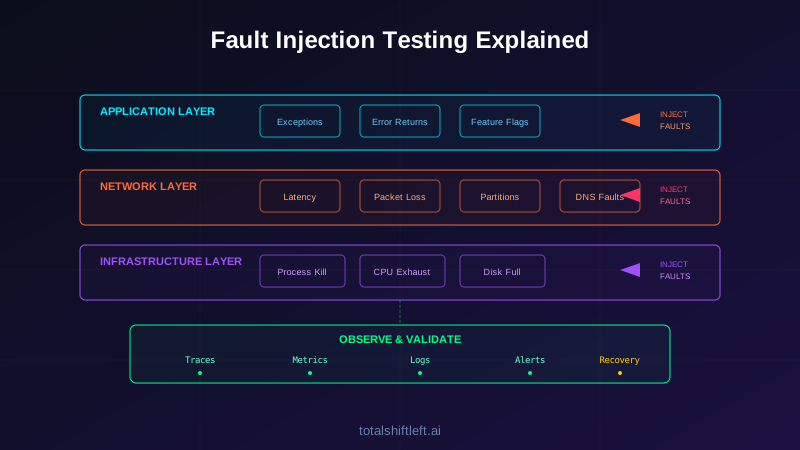
Compile-time injection modifies source code or configuration to simulate error conditions. This includes throwing exceptions in specific code paths, returning error responses from mock objects, and toggling feature flags that activate degraded-mode behavior. This is the simplest form and belongs in unit and integration tests.
Runtime injection introduces faults while the system is executing. Tools like Gremlin and Litmus inject faults at the process, container, or VM level — killing processes, consuming CPU, filling disks, or exhausting memory. The system is running normally when the fault is introduced, making the test realistic.
Network-level injection manipulates the network layer between services. Toxiproxy, Envoy, and Istio can add latency to specific connections, drop a percentage of packets, reset TCP connections, or partition services from each other. This is critical for microservices where network boundaries are the primary failure surface.
Protocol-level injection targets the application protocol. WireMock and similar tools — or a configurable mock server standing in for an unavailable dependency — return malformed HTTP responses, incorrect status codes, truncated payloads, or responses that violate the API contract. This tests whether consuming services handle upstream API failures gracefully — a key concern in any API testing strategy for microservices.
The common thread across all categories: you control the fault, you predict the outcome, and you observe whether reality matches the prediction. When it does not, you have found a resilience gap.
The layer definitions this rests on are set out in unit vs integration vs system testing.
Why Fault Injection Testing Is Critical
Error-Handling Code Is the Least-Tested Code
Happy-path code runs on every request. Error-handling code runs only when something goes wrong — which in well-functioning systems is rare. This means error handlers, fallback paths, and recovery procedures accumulate bugs silently. They rot. Fault injection is the only way to exercise this code regularly.
Resilience Patterns Require Validation
Implementing a circuit breaker is not the same as having a working circuit breaker. Teams add retry policies, timeout configurations, bulkhead patterns, and fallback handlers — but the specific thresholds, conditions, and interactions between these mechanisms are rarely tested against realistic failure scenarios. A retry policy with no backoff causes a retry storm. A circuit breaker with the wrong error-code filter never opens. A timeout set to 30 seconds when the SLA requires 5 seconds is worse than no timeout.
Distributed Systems Fail in Unexpected Ways
In a monolith, a function call either succeeds or throws an exception. In a microservices architecture, a service call can succeed, fail, hang indefinitely, return partial data, return stale data, or succeed on the second retry after failing on the first. The failure modes multiply with every network boundary. Fault injection tests the specific failure modes that exist in your topology — not the ones your team imagined during design. Understanding service dependencies is essential for knowing where to inject faults.
Compliance and SLA Requirements
Many industries require demonstrated resilience testing for compliance. Financial services, healthcare, and critical infrastructure organizations must prove their systems can handle component failures without violating SLAs. Fault injection testing produces the evidence — documented experiments with measurable outcomes — that satisfies these requirements.
Key Components of Fault Injection Testing
Fault Models
A fault model defines the specific failure you are injecting and its parameters:
- Type: Network latency, connection reset, process kill, disk full, CPU saturation, malformed response
- Magnitude: 500ms latency vs. 30s latency, 10% packet loss vs. 100% packet loss
- Duration: How long the fault persists (30 seconds, 5 minutes, until manual removal)
- Scope: Which service, instance, endpoint, or percentage of traffic is affected
Well-defined fault models are essential. Vague experiments like "make the database slow" produce vague results.
Injection Points
Where you inject the fault determines what you test:
Between services (network layer): Tests service-to-service resilience — timeouts, retries, circuit breakers. Use Toxiproxy or service mesh fault injection.
Within a service (process layer): Tests internal error handling — exception handling, resource management, graceful degradation. Use Gremlin agents or custom instrumentation.
At the infrastructure layer: Tests orchestration and recovery — container restart policies, auto-scaling, health checks. Use Litmus, Chaos Mesh, or cloud-native tools.
Ready to shift left with your API testing?
Try our no-code API test automation platform free. Generate tests from OpenAPI, run in CI/CD, and scale quality.
At the API layer: Tests consumer resilience to upstream failures — schema violations, unexpected status codes, slow responses. Use WireMock or Shift-Left API for OpenAPI-driven fault simulation.
Observability Requirements
Every fault injection test requires instrumentation to observe the outcome:
- Distributed traces to see how the fault propagates across service boundaries
- Service-level metrics (latency, error rate, throughput) to quantify impact
- Application logs to verify error-handling code executed correctly
- Alert verification to confirm monitoring detects the injected failure
Recovery Validation
Injecting a fault is half the test. The other half is removing the fault and verifying the system recovers:
- Do connection pools refill?
- Do circuit breakers close after the failure clears?
- Do message queues drain their backlog?
- Does the system return to steady-state performance?
Recovery failures are often more damaging than the original fault. A system that survives a failure but never fully recovers is a system that degrades with every incident.
Fault Injection Architecture
Fault injection can be implemented at multiple architectural layers, each with different tradeoffs:
Sidecar/Proxy-based injection uses a network proxy (Envoy, Toxiproxy) deployed alongside each service. Traffic flows through the proxy, which can add latency, drop connections, or modify responses. This approach requires no code changes and works with any language or framework.
Agent-based injection deploys a lightweight agent on each host or container. The agent can kill processes, consume resources, manipulate the filesystem, or modify network rules. Gremlin and Litmus use this approach.
Service mesh injection leverages the mesh's traffic management capabilities (Istio, Linkerd) to inject faults at the routing layer. This is elegant for Kubernetes environments and allows per-route fault configuration.
Library-based injection uses in-process libraries that intercept outgoing calls and inject faults programmatically. This offers the finest control but requires code changes and language-specific implementations.
┌─────────────────────────────────────────────────────┐
│ Fault I
njection Layers │
├─────────────────────────────────────────────────────┤
│ │
│ Application Layer ┌──────────────────────┐ │
│ (Library-based) │ Resilience4j / Polly│ │
│ │ Fault flags in code │ │
│ └──────────┬───────────┘ │
│ │ │
│ Service Layer ┌──────────▼───────────┐ │
│ (Sidecar/Proxy) │ Toxiproxy / Envoy │ │
│ │ WireMock stubs │ │
│ └──────────┬───────────┘ │
│ │ │
│ Platform Layer ┌──────────▼───────────┐ │
│ (Agent-based) │ Gremlin / Litmus │ │
│ │ Chaos Mesh agents │ │
│ └──────────┬───────────┘ │
│ │ │
│ Infrastructure Layer ┌──────────▼───────────┐ │
│ (Cloud-native) │ AWS FIS / Azure │ │
│ │ Chaos Studio │ │
│ └──────────────────────┘ │
└─────────────────────────────────────────────────────┘
Fault Injection Tools Comparison
| Tool | Injection Level | Protocol Support | CI/CD Integration | Language Agnostic | Best For |
|---|---|---|---|---|---|
| Gremlin | Infra + Network + App | TCP, HTTP, DNS | Yes (API-driven) | Yes | Enterprise full-spectrum injection |
| Toxiproxy | Network (proxy) | TCP | Yes (lightweight) | Yes | CI pipeline network faults |
| Istio/Envoy | Service mesh | HTTP, gRPC | Yes (CRDs) | Yes | K8s service mesh fault injection |
| WireMock | API responses | HTTP | Yes | Yes | API-level fault simulation |
| Litmus (LitmusChaos) | K8s platform | Pod/Network/IO | Yes (CRDs) | Yes | Kubernetes-native fault injection |
| Chaos Mesh | K8s platform | Pod/Network/IO/Time | Yes (CRDs) | Yes | K8s with time-travel faults |
| AWS Fault Injection Simulator | AWS infra | EC2, ECS, EKS, RDS, Lambda | Yes (API-driven) | AWS-only | Managed fault injection for AWS-native workloads |
| Testcontainers | Container infra | Any (containers) | Yes | JVM, .NET, Go, Node | Disposable test infrastructure |
| Shift-Left API | API contract | HTTP/REST | Yes (CI-native) | Yes | OpenAPI-driven fault validation |
For teams selecting their microservices testing tools, Toxiproxy is the best starting point for CI pipeline fault injection, while Gremlin or Litmus are better suited for production experiments.
Real-World Example: Payment Service Fault Injection
A fintech team operates a payment processing pipeline: checkout-api → payment-orchestrator → payment-gateway (third-party) → ledger-service. They need to validate that the pipeline handles payment gateway failures gracefully.
Test 1: Gateway latency injection
Using Toxiproxy in the CI pipeline, the team adds 5 seconds of latency to the connection between payment-orchestrator and the mock payment-gateway:
// Toxiproxy configuration in integration test
proxy := toxiClient.CreateProxy("payment-gateway", "localhost:8474", "payment-gateway:443")
proxy.AddToxic("latency", "latency", "downstream", 1.0, toxiproxy.Attributes{
    "latency": 5000,
    "jitter":  500,
})
Expected: payment-orchestrator times out after 3 seconds (configured timeout), returns a pending status to checkout-api, which shows the user a "processing" message.
Actual: The timeout was configured at 30 seconds (default), not 3 seconds. The checkout UI hung for 30 seconds before showing an error. The team fixed the timeout configuration.
Test 2: Gateway error response injection
Using WireMock, the team configures the mock gateway to return HTTP 502 for 50% of requests:
{
  "request": { "method": "POST", "urlPath": "/v1/charges" },
  "response": {
    "status": 502,
    "fixedDelayMilliseconds": 100,
    "fault": "RANDOM_DATA_THEN_CLOSE"
  }
}
Expected: payment-orchestrator retries once with idempotency key, then marks the transaction as failed and triggers a refund workflow.
Actual: The retry logic worked, but the idempotency key was not included in the retry request. This caused a double charge when the gateway processed both the original and the retry. Critical bug caught before production.
Test 3: Ledger service unavailability
Using Testcontainers, the team stops the ledger-service container mid-transaction:
Expected: payment-orchestrator writes the transaction to a dead-letter queue for later reconciliation. No customer-facing impact.
Actual: The dead-letter queue topic had not been created in the test environment. The transaction was lost silently. The team added queue existence checks to the service startup sequence.
Three fault injection tests found three critical bugs — a misconfigured timeout, a missing idempotency key, and a missing queue topic — none of which would have been caught by functional tests.
Fault injection testing challenges and how to solve them
Challenge: Knowing What Faults to Inject
Free 1-page checklist
API Testing Checklist for CI/CD Pipelines
A printable 25-point checklist covering authentication, error scenarios, contract validation, performance thresholds, and more.
Download FreeTeams struggle to identify which faults are worth testing. The space of possible failures is enormous, and testing every permutation is impractical.
Solution: Start with your dependency map. For each external dependency (database, cache, message queue, downstream service), test three failure modes: complete unavailability, high latency (10x normal), and error responses. This covers the most common and most damaging failure categories. Expand to edge cases (partial failures, intermittent errors) after covering the basics. A thorough service dependency analysis helps prioritize.
Challenge: Fault Injection in CI Pipelines
Production-grade fault injection tools (Gremlin, Litmus) are designed for running environments, not CI pipelines. Teams need lightweight injection that works in ephemeral test environments.
Solution: Use Toxiproxy for network faults and WireMock for API faults in CI. Both are lightweight, fast, and programmable. Testcontainers provides disposable databases and message brokers that can be stopped, paused, or degraded during tests. Reserve Gremlin and Litmus for staging and production experiments.
Challenge: False Positives from Flaky Injection
Fault injection tests that intermittently pass or fail erode team confidence in the testing suite.
Solution: Make fault injection deterministic. Instead of injecting faults randomly, inject them at specific points in the test scenario. Use fixed latency values instead of ranges. Run each fault injection test multiple times during validation to confirm it produces consistent results before adding it to CI.
Challenge: Measuring Fault Injection Effectiveness
Teams invest in fault injection testing but struggle to quantify its value.
Solution: Track three metrics: (1) the number of resilience bugs found by fault injection before production, (2) the reduction in production incidents related to failure handling, and (3) the mean time to recovery (MTTR) for incidents that do occur. Teams with mature fault injection practices typically see 40-60% fewer resilience-related incidents.
Fault injection testing best practices
- Inject faults at the network boundary first — Network failures between services are the most common and most impactful failure mode in microservices; start there before testing process-level or infrastructure-level faults
- Test the recovery, not just the failure — Inject a fault, observe the degradation, remove the fault, and verify the system returns to steady state within your SLA; recovery bugs are often worse than failure bugs
- Use fault injection in every test stage — Unit tests (mock exceptions), integration tests (Toxiproxy/WireMock), staging (Gremlin/Litmus), production (chaos experiments); each stage catches different categories of issues
- Make fault injection part of your CI pipeline — Run network fault and API fault injection tests on every pull request; do not treat fault injection as a periodic manual activity
- Test with realistic fault parameters — Use latency values, error rates, and failure durations observed in your production monitoring; a 5-second timeout test is useless if your real failures involve 60-second hangs
- Validate circuit breaker configurations specifically — Test that circuit breakers open at the configured threshold, reject requests while open, and close correctly after the recovery period
- Test timeout interactions — When Service A calls Service B which calls Service C, verify that timeout values cascade correctly and that A does not wait longer than its own SLA allows
- Inject faults during load tests — Combine fault injection with load testing to discover failures that only manifest under concurrent traffic; a circuit breaker that works at 10 RPS may fail at 10,000 RPS
- Use contract tests to define the "correct" response, then inject faults that violate it — This validates that consumers handle contract violations gracefully
- Document fault models in your service catalog — For each service, document which faults have been tested and which failure modes remain untested
Fault Injection Testing Checklist
- ✔ Dependency map created showing all external calls per service
- ✔ Three failure modes tested per dependency (unavailable, slow, error response)
- ✔ Timeout values validated against actual SLA requirements for each service call
- ✔ Retry policies tested with correct backoff, jitter, and idempotency key handling
- ✔ Circuit breaker thresholds verified for each downstream dependency
- ✔ Fallback mechanisms tested for correctness when primary path fails
- ✔ Recovery validated — system returns to steady state after fault is removed
- ✔ Dead-letter queues verified for message processing failures
- ✔ Connection pool exhaustion tested under sustained failure conditions
- ✔ Toxiproxy or WireMock fault injection integrated into CI pipeline
- ✔ Load + fault injection combination tested for critical paths
- ✔ Fault injection results documented in service runbooks
- ✔ Alert verification — monitoring detects injected faults correctly
- ✔ Resilience testing patterns validated end-to-end
- ✔ API fault scenarios validated with Shift-Left API using OpenAPI specifications
Fault injection testing FAQ
What is fault injection testing?
Fault injection testing is a software testing technique that deliberately introduces faults — errors, latency, resource exhaustion, or crashes — into a system to evaluate how it handles failure conditions. The goal is to verify that error-handling paths, fallback mechanisms, and recovery procedures work correctly under adverse conditions. It converts theoretical resilience into empirically validated resilience.
What are the main types of fault injection?
The main types are compile-time injection (modifying code to simulate errors during testing), runtime injection (introducing faults while the system is running via agents or tools), network-level injection (adding latency, dropping packets, or partitioning connections between services), and protocol-level injection (returning malformed responses or incorrect status codes from API endpoints). Each type targets different failure categories and is appropriate at different stages of the testing lifecycle.
What tools are used for fault injection testing?
Widely used tools include Gremlin for enterprise-grade fault injection across infrastructure and application layers, Toxiproxy for lightweight network-level fault simulation ideal for CI pipelines, Envoy and Istio for service mesh-based fault injection in Kubernetes environments, WireMock for API response simulation and contract violation testing, Testcontainers for creating disposable test infrastructure, and Chaos Mesh for Kubernetes-native fault injection including time manipulation.
How is fault injection different from chaos testing?
Fault injection is a technique — the act of introducing a specific, controlled fault into a system. Chaos testing (chaos engineering) is a discipline that uses fault injection as one of its tools within a broader methodology of hypothesis-driven experimentation against production systems. All chaos testing involves fault injection, but fault injection can also be used outside of chaos engineering — in unit tests, integration tests, and CI pipelines — without the full chaos engineering methodology.
When should fault injection testing be performed?
Fault injection should be performed at every stage of the development lifecycle. During unit testing, inject exceptions and error returns to verify error handling. During integration testing, use Toxiproxy and WireMock to simulate network and API failures. During CI/CD, run automated fault injection to catch resilience regressions. In staging and production, run chaos experiments with broader blast radius. The earlier you inject faults, the cheaper the bugs are to fix.
What failures should fault injection testing cover?
Essential failure categories include network failures (latency spikes, timeouts, DNS resolution errors, connection resets), dependency failures (downstream services returning 5xx errors, becoming completely unreachable, or responding with malformed data), resource exhaustion (CPU saturation, memory pressure, disk full, connection pool depletion, file descriptor exhaustion), data corruption (malformed responses, schema violations, encoding errors), and infrastructure failures (node crashes, container kills, availability zone outages).
Sources and further reading
- Toxiproxy — a TCP proxy for simulating latency and partitions.
- Chaos Mesh — Kubernetes-native fault injection.
- AWS Fault Injection Service — managed fault injection for AWS workloads.
Key takeaways
- Fault injection testing is the bridge between implementing resilience patterns and knowing they work.
- Every microservices architecture has retry logic, circuit breakers, timeouts, and fallback handlers somewhere in the codebase.
- The question is whether those mechanisms have been validated against realistic failure conditions — or whether they are untested code waiting to fail at the worst possible moment.
- The practice is straightforward: map your dependencies, define the failures that matter, inject them systematically, and fix what breaks.
- Start with Toxiproxy and WireMock in your CI pipeline — that alone catches the majority of resilience bugs.
- Expand to Gremlin or Litmus for staging and production experiments as your practice matures.
Stop waiting for production to test your failure paths. Try Shift-Left API free to generate fault scenarios from your OpenAPI specifications and validate resilience at the API layer before deployment.
Ready to shift left with your API testing?
Try our no-code API test automation platform free.