
REST Assured Tutorial: API Testing in Java (2026)
Quick answer
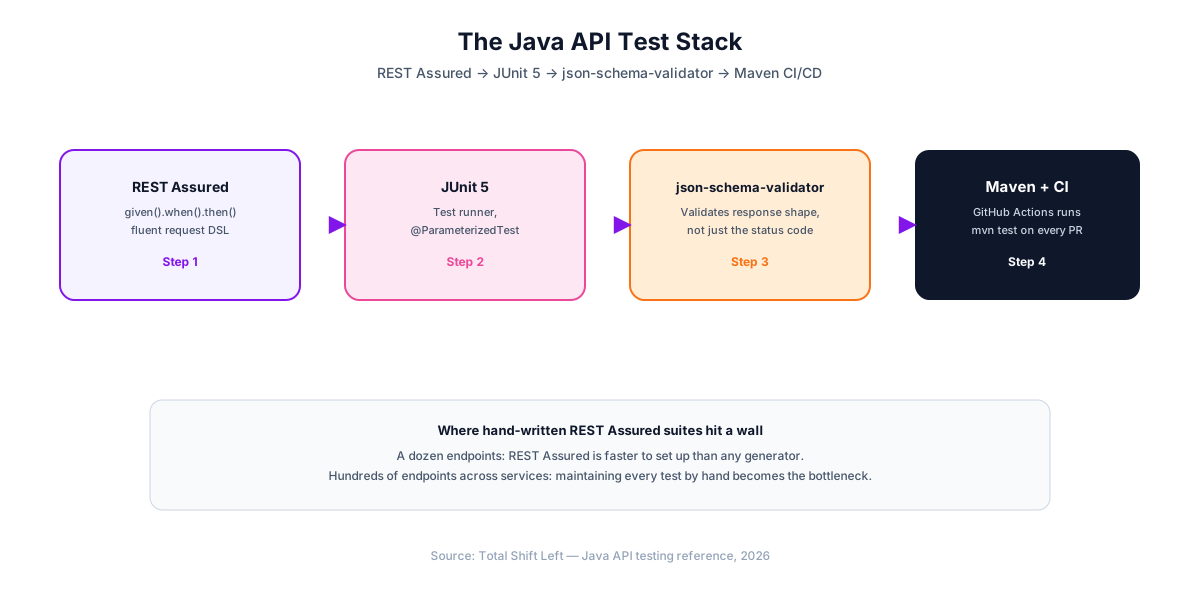
REST Assured is a Java library that gives API tests a fluent given().when().then() syntax, so a test reads like the request it makes instead of manually building an HttpClient. Pair it with JUnit 5 for the runner and parametrization, and json-schema-validator for response-structure validation instead of field-by-field assertions. It is the closest Java equivalent to Python's pytest + requests, and integrates the same way — as a normal Maven or Gradle test dependency, not a separate tool.
Reviewed by Parveen Kumari
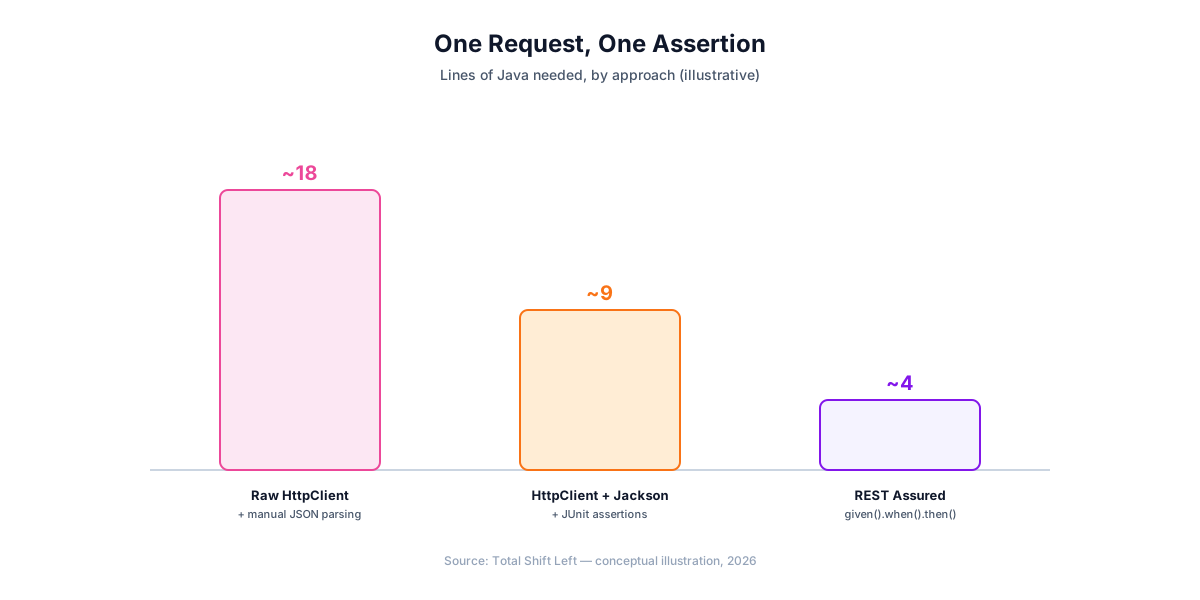
REST Assured is a Java library for testing REST APIs with a fluent, readable syntax — given() sets up the request, when() fires it, and then() asserts on the response — so a test reads as a description of the HTTP interaction it performs, not a wall of HttpClient boilerplate. It is the closest thing Java has to Python's pytest + requests combination, and it integrates the same way: as a normal test dependency that runs inside your existing Maven or Gradle build.
This guide builds a real REST Assured + JUnit 5 suite from scratch: project setup, the given-when-then DSL, JSON schema validation, parametrized tests across multiple endpoints, and a GitHub Actions workflow that runs mvn test on every push. Every code sample runs as written against JSONPlaceholder, a free public fake REST API.
In this guide
- Why REST Assured for Java API Testing
- What you need before you start
- Project Structure
- Writing Your First REST Assured Test
- Validating Response Schemas
- Testing POST, PUT, and DELETE Requests
- Parametrized Tests with JUnit 5
- Shared Setup with @BeforeAll and RequestSpecification
- Running Your Suite in CI/CD with GitHub Actions
- Common Pitfalls in REST Assured Suites
- REST Assured vs Postman vs pytest vs AI-Generated Tests
- When to Move Beyond Hand-Written Tests
- Running the suite in parallel
- Frequently asked questions about REST Assured
Why REST Assured for Java API Testing
Testing a REST API in plain Java without a library means building the request with HttpClient or OkHttp, manually parsing the JSON response, and asserting on individual fields with a general-purpose assertion library. REST Assured collapses all three steps into one chained expression, and integrates Hamcrest matchers and JsonPath so you can assert on nested JSON fields ("address.city") without deserializing into a POJO first.
Because it is a plain JVM library — not a separate application — it runs inside the same mvn test or gradle test command as your unit tests, in the same CI job, reviewed in the same pull requests as the rest of your Java code.
If you have not settled on a framework yet, how to choose an API testing framework walks through the selection criteria before you commit a suite to one.
If your tooling behaves differently across spec versions, OpenAPI 3.0 vs 3.1 explains why.
On the JVM the choice is usually between two frameworks — REST Assured vs Karate works through it with the same test written both ways.
What you need before you start
- Java 17+ (this guide targets a current LTS release)
- Maven (Gradle works identically; this guide uses Maven)
- JUnit 5 — the test runner
- REST Assured — the request/response DSL
- json-schema-validator — REST Assured's schema validation module
<!-- pom.xml -->
<dependencies>
  <dependency>
    <groupId>io.rest-assured</groupId>
    <artifactId>rest-assured</artifactId>
    <version>5.4.0</version>
    <scope>test</scope>
  </dependency>
  <dependency>
    <groupId>io.rest-assured</groupId>
    <artifactId>json-schema-validator</artifactId>
    <version>5.4.0</version>
    <scope>test</scope>
  </dependency>
  <dependency>
    <groupId>org.junit.jupiter</groupId>
    <artifactId>junit-jupiter</artifactId>
    <version>5.10.2</version>
    <scope>test</scope>
  </dependency>
</dependencies>
Check Maven Central for the current release of each artifact before pinning — these versions were current as of this guide's publication.
Project Structure
api-tests/
├── pom.xml
└── src
    └── test
        ├── java
        │   └── com/example/apitests/
        │       ├── UsersApiTest.java
        │       └── PostsApiTest.java
        └── resources
            └── schemas/
                └── user-schema.json
Maven's convention places JSON Schema files under src/test/resources so they land on the test classpath automatically — matchesJsonSchemaInClasspath(), used below, depends on that.
Writing Your First REST Assured Test
// UsersApiTest.java
package com.example.apitests;

import io.restassured.RestAssured;
import org.junit.jupiter.api.BeforeAll;
import org.junit.jupiter.api.Test;

import static io.restassured.RestAssured.given;
import static org.hamcrest.Matchers.*;

class UsersApiTest {

    @BeforeAll
    static void setup() {
        RestAssured.baseURI = "https://jsonplaceholder.typicode.com";
    }

    @Test
    void getUserReturns200() {
        given()
        .when()
            .get("/users/1")
        .then()
            .statusCode(200);
    }

    @Test
    void getUserReturnsExpectedFields() {
        given()
        .when()
            .get("/users/1")
        .then()
            .statusCode(200)
            .body("id", equalTo(1))
            .body("email", containsString("@"))
            .body("name", not(emptyString()));
    }
}
Run it:
mvn test
given(), when(), and then() are not just readable naming — each returns a builder scoped to its stage, so a request specification (headers, auth, base URI) set in given() cannot accidentally leak into the assertion stage in then().
Validating Response Schemas
Field-by-field assertions do not catch a field silently changing type or an unexpected field appearing. json-schema-validator checks the whole response shape in one assertion.
src/test/resources/schemas/user-schema.json:
{
  "type": "object",
  "required": ["id", "name", "username", "email"],
  "properties": {
    "id": { "type": "integer" },
    "name": { "type": "string" },
    "username": { "type": "string" },
    "email": { "type": "string", "format": "email" },
    "address": { "type": "object" },
    "phone": { "type": "string" },
    "website": { "type": "string" },
    "company": { "type": "object" }
  }
}
Ready to shift left with your API testing?
Try our no-code API test automation platform free. Generate tests from OpenAPI, run in CI/CD, and scale quality.
import static io.restassured.module.jsv.JsonSchemaValidator.matchesJsonSchemaInClasspath;

@Test
void userMatchesSchema() {
    given()
    .when()
        .get("/users/1")
    .then()
        .statusCode(200)
        .body(matchesJsonSchemaInClasspath("schemas/user-schema.json"));
}
Testing POST, PUT, and DELETE Requests
// PostsApiTest.java
package com.example.apitests;

import io.restassured.RestAssured;
import org.junit.jupiter.api.BeforeAll;
import org.junit.jupiter.api.Test;

import static io.restassured.RestAssured.given;
import static org.hamcrest.Matchers.*;

class PostsApiTest {

    @BeforeAll
    static void setup() {
        RestAssured.baseURI = "https://jsonplaceholder.typicode.com";
    }

    @Test
    void createPost() {
        String payload = "{ \"title\": \"foo\", \"body\": \"bar\", \"userId\": 1 }";

        given()
            .contentType("application/json")
            .body(payload)
        .when()
            .post("/posts")
        .then()
            .statusCode(201)
            .body("title", equalTo("foo"))
            .body("id", notNullValue());
    }

    @Test
    void updatePost() {
        String payload = "{ \"id\": 1, \"title\": \"updated\", \"body\": \"bar\", \"userId\": 1 }";

        given()
            .contentType("application/json")
            .body(payload)
        .when()
            .put("/posts/1")
        .then()
            .statusCode(200)
            .body("title", equalTo("updated"));
    }

    @Test
    void deletePost() {
        given()
        .when()
            .delete("/posts/1")
        .then()
            .statusCode(200);
    }
}
For anything beyond a trivial inline string, build the request body from a Java object (a POJO or record) and let REST Assured serialize it with Jackson or Gson on the classpath, rather than hand-writing JSON strings — it keeps the payload type-checked and refactor-safe.
Parametrized Tests with JUnit 5
import org.junit.jupiter.params.ParameterizedTest;
import org.junit.jupiter.params.provider.CsvSource;

import static io.restassured.RestAssured.given;
import static org.hamcrest.Matchers.equalTo;

class UserStatusCodeTest {

    @ParameterizedTest
    @CsvSource({
        "1, 200",
        "10, 200",
        "999, 404"
    })
    void getUserStatusCodes(int userId, int expectedStatus) {
        given()
            .baseUri("https://jsonplaceholder.typicode.com")
        .when()
            .get("/users/" + userId)
        .then()
            .statusCode(expectedStatus);
    }
}
@CsvSource keeps the input table next to the test instead of in a separate data file, and JUnit 5 reports each row as its own pass/fail case — the 999 → 404 row proves the API rejects an invalid ID correctly, which a suite that only tests valid IDs would never catch.
Shared Setup with @BeforeAll and RequestSpecification
Repeating .baseUri(...), headers, and auth on every test invites drift. A RequestSpecification centralizes them once:
import io.restassured.builder.RequestSpecBuilder;
import io.restassured.specification.RequestSpecification;
import org.junit.jupiter.api.BeforeAll;

import static io.restassured.RestAssured.given;

class AuthenticatedApiTest {

    static RequestSpecification spec;

    @BeforeAll
    static void setup() {
        spec = new RequestSpecBuilder()
            .setBaseUri("https://jsonplaceholder.typicode.com")
            .addHeader("Authorization", "Bearer " + System.getenv("TEST_API_TOKEN"))
            .build();
    }

    @Test
    void getProtectedResource() {
        given()
            .spec(spec)
        .when()
            .get("/account")
        .then()
            .statusCode(200);
    }
}
Reading the token from System.getenv("TEST_API_TOKEN") keeps it out of the repository — set it as an encrypted secret in your CI provider, never as a literal string in a test file.
Running Your Suite in CI/CD with GitHub Actions
# .github/workflows/api-tests.yml
name: API Tests

on: [push, pull_request]

jobs:
  api-tests:
    runs-on: ubuntu-latest
    steps:
      - uses: actions/checkout@v4
      - uses: actions/setup-java@v4
        with:
          distribution: 'temurin'
          java-version: '17'
          cache: 'maven'
      - run: mvn -B test
      - uses: actions/upload-artifact@v4
        if: always()
        with:
          name: surefire-reports
          path: target/surefire-reports/
cache: 'maven' caches ~/.m2/repository between runs, so dependency resolution does not re-download on every build. if: always() on the upload step ensures the Surefire report artifact is available specifically on the runs that fail — see our step-by-step CI/CD guide for the equivalent GitLab CI and Jenkins configuration.
Common Pitfalls in REST Assured Suites
- Setting
RestAssured.baseURIas a static field shared across test classes. It works but creates ordering-dependent tests if any class changes it; prefer aRequestSpecificationbuilt per test class. - Asserting only the status code. Validate structure with
matchesJsonSchemaInClasspath(), not just individual.body("field", ...)checks. - Hand-building JSON strings for request bodies. Serialize a Java object instead — string-built JSON breaks silently on a missed comma or unescaped quote.
- No negative-path coverage. Parametrize invalid IDs and malformed payloads alongside valid ones, the same way you would in pytest.
- Ignoring response time. REST Assured supports
.time(lessThan(2000L, TimeUnit.MILLISECONDS))in the.then()chain — a cheap way to catch a latency regression in the same test that already checks correctness. - Committing tokens or passwords into test source. Read them from environment variables set as CI secrets.
REST Assured vs Postman vs pytest vs AI-Generated Tests
| Approach | Language | Learning curve | CI/CD fit | Schema validation | Best for |
|---|---|---|---|---|---|
| REST Assured | Java | Medium | Native — same runner as JUnit/TestNG | Automatic (json-schema-validator) | Java/JVM teams |
| pytest + requests | Python | Low | Native — same runner as unit tests | Manual (jsonschema) | Python teams |
| Postman + Newman | JSON collections, JS scripts | Low for exploration, higher for CI | Requires exporting/running via Newman CLI | Manual (pm.test scripts) | Manual exploration, small automated suites |
| AI-generated (Total Shift Left) | None required | Low — import a spec | Native CI plugins | Automatic — generated from the OpenAPI schema | Teams testing many endpoints across services |
Free Guided worksheet
Build Your Testing Strategy in 30 Minutes
A structured worksheet that walks you through defining your testing strategy in 30 minutes. Cover architecture, tools, layers, and team responsibilities.
Download FreeREST Assured and pytest occupy the same role for their respective ecosystems: both run as a normal test dependency inside the language's existing test runner, rather than as a separate application. Postman remains strongest for exploring an API before a test exists — see our full tools comparison for the wider field.
When to Move Beyond Hand-Written Tests
REST Assured's readability does not change the underlying economics: twice the endpoints means roughly twice the test methods, schema files, and request specifications to maintain. For a service with a dozen endpoints, that is a reasonable trade. Somewhere in the range of a few dozen endpoints across multiple services, the test suite's maintenance cost starts competing with the API's own development for engineering time.
The alternative is generating the suite directly from the OpenAPI specification instead of hand-translating it into Java. Total Shift Left imports your spec, generates positive, negative, and boundary test cases for every endpoint, and re-generates automatically when the spec changes — so schema drift updates the suite instead of silently breaking it.
Running the suite in parallel
A REST Assured suite is a JUnit suite, so parallelism is a JUnit concern. It is off by default and enabled through configuration rather than code:
# src/test/resources/junit-platform.properties
junit.jupiter.execution.parallel.enabled = true
junit.jupiter.execution.parallel.mode.default = concurrent
junit.jupiter.execution.parallel.config.strategy = dynamic
Before turning it on, check two things. Static state is the enemy. RestAssured.baseURI and friends are static, so a test that changes them mid-run changes them for every concurrently executing test. Configure them once in @BeforeAll, or better, use a RequestSpecification passed explicitly rather than mutating global configuration.
@TestInstance and shared fields. Fields on the test class are shared when the lifecycle is per-class. Anything mutable there needs to become a local, or the class needs marking @Execution(SAME_THREAD) — which is an acceptable escape hatch for a handful of tests and a bad default for the suite.
The payoff is significant for API tests specifically, because they are dominated by network wait rather than CPU. A suite that takes eight minutes serially frequently drops to under two.
A final note on structuring a growing suite: keep the request specification separate from the assertions. A shared RequestSpecification holding the base URI, content type and authentication means a change to any of them is one edit, and it keeps each test's body limited to what it actually verifies. The same applies to a ResponseSpecification for the checks every response should satisfy — status class, content type, and a maximum response time — which removes several repeated lines from every test and gives you one place to tighten the standard later.
Finally, a note on where REST Assured stops being the right tool. It is excellent for expressing what a specific request should return, and it scales to a few hundred hand-written cases comfortably. What it cannot do is tell you which operations in your contract have no test at all — it only knows about the tests someone wrote. Once the API surface is large enough that nobody can hold the coverage picture in their head, pair the hand-written suite with something generated from the OpenAPI document, and keep REST Assured for the cases that encode real business rules.
Frequently asked questions about REST Assured
What is REST Assured used for? REST Assured is a Java library for testing REST APIs. It provides a fluent given().when().then() syntax for building requests and asserting on responses — status codes, headers, and JSON or XML body content — without writing raw HttpClient or OkHttp calls by hand.
Do I need Postman if I use REST Assured? For ad-hoc exploration, Postman is still faster. For automated, version-controlled regression testing in a Java codebase, REST Assured is the better long-term home — it runs with the same Maven or Gradle test task as your unit tests, in the same CI pipeline, with no separate collection file to export or sync.
How do I validate a JSON schema with REST Assured? Add the io.rest-assured:json-schema-validator dependency, put your JSON Schema file on the test classpath (typically src/test/resources), and call .body(matchesJsonSchemaInClasspath("schema.json")) inside the .then() block. This validates the full response structure in one assertion instead of checking individual fields.
REST Assured vs Postman — which is better for CI/CD? REST Assured. It is a JVM test library that runs via mvn test or gradle test, the exact command your CI pipeline already runs for unit tests — no separate Newman CLI step or collection export needed. Postman collections require Newman to run outside the Postman app, adding a second tool to the pipeline.
Can REST Assured test SOAP APIs as well as REST? REST Assured is built for REST/JSON and XML-over-HTTP, and can send and assert on XML bodies (including SOAP envelopes) with its XmlPath support, but it does not manage WSDL contracts the way a dedicated SOAP client does. For heavy SOAP/WSDL testing, a SOAP-specific client is usually a better fit.
Can a REST Assured suite fully replace an AI-generated API test suite? For a handful of endpoints, hand-written REST Assured is often faster to set up. Past a few dozen endpoints across services, generating the suite from an OpenAPI spec keeps coverage complete without the manual upkeep.
Sources and further reading
- REST Assured — the Java DSL for HTTP API tests.
- Testcontainers — throwaway real dependencies for integration tests.
- RFC 9110 — HTTP Semantics — the normative definition of methods, status codes and headers.
Key takeaways
- REST Assured's given-when-then DSL replaces raw HttpClient boilerplate and runs as a normal Maven or Gradle test dependency.
json-schema-validatorcatches structural drift that field-by-field.body("field", ...)assertions miss.@ParameterizedTestwith@CsvSourcecovers negative paths cheaply — invalid IDs belong in the same table as valid ones.- A shared
RequestSpecificationcentralizes base URI, headers, and auth instead of repeating them per test class. mvn testin CI needs no separate tool — it is the same command your unit tests already run under.- Hand-written suites scale linearly with endpoint count. Past a few dozen endpoints across services, generating tests from an OpenAPI spec becomes the more maintainable path.
Generate the Equivalent Suite from Your OpenAPI Spec
Every test in this guide can also be generated automatically. Import your OpenAPI specification into Total Shift Left and get positive, negative, and boundary test cases for every endpoint — regenerated the moment your spec changes, with no REST Assured classes to maintain by hand.
Start your free trial and compare the generated suite against your own, or see plans and pricing if you're already evaluating.
Ready to shift left with your API testing?
Try our no-code API test automation platform free.