
API Testing Framework: What It Is and How to Choose One (2026)
Quick answer
An API testing framework combines a test runner, assertion library, and reporting into one tool — not just a way to send HTTP requests. Frameworks fall into three categories: language-native (pytest, REST Assured, Playwright, Cypress — real code in your existing language), BDD-style (Karate, Cucumber — readable specs), and no-code/GUI (Postman, JMeter — built visually). Choose by team language and CI/CD fit first, then by who needs to read and write the tests.
Reviewed by Rishi Gaurav
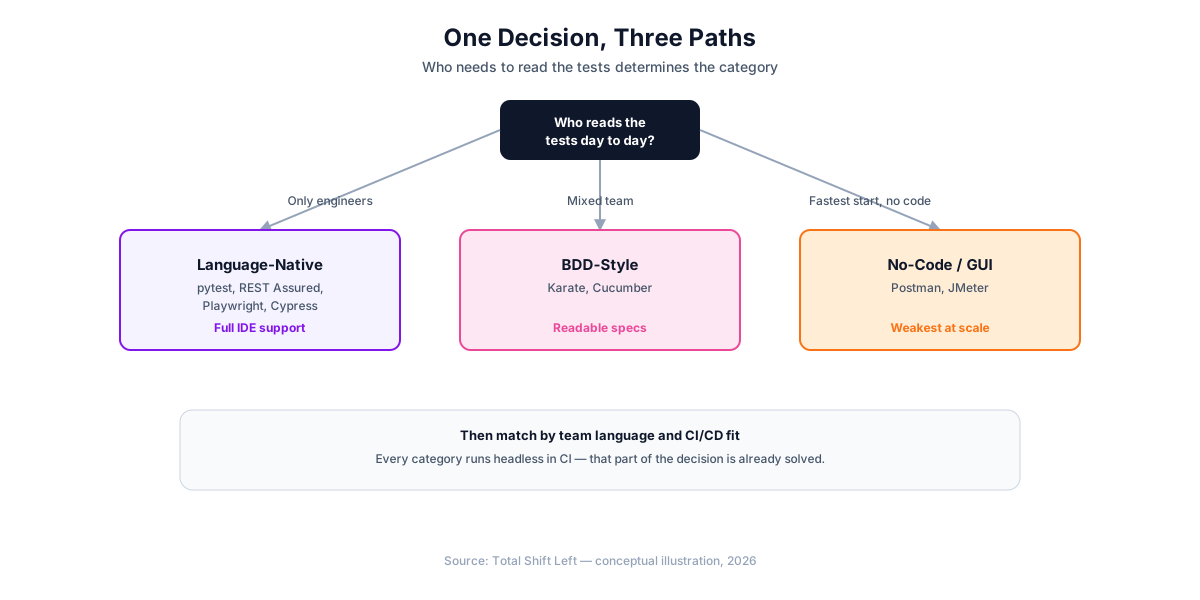
An API testing framework combines a test runner, an assertion library, and reporting into one system — distinct from an HTTP client like requests or axios, which sends a call but provides no test structure, assertions, or CI-usable output on its own. Choosing between frameworks is less about "which is best" in the abstract and more about which category fits your team's language, CI/CD setup, and who needs to be able to read the tests.
In this guide
- The Three Framework Categories
- Language-Native Frameworks
- BDD-Style Frameworks
- No-Code / GUI Frameworks
- Decision Framework: How to Choose
- Functional Frameworks vs Load Testing Tools
- When Any Hand-Written Framework Stops Scaling
- One test, three frameworks
- What a framework actually gives you
- The five criteria that decide it
- What it costs to change your mind
- Common mistakes when choosing a framework
- A framework choice that ages well
- Frequently asked questions about API testing frameworks
The Three Framework Categories
Every API testing framework falls into one of three categories, and the category matters more for the decision than any individual tool's feature list:
| Category | Tests are | Examples |
|---|---|---|
| Language-native | Real code in your team's existing language | pytest, REST Assured, Playwright, Cypress |
| BDD-style | Gherkin-style specifications | Karate, Cucumber |
| No-code / GUI | Built visually, no code required to author | Postman, JMeter |
On the JVM the choice is usually between two frameworks — REST Assured vs Karate works through it with the same test written both ways.
Language-Native Frameworks
Tests are written as ordinary code in the language your team already uses — Python, Java, TypeScript/JavaScript — and run through the same test runner as your unit tests, with full IDE support: autocomplete, refactoring, type checking (where the language has it).
- pytest (Python) — see the full tutorial
- REST Assured (Java) — see the full tutorial
- Playwright (TypeScript/JavaScript) — see the full tutorial
- Cypress (JavaScript) — see the full tutorial
This is the right default when the team writing API tests is the same team writing the API's code, and when consistency with the existing unit-test toolchain matters more than readability for a non-engineer.
BDD-Style Frameworks
Tests are written in Gherkin (Given/When/Then) syntax, which reads closer to a specification than code. The key distinction within this category is whether the framework requires separate glue code:
- Karate — Gherkin steps are built in; no step-definition code required. See the full tutorial.
- Cucumber — Gherkin steps require you to write Java (or another language's) step-definition methods behind every line.
Choose this category when non-engineers (product owners, manual QA, business analysts) need to read or contribute to the test suite directly — the tradeoff is somewhat less IDE tooling for the test logic itself compared to a fully code-native framework.
No-Code / GUI Frameworks
Tests are built through a visual interface with no code required to author them, though CI execution still runs headless via a CLI companion tool:
- Postman (+ Newman for CI) — see the beginner guide
- JMeter (GUI-authored,
.jmxfiles, headless CLI execution) — primarily load testing, see the full tutorial
This category is fastest to get started with and requires the least programming knowledge upfront, at the cost of weaker scaling — a large hand-built Postman collection or JMeter plan takes real discipline to keep in sync with the API as it grows, since there's no compiler or type system catching drift.
Decision Framework: How to Choose
Work through these questions in order:
- What language does the team building the API already use? Match a language-native framework to it if the same engineers will write the tests — this is the highest-leverage decision.
- Does anyone outside engineering need to read or write test cases? If yes, weight toward Karate or Cucumber's Gherkin readability.
- Is functional correctness or load/performance the actual goal? These need different tools entirely — see the next section.
- How fast does the team need to start? No-code tools (Postman) have the shortest time-to-first-test; language-native frameworks have a small setup cost that pays off at scale.
- What does the CI/CD pipeline already run? A language-native framework slots into an existing
mvn test/pytest/npm teststep with zero new tooling; Postman and JMeter both need Newman or the JMeter CLI as an additional CI dependency.
Functional Frameworks vs Load Testing Tools
A common confusion: pytest, REST Assured, Playwright, Cypress, and Karate all test functional correctness — is this one response correct. JMeter and k6 test load and performance — does the API hold up under concurrent traffic. These are not competing choices in the same category; a complete strategy runs one of each, not one instead of the other. See types of API testing for the full breakdown of what each testing type actually catches.
Ready to shift left with your API testing?
Try our no-code API test automation platform free. Generate tests from OpenAPI, run in CI/CD, and scale quality.
When Any Hand-Written Framework Stops Scaling
Every category above scales the same way regardless of which one you pick: twice the endpoints means roughly twice the test cases, fixtures, and assertions to write and maintain by hand, in whichever syntax the chosen framework uses. For a service with a dozen endpoints, any of these frameworks is a reasonable, fast choice. Somewhere past a few dozen endpoints across multiple services, the suite's maintenance cost — keeping tests in sync with an evolving API — starts competing with the API's own development for engineering time, independent of which framework category you chose.
Total Shift Left generates the functional suite directly from your OpenAPI spec instead of hand-writing it in any of these frameworks' syntax, and regenerates it automatically when the spec changes — see how AI generates API tests from OpenAPI for how that compares to picking a framework and writing every test by hand.
One test, three frameworks
The honest way to choose is to write the same test in each candidate and look at what your team will maintain. pytest keeps it in Python, close to the service code:
# pytest + requests
def test_create_order(client):
    r = client.post("/v1/orders", json={"sku": "A-1", "qty": 2})
    assert r.status_code == 201
    assert r.json()["status"] == "pending"
REST Assured keeps it in the JVM build, so it runs in the same Maven or Gradle lifecycle as the unit tests; Karate drops the programming language entirely, which is the trade teams make when non-Java testers own the suite:
// REST Assured (Java)
given().contentType(JSON).body(Map.of("sku", "A-1", "qty", 2))
.when().post("/v1/orders")
.then().statusCode(201).body("status", equalTo("pending"));

/* Karate (feature file — no Java at all)
Scenario: create an order
  Given path 'v1/orders'
  And request { sku: 'A-1', qty: 2 }
  When method post
  Then status 201
  And match response.status == 'pending'
*/
What a framework actually gives you
"Framework" covers more than the assertion syntax people compare first. Five capabilities decide how a suite feels at 500 tests, and only the first is visible in a tutorial.
| Capability | What it means | Why it bites later |
|---|---|---|
| Test discovery and running | Finds and executes cases, reports results | Determines whether CI integration is one command or a script |
| Assertions | Expresses what should be true | Poor failure messages cost minutes per failure, every failure |
| Fixtures and setup | Creates and tears down state | The main source of flakiness and cross-test coupling |
| Parallelism | Runs cases concurrently | The difference between a 3-minute and a 30-minute suite |
| Reporting | Produces human and machine output | JUnit XML is what CI, dashboards and auditors consume |
A framework that nails assertions and ignores fixtures produces a suite that is pleasant to write and miserable to maintain. When you evaluate, write three tests that share setup rather than one test in isolation — that is where the differences appear.
The five criteria that decide it
1. The language your team already writes. This dominates everything else. A Java team writing Python tests reviews them less carefully, debugs them more slowly, and abandons them faster. Pick the language of the service, or the language of the people who will maintain the suite.
2. Who reads the tests. If non-engineers genuinely read the suite, a BDD layer earns its cost. If they do not — and usually they do not — Gherkin adds a translation layer between the test and the thing it tests, for no reader.
3. What the CI already runs. A framework that emits JUnit XML slots into every CI system with no glue. One with a bespoke report format needs a converter that someone has to own.
4. How the suite is seeded. Tests need data. A framework whose fixtures compose well lets you build a request-scoped user, order and token without repetition. This is the single best predictor of whether a suite survives past a year.
5. Whether it can run in parallel safely. Parallelism is only usable if fixtures isolate state. Check that the framework supports per-worker isolation before the suite is large enough for it to matter.
What it costs to change your mind
Framework decisions feel permanent, and they are less permanent than they feel — but the cost is not evenly distributed.
Cheap to change: the assertion library and the reporter. Both are usually a mechanical find-and-replace and a CI flag.
Moderate: the runner, if fixtures are already isolated. Moving from one language-native framework to another in the same language is mostly re-plumbing setup.
Expensive: the language, and the BDD layer. Changing language means rewriting every test and retraining every reviewer. Removing a BDD layer means unpicking step definitions that several features share, which is exactly the coupling the layer encouraged.
The practical implication: be decisive about assertions and reporters, and slow about language and BDD. Those are the two that lock you in.
Free Guided worksheet
Build Your Testing Strategy in 30 Minutes
A structured worksheet that walks you through defining your testing strategy in 30 minutes. Cover architecture, tools, layers, and team responsibilities.
Download FreeCommon mistakes when choosing a framework
Choosing for the demo, not the hundredth test. Every framework looks clean in a three-line example. Suites fail at scale because of shared state, unclear failures and slow runs — none of which a demo shows.
Adopting BDD without a business reader. Gherkin written by engineers and read by engineers is a more verbose way of writing a test. The layer pays for itself only when someone outside the team actually reads and corrects the scenarios.
Letting the framework own test data. Fixtures that create data through the UI or through another team's API make the suite fragile in a way no framework choice fixes. Seed through the fastest reliable path — usually the database or a setup endpoint.
Picking a no-code tool to avoid the hiring problem. No-code frameworks lower the authoring floor and raise the ceiling on maintenance, because the tests are not diffable artifacts. That trade is sometimes right, but make it deliberately.
Treating the choice as one decision. Most mature suites use two or three: a language-native framework for the bulk, something generated from the contract for breadth, and a load tool for performance. They are not competing for the same slot.
A framework choice that ages well
Three habits separate suites that are still trusted after two years from the ones that get quarantined into a nightly job nobody reads.
Keep the framework at the edges. Assertions and fixtures should be the only places framework types appear. When a test's body is ordinary code calling ordinary helpers, replacing the runner later is mechanical rather than a rewrite.
Make failures self-explanatory. A failure that names the endpoint, the payload and the difference costs seconds to triage. One that says AssertionError: False is not True costs a context switch. This is worth optimising for early, because it is paid on every red build for the life of the suite.
Separate what the framework should own from what it should not. Frameworks are good at running cases, isolating state and reporting. They are bad at being the source of truth for what the API should do — that belongs to the contract. Teams that keep the two separate can regenerate breadth from the spec and hand-write only the cases that encode real business rules.
Frequently asked questions about API testing frameworks
What is an API testing framework? A tool combining a test runner, assertion library, and reporting into one system for testing APIs — distinct from just an HTTP client. pytest, REST Assured, Playwright, Karate, and Postman are all frameworks in this sense; requests or axios alone are HTTP clients, not frameworks, since they provide no test structure, assertions, or reporting on their own.
What is the difference between a language-native and a BDD-style framework? Language-native frameworks (pytest, REST Assured, Playwright, Cypress) write tests as real code in your team's existing language, with full IDE support. BDD-style frameworks (Karate, Cucumber) write tests as Gherkin specifications that read closer to plain English, trading some IDE tooling for readability by non-programmers.
Is Postman a testing framework? Yes, in the practical sense — its Tests tab (pm.test/pm.expect), Collection Runner, and Newman CLI together provide the runner, assertions, and CI-executable reporting a framework needs, even though it's GUI-authored rather than code-first like the other categories.
What API testing framework should a Python team use? pytest, paired with the requests library for HTTP calls and jsonschema for response structure validation. It's the closest Python equivalent to REST Assured for Java or Playwright for JavaScript/TypeScript, and integrates directly into the same test runner Python teams already use for unit tests.
Do I need a different framework for functional testing vs load testing? Generally yes. pytest, REST Assured, Playwright, Cypress, and Karate are built for functional correctness; JMeter and k6 are built for load and performance. They answer different questions and are typically run as separate suites in the same pipeline rather than one framework covering both.
How do I migrate from one API testing framework to another? Map each existing test case to the template covered in how to write API test cases -- ID, precondition, request, expected result, postcondition -- then re-implement each one in the new framework's syntax. This is also the natural point to consider generating the suite from your OpenAPI spec instead of hand-porting every test.
Sources and further reading
- pytest documentation — fixtures, parametrization and reporting for Python tests.
- REST Assured — the Java DSL for HTTP API tests.
- Karate documentation — the BDD-style API test DSL.
Key takeaways
- A framework is a runner + assertions + reporting, not just an HTTP client. requests/axios alone aren't frameworks.
- The three categories — language-native, BDD-style, no-code — trade IDE tooling for readability differently, not "better" vs "worse."
- Match the framework to the language of the team already writing the API, not to whichever tool is most popular.
- Functional frameworks and load testing tools are not substitutes — a complete strategy runs both.
- Every hand-written framework scales the same way: linearly with endpoint count. The category you choose doesn't change that math.
Skip the Framework Decision for Most of Your Suite
Every framework in this guide still requires hand-writing and maintaining tests as your API evolves. Total Shift Left generates the functional suite directly from your OpenAPI spec — positive, negative, and boundary cases for every endpoint — so the framework choice above matters only for the hand-tuned edge cases a generator can't infer from the spec alone.
Start your free trial to see generated coverage for your own API, or see plans and pricing if you're already evaluating.
Ready to shift left with your API testing?
Try our no-code API test automation platform free.