
Testing Strategy for SaaS Platforms: Multi-Tenant Quality Guide
Quick answer
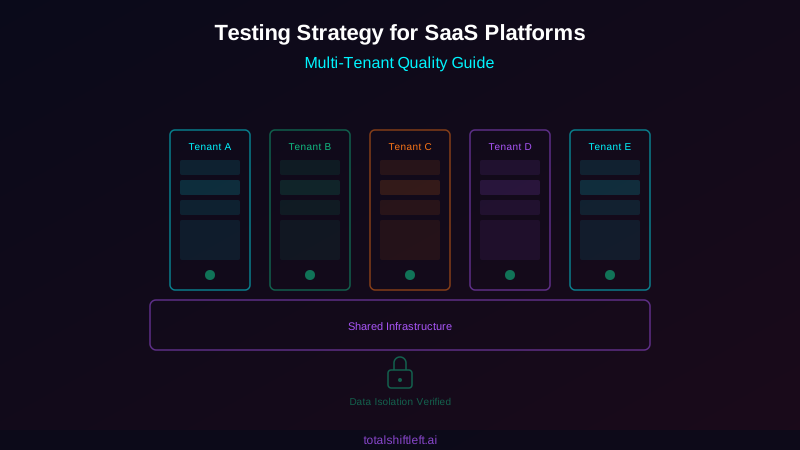
A SaaS testing strategy extends standard application testing with five multi-tenant-specific dimensions: tenant isolation (data, cache, and API access cannot leak across tenants), subscription tier feature gating, multi-tenant performance under noisy-neighbor load, zero-downtime deployment validation, and API version compatibility. Tenant isolation is the highest-priority dimension because a single leak can trigger breach notifications and regulatory penalties across every customer.
Reviewed by Sushant Joshi

A SaaS testing strategy is a comprehensive testing approach designed for multi-tenant software-as-a-service platforms. It addresses the unique quality challenges of serving multiple customers from a shared infrastructure: tenant data isolation, subscription tier feature gating, multi-tenant performance, zero-downtime deployments, and API stability for customer integrations.
SaaS platforms serve hundreds or thousands of customers from a single codebase and shared infrastructure. Every deployment affects every customer simultaneously. Every defect can expose one customer's data to another. Every performance regression degrades the experience for all customers. The stakes of SaaS testing are uniquely high because the blast radius of any defect is your entire customer base, and the trust violation of a data isolation failure can be existential.
Building a SaaS platform means building one product that must work correctly for every customer, at every scale, with every configuration, simultaneously. A defect in a single-tenant application affects one customer. A defect in a multi-tenant SaaS platform affects every customer. A data isolation failure in a single-tenant application is embarrassing. A data isolation failure in a multi-tenant SaaS platform is a security incident that triggers breach notifications and regulatory penalties.
The 2025 SaaS Operations report found that SaaS platforms with comprehensive multi-tenant testing strategies experience 73% fewer customer-impacting incidents and achieve 2.8 times higher customer retention rates than those that test without considering multi-tenancy. The investment in SaaS-specific testing pays for itself through reduced churn and lower incident response costs.
This guide provides a complete testing strategy for SaaS platform engineering teams. It covers the testing dimensions unique to SaaS: tenant isolation, subscription tier logic, multi-tenant performance, zero-downtime deployment validation, and API stability for customer integrations. Whether you are building a new SaaS platform or hardening an existing one, this strategy addresses the quality challenges that generic software testing strategies do not cover.
In this guide
- What Is a SaaS Testing Strategy?
- Why SaaS Platforms Require Specialized Testing
- Key Components of a SaaS Testing Strategy
- SaaS Testing Architecture
- Tools for SaaS Platform Testing
- SaaS testing strategy in practice: a worked example
- SaaS testing strategy challenges and how to solve them
- SaaS testing strategy best practices
- SaaS Testing Strategy Checklist
- The tests only a multi-tenant platform needs
- SaaS testing strategy FAQ
What Is a SaaS Testing Strategy?
A SaaS testing strategy extends standard application testing with five SaaS-specific testing dimensions:
Tenant Isolation Testing: Validates that one tenant's data, configuration, and activity cannot be accessed by or leak to another tenant. This is the most critical testing dimension for SaaS platforms because isolation failures have legal, regulatory, and reputational consequences.
Subscription Tier Testing: Validates that features, usage limits, and capabilities are correctly gated based on the customer's subscription plan. This includes testing the boundaries between tiers, upgrade/downgrade transitions, and trial-to-paid conversions.
Multi-Tenant Performance Testing: Validates that the platform performs acceptably when many tenants are active simultaneously, including noisy neighbor scenarios where one tenant's heavy usage could degrade others' experience.
Zero-Downtime Deployment Testing: Validates that new deployments do not interrupt active customer sessions, cause data inconsistency, or degrade performance during rollout. SaaS customers expect 99.9%+ availability, which leaves no room for deployment-related downtime.
API Compatibility Testing: Validates that API changes do not break existing customer integrations. SaaS platforms expose APIs that customers build critical workflows on, and breaking changes directly cause customer churn. This is where Shift-Left API provides critical value by auto-generating comprehensive API tests from OpenAPI specifications.
These five dimensions layer on top of standard functional, performance, and security testing. A complete SaaS testing strategy addresses both the standard and SaaS-specific dimensions.
The layer definitions this rests on are set out in unit vs integration vs system testing.
Why SaaS Platforms Require Specialized Testing
Multi-Tenancy Multiplies Risk
In a single-tenant application, a bug affects one customer. In a multi-tenant SaaS platform, the same bug can affect thousands of customers simultaneously. The risk multiplier of multi-tenancy demands proportionally more rigorous testing. Every code path that handles tenant context—database queries, API authorization, caching, logging, file storage—must be tested for correct tenant isolation. Running your test suites under a multi-tenant architecture that mirrors production tenant boundaries is what makes these cross-tenant leakage checks realistic rather than theoretical.
Subscription Logic Is Business-Critical
Subscription tier enforcement directly impacts revenue. If a free-tier user can access premium features, you lose revenue. If a premium user is incorrectly blocked from paid features, you lose trust and face support escalations. Subscription logic permeates the entire application—APIs, UI, background jobs, data exports—and must be tested comprehensively across all touchpoints.
Customer Integrations Depend on API Stability
SaaS customers invest significant engineering effort integrating your APIs into their workflows. A breaking API change forces customers to modify their systems, creating friction and resentment. Customers evaluate SaaS platforms partly on API stability—platforms with frequent breaking changes lose to competitors with more stable interfaces. Your DevOps testing strategy must include API backward compatibility validation on every release.
Performance Is Shared Across Tenants
In multi-tenant architectures, tenants share compute, storage, and network resources. Without proper isolation, one tenant's heavy workload degrades performance for all others—the noisy neighbor problem. Performance testing must simulate realistic multi-tenant load patterns to identify and prevent resource contention.
Key Components of a SaaS Testing Strategy
Tenant Isolation Testing Suite
Build a dedicated test suite that validates tenant isolation across all data access paths:
- Database isolation: Execute queries as Tenant A and verify zero results belonging to Tenant B are returned. Test all query paths, including search, analytics, exports, and reports.
- API isolation: Call every API endpoint authenticated as Tenant A and verify that Tenant B's resources are inaccessible. Test both direct access (GET /tenant-b-resource) and indirect access (search queries that could return cross-tenant results).
- Cache isolation: Verify that cached data is properly scoped to the tenant. Test cache invalidation across tenant boundaries—updating Tenant A's data should not serve stale data to Tenant A from a cache keyed without tenant context.
- File storage isolation: Verify that uploaded files, generated reports, and exported data are accessible only to the owning tenant. Test signed URL generation, pre-signed download links, and storage bucket policies.
- Background job isolation: Verify that asynchronous jobs process only the triggering tenant's data. Test that job failures in one tenant's context do not affect other tenants' job processing.
Ready to shift left with your API testing?
Try our no-code API test automation platform free. Generate tests from OpenAPI, run in CI/CD, and scale quality.
Automate this suite using Shift-Left API to generate API-level isolation tests from your OpenAPI specifications, supplemented with custom tests for database, cache, and storage isolation.
Subscription Tier Testing Matrix
Create a test matrix that validates feature availability across all subscription tiers:
| Feature | Free | Starter | Professional | Enterprise |
|---|---|---|---|---|
| Basic API Access | Yes | Yes | Yes | Yes |
| Advanced Analytics | No | Limited | Yes | Yes |
| SSO | No | No | Yes | Yes |
| Custom Domains | No | No | No | Yes |
| API Rate Limit | 100/hr | 1K/hr | 10K/hr | Unlimited |
| Data Export | CSV | CSV+JSON | All formats | All formats |
Test every cell in this matrix. Test the boundaries: what happens when a free-tier user reaches exactly 100 API calls? What happens at 101? Test tier transitions: what happens to data and access when upgrading from Starter to Professional? What happens when downgrading?
Multi-Tenant Performance Testing
Design performance tests that simulate realistic multi-tenant load:
- Baseline load: Many tenants with normal usage patterns running concurrently.
- Noisy neighbor: One tenant generating extremely heavy load while others operate normally. Verify that noisy tenant is rate-limited or throttled without degrading other tenants.
- Spike handling: Sudden increase in tenant count or per-tenant load. Verify auto-scaling responds correctly.
- Resource saturation: Push the platform to resource limits and verify gr
aceful degradation, appropriate error responses, and no data corruption.
Zero-Downtime Deployment Testing
Validate deployment procedures do not interrupt customer operations:
- Deploy a new version while synthetic users maintain active sessions across multiple tenants.
- Verify no requests fail, no sessions are dropped, and no data inconsistency occurs during rolling deployment.
- Test database migration compatibility: the old and new application versions must coexist during the rollout window.
- Validate that feature flags enable progressive rollout without affecting tenants not targeted for the rollout.
API Versioning and Compatibility Testing
Test API versioning across all supported versions:
- Run the complete API test suite against each supported API version.
- Verify that deprecated endpoints still function correctly with deprecation warnings.
- Test that new API features do not affect the behavior of existing endpoints.
- Validate rate limiting, authentication, and authorization across API versions and tenant contexts.
SaaS Testing Architecture
The SaaS testing architecture adds tenant-aware layers to the standard testing architecture:
Layer 1: Unit Tests with Tenant Context — Unit tests that validate business logic correctly handles tenant context. Every function that takes a tenant ID must be tested with multiple tenant contexts to verify isolation. Mock tenant context at the boundary.
Layer 2: API Contract and Isolation Tests — Automated API tests that validate both contract compliance and tenant isolation simultaneously. Every API endpoint is tested with multiple tenant credentials, verifying correct responses and zero cross-tenant data leakage. Shift-Left API generates the contract tests; custom isolation assertions extend them.
Layer 3: Subscription Tier Integration Tests — Tests that validate feature gating across all tiers by provisioning test tenants at each subscription level and exercising all features. Verify correct access control, usage limit enforcement, and tier transition behavior.
Layer 4: Multi-Tenant Performance Tests — Load tests with realistic multi-tenant patterns including noisy neighbor scenarios, spike handling, and resource saturation. Run on a schedule (nightly or weekly) and on major releases.
Layer 5: Deployment Validation Tests — Synthetic user sessions that run continuously during deployment to verify zero downtime. Automated canary analysis that compares error rates between old and new versions during rollout.
Tools for SaaS Platform Testing
| Tool | Type | Best For | Open Source |
|---|---|---|---|
| Shift-Left API | API Testing | Multi-tenant API testing and contract validation | No |
| k6 | Performance Testing | Multi-tenant load simulation with scripting | Yes |
| Playwright | E2E Testing | Tenant-aware end-to-end workflow testing | Yes |
| OWASP ZAP | Security Testing | Cross-tenant security vulnerability scanning | Yes |
| LaunchDarkly | Feature Flags | Subscription tier and progressive rollout management | No |
| Pact | Contract Testing | API contract testing across versions | Yes |
| Grafana | Monitoring | Multi-tenant performance dashboards | Yes |
| Stripe Test Mode | Billing Testing | Subscription lifecycle and payment testing | No |
| Testcontainers | Integration Testing | Isolated database testing per tenant model | Yes |
| Sentry | Error Tracking | Tenant-scoped error monitoring and alerting | No |
| pgTAP / utPLSQL | Database Testing | Tenant isolation at the database query level | Yes |
| Artillery | Performance Testing | Multi-scenario load testing with tenant simulation | Yes |
SaaS testing strategy in practice: a worked example
Problem: A B2B SaaS platform serving 2,000 customers experienced a data isolation incident: a search query in the analytics feature returned results from a different tenant's dataset. The root cause was a missing tenant filter in a newly added Elasticsearch index. The incident triggered breach notifications to 15 affected enterprise customers, resulted in two customer churns, and required 200 hours of incident response and forensic analysis. Their testing strategy had no SaaS-specific tests—they tested features but not tenant isolation.
Solution: They implemented a comprehensive SaaS testing strategy:
- Built a tenant isolation test suite covering all data access paths: database, API, cache, Elasticsearch, file storage, and background jobs. Over 500 isolation-specific test cases.
- Adopted Shift-Left API to generate API tests that included multi-tenant authentication headers, verifying every endpoint for cross-tenant data access attempts.
- Created a subscription tier test matrix covering all feature and limit combinations across 4 tiers, with automated tests for tier transitions.
- Implemented multi-tenant performance testing using k6 with 50 simulated tenants running concurrent load patterns including noisy neighbor scenarios.
- Added deployment validation: synthetic users across 5 test tenants running continuously during deployments to detect zero-downtime violations.
- Implemented automated security scanning specifically targeting cross-tenant access vectors.
Results: Zero tenant isolation incidents in the 12 months following implementation (vs. 3 in the preceding year). Subscription tier bugs dropped by 90%. Deployment-related customer impact incidents dropped from 6 per year to 0. The company used the improved security posture as a sales differentiator, contributing to a 40% increase in enterprise deal closures. The testing investment paid for itself within the first quarter through reduced churn and increased enterprise revenue.
SaaS testing strategy challenges and how to solve them
Challenge: Testing Every Tenant Isolation Path
Multi-tenant applications have hundreds of data access paths. Testing every path for every tenant context is overwhelming.
Solution: Map all data access paths systematically: database queries, API endpoints, cache keys, file operations, search indices, and background jobs. Prioritize testing based on data sensitivity: paths handling PII, financial data, or authentication tokens get tested first. Use test automation strategy to automate isolation tests progressively, starting with the highest-risk paths.
Free Guided worksheet
Build Your Testing Strategy in 30 Minutes
A structured worksheet that walks you through defining your testing strategy in 30 minutes. Cover architecture, tools, layers, and team responsibilities.
Download FreeChallenge: Subscription Tier Combinatorial Complexity
Multiple tiers, features, and limits create a large test matrix.
Solution: Use pairwise testing to reduce the matrix size while covering the most important interactions. Focus exhaustive testing on the boundaries between tiers—the exact limits where features are enabled or disabled. Automate tier transition testing because manual transitions are slow and error-prone.
Challenge: Realistic Multi-Tenant Load Simulation
Simulating realistic multi-tenant load requires modeling diverse tenant behaviors.
Solution: Analyze production traffic patterns to identify tenant usage archetypes (light, medium, heavy, bursty). Create load test profiles for each archetype and mix them realistically. Use production traffic replay tools where possible. Start with a small number of simulated tenants and increase gradually.
Challenge: Zero-Downtime Testing in CI/CD
Testing zero-downtime deployments requires a running system with active users, which is difficult to simulate in CI/CD.
Solution: Maintain a dedicated deployment testing environment with continuous synthetic traffic. Deploy to this environment as part of the release pipeline. Use automated canary analysis tools that compare metrics between the old and new versions during rolling deployment. Flag any increase in error rates or latency.
Challenge: API Backward Compatibility Across Versions
Supporting multiple API versions while adding new features creates testing complexity.
Solution: Maintain separate test suites for each supported API version. Use Shift-Left API to generate version-specific tests from versioned OpenAPI specifications. Run all version test suites on every release. Implement automated detection of breaking changes using API schema comparison tools.
SaaS testing strategy best practices
- Treat tenant isolation testing as a first-class security requirement, not a functional afterthought
- Automate multi-tenant API testing with Shift-Left API to cover all endpoints for cross-tenant access violations
- Build a subscription tier test matrix and automate it completely—manual tier testing is too slow and error-prone
- Simulate realistic multi-tenant load including noisy neighbor scenarios in performance testing
- Validate zero-downtime deployments with continuous synthetic traffic during every deployment
- Test API backward compatibility on every release across all supported API versions
- Map all data access paths and prioritize isolation testing by data sensitivity
- Implement tenant-scoped monitoring and alerting so that tenant-specific issues are detected quickly
- Test tier transitions bidirectionally—upgrade and downgrade paths both need validation
- Use feature flags for progressive rollout and test the flag evaluation logic across tenant contexts
- Include shift-left testing practices to catch isolation defects during code review rather than post-deployment
- Conduct quarterly security audits focused specifically on multi-tenant isolation vectors
SaaS Testing Strategy Checklist
- ✔ Build and automate tenant isolation test suite covering database, API, cache, storage, and jobs
- ✔ Implement automated API testing with multi-tenant authentication using Shift-Left API
- ✔ Create subscription tier test matrix covering all feature and limit combinations
- ✔ Automate subscription tier transition testing (upgrade, downgrade, trial-to-paid)
- ✔ Implement multi-tenant performance testing with noisy neighbor scenarios
- ✔ Validate zero-downtime deployments with synthetic traffic during rollouts
- ✔ Test API backward compatibility across all supported versions
- ✔ Implement tenant-scoped security scanning and penetration testing
- ✔ Set up tenant-scoped monitoring, alerting, and error tracking
- ✔ Test rate limiting and usage quota enforcement across all tiers
- ✔ Validate feature flag behavior across tenant and tier contexts
- ✔ Document the SaaS testing strategy and review quarterly
- ✔ Conduct annual third-party security audit focused on tenant isolation
- ✔ Track SaaS-specific quality metrics: isolation incidents, tier defects, deployment impact
The tests only a multi-tenant platform needs
Everything a single-tenant application tests, a SaaS platform tests too — plus the tenancy boundary, which is the failure mode that ends a SaaS business rather than causing a bad week:
# tests/test_tenancy.py
import pytest, itertools

RESOURCES = ["/v1/orders", "/v1/invoices", "/v1/reports", "/v1/users"]

@pytest.mark.parametrize("resource", RESOURCES)
def test_no_resource_leaks_across_tenants(api_a, api_b, resource, seeded_ids):
    """Every object created by tenant A must be invisible to tenant B."""
    for object_id in seeded_ids[resource]["tenant_a"]:
        r = api_b.get(f"{resource}/{object_id}")
        assert r.status_code in (403, 404), f"{resource}/{object_id} leaked to tenant B"

@pytest.mark.parametrize("resource", RESOURCES)
def test_list_endpoints_are_tenant_scoped(api_b, resource, seeded_ids):
    ids = {item["id"] for item in api_b.get(resource).json()["items"]}
    assert not (ids & set(seeded_ids[resource]["tenant_a"]))

def test_noisy_neighbour_is_rate_limited_per_tenant(api_a, api_b):
    """Tenant A exhausting its quota must not degrade tenant B."""
    for _ in range(200):
        api_a.get("/v1/reports?heavy=true")
    assert api_b.get("/v1/orders").status_code == 200

def test_tenant_scoped_feature_flags_do_not_bleed(api_a, api_b, flags):
    flags.enable("new-checkout", tenant="tenant-a")
    assert api_a.get("/v1/features").json()["new-checkout"] is True
    assert api_b.get("/v1/features").json()["new-checkout"] is False
Run the leak test against every resource automatically rather than a hand-picked list — a new endpoint added without tenant scoping is the way this bug actually ships:
# enumerate resources from the spec so the test list cannot fall behind
yq -r '.paths | keys[] | select(test("\\{[a-zA-Z]+\\}$"))' openapi.yaml > tests/tenant_resources.txt
SaaS testing strategy FAQ
What is SaaS testing strategy?
A SaaS testing strategy is a testing approach designed for multi-tenant software-as-a-service platforms. It addresses SaaS-specific concerns including tenant data isolation, subscription tier feature gating, multi-tenant performance under load, zero-downtime deployments, and API versioning for diverse customer integrations.
How do you test multi-tenant isolation?
Test multi-tenant isolation at three levels: data isolation (one tenant cannot access another's data), resource isolation (one tenant's load does not degrade another's performance), and configuration isolation (one tenant's settings do not affect another). Use penetration testing, load testing with multiple simulated tenants, and automated API tests that attempt cross-tenant data access.
What is subscription tier testing?
Subscription tier testing validates that features are correctly gated based on the customer's subscription plan. It ensures that free-tier users cannot access premium features, that usage limits are enforced correctly, and that upgrading or downgrading a subscription immediately enables or disables the correct features.
How do you performance test a SaaS platform?
Performance test a SaaS platform by simulating realistic multi-tenant load: many tenants with varying usage patterns running concurrently. Test noisy neighbor scenarios where one tenant's heavy usage affects others. Validate that rate limiting, resource quotas, and auto-scaling work correctly under pressure.
Why is API testing critical for SaaS platforms?
SaaS platforms expose APIs that customers integrate into their workflows. Breaking API changes cause customer churn. API testing with tools like Shift-Left API ensures backward compatibility, validates rate limiting and authentication, and verifies that API behavior is consistent across tenant contexts and subscription tiers.
Sources and further reading
- Google SRE Workbook — Implementing SLOs — how to define SLOs and error budgets.
- OWASP API Security Top 10 (2023) — the reference list of API risk categories.
- DORA State of DevOps research — the multi-year dataset behind the four delivery metrics.
Key takeaways
- SaaS platforms carry unique quality responsibilities. When you serve thousands of customers from shared infrastructure, every defect has an amplified impact, every isolation failure is a security incident, and every breaking API change erodes customer trust.
- A generic testing strategy is insufficient—you need a strategy that explicitly addresses multi-tenancy, subscription tiers, shared performance, and API stability.
- Start with tenant isolation testing—it is the highest-priority and highest-consequence testing dimension.
- Automate API testing across tenant contexts and subscription tiers. Simulate realistic multi-tenant load to validate performance under pressure.
- Test every deployment for zero-downtime compliance.
If you are ready to automate API testing for your SaaS platform with multi-tenant awareness, start your free trial of Shift-Left API and generate comprehensive API tests that validate both contract compliance and tenant isolation.
Related: DevOps Testing Complete Guide | Software Testing Strategy for Modern Applications | Enterprise Testing Strategy Guide | Test Automation Strategy | What Is Shift Left Testing? | How to Build a Test Automation Framework
Ready to shift left with your API testing?
Try our no-code API test automation platform free.