
API Test Plan Template: Free Fill-In Plan and Strategy
Quick answer
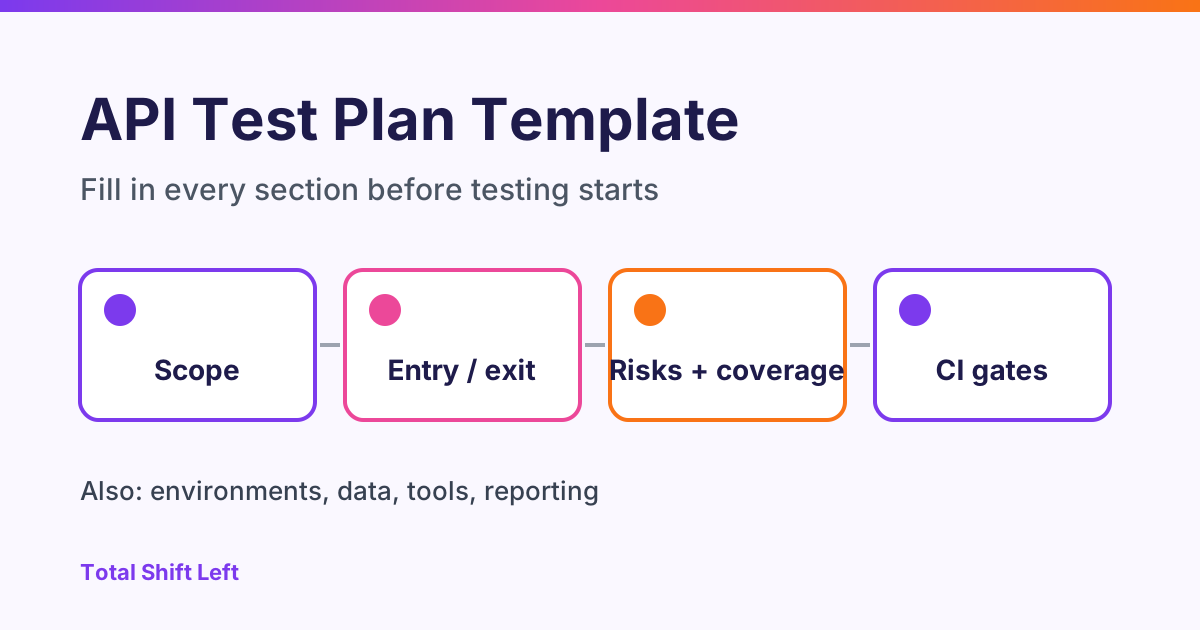
An API test plan template is a fill-in document that fixes the scope, environments, entry and exit criteria, risks, coverage targets, test data, tools, CI gates and reporting for testing one API or release. Copy the tables below or download the Markdown file, replace every bracketed field, and review the plan with development and product before testing starts.
Reviewed by Parveen Kumari
Part of the Shift-Left, DevOps & QA Strategy hub. Start with the pillar guide: What is shift-left testing?.
An API test plan template gives you a fixed set of sections to fill in before testing an API: what is in scope, where you test, when testing can start and stop, what could go wrong, how much coverage you need, which data and tools you use, which CI gates block a release, and how results are reported. This page gives you the whole template as fill-in tables, a worked example and a one-page API test strategy. You can also download the template as a Markdown file.
The plan applies a wider testing approach to one API or release. If you haven't set that approach yet, start with our guide to software testing strategy for modern applications, then come back and fill this in.
What is an API test plan?
An API test plan is a short, agreed document that says how one API, version or release will be tested and how the team will decide it is ready. It turns a general strategy into specifics: named endpoints, named environments, named owners, dates and numbers.
People often mix up the plan and the strategy. The difference matters, because writing a fresh strategy for every release wastes time, and skipping the plan leaves exit criteria up to whoever is on call.
| API test strategy | API test plan | |
|---|---|---|
| Scope | All APIs in a product or organization | One API, version, release or project |
| Lifespan | Long-lived, reviewed once or twice a year | One release or project |
| Answers | Which test levels, tools, standards and gates we use | What exactly we test this time, where, by whom, by when |
| Owner | QA lead or head of engineering | Test lead for the release |
| Example line | "Every API has contract tests generated from its OpenAPI spec" | "Contract tests for Orders API v2.3 run in staging-eu from 3 Nov" |
Standards such as ISO/IEC/IEEE 29119-3 define test plan contents in detail. The template below keeps the parts that change decisions for API teams and drops the rest.
How to use this API test plan template
- Copy the template below, or download the Markdown version and commit it next to the API's OpenAPI spec (for example
docs/test-plan.md). - Fill in the scope from the spec, not from memory. List each operation (
GET /orders/{id}) and mark it in or out of scope. - Write the risk register next, before coverage targets. Risk tells you where to spend effort.
- Set numbers for the entry and exit criteria. "Most tests pass" is not an exit criterion; "no open critical or high defects" is.
- Map each gate to a CI job. If a gate can't be checked automatically, name the person who checks it.
- Review the plan with development and product in a 30-minute meeting. Changes after that go in the change log.
- Update it when scope changes, and close it with a short summary report when the release ships.
Need a number for the business case? Before you set coverage targets, estimate what manual API regression costs you today with the free test automation ROI calculator. The result is a useful line for the "Objectives" row in section 1.
The API test plan template
Replace everything in [brackets]. Delete rows that don't apply rather than writing "N/A" everywhere.
1. Document control and objectives
| Field | Value |
|---|---|
| API and version | [Orders API v2.3] |
| Spec location | [repo/path/openapi.yaml @ commit or tag] |
| Release or milestone | [Release 2026.11] |
| Test lead | [Name] |
| Approvers | [Engineering lead, Product owner] |
| Objectives | [e.g. Verify new refund endpoints; no regression on v2.2 behaviour; p95 latency within SLO] |
| Plan version and date | [1.0, YYYY-MM-DD] |
2. Scope
| Item | In scope | Out of scope | Notes |
|---|---|---|---|
| Operations | [All operations tagged orders, refunds] | [/admin/*] | [Admin covered by separate plan] |
| API versions | [v2.3; v2.2 for backward compatibility] | [v1 (retired)] | |
| Protocols | [REST/JSON] | [Legacy SOAP endpoint] | |
| Consumers | [Web app, mobile app, partner X] | [Partner contract tests required] | |
| Integrations | [Payments provider sandbox, email service mock] | [Live payments] | |
| Test types | [Functional, contract, integration, regression, performance, security] | [Usability] |
3. Test approach by level
| Level | What it checks | How (tool or method) | Owner | When it runs |
|---|---|---|---|---|
| Contract / schema | Responses match the OpenAPI spec; breaking changes blocked | [Generated from spec] | [Dev] | Every PR |
| Functional | Status codes, business rules, validation, errors, state changes | [pytest / REST Assured / generated suite] | [QA] | Every PR |
| Integration | Calls across services, databases, queues | [Docker Compose / staging] | [QA + Dev] | Merge to main |
| Regression | Previously working behaviour still works | [Full functional + contract suite] | [QA] | Nightly and pre-release |
| Performance | Latency, throughput, error rate under load | [k6 / JMeter / platform add-on] | [Perf engineer] | Pre-release |
| Security | OWASP API Top 10 risks, auth, rate limits | [DAST / security checks] | [AppSec] | Pre-release and weekly |
| Exploratory | Unscripted sessions on new features | [Charters, timeboxed] | [QA] | Per feature |
4. Environments
| Environment | URL | Data | Dependencies | Who can deploy | Use |
|---|---|---|---|---|---|
| Local | [localhost:8080] | Seeded fixtures | Mocks | Developer | Unit, contract, functional |
| CI ephemeral | [per-PR URL] | Seeded on start | Mocks + containers | Pipeline | PR gates |
| Staging | [https://staging.example.com] | Masked copy, refreshed [weekly] | Sandboxes | Release pipeline | Integration, regression, performance |
| Production | [https://api.example.com] | Real | Real | Release manager | Smoke and monitoring only |
Ready to shift left with your API testing?
Try our no-code API test automation platform free. Generate tests from OpenAPI, run in CI/CD, and scale quality.
5. Entry and exit criteria
| Type | Criterion | Measured by |
|---|---|---|
| Entry | Spec for the release merged and linted with no errors | Linter job |
| Entry | Build deployed to staging and smoke suite green | CI job |
| Entry | Test data and accounts for every role available | Checklist |
| Exit | 100% of planned critical and high-priority tests executed | Test report |
| Exit | No open critical or high defects, or each waived in writing by [approver] | Defect tracker |
| Exit | Every in-scope operation has at least one positive and one negative test | Coverage report |
| Exit | Contract tests green against the published spec | CI job |
| Exit | p95 latency ≤ [300 ms] and error rate ≤ [0.1%] at [200] requests per second | Performance report |
| Exit | No new high or critical security findings | Security report |
| Suspend | Smoke suite failing or environment down for more than [4 hours] | On-call |
6. Risk register
Score likelihood and impact from 1 to 3; multiply for priority. Test the highest scores first and deepest.
| ID | Risk | Likelihood | Impact | Score | Mitigation (tests) |
|---|---|---|---|---|---|
| R1 | Refund amount calculated wrongly | 2 | 3 | 6 | Decision-table tests on refund rules; reconciliation check |
| R2 | Breaking change for mobile app | 2 | 3 | 6 | Contract tests on every PR; consumer tests for mobile |
| R3 | Customer reads another customer's order | 1 | 3 | 3 | Two-user authorization tests on every {id} operation |
| R4 | Latency spike under month-end load | 2 | 2 | 4 | Load test at 2× expected peak |
| R5 | Payments sandbox unavailable | 3 | 1 | 3 | Mock payments provider for PR gates |
7. Coverage targets
| Dimension | Target | Notes |
|---|---|---|
| Operations with at least one test | 100% | From the spec |
| Operations with positive and negative tests | 100% | |
| Documented status codes asserted | [≥ 90%] | |
| Required fields with a "missing" test | 100% | |
Field constraints (min/max, pattern, enum) with a boundary test | [≥ 80%] | |
| Requirements with at least one linked test | 100% | Traceability matrix |
| Risks scored 6 or more with a dedicated test | 100% | From section 6 |
For how to measure these, see how to measure API test coverage.
8. Test data
| Data set | Source | Refresh | Owner | Sensitive data handling |
|---|---|---|---|---|
| Customer accounts for each role | Seed script | Every run | QA | Synthetic only |
| Product catalogue | Masked production subset | Weekly | Data team | Masked, no PII |
| Payment cards | Provider's published test numbers | Static | QA | Never real cards |
| Boundary and negative values | Generated from spec | Every run | QA | n/a |
See test data management best practices for masking and refresh options.
9. Tools
| Purpose | Tool | Version or plan | Owner |
|---|---|---|---|
| Spec linting | [Spectral] | [x.y] | Dev |
| Functional and contract tests | [pytest / REST Assured / Shift-Left API] | QA | |
| Mocks | [WireMock / Prism / platform mock server] | Dev | |
| Performance | [k6 / JMeter] | Perf | |
| Security | [ZAP / security add-on] | AppSec | |
| Test management | [Jira + Xray / Azure Test Plans / TestRail] | QA | |
| CI | [GitHub Actions / Jenkins / Azure DevOps] | DevOps |
10. CI quality gates
| Stage | Trigger | Jobs | Blocks | Time budget |
|---|---|---|---|---|
| Pull request | Every push | Lint spec, contract tests, functional smoke | Merge | [≤ 10 min] |
| Merge to main | Merge | Full functional, integration | Deploy to staging | [≤ 30 min] |
| Nightly | Schedule | Full regression, security checks | Next day's release | [≤ 2 h] |
| Pre-release | Release tag | Performance, security, exit-criteria report | Production deploy | [≤ 4 h] |
11. Reporting and defects
| Item | Value |
|---|---|
| Run results | [JUnit XML in CI; dashboard link] |
| Daily status | [Channel / time] |
| Defect tracker | [Jira project / board] |
| Severity definitions | Critical: data loss, security breach or outage. High: core flow broken, no workaround. Medium: workaround exists. Low: cosmetic. |
| Test summary report | At exit: scope tested, results, open defects, waivers, risks remaining |
12. Roles and schedule
| Role | Name | Responsibilities |
|---|---|---|
| Test lead | [Name] | Plan, report, sign-off recommendation |
| QA engineers | [Names] | Design, automate, execute |
| Developers | [Names] | Unit and contract tests, fixes |
| Product owner | [Name] | Accept risk waivers, approve exit |
| Milestone | Date |
|---|---|
| Plan approved | [YYYY-MM-DD] |
| Test complete | [YYYY-MM-DD] |
| Go/no-go | [YYYY-MM-DD] |
Example: a filled-in API test plan (excerpt)
Here is what a lean, filled-in plan looks like for a single feature release. It is a composite example, not a customer's real plan.
Orders API v2.3, Release 2026.11. Objective: ship partial refunds without regressions on v2.2 behaviour.
Free PDF (10 pages)
Shift Left Testing Playbook
Move testing earlier in your SDLC with a proven adoption roadmap. Includes CI/CD architecture, tool stack recommendations, and metrics to track success.
Download Free- Scope: 4 new operations under
/orders/{id}/refunds, plus regression on the 18 existingordersoperations. Admin endpoints are out of scope. - Top risks: R1 refund maths (score 6), R2 breaking the mobile app (6), R3 cross-customer access (3).
- Approach: contract tests generated from the spec on every PR; 42 functional tests for refunds, including a decision table for full, partial and repeated refunds; two-user authorization tests for every
{id}route; a 30-minute load test at twice month-end peak. - Exit: all 42 refund tests pass, no open high defects, every operation has positive and negative tests, p95 under 300 ms at 200 requests per second, no new high security findings.
- Gates: PR (lint, contract, smoke, 7 minutes), main (full functional, 18 minutes), pre-release (performance and security).
The whole plan fits on three pages. The detailed test cases live in the test management tool and link back to the risk IDs.
API test strategy template: the one-page version
If you need a test strategy for API testing across many services, keep it to one page that every plan can point to. Fill in this table once and review it twice a year.
| Area | Your standard |
|---|---|
| Source of truth | [Every API has an OpenAPI spec in its repo; tests are planned from it] |
| Test levels | [Contract, functional, integration, regression, performance, security] |
| Automation policy | [All functional and contract tests automated; manual only for exploratory] |
| Where tests run | [PR: contract + smoke; main: full; nightly: regression + security; release: performance] |
| Definition of done | [New operation ships with positive, negative and boundary tests and an updated spec] |
| Test data policy | [Synthetic by default; masked production data only in staging; no real PII in CI] |
| Environments | [Ephemeral per PR; shared staging; production smoke only] |
| Quality gates | [No merge on red contract tests; no release with open critical or high defects] |
| Metrics | [Operation coverage, escaped defects, flaky-test rate, time to feedback] |
| Tooling | [Approved tools per purpose] |
| Ownership | [Teams own tests for their APIs; QA owns standards and shared tooling] |
This is where a shift-left approach pays off: when tests are planned from the spec before code is merged, the plan for each release only has to list what changed. That is the model behind shift-left API testing, where suites are generated from the spec and run as PR gates in GitHub Actions, Jenkins or Azure DevOps. For multi-service systems, see API testing strategy for microservices and risk-based testing.
Common API test plan mistakes
- Copying the scope from the last release. Scope comes from the current spec. Diff the spec against the last release and list what changed.
- Exit criteria without numbers. "Acceptable quality" can't be checked. Every exit row needs a threshold and a source.
- No risk register. Without one, effort spreads evenly and the riskiest flow gets the same attention as a health check.
- Gates that exist only on paper. If a gate isn't a CI job, or a named person's sign-off, it won't happen at 6 p.m. on release day.
- Production data in test environments. Use synthetic or masked data, and say so in section 8.
- A plan nobody updates. Keep the plan in the repository so scope changes show up in pull requests.
API test plan template FAQ
What should an API test plan include?
Scope (which APIs, versions and operations are in and out), environments, the test approach by level, entry and exit criteria, a risk register, coverage targets, test data, tools, CI quality gates, reporting, roles and a schedule. The template in this article has a table for each one.
What is the difference between an API test plan and an API test strategy?
A test strategy is the long-lived approach for all your APIs: which test levels you use, which tools, what "done" means, and how tests run in CI. A test plan applies that strategy to one API, release or project, with concrete scope, dates, owners, environments and exit criteria. Most teams keep one strategy and write many plans.
How long should an API test plan be?
As short as it can be while still answering who tests what, where, with which data, and how you decide it is ready to ship. For one API release that is usually two to five pages. If nobody reads it, cut it; the tables matter more than the prose.
What are good exit criteria for API testing?
All planned critical and high-priority tests executed, no open critical or high defects (or each one waived in writing), 100 percent of documented operations covered by at least one positive and one negative test, contract tests green against the published spec, and performance and security results within the agreed thresholds.
Can I keep an API test plan in Jira or Azure DevOps?
Yes. Many teams keep the plan document in a wiki or the repository and track the test cases and runs in Jira with a test management app such as Xray or Zephyr, or in Azure Test Plans. Link the plan to the epic or release so scope changes are visible.
Sources and further reading
- ISO/IEC/IEEE 29119: the software testing standards series; part 3 covers test documentation, including test plans.
- ISTQB Glossary: definitions of test plan, test strategy, entry and exit criteria.
- OpenAPI Specification: the source for in-scope operations and constraints.
- Azure Test Plans documentation: managing test plans and suites in Azure DevOps.
- Google SRE Book: Service Level Objectives: how to set the latency and error thresholds used in exit criteria.
- Download the API test plan template (Markdown)
Ready to shift left with your API testing?
Import your OpenAPI spec and get a runnable test suite, in our cloud or on your own infrastructure.