
Black Box vs White Box Testing: Differences & Examples
Quick answer
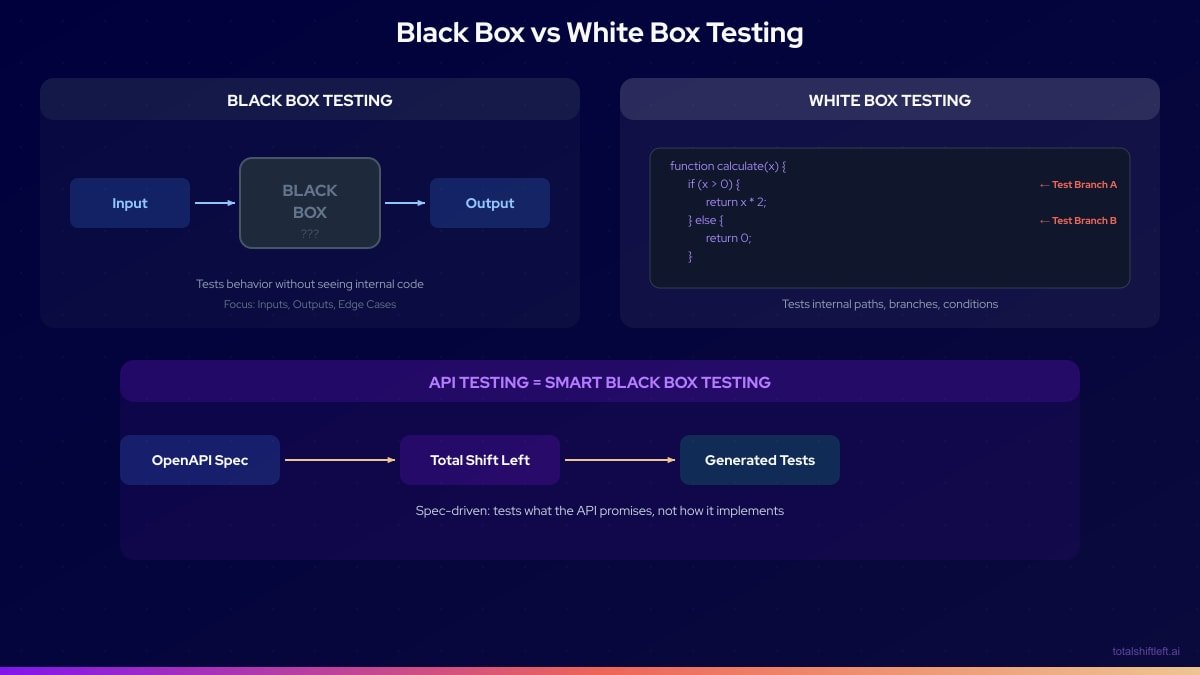
Black box testing validates software from outside, through inputs and outputs only; API testing works this way, checking the implementation against the OpenAPI spec without reading code. White box testing uses internal code knowledge to exercise branches and paths, as unit tests do. Grey box testing uses partial internal knowledge to design smarter black-box tests. All three are complementary.
Reviewed by Rishi Gaurav

Part of the Shift-Left, DevOps & QA Strategy hub. Start with the pillar guide: What is shift-left testing?.
Black box testing vs white box testing compares two fundamental software testing approaches. Black box testing validates behavior from the user's perspective without examining source code, while white box testing uses internal code knowledge to verify logic paths and data flows. Together, they provide comprehensive defect coverage across applications.
Black box testing and white box testing represent two complementary philosophies for validating software quality. Black box testers care only about inputs and outputs—they validate behavior against specifications without looking inside the implementation. White box testers use knowledge of the internal structure to design tests that exercise specific code paths, branches, and logic flows. Understanding both approaches, when each is appropriate, and how they complement each other is essential for any team building a comprehensive shift left testing strategy. This guide provides a 10-row comparison table, clear guidance on when each approach is appropriate, and explains why API testing with Shift-Left API represents black box testing at its most powerful and scalable.
The terms "black box" and "white box" testing were established by computer scientists in the 1970s to describe two fundamentally different testing philosophies. Fifty years later, the distinction remains one of the most practically important in software quality engineering—particularly as modern architectures have shifted business logic from monolithic application layers into API services that are naturally tested from the outside.
Black box testing is the dominant paradigm for QA teams, acceptance testing, and API testing. White box testing is the dominant paradigm for developer unit testing, code coverage analysis, and security penetration testing. Both have essential roles; neither can replace the other.
The most consequential development for this distinction in recent years is the rise of API-first architectures. When your application's business logic lives in REST APIs documented by OpenAPI specifications, black box testing becomes both natural and powerful: the specification defines the contract, and tests validate that the implementation honors that contract without any knowledge of how the service is built internally. Shift-Left API operationalizes this at scale—generating complete API test suites from OpenAPI specifications without requiring any knowledge of internal service implementation.
In this guide
- What Is Black Box Testing?
- What Is White Box Testing?
- Grey Box Testing: The Middle Ground
- Why the Distinction Matters
- Key Techniques for Each Approach
- Black vs. White Box Testing Architecture
- 10-Row Comparison Table
- APIs and the Black Box Perspective
- Black box and white box testing in practice: a worked example
- Black box and white box testing challenges and how to solve them
- Best Practices for Combining Both Approaches
- Testing Strategy Checklist
- The same bug, found two ways
- Frequently asked questions about black box and white box testing
What Is Black Box Testing?
Black box testing validates software behavior from the external perspective, treating the system under test as an opaque box: inputs go in, outputs come out, and the tester evaluates outputs against specifications without any knowledge of or access to the internal implementation.
The "black box" metaphor is precise: the tester cannot see inside. They know what the system is supposed to do (from requirements, user stories, or API specifications) and they observe what it actually does (outputs, responses, UI state). The gap between specification and behavior is where black box testing finds defects.
Core Characteristics of Black Box Testing
- Specification-driven: Tests are derived from requirements, user stories, or API contracts
- Implementation-agnostic: Tests do not change when internal implementation changes (only when behavior changes)
- User-perspective: Tests validate what users and consumers actually experience
- No source code access required: QA engineers can write black box tests without programming skills
Black Box Testing Types
Equivalence Partitioning: Divides valid and invalid input ranges into equivalence classes. If a field accepts integers 1–100, equivalence classes are: negative numbers (invalid), 0 (invalid), 1–100 (valid), >100 (invalid). Test one value from each class.
Boundary Value Analysis: Tests at the boundaries between equivalence classes. If valid range is 1–100, test: 0, 1, 2, 99, 100, 101. Boundaries are where off-by-one errors typically occur.
Decision Table Testing: Tests all combinations of conditions and their expected outcomes. Used for complex business rules with multiple conditions.
State Transition Testing: Tests that the system moves through valid states correctly in response to inputs and events.
Error Guessing: Based on experience, the tester guesses likely error locations and designs tests for those scenarios.
Exploratory Testing: Unscripted investigation of the system's behavior, guided by the tester's knowledge and intuition.
Black Box Testing in Software Layers
Black box testing applies at every layer:
- UI black box testing: Validate that the user interface behaves correctly from the user's perspective (Playwright, Cypress)
- API black box testing: Validate that API endpoints return correct responses for given inputs (Shift-Left API, Postman)
- System black box testing: Validate that the complete system meets functional requirements
- Acceptance testing: Validate that the system meets stakeholder acceptance criteria
For where each test level starts and stops, see unit vs integration vs system testing.
What Is White Box Testing?
White box testing (also called "clear box," "glass box," or "structural testing") validates software by designing test cases based on knowledge of the internal implementation—the code structure, logic branches, algorithms, and data flows.
White box testers have access to source code and use that knowledge to design tests that exercise specific code paths, ensure that all branches are covered, and verify that internal logic behaves correctly. The goal is not just to verify observable behavior but to ensure that the code structure is correct and fully exercised.
Core Characteristics of White Box Testing
- Implementation-driven: Tests are derived from code structure (branches, conditions, loops)
- Coverage-oriented: Success is measured by code coverage metrics (line, branch, path coverage)
- Developer-centric: Typically written by developers who understand the code
- Source code access required: Cannot be performed without implementation visibility
White Box Testing Types
Statement Coverage: Every executable statement in the code is executed at least once.
Branch Coverage: Every branch of every decision point (if/else, switch) is executed at least once.
Path Coverage: Every unique execution path through the code is tested. For complex code, this can be exponentially large.
Condition Coverage: Every boolean sub-condition in every compound condition is evaluated as both true and false.
Modified Condition/Decision Coverage (MC/DC): Used in safety-critical systems (aviation, medical devices). Every condition independently affects each decision outcome.
Loop Testing: Tests all loop boundaries: zero iterations, one iteration, maximum iterations.
White Box Testing in Software Layers
- Unit testing: The most common white box testing—testing individual functions with knowledge of their internal logic
- Code coverage analysis: Measuring which lines and branches are exercised by the test suite
- Static analysis: Analyzing code structure without executing it
- Security white box testing: Code review and penetration testing with source code access
Grey Box Testing: The Middle Ground
Grey box testing uses partial internal knowledge — architecture diagrams, data models, or API contracts — to design smarter black-box tests, without full source-code access. It sits between the two extremes: more informed than pure black box, less invasive than white box.
A concrete API example: a tester who has read the service's OpenAPI spec and knows from the architecture that GET /orders/{id} is backed by a cache with a 60-second TTL can design a grey-box test that checks for stale-read behavior immediately after an update — a test case a pure black-box tester (who only sees the contract) would never think to write, and one a white-box unit test (scoped to a single function) wouldn't catch either, because the bug only appears at the integration boundary between the cache and the database.
Ready to shift left with your API testing?
Try our no-code API test automation platform free. Generate tests from OpenAPI, run in CI/CD, and scale quality.
Grey box testing is common in:
- Integration testing — knowing the database schema or message-queue topology without reading application code
- Contract testing — the consumer knows the pact/contract but not the producer's implementation
- Security testing — penetration testers given API documentation and a network diagram, but not source code, to simulate a semi-informed attacker
- Performance testing — knowing which endpoints hit a cache, a slow join, or an external API, without reading the code that implements them
Why the Distinction Matters
Different Defect Classes
Black box finds:
- Requirement gaps: functionality not specified but needed
- Incorrect external behavior: the system does the wrong thing from the user's perspective
- Missing input validation: invalid inputs accepted when they should be rejected
- Security vulnerabilities from the attacker's perspective (attack surface exploration)
- Interface contract violations: responses that do not match specifications
- Usability issues: the system does the right thing in the wrong way
White box finds:
- Unexercised code paths: dead code, unreachable branches
- Incorrect logic in conditionals: off-by-one errors, wrong operator, missing condition
- Variable initialization errors: uninitialized variables, null pointer risks
- Algorithm correctness: wrong implementation of correct specification
- Security vulnerabilities from the inside: privilege escalation paths, injection points
Neither approach finds all defects. A system can pass complete black box testing while containing internal logic errors in unexercised paths. A system can achieve 100% code coverage while failing to implement requirements correctly. Both approaches are necessary.
The Coverage Paradox
100% code coverage does not mean 100% correctness. A trivial test that calls every function without meaningful assertions can achieve 100% coverage while missing every behavior defect. Conversely, a comprehensive black box test suite can achieve high behavioral coverage while leaving entire sections of code unexercised.
The solution is not to choose one metric over the other—it is to use both as complementary indicators. Code coverage (white box) tells you what code is exercised. Behavior coverage (black box) tells you what behavior is validated.
Key Techniques for Each Approach
Black Box Testing Techniques
| Technique | When to Use | Example |
|---|---|---|
| Equivalence Partitioning | Any input field with valid/invalid ranges | Age field: <0 (invalid), 0-120 (valid), >120 (invalid) |
| Boundary Value Analysis | Numeric fields, string length limits | Max 100 chars: test 99, 100, 101 |
| Decision Table | Complex business rules | Discount calculation based on membership + order size |
| State Transition | Multi-step workflows | Order: Created → Paid → Shipped → Delivered |
| Error Guessing | High-risk areas known from experience | Authentication: SQL injection, empty credentials |
| Exploratory Testing | New features, high-risk areas | Session-based exploration with charter |
Most of these techniques are mechanical once the input domain is known, which is why they automate well at the API layer. Shift-Left API's test strategy fan-out applies boundary values, equivalence classes, decision tables and authentication depth to each endpoint, deriving the input domain from the spec and, where you supply them, the business and requirement documents behind it. Each potential issue gets a business-impact severity, so the black-box suite says not just "this failed" but how much it matters. Error guessing and exploratory testing stay with people.
White Box Testing Techniques
| Technique | Coverage Target | When to Use |
|---|---|---|
| Statement Coverage | All statements executed | Minimum baseline for all code |
| Branch Coverage | All branches taken | Logic-heavy code with conditions |
| Path Coverage | All paths traversed | Critical algorithms |
| MC/DC | All conditions affect decisions | Safety-critical code |
| Loop Testing | All loop boundary conditions | Iterative algorithms |
| Static Analysis | All code scanned | Security-sensitive code, any production code |
Black vs. White Box Testing Architecture
10-Row Comparison Table
| Dimension | Black Box Testing | Grey Box Testing | White Box Testing |
|---|---|---|---|
| Knowledge of internals | None required — external perspective only | Partial — architecture, schema, or contract knowledge | Required — tests derived from code structure |
| Test design basis | Requirements, specifications, user stories | Specs plus architecture/data-model awareness | Source code, control flow, data flow |
| Primary practitioner | QA engineers, product owners | Integration testers, security testers, SDETs | Developers |
| Code access required | No | No (diagrams/schema instead) | Yes |
| Coverage metric | Requirement/behavior coverage | Behavior coverage, informed by known integration points | Line, branch, path, condition coverage |
| Defects caught | Requirement gaps, wrong behavior, security from outside | Integration-boundary bugs (caching, schema, contract mismatches) | Logic errors, unreachable code, incorrect algorithms |
| Implementation coupling | Low — tests survive refactoring | Low-to-medium — coupled to architecture, not code | High — tests may break on refactoring |
| Applicability to APIs | Native — APIs are defined by contracts (OpenAPI) | Common — contract testing, cache/DB-aware negative tests | Possible via code analysis but not standard for API consumers |
| Automation accessibility | High — no coding needed (TSL for APIs) | Medium — needs some architectural context | Requires programming expertise |
| Security testing | Attack surface exploration, input fuzzing | Semi-informed penetration testing (docs + network diagram) | Source code vulnerability analysis |
APIs and the Black Box Perspective
APIs represent the most natural domain for black box testing in modern software. An API is, by design, a contract: it specifies exactly what inputs it accepts and exactly what outputs it produces. The internal implementation is irrelevant to API consumers—they care only about the contract.
This makes API testing a canonical black box activity:
- The specification (OpenAPI/Swagger) defines the contract
- The tests send inputs as specified and validate outputs as specified
- The implementation can be in any language, any framework, any database—the tests do not care
This also explains why Shift-Left API's approach to API testing is powerful: it generates tests from the OpenAPI specification (the black box contract), not from the implementation. Tests validate behavior against the spec without any knowledge of how the API is built. See also: Codeless API testing automation guide.
Black Box API Test Coverage via OpenAPI Spec
An OpenAPI specification defines, for each endpoint:
- Valid request schemas (parameters, request bodies, required fields)
- Valid response schemas (response bodies, status codes)
- Error scenarios (invalid input → expected error response)
- Authentication requirements
Black box API tests (as generated by Shift-Left API) validate:
- Valid inputs return specified successful responses
- Invalid inputs return specified error responses
- Authentication is correctly enforced
- Response bodies match defined schemas
- Response times meet SLA thresholds
All of this is external validation—no implementation knowledge required. A team with an OpenAPI spec can validate a service they have never seen the code for.
When White Box Is Appropriate for APIs
White box analysis of APIs is valuable in specific contexts:
- Security code review: Identifying potential injection points, authentication flaws, or authorization bypasses by reading the code
- Performance analysis: Understanding database queries and identifying N+1 problems by reading the code
- Coverage gap analysis: Using code coverage tools to identify which code paths are never exercised by the black box test suite
- Bug reproduction: When a black box test fails, developers use white box knowledge to locate and fix the root cause
These are complementary activities to black box API testing, not replacements for it.
Black box and white box testing in practice: a worked example
Problem
A healthcare data platform was required by compliance obligations to demonstrate comprehensive API test coverage. Their security audit found that APIs were being tested only through manual QA runs using Postman, with no systematic coverage of security scenarios (authentication, authorization, input validation). The compliance requirement was: "All API endpoints must be validated against the defined API contract before each production deployment."
Free PDF (10 pages)
Shift Left Testing Playbook
Move testing earlier in your SDLC with a proven adoption roadmap. Includes CI/CD architecture, tool stack recommendations, and metrics to track success.
Download FreeThey had 6 microservices with 247 API endpoints total, documented in OpenAPI specifications. Building manual black box test coverage for 247 endpoints would take their QA team an estimated 14 weeks.
Solution
Phase 1: Shift-Left API import and generation (week 1)
- Imported all 6 OpenAPI specifications into Shift-Left API
- Auto-generated 520 black box API tests covering all 247 endpoints:
- Valid request/response validation
- Authentication enforcement (missing token, expired token, invalid token)
- Authorization validation (cross-tenant access prevention)
- Input validation for all parameter types
- Error response schema validation
Phase 2: CI integration (week 2)
- Wired TSL into their GitLab CI pipeline through the public REST API
- Tests run against staging environment on every build
- Pre-deployment gate added: all 520 API tests must pass
Phase 3: White box complement (weeks 3–6)
- Developers added branch coverage to their unit test suite
- Achieved 84% branch coverage (up from 47%)
- Code coverage reports generated automatically in CI
- Security team performed white box code review on authentication modules
Results
- Compliance requirement met: 100% API endpoint coverage within 2 weeks (estimated 14 weeks manual)
- Black box test suite: 520 tests, runs in 4.5 minutes
- Authentication defects found by black box tests during onboarding: 3 critical security vulnerabilities (cross-tenant data access, token validation bypass on one endpoint, insufficient authorization on administrative endpoints)
- All 3 vulnerabilities fixed before production deployment
- White box branch coverage: 47% → 84%
- Combined approach: Zero compliance findings in subsequent audit
Black box and white box testing challenges and how to solve them
Challenge: Team confuses black box and white box testing, creating redundant coverage Solution: Map testing activities to layers. Unit tests (white box, written by developers) cover internal logic. API tests (black box, generated from spec) cover external behavior. E2E tests (black box, driven by user stories) cover complete workflows. Each layer is distinct.
Challenge: Black box tests cannot find all defects Solution: Correct—black box tests catch behavior defects, not all internal logic errors. Complement with white box unit tests (branch coverage) written by developers. The two approaches together provide comprehensive coverage.
Challenge: API black box tests require someone to write them Solution: Use Shift-Left API to auto-generate API black box tests from your OpenAPI specification. No test writing required — generate tests for every endpoint of a project in one go, then review them, and use the Coverage dashboard to see any gaps that remain.
Challenge: White box coverage metrics give false confidence Solution: 100% code coverage does not guarantee correct behavior. Pair code coverage (white box) with behavioral coverage (black box) to provide a more complete picture. Both are necessary; neither is sufficient alone.
Challenge: Security testing requires both black box and white box approaches Solution: Black box security testing (attack surface exploration, input fuzzing) finds exploitable vulnerabilities from the attacker's perspective. White box security testing (code review, static analysis) finds vulnerabilities from the developer's perspective. Security programs should include both.
On the black-box side, Shift-Left API's API security testing add-on (a paid add-on, included in the Trial) generates OWASP-mapped checks beside the functional tests you already have, using the same endpoints, environments and credentials. It is grey box in the sense this guide uses: you give it a second test user and an access matrix (Deny, Own data only, Allow), and it checks whether one user can read another's data — the cross-tenant class of defect in the worked example above. Every report lists what it could not check, and it is explicitly not a penetration test, so the white-box code review still has a job.
Challenge: Regression testing requires API tests to be written after every change Solution: With Shift-Left API, regression tests are regenerated from the updated OpenAPI spec. When an endpoint changes, re-import the spec and regenerate; the generator reports which tests it created, updated or skipped and why. Changes to existing tests that fail after the update arrive as AI fix proposals a person accepts, so maintenance becomes review rather than rewriting.
Best Practices for Combining Both Approaches
- Use white box testing (unit tests) for internal logic verification. Developers write unit tests with code-level knowledge to exercise every branch and condition. Teams adopting a shift left testing approach run these tests as early as possible in the development lifecycle.
- Use black box testing (API tests) for behavioral verification. QA engineers or shift left testing tools like Shift-Left API validate that the API honors its contract from the external perspective.
- Generate API black box tests from OpenAPI specs. This is the most efficient way to achieve comprehensive behavioral coverage without programming expertise.
- Track both coverage types separately. Code coverage (white box) and API endpoint coverage (black box) are different metrics that tell different stories. Include both in your test automation strategy.
- Use black box testing for security attack surface exploration. Test what an attacker would test: invalid inputs, authentication bypass attempts, cross-tenant access attempts.
- Understand how black box and white box relate to functional testing vs integration testing. Each testing type applies different levels of internal knowledge depending on its scope and objectives.
- Treat the OpenAPI spec as the source of truth for black box tests. If the spec says it should return 400 for invalid input, the test validates that. No internal knowledge required.
- Use white box code review to find what black box testing misses. Unreachable code, uninitialized variables, and logic errors in unexercised paths are best found by code review.
- Never use implementation knowledge in black box tests. Black box tests that depend on internal details are poorly designed—they create implementation coupling that makes tests fragile.
Testing Strategy Checklist
- ✔ Black box API tests cover 100% of endpoints (use Shift-Left API for auto-generation from OpenAPI spec)
- ✔ Black box tests validate all status codes, schemas, and error responses defined in the API spec
- ✔ White box unit tests achieve 80%+ branch coverage for all business logic
- ✔ Security testing includes both black box (attack surface) and white box (code review) perspectives
- ✔ Black box tests are derived from specifications, not from knowledge of implementation
- ✔ Coverage metrics reported separately: API behavioral coverage (black box) and code coverage (white box)
- ✔ New API endpoints automatically covered by black box tests via TSL spec re-import
- ✔ Black box and white box approaches are documented and understood by all team members
The same bug, found two ways
A black-box API test knows only the contract — it sends a request and judges the response, which is exactly how a consumer experiences the API:
# black box: no knowledge of the implementation, only the published contract
curl -s -X POST "$API/v1/orders" \
  -H 'Content-Type: application/json' \
  -d '{"sku":"A-1","qty":-1}' -w '\n%{http_code}\n'
# expected 422; a 500 here is the finding
A white-box test reaches into the implementation and asserts on the path taken, which finds the branch that black-box testing can only find by accident:
# white box: asserts the code path, not just the response
def test_negative_quantity_short_circuits_before_the_repository(mocker):
    repo = mocker.patch("app.orders.repository.save")
    with pytest.raises(ValidationError):
        create_order(sku="A-1", qty=-1)
    repo.assert_not_called()      # the invalid write never reached the database
Frequently asked questions about black box and white box testing
What is the difference between black box testing and white box testing?
Black box testing validates software behavior from the outside without knowledge of internal implementation—testers only see inputs and outputs. White box testing validates internal code paths, branches, and logic with full knowledge of the implementation. Both approaches catch different defect types.
Which is better: black box or white box testing?
Neither is universally better—they are complementary. White box testing excels at finding logic errors in code paths that behavioral tests would not exercise. Black box testing excels at finding requirement gaps, incorrect behavior, and security vulnerabilities from the attacker or user perspective.
How does API testing relate to black box testing?
API testing is inherently black-box: testers send HTTP requests and validate responses without knowing or caring about the internal implementation. The API contract (OpenAPI spec) serves as the specification, and tests validate that the implementation matches the specification.
What tools support automated black box API testing?
Shift-Left API imports your OpenAPI/Swagger specification and generates tests that validate API behavior from the outside—testing inputs, outputs, status codes, and schemas without any knowledge of the internal implementation. This is the definition of automated black box testing at scale.
Sources and further reading
- ISTQB Glossary — the standard vocabulary for test terms.
- OWASP Web Security Testing Guide — test procedures for each class of web and API vulnerability.
- Martin Fowler — The Practical Test Pyramid — the reference argument for test-layer proportions.
Key takeaways
Black box testing and white box testing are not competing philosophies—they are complementary lenses through which software quality can be viewed. Black box testing validates that software behaves correctly from the external perspective of users and consumers, catching requirement gaps, behavioral defects, and security vulnerabilities from the attack surface. White box testing validates that software is internally correct, catching logic errors, unreachable code, and unexercised conditions. For API-driven applications, black box testing via the OpenAPI specification is the most powerful and accessible approach—and Shift-Left API makes it available to any team by auto-generating comprehensive API tests from your specification in minutes. Start your free trial and achieve complete black box API coverage today.
Related: Functional Testing vs Integration Testing | Test Automation Strategy | What Is Shift Left Testing | Shift Left Testing Strategy | Best Shift Left Testing Tools | DevOps Testing Strategy | No-code API testing platform | Start Free Trial
Ready to shift left with your API testing?
Import your OpenAPI spec and get a runnable test suite, in our cloud or on your own infrastructure.