
End-to-End Testing vs API Testing: Which Comes First?
Quick answer
Prioritize API testing. It runs 10-50x faster than end-to-end (E2E) testing, costs far less to maintain and catches the 80-90% of defects that live in backend logic and service contracts rather than the UI. Reserve E2E testing, which validates a complete multi-step user workflow through a real browser, for the 10-30 critical journeys where frontend-backend interaction genuinely needs proving.
Reviewed by Parveen Kumari
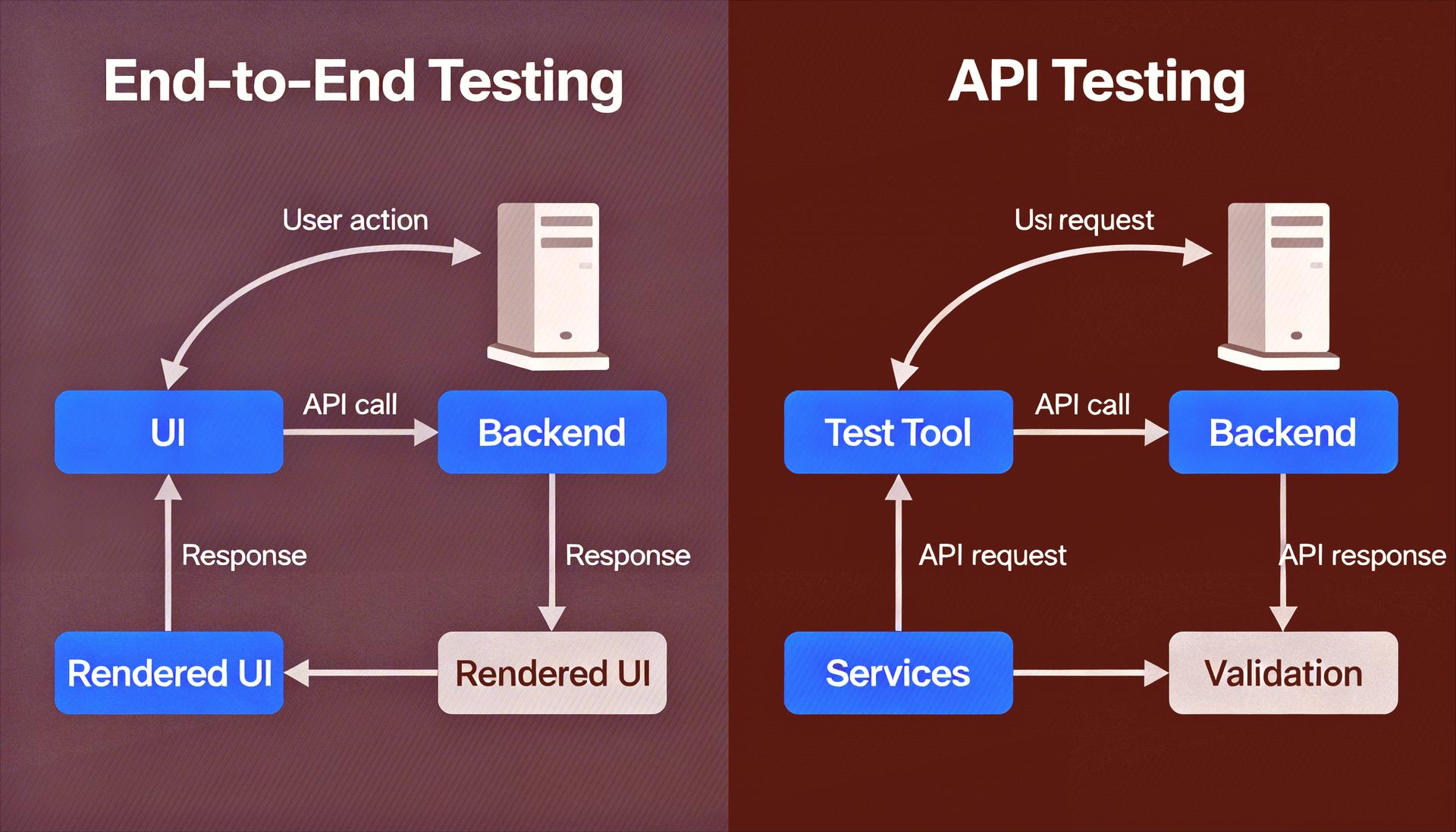
Part of the API Testing hub. Start with the pillar guide: What is API testing? Types, tools and how it works.
End-to-end testing vs API testing compares two approaches that operate at different application layers. End-to-end testing validates complete user workflows through the UI, while API testing targets service interfaces directly via HTTP requests. API tests run faster, cost less, and catch defects earlier in the development lifecycle.
The question of end-to-end testing vs. API testing is one of the most consequential decisions in a modern software team's quality strategy. Get it right and you have a fast, reliable safety net that enables confident continuous delivery. Get it wrong and you have an expensive, brittle test suite that slows releases and erodes developer trust. The evidence from thousands of engineering teams points consistently in one direction: test APIs first, comprehensively, and treat E2E testing as a focused supplement for scenarios that genuinely require browser-level validation. This guide explains why, with a detailed comparison table, concrete metrics, and guidance on where Shift-Left API enables API-first coverage at scale.
End-to-end testing feels comprehensive. It mimics real user behavior, exercises the complete application stack, and validates that the whole system works together. For these reasons, many teams invest heavily in E2E automation—and then discover that their investment has created a slow, brittle, expensive test suite that blocks CI pipelines and generates false positives faster than it catches real defects.
The research is clear. Google's testing blog documented that their E2E tests have a false positive rate 10x higher than their unit and API tests. Spotify's engineering team found that 50% of test failures in their E2E suite were not caused by code defects—they were caused by test infrastructure issues, timing problems, and environmental flakiness. And yet, the scenarios those failing E2E tests were written to catch? 80–90% of them could have been validated faster and more reliably at the API layer.
This guide makes the case for API-first testing: invest primarily in API testing for comprehensive, fast, reliable coverage of business logic and service contracts, then add E2E testing as a focused supplement for scenarios that genuinely require browser-level validation. This approach is a core element of shift-left testing.
In this guide
- What Is End-to-End Testing?
- What Is API Testing?
- Why the Prioritization Question Matters
- Key Characteristics of Each Approach
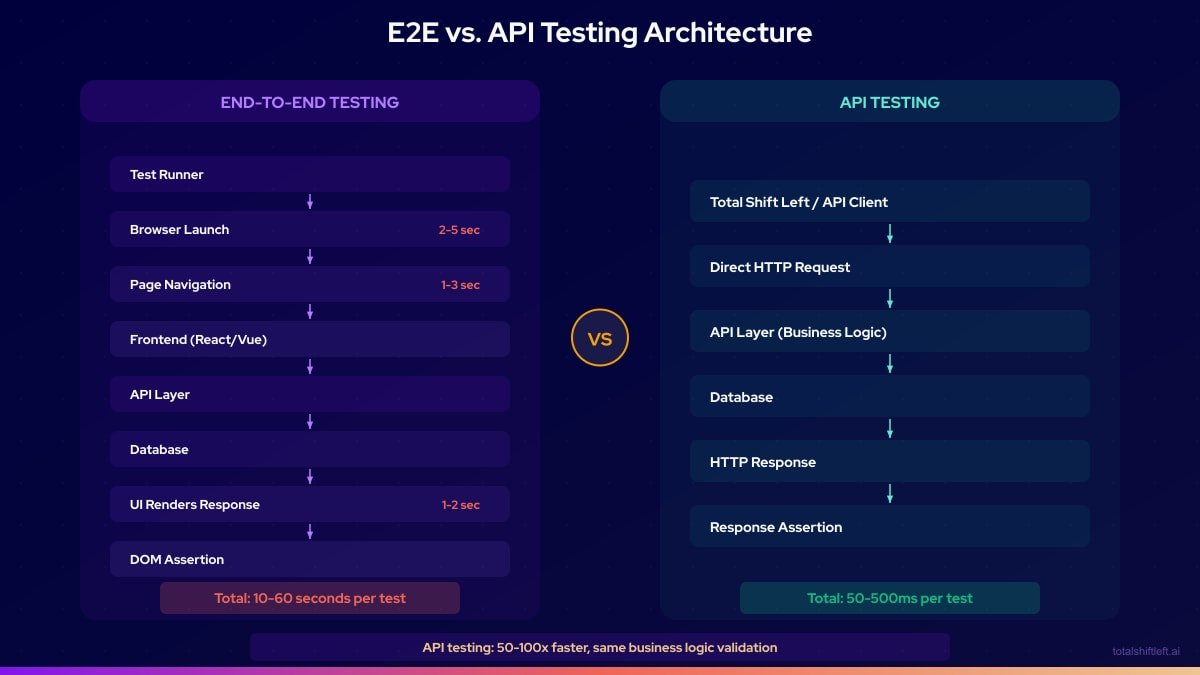
- E2E vs. API Testing Architecture
- Detailed Comparison Table
- When API Testing Wins (Most Scenarios)
- When E2E Testing Is Appropriate
- End-to-end and API testing in practice: a worked example
- End-to-end and API testing challenges and how to solve them
- Best Practices for E2E and API Testing
- API-First Testing Checklist
- Frequently asked questions about end-to-end and API testing
What the API layer has to assert changes with the protocol — REST vs GraphQL vs gRPC covers how failure signalling and authorization differ across the three. For the Java framework choice underneath, see REST Assured vs Karate.
What Is End-to-End Testing?
End-to-end (E2E) testing validates complete user workflows by simulating real user interactions with the application through a web browser or mobile interface. E2E tests exercise the entire application stack—frontend, backend, database, third-party services—in an integrated, deployed environment.
How E2E Tests Work
- A browser automation framework (Playwright, Cypress, Selenium) launches a real browser
- The test navigates to the application URL
- The test simulates user interactions: clicking buttons, filling forms, navigating pages
- The test asserts on visible UI state: element presence, text content, visual appearance
- The test tears down and the browser closes
Each of these steps takes time. Browser launch: 2–5 seconds. Page load: 1–3 seconds. User interaction simulation: 1–10 seconds. Result verification: 1–2 seconds. A complex E2E test for a multi-step workflow can take 30–60 seconds.
What E2E Tests Validate
- Complete user workflows across multiple pages
- UI rendering and visual behavior
- Cross-browser compatibility (Playwright supports Chromium, Firefox, Safari)
- JavaScript-driven client-side behavior
- Integration of frontend with backend in a real deployment
- Third-party embedded components (payment widgets, authentication flows)
The same multi-step "browse → add to cart → checkout" workflow, written as an E2E test and then as the equivalent API test, shows exactly why the speed gap exists:
// E2E: Playwright drives a real browser through every UI step (~15-30s)
test('user can complete checkout', async ({ page }) => {
  await page.goto('/products');
  await page.click('[data-testid="add-to-cart"]');
  await page.click('[data-testid="cart-icon"]');
  await page.click('[data-testid="checkout-button"]');
  await page.fill('[data-testid="card-number"]', '4242424242424242');
  await page.click('[data-testid="place-order"]');
  await expect(page.locator('[data-testid="order-confirmation"]')).toBeVisible();
});
// API: the same workflow validated directly against the endpoints (~200-500ms)
const cart = await api.post('/cart/items', { productId: 42, qty: 1 });
const checkout = await api.post('/checkout', { cartId: cart.body.id, paymentToken: 'tok_test' });
assert.equal(checkout.status, 201);
assert.equal(checkout.body.status, 'confirmed');
The API version proves the same business logic — cart creation, checkout, payment confirmation — two orders of magnitude faster, and its failure message points at the exact endpoint and field that broke instead of "element not found."
E2E Testing Tools in 2026
- Playwright: Fast, cross-browser, excellent async handling, CI-friendly
- Cypress: Outstanding developer experience, limited cross-browser support
- Selenium WebDriver: Mature, widely understood, slower than modern alternatives
- Appium: E2E testing for mobile applications
What Is API Testing?
API testing validates REST, GraphQL, gRPC, or WebSocket service interfaces directly, without involving a browser or UI layer. API tests make HTTP requests to service endpoints and assert on the responses—status codes, response body structure, response body values, headers, and timing.
How API Tests Work
- An HTTP client (or tool like Shift-Left API) constructs a request based on the API specification
- The request is sent to the API endpoint
- The response is received in milliseconds
- The test asserts on the response: status code, schema validity, value correctness, timing
The entire process takes milliseconds. A comprehensive API test suite of 500 tests typically runs in 1–3 minutes.
What API Tests Validate
- HTTP status codes for all endpoint/input combinations
- Response body schemas (matching the OpenAPI specification)
- Business logic: correct calculations, correct state transitions, correct filtering
- Authentication and authorization: correct token validation, correct permission enforcement
- Error handling: meaningful error messages for invalid inputs
- Input validation: boundary values, invalid types, missing required fields
- Response timing: performance SLAs for critical endpoints
API Testing Tools in 2026
- Shift-Left API: Auto-generates API tests from OpenAPI/Swagger specs, no code required
- REST Assured: Java-based fluent API testing DSL
- SuperTest: Node.js in-process API testing
- Postman/Newman: UI-based API testing with CLI for CI
- Requests + PyTest: Python-based API testing
Generate API test cases from your spec (free)
Free, runs in your browser, no sign-up needed.
Why the Prioritization Question Matters
The Speed Gap
A single E2E test for a checkout workflow might take 45 seconds to execute. The API tests that cover the same checkout business logic—creating an order, validating payment, updating inventory—collectively take 200 milliseconds. For a team running CI on every PR:
- 100 E2E tests × 45 seconds = 75 minutes per CI run
- 100 API tests covering equivalent business logic × 200ms = 20 seconds per CI run
The speed difference makes API testing feasible as a PR gate and makes E2E testing feasible only as a scheduled, nightly process.
The Reliability Gap
E2E tests fail for reasons that have nothing to do with application defects:
- Browser version changes
- CSS selector changes (UI refactors not related to functionality)
- Timing issues (animations, async loads, race conditions)
- Test environment infrastructure failures
- Third-party service (auth, payment) instability in test environments
- DOM structure changes that break selectors
According to research by Tricentis, the average E2E test suite has a flakiness rate of 15–25%. API tests have a flakiness rate under 2% for equivalent coverage, because they do not depend on browser rendering, UI timing, or visual DOM structure.
API tests still fail for environmental reasons — an expired sign-in, a gateway error page, rate limiting in a shared staging environment — but those causes are readable in the response. Shift-Left API uses that: its run failure analysis groups a failed run into a handful of causes and labels each one as a test defect, data issue, environment problem or suspected product bug, so "check whether it works manually and deploy anyway" is replaced by a verdict per cause.
The Defect Coverage Gap
The business logic that determines whether your application works correctly lives in the API layer, not the UI layer. The UI is a presentation layer that renders what the API provides. By testing at the API layer:
- You validate business logic directly, without UI intermediation
- You catch defects earlier in the pipeline (before the UI even exists)
- You validate behavior across all consumers (web app, mobile app, third-party integrations)
- You validate error scenarios that are difficult to reproduce through UI automation
The shift-left principle (see: Shift Left Testing Strategy) applies directly here: catching defects at the API layer is faster and cheaper than catching them at the UI/E2E layer.
Key Characteristics of Each Approach
End-to-End Testing Characteristics
- Realistic: Validates real user behavior in real application deployments
- Comprehensive stack coverage: Exercise every layer from browser to database
- Expensive: High development time, high maintenance cost, slow execution
- Fragile: Sensitive to UI changes, timing issues, browser behavior
- High false positive rate: Infrastructure failures masquerade as application failures
- CI cadence: Nightly or pre-release (too slow for every-commit)
API Testing Characteristics
- Fast: Millisecond execution enables every-commit and every-build validation
- Reliable: Not sensitive to UI changes or browser behavior
- Comprehensive business logic coverage: Directly validates the layer that contains business rules
- Multi-consumer: Validates behavior for all API consumers simultaneously
- Maintainable: Tests change when API contracts change, not when CSS changes
- CI cadence: Every commit and every build (fast enough for tight feedback loops)
E2E vs. API Testing Architecture

Detailed Comparison Table
| Dimension | End-to-End Testing | API Testing |
|---|---|---|
| Execution speed | 10–60 seconds per test | 50–500ms per test |
| Test suite runtime (100 tests) | 30–90 minutes | 10–60 seconds |
| Flakiness rate (industry avg) | 15–25% | Under 2% |
| Maintenance cost | High (UI changes, browser updates) | Low (API contract changes) |
| Development cost | High (browser automation, page objects) | Low (TSL auto-generates from spec) |
| Defect detection layer | UI rendering + business logic | Business logic only |
| CI/CD suitability | Nightly or pre-release | Every commit and build |
| Multi-consumer validation | No (web UI only) | Yes (all API consumers) |
| Infrastructure requirements | Full deployed app + browser | API running (can use mock) |
| False positive causes | Browser, CSS, timing, infrastructure | Application logic only |
When API Testing Wins (Most Scenarios)
Business logic validation: Every calculation, state transition, filtering rule, and data transformation should be tested at the API layer. This is where the business rules live. API tests validate them directly without UI intermediation.
Regression testing: The most repetitive testing activity in software development is regression—re-validating existing functionality after changes. API regression tests run in seconds, not minutes. A full API regression suite can run on every PR without blocking developers. See how to integrate this into your CI/CD testing pipeline.
Error handling: Validating that the API returns correct error codes, messages, and formats for hundreds of invalid input scenarios is trivially easy with API testing and practically impossible with E2E automation. Follow REST API testing best practices for comprehensive error scenario coverage.
Security validation: Authentication, authorization, and input validation are all API-layer concerns. API testing validates them directly. E2E testing validates them indirectly through the UI. For a broader perspective on layer-specific testing, see API testing vs UI testing.
Performance validation: Response time SLAs are API-level concerns. API testing can validate that every endpoint meets its P95 response time requirement. E2E tests measure a combination of API time, network time, and UI rendering time—making it difficult to isolate API performance problems. The same functional API tests can also become the load test: Shift-Left API's load testing add-on (paid; included in the Trial) builds load, stress, spike and soak runs from them and breaks each step's time into DNS, connect, TLS, time to first byte and download.
Multi-environment validation: API tests can run against development, staging, and production environments with simple configuration changes. E2E tests are significantly harder to run across multiple environments due to authentication, third-party service behavior, and data dependencies.
When E2E Testing Is Appropriate
Despite the strong case for API-first testing, E2E testing has genuine value for specific scenarios:
Critical user journeys: The 5–10 most important paths through your application (checkout, authentication, account creation, core workflows) deserve E2E validation. These paths involve UI behavior that is not captured at the API layer.
Cross-browser compatibility: If your application must work correctly in Chromium, Firefox, and Safari, E2E testing is the only way to validate browser-specific behavior.
JavaScript-driven UI behavior: Client-side state management, real-time updates, complex animations, and UI interactions that do not involve API calls must be validated at the E2E layer.
Free ZIP: 5 CSV packs + guide
API Test Case Library
159 ready-made API test cases in five CSV packs: login, pagination, search and filter, auth (API key, JWT, OAuth 2.0) and errors. Copy, adapt, run.
Download FreeThird-party integrations that cannot be mocked: Payment widgets (Stripe, PayPal), social authentication (OAuth flows), and embedded third-party components can only be validated E2E.
Visual regression testing: Screenshot comparison tools (Percy, Chromatic) catch visual regressions that have no API-level equivalent.
Accessibility validation: WCAG compliance testing requires a rendered UI and an accessibility testing tool (axe-core, Lighthouse).
End-to-end and API testing in practice: a worked example
Problem
A SaaS analytics platform had 1,200 E2E tests written over 2 years. The suite took 6 hours to run sequentially and 90 minutes with parallelism. It was 28% flaky. Developers had a documented policy: "If only E2E tests are failing, check if the same functionality works manually and deploy anyway." This policy—born of frustration with flaky tests—had led to 4 production incidents in 6 months.
The team had zero API tests. Their 1,200 E2E tests were doing the work of both API and E2E validation.
Solution
Phase 1: Audit E2E tests (week 1)
- Categorized all 1,200 tests by what they were actually validating:
- 840 tests (70%): Validating API business logic through the UI
- 180 tests (15%): Validating UI rendering and interaction behavior
- 120 tests (10%): Validating complete user workflows (genuine E2E)
- 60 tests (5%): Duplicates, redundant, or covering deprecated features
Phase 2: API layer with Shift-Left API (weeks 2–4)
- Imported OpenAPI specification (127 endpoints across 3 services)
- Auto-generated 480 API tests covering all endpoints
- Integrated into CI pipeline: runs on every PR in 4 minutes
Phase 3: E2E reduction (weeks 5–8)
- Deleted 840 E2E tests replaced by TSL API tests
- Deleted 60 redundant/deprecated tests
- Retained 180 UI-specific + 120 workflow tests = 300 focused E2E tests
- E2E suite: 6 hours → 18 minutes (10x smaller suite, parallelized)
Phase 4: CI pipeline restructure (week 9)
- PR gate: API tests via TSL (4 minutes) — gates every PR
- Build gate: Integration validation (additional API checks, 6 minutes total)
- Nightly: 300-test E2E suite (18 minutes)
Results After 90 Days
| Metric | Before | After |
|---|---|---|
| E2E test count | 1,200 | 300 |
| API test count | 0 | 480 (via TSL) |
| E2E suite runtime | 90 min (parallel) | 18 min |
| E2E flakiness | 28% | 4% |
| PR gate time | 90 min | 4 min |
| Production incidents from false deployments | 4 in 6 months | 0 in 90 days |
| API business logic coverage | Low (indirect via UI) | 100% (direct via TSL) |
End-to-end and API testing challenges and how to solve them
Challenge: Leadership believes more E2E tests = better quality Solution: Show the data. Track defect escape rate per test type. API tests almost always catch more defects per test than E2E tests, at lower cost. Present the cost-per-defect comparison to make the case for API-first investment.
Challenge: E2E tests keep breaking on minor UI changes Solution: Move business logic validation to the API layer. Redesign E2E tests to use stable selectors (data-testid attributes) and page object models. Keep E2E tests as abstract user behavior validators, not implementation-specific scripts.
Challenge: Building API tests requires expertise the team does not have Solution: Use Shift-Left API to auto-generate API tests from your OpenAPI specification. No programming expertise required. Tests are generated from the spec and can be maintained by QA engineers without coding skills.
Challenge: E2E tests are the only thing catching integration defects Solution: This indicates a missing API/integration testing layer. E2E tests are catching integration defects as a side effect of full-stack execution. Build explicit API integration tests to catch these defects faster and more reliably.
The usual objection is that a multi-step journey is tedious to assemble at the API layer — someone has to pass the cart ID into checkout and the order ID into the confirmation call. Shift-Left API takes most of that away: workflows build themselves from approved use-case requirements, from the spec and existing tests, or from a one-line description, with each step's data wired to the earlier step that produces it. If a step has no test yet, the product names it and can generate the missing tests and the workflow in one accepted change, and a Workflow Doctor diagnoses a broken workflow and offers fixes that only add what is missing. A workflow run also counts as evidence that the use-case requirement it came from was verified.
Challenge: Cannot agree on which E2E tests to delete Solution: Apply data: check test failure history. Any E2E test that has not caught a defect in 12+ months and covers the same scenario as an API test is a deletion candidate. Use defect traceability data to make the decision objective.
Best Practices for E2E and API Testing
- Adopt the API-first principle. If a defect can be caught at the API layer, it should be caught there—not at the E2E layer.
- Set a maximum E2E test count. No more than 150–200 E2E tests for most applications. Additional coverage belongs at the API layer.
- Use Shift-Left API for complete API coverage. Generate tests directly from your OpenAPI or Swagger spec—no code writing, 100% endpoint coverage.
- Run API tests on every PR. The speed of API tests makes them viable as PR gates. E2E tests are too slow for this role.
- Use stable selectors in E2E tests. Always use data-testid attributes. Never rely on CSS classes or text content for E2E selectors.
- Track flakiness by test type. If API test flakiness exceeds 2% or E2E test flakiness exceeds 5%, investigate immediately.
- Review E2E suite quarterly. Delete tests that have not caught a defect. Delete tests that duplicate API coverage.
- Prioritize E2E tests on critical revenue paths. Checkout, authentication, onboarding, and core workflows deserve E2E validation even with excellent API coverage.
API-First Testing Checklist
- ✔ API endpoints are fully covered by automated tests (use TSL for no-code generation)
- ✔ Business logic validation is performed at the API layer, not through E2E tests
- ✔ API tests run on every PR via CI integration (under 5 minutes)
- ✔ E2E tests are limited to genuine UI validation and critical user journeys
- ✔ E2E test count is tracked and capped (target: under 200 tests)
- ✔ Flakiness rate is tracked separately for API and E2E test suites
- ✔ E2E suite uses stable selectors (data-testid attributes)
- ✔ E2E suite runs are scheduled nightly and pre-release, not on every PR
See also: contract testing in our learn hub for the underlying concept.
Frequently asked questions about end-to-end and API testing
What is the difference between end-to-end testing and API testing?
End-to-end testing validates complete user workflows through the full application stack including the UI, while API testing validates the backend service interfaces directly via HTTP requests without a browser. API tests are significantly faster, cheaper, and more reliable than equivalent E2E tests.
Why is API testing faster than end-to-end testing?
API tests make direct HTTP calls to service endpoints, returning results in milliseconds. E2E tests launch browsers, load pages, render UI, simulate user interactions, and wait for UI state changes—a process that typically takes 5-30 seconds per test scenario.
When should you use end-to-end testing instead of API testing?
Use E2E testing for scenarios that specifically validate UI behavior, cross-browser compatibility, visual correctness, user experience flows that cannot be validated at the API layer, and critical user journeys where the complete user experience must be verified.
What tools support API-first testing strategies?
Shift-Left API imports your OpenAPI/Swagger specification and auto-generates comprehensive API tests covering every endpoint, parameter combination, and error scenario—enabling teams to achieve complete API coverage without writing test code, forming a reliable foundation before E2E tests are added.
Sources and further reading
- Martin Fowler — The Practical Test Pyramid — the reference argument for test-layer proportions.
- Playwright API testing — Playwright's request-context API for testing endpoints.
- Martin Fowler — Testing Strategies in a Microservice Architecture — the canonical breakdown of microservice test layers.
Key takeaways
The choice between E2E testing and API testing is not binary—it is a question of prioritization and proportion. The evidence is clear: API testing should be the primary investment for comprehensive, fast, reliable coverage of business logic, while E2E testing should be a focused supplement for the scenarios that genuinely require browser-level validation. Teams that adopt this API-first approach consistently achieve faster feedback loops, lower flakiness rates, and higher confidence in continuous delivery. Shift-Left API makes the API-first approach accessible to every team by auto-generating complete API test suites from your OpenAPI specification—no code required. Start your free trial and shift your testing investment to where it delivers the most value.
Related: What Is Shift Left Testing: Complete Guide | Shift Left Testing Strategy | API Testing vs UI Testing | REST API Testing Best Practices | API Testing Strategy for Microservices | How to Build a CI/CD Testing Pipeline | Best Shift Left Testing Tools | No-code API testing platform | Total Shift Left home | Start Free Trial
Ready to shift left with your API testing?
Import your OpenAPI spec and get a runnable test suite, in our cloud or on your own infrastructure.