
How to Generate Test Data for API Testing (Faker + Schema)
Quick answer
Generate API test data directly from your OpenAPI spec rather than hand-writing fixtures: use the spec's schema constraints and example values as the source of truth, layer in Faker (or json-schema-faker) for realistic random values within those constraints, and regenerate the data automatically in CI whenever the spec changes so fixtures never drift from the contract they're meant to test.
Reviewed by Sushant Joshi

Generating test data for API testing is the process of creating valid, invalid, and edge-case request payloads, query parameters, headers, and response expectations for every API endpoint. Effective test data generation covers happy paths, error conditions, boundary values, and security scenarios—derived from API specifications rather than manual creation.
Every API test needs data. A POST request needs a valid request body. A GET request needs valid query parameters. A DELETE request needs a valid resource identifier. Authentication endpoints need credentials. Validation tests need deliberately invalid data. The question that determines whether your API testing is thorough or superficial is: how do you generate this data?
Most API testing failures trace back to test data, not test logic. The test framework works. The assertions are correct. But the test data is incomplete—missing edge cases, ignoring boundary values, or using hardcoded data that drifts out of sync with the API schema. The result is a test suite that provides a false sense of coverage while missing the bugs that actually reach production.
Generating test data for API testing is both a science and a discipline. The science involves systematic techniques for deriving test data from specifications: boundary value analysis, equivalence partitioning, combinatorial coverage, and negative testing patterns. The discipline involves automating these techniques so that test data stays current as APIs evolve.
This guide covers practical, implementable techniques for generating test data that provides genuine API test coverage. It builds on the broader API testing guide and integrates with test data automation in CI/CD pipelines for production-grade implementation.
In this guide
- What Is Test Data Generation for API Testing
- Why Proper Test Data Generation Matters
- Key Components of API Test Data Generation
- Architecture for Test Data Generation
- Tools for API Test Data Generation
- API test data generation in practice: a worked example
- API test data generation challenges and how to solve them
- API test data generation best practices
- API test data generation checklist
- Frequently asked questions about API test data generation
What Is Test Data Generation for API Testing
Test data generation for API testing is the systematic creation of inputs and expected outputs for API endpoint testing. It encompasses several categories of data:
Positive test data: Valid request payloads that the API should accept and process correctly. These test the happy path—the normal, expected use cases.
Negative test data: Invalid request payloads that the API should reject with appropriate error responses. These test input validation, error handling, and security boundaries.
Boundary test data: Values at the exact boundaries of valid ranges—minimum values, maximum values, values just inside and just outside limits. These test the precision of validation logic.
Combinatorial test data: Combinations of valid and invalid values across multiple fields. A request with 5 fields has exponential combinations; systematic combinatorial strategies provide coverage without exhaustive enumeration.
Stateful test data: Data that depends on prior API operations. Creating an order requires a customer ID obtained from a prior customer creation call. Testing order cancellation requires a created order in "pending" status.
Security test data: Payloads designed to test authentication, authorization, injection resistance, and input sanitization. SQL injection strings, XSS payloads, oversized inputs, and malformed encodings.
The goal is not to test every possible combination—that is computationally infeasible—but to systematically cover the categories that historically contain the most bugs: boundary violations, missing field handling, type mismatches, and security bypasses.
Why Proper Test Data Generation Matters
Incomplete Test Data Creates False Coverage
A test suite with 200 API tests sounds comprehensive. But if every test uses the same hardcoded request body with only the happy path, the suite covers exactly one scenario per endpoint. Real-world API bugs live in the edges: what happens when a string field receives an integer, when a required field is missing, when a numeric value is exactly at the minimum boundary. Without systematic test data generation, these scenarios go untested.
API Schemas Change Faster Than Manual Data
Modern APIs evolve rapidly—new fields, changed validation rules, deprecated parameters. Manually maintained test data fixtures become stale within weeks. A required field is added to an endpoint, but the test fixture does not include it, so the test breaks with a misleading error. Or worse, the test still passes because the test environment does not enforce the same validation as production.
Negative Testing Is Where Bugs Hide
Most developers test their own code with valid inputs. They verify that the happy path works. The bugs that reach production are almost always in negative scenarios: unexpected input types, missing fields, boundary violations, and authentication edge cases. Generating negative test data systematically is the single highest-value testing activity for API quality. This aligns with REST API testing best practices that prioritize comprehensive input validation testing.
Compliance Requires Data Diversity
Accessibility, internationalization, and data protection regulations require APIs to handle diverse data correctly: unicode characters, RTL text, maximum-length inputs, empty strings, and special characters. Generating diverse test data ensures compliance with these requirements rather than discovering failures in production.
Key Components of API Test Data Generation
Spec-Driven Generation
The most effective approach to API test data generation starts with the API specification—typically OpenAPI (Swagger), AsyncAPI, or GraphQL schema. The specification is the source of truth for what data each endpoint accepts.
From an OpenAPI spec, you can extract:
- Field names, types, and formats
- Required vs. optional fields
- String constraints: minLength, maxLength, pattern (regex)
- Numeric constraints: minimum, maximum, exclusiveMinimum, exclusiveMaximum
- Enum values
- Nested object structures
- Array constraints: minItems, maxItems, uniqueItems
# OpenAPI spec excerpt
components:
  schemas:
    CreateOrderRequest:
      type: object
      required: [customerId, items, shippingMethod]
      properties:
        customerId:
          type: string
          format: uuid
        items:
          type: array
          minItems: 1
          maxItems: 100
          items:
            $ref: '#/components/schemas/OrderItem'
        shippingMethod:
          type: string
          enum: [standard, express, overnight]
        couponCode:
          type: string
          maxLength: 20
          pattern: '^[A-Z0-9]+$'
From this spec, a generator can produce:
- A valid order with 1 item, standard shipping, and a valid coupon code
- A valid order with 100 items (maxItems boundary)
- An invalid order with 0 items (minItems violation)
- An invalid order with 101 items (maxItems violation)
- An invalid order missing customerId (required field omission)
- An invalid order with shippingMethod = "teleportation" (invalid enum)
- A coupon code at exactly 20 characters (maxLength boundary)
- A coupon code with 21 characters (maxLength violation)
- A coupon code with lowercase letters (pattern violation)
Shift-Left API performs this extraction and generation automatically—parsing your OpenAPI spec and producing comprehensive test suites with all of these data variations without any manual configuration.
Boundary Value Analysis
Boundary value analysis generates test data at the edges of valid ranges. For every constrained field, generate values at:
| Position | Example (minLength: 3, maxLength: 50) |
|---|---|
| At minimum | 3-character string |
| Just below minimum | 2-character string |
| At maximum | 50-character string |
| Just above maximum | 51-character string |
| Well within range | 25-character string |
| Empty (if allowed) | Empty string |
For numeric fields with minimum: 0 and maximum: 999:
| Position | Value |
|---|---|
| At minimum | 0 |
| Just below minimum | -1 |
| At maximum | 999 |
| Just above maximum | 1000 |
| Midpoint | 500 |
| Zero (if distinct from min) | 0 |
This technique catches the most common validation bug: off-by-one errors where the boundary check uses > instead of >= or < instead of <=.
Ready to shift left with your API testing?
Try our no-code API test automation platform free. Generate tests from OpenAPI, run in CI/CD, and scale quality.
How Total Shift Left does this: AI reads the minLength, maxLength, pattern, enum, and required-field constraints directly from your OpenAPI spec and generates the boundary values above automatically — at-minimum, just-below-minimum, at-maximum, and just-above-maximum cases — alongside negative tests for missing fields and type mismatches. Configure a self-hosted LLM (Ollama, LM Studio, or vLLM) and this generation runs without any spec or field value leaving your infrastructure.
Combinatorial Test Data Strategies
With multiple fields per request, testing every combination is infeasible. A request with 5 fields, each having 5 possible test values, produces 3,125 combinations. Pairwise (2-way) combinatorial testing reduces this to approximately 25 test cases while covering every pair of field values at least once.
Tools like PICT (Microsoft's Pairwise Independent Combinatorial Testing tool) generate optimal pairwise test data sets:
# PICT model for order creation
customerId: valid_uuid, invalid_uuid, empty, missing
items: one_item, max_items, empty_array, over_max
shippingMethod: standard, express, overnight, invalid
couponCode: valid, too_long, invalid_pattern, missing
Pairwise coverage catches the majority of field-interaction bugs while keeping the test count manageable. Once you have these variations, running a single test across many rows of data lets you exercise every combination without duplicating test logic.
Response Validation Data
Test data generation is not just about request payloads—it also includes expected responses. For each request, define:
- Expected HTTP status code
- Expected response schema (or reference to response schema in spec)
- Expected error message patterns for negative tests
- Expected response headers
- Expected response time threshold
// Test data with expected responses
const testCases = [
  {
    name: "valid order creation",
    request: { customerId: "uuid-123", items: [item], shippingMethod: "standard" },
    expected: { status: 201, bodySchema: "OrderResponse", maxResponseTime: 500 }
  },
  {
    name: "missing required field",
    request: { items: [item], shippingMethod: "standard" },
    expected: { status: 400, bodyContains: "customerId is required" }
  }
];
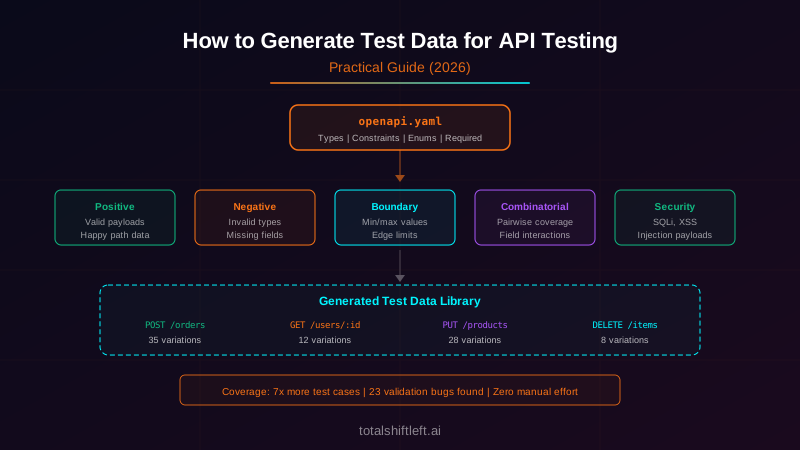
Architecture for Test Data Generation
┌─────────────────────────────────────────────────────┐
│              API Specification (OpenAPI)              │
│   Field types, constraints, enums, required fields   │
└──────────────────────┬──────────────────────────────┘
                       │
                       ▼
┌─────────────────────────────────────────────────────┐
│           Test Data Generation Engine                │
│                                                     │
│  ┌─────────────┐ ┌──────────────┐ ┌──────────────┐ │
│  │ Positive    │ │ Negative     │ │ Boundary     │ │
│  │ Data Gen    │ │ Data Gen     │ │ Value Gen    │ │
│  └─────────────┘ └──────────────┘ └──────────────┘ │
│                                                     │
│  ┌─────────────┐ ┌──────────────┐ ┌──────────────┐ │
│  │ Combinat.   │ │ Security     │ │ Stateful     │ │
│  │ Coverage    │ │ Payloads     │ │ Chain Gen    │ │
│  └─────────────┘ └──────────────┘ └──────────────┘ │
└──────────────────────┬──────────────────────────────┘
                       │
                       ▼
┌─────────────────────────────────────────────────────┐
│              Test Case Library                        │
│   Request payloads + expected responses per endpoint │
├─────────────────────────────────────────────────────┤
│  POST /orders     → 35 test data variations          │
│  GET /orders/:id  → 12 test data variations          │
│  PUT /orders/:id  → 28 test data variations          │
│  DELETE /orders   → 8 test data variations           │
└──────────────────────┬──────────────────────────────┘
                       │
                       ▼
┌─────────────────────────────────────────────────────┐
│              CI/CD Pipeline Execution                │
│   Test data generated → Tests run → Results reported │
└─────────────────────────────────────────────────────┘
The architecture flows from specification to generation to execution. The specification is the single source of truth. The generation engine applies multiple strategies (positive, negative, boundary, combinatorial, security) to produce comprehensive test data. The test case library stores the generated data alongside expected responses. The pipeline consumes this library on every run.
Tools for API Test Data Generation
| Tool | Category | Best For | Spec Support |
|---|---|---|---|
| Shift-Left API | Full Automation | End-to-end API test data from specs | OpenAPI 3.x, Swagger 2.0 |
| Schemathesis | Property-Based | Fuzz testing from OpenAPI specs | OpenAPI 3.x |
| Faker.js | Field-Level | Realistic field values (names, emails) | Manual schema mapping |
| Bogus (.NET) | Field-Level | .NET API test data | Manual schema mapping |
| PICT | Combinatorial | Pairwise test data reduction | Custom model files |
| Prism (Stoplight) | Mock + Generation | OpenAPI mock servers with examples | OpenAPI 3.x |
| Dredd | Contract Testing | API blueprint validation | OpenAPI, API Blueprint |
| Postman | Manual + Dynamic | Request data with variables | OpenAPI import |
| REST Assured | Java Testing | Java API test data builders | Manual + spec parsing |
| JSON Schema Faker | Schema-Based | JSON data from JSON Schema | JSON Schema |
The key differentiator is whether the tool generates test data from specifications automatically or requires manual test data definition. Specification-driven tools scale with API complexity; manual tools create maintenance burden that grows with every endpoint.
JSON Schema Faker + Faker.js together is the common combination for teams building their own data-generation script: JSON Schema Faker walks the schema and respects every constraint (minLength, pattern, enum, required), while Faker.js supplies realistic values (names, emails, addresses) for fields tagged with a faker extension:
import jsf from 'json-schema-faker';
import { faker } from '@faker-js/faker';

jsf.extend('faker', () => faker);

const schema = {
  type: 'object',
  required: ['customerId', 'email', 'shippingMethod'],
  properties: {
    customerId: { type: 'string', format: 'uuid' },
    email: { type: 'string', format: 'email', faker: 'internet.email' },
    shippingMethod: { type: 'string', enum: ['standard', 'express', 'overnight'] },
    quantity: { type: 'integer', minimum: 1, maximum: 10 },
  },
};

const testOrder = jsf.generate(schema);
// -> { customerId: '...', email: 'realistic@example.com', shippingMethod: 'express', quantity: 7 }
// Every field respects the schema's constraints; email looks like a real address, not "string1".
The same schema can come directly from your OpenAPI components — point jsf.generate() at openApiSpec.components.schemas.CreateOrderRequest and every generated test case automatically tracks spec changes, which is what keeps this approach viable in CI rather than becoming another set of stale fixtures.
API test data generation in practice: a worked example
Scenario: A healthcare API platform with 45 endpoints across 3 services, migrating from manually maintained Postman collections to automated test data generation.
Before: QA team manually created Postman test data for each endpoint. Each endpoint had 3-5 test cases on average (mostly happy path). Total coverage: approximately 180 test cases. Missing: boundary values, negative tests for optional fields, combinatorial coverage. Time to create test data for a new endpoint: 2-4 hours.
Implementation:
-
Week 1 - Spec Audit: Verified that all 45 endpoints had complete OpenAPI specs with proper constraints (minLength, maxLength, pattern, required fields, enums). Fixed 12 endpoints with incomplete constraint definitions.
-
Week 2 - Generator Setup: Integrated Shift-Left API to generate test data from the OpenAPI specs. Initial generation produced 1,240 test cases across all 45 endpoints—7x more coverage than the manual Postman collection.
-
Week 3 - Custom Edge Cases: Added healthcare-specific edge cases that the generic generator could not infer: patient IDs with check digits, date ranges spanning leap years, medication dosage boundary values. These were defined as custom test data extensions layered on top of the generated data.
Free PDF + code examples
OpenAPI to Test Generation Template Pack
Go from OpenAPI spec to full test coverage. Includes sample specs, example generated tests, edge case patterns, and CI/CD integration guides.
Download Free- Week 4 - Pipeline Integration: Connected the generated test suite to the CI/CD pipeline. Test data regenerates automatically when the OpenAPI spec changes. Pipeline runs the full suite on every PR.
Results:
- Test case count increased from 180 to 1,400+ (including boundaries, negatives, combinatorials)
- 23 validation bugs discovered in the first week—most were missing constraint enforcement on optional fields
- Time to add test data for a new endpoint: 0 (automatic from spec) + 30 minutes for custom domain-specific cases
- New endpoints get full test coverage the moment they are defined in the spec
API test data generation challenges and how to solve them
Challenge: API Spec Is Incomplete or Inaccurate
Many teams have OpenAPI specs that are missing constraints, have incorrect types, or do not reflect the actual API behavior. Spec-driven generation from an inaccurate spec produces inaccurate test data.
Solution: Treat spec completeness as a prerequisite. Before implementing test data generation, audit every endpoint's spec for complete constraints. Use the test data generation process itself as a spec quality check—if the generated data reveals missing constraints, fix the spec. Over time, spec-driven testing becomes a forcing function for spec accuracy.
Challenge: Dependent Data Across Endpoints
Testing order creation requires a valid customer ID from the customer creation endpoint. Testing order cancellation requires an order ID from order creation. These dependencies create chains that simple per-endpoint generation cannot handle.
Solution: Define dependency chains in your test data configuration. The generation engine creates dependencies first, extracts identifiers from responses, and injects them into dependent requests. Most test frameworks support this through fixtures or setup hooks:
// Dependency chain
const customer = await api.post('/customers', generateCustomer());
const product = await api.post('/products', generateProduct());
const order = await api.post('/orders', {
  ...generateOrder(),
  customerId: customer.body.id,
  items: [{ productId: product.body.id, quantity: 1 }]
});
Challenge: Test Data for Pagination and Bulk Endpoints
Endpoints that return paginated lists or accept bulk operations need test data at scale—dozens or hundreds of records to test pagination logic, sorting, and filtering.
Solution: Use seed factories that create volume data as a test setup step. Generate N records (where N exceeds the page size) before running pagination tests. Ensure each record has varied field values so that sorting and filtering tests exercise different orderings.
Challenge: Authentication and Authorization Test Data
Testing authorization requires multiple user contexts—admin users, regular users, users without access to specific resources. Each context needs its own credentials and associated data.
Solution: Create a user factory that generates users with specific roles and permissions. Before running authorization tests, create users for each role, authenticate each user to obtain tokens, and use the appropriate token for each test case. Store tokens in test context, not in fixtures, so they are generated fresh each run.
API test data generation best practices
- Start with the spec, not with manual data. Every test data point should trace back to a constraint, type, or business rule defined in the API specification. This makes test data self-documenting and automatically current.
- Generate negative tests for every constraint. For every minLength, maxLength, pattern, required field, enum, and type constraint, generate at least one test case that violates it. These negative tests catch more production bugs than positive tests.
- Use boundary value analysis for all numeric and string constraints. Test at the boundary, just inside, and just outside. Boundary bugs are the most common validation errors.
- Apply pairwise combinatorial coverage. Full combinatorial testing is infeasible for endpoints with many fields. Pairwise (2-way) coverage provides strong bug detection with manageable test counts.
- Separate data generation from test execution. Generate test data as a library that multiple test suites can consume. This avoids duplicating generation logic across unit tests, integration tests, and end-to-end tests.
- Include security-oriented test data. SQL injection strings, XSS payloads, path traversal patterns, and oversized inputs should be part of every API's test data set.
- Regenerate test data when the spec changes. Tie test data generation to spec changes in the CI/CD pipeline. When the spec is modified, test data is regenerated automatically—keeping data and spec in sync.
- Track test data coverage metrics. Measure what percentage of spec constraints have corresponding test data. Aim for 100% constraint coverage as a baseline.
API test data generation checklist
- ✔ OpenAPI spec is complete with types, constraints, required fields, and enums for all endpoints
- ✔ Positive test data is generated for every endpoint operation (GET, POST, PUT, DELETE)
- ✔ Negative test data covers every required field omission
- ✔ Negative test data covers every type violation (string for integer, etc.)
- ✔ Boundary value test data exists for every minLength, maxLength, minimum, maximum constraint
- ✔ Enum coverage includes every valid value plus at least one invalid value
- ✔ Pairwise combinatorial coverage is applied for endpoints with 4+ fields
- ✔ Security test data includes injection payloads and oversized inputs
- ✔ Dependency chains are handled (create parent before child resources)
- ✔ Expected responses are defined for every test data variation
- ✔ Test data regenerates automatically when the OpenAPI spec changes
- ✔ Authentication test data covers all roles and permission levels
- ✔ Test data is generated in CI/CD, not maintained as static fixtures
See also: validation errors in our learn hub for the underlying concept.
Frequently asked questions about API test data generation
What is the best way to generate test data for API testing?
The best approach is spec-driven generation—deriving test data directly from your OpenAPI or AsyncAPI specification. The spec defines every endpoint's request schema, required fields, data types, constraints, and enumerations. Generating data from the spec ensures test data is always valid for positive tests and systematically invalid for negative tests, while staying synchronized with API changes automatically. Tools like Shift-Left API automate this entire process, parsing the spec and generating comprehensive test data without manual configuration.
How do you generate negative test data for APIs?
Generate negative test data by systematically violating each constraint defined in the API spec: omit required fields one at a time, exceed maxLength and minLength boundaries, use wrong data types (string where integer is expected), send values outside min/max ranges, use invalid enum values, and send malformed JSON. Each violation should be a separate test case to isolate exactly which constraint the API enforces. The goal is one negative test per constraint per endpoint.
Should I use production data for API testing?
No. Production data contains PII, is subject to privacy regulations (GDPR, HIPAA, CCPA), changes unpredictably, and creates security exposure in non-production environments. Synthetic test data generated from API specifications is predictable, reproducible, privacy-compliant, and provides better test coverage because you can explicitly generate edge cases and boundary values that may not exist in production data.
How much test data do I need for comprehensive API testing?
For each API endpoint, you need at minimum: one valid request per operation, one test per required field omission, one test per boundary value (min, max, just above, just below), one test per enum value, one test per data type violation, and tests for authentication and authorization scenarios. A typical endpoint with 5 fields and standard constraints requires 25-40 test data variations for thorough coverage. Pairwise combinatorial analysis helps manage this volume for endpoints with many fields.
Can test data generation be automated from OpenAPI specs?
Yes. OpenAPI specifications contain all the information needed for automated test data generation: field names, types, constraints (minLength, maxLength, pattern, minimum, maximum), required vs optional status, enum values, and nested object structures. Tools like Shift-Left API parse the spec and generate both valid and invalid test data for every endpoint automatically, including boundary values, type violations, and combinatorial coverage.
How do you handle dependent test data across API endpoints?
For endpoints that depend on data from other endpoints (creating an order requires a customer ID from customer creation), use chained test data generation. Your test setup creates dependency resources first, extracts generated IDs from responses, and injects them into dependent requests. Test frameworks with fixture support or setup/teardown hooks automate this chaining. The key is making the dependency explicit in the test configuration rather than relying on pre-existing data in a shared database.
Sources and further reading
- Faker (Python) — locale-aware fake data generation.
- json-schema-faker — generates payloads directly from a JSON Schema.
- Faker.js — the JavaScript equivalent for generated test data.
Key takeaways
- Generating test data for API testing is the foundation that determines whether your test suite provides genuine coverage or a false sense of security.
- Manual test data creation does not scale, static fixtures become stale, and happy-path-only testing misses the bugs that reach production.
- The systematic approach—spec-driven generation, boundary value analysis, negative testing for every constraint, combinatorial coverage, and security payloads—transforms API testing from a checklist activity into a genuine quality assurance practice.
- Every constraint in the spec gets tested. Every boundary gets exercised.
- Every error path gets validated. For teams that want comprehensive API test data without the engineering overhead of building and maintaining generation infrastructure, Shift-Left API generates complete test suites with test data directly from your OpenAPI specifications.
- Every endpoint, every constraint, every boundary value—generated automatically and regenerated whenever the spec changes.
Start your free trial and generate comprehensive API test data from your specs today.
Related: API Testing: The Complete Guide | REST API Testing Best Practices | Test Data Automation in CI/CD Pipelines | How to Automate API Testing in CI/CD | Managing Test Data in Microservices | DevOps Testing Best Practices | Platform | Start Free Trial
Continue learning
Go deeper in the Learning Center
Hands-on lessons with runnable code against our live sandbox.
Happy paths prove your API works. Negative paths prove it doesn't break. Both matter.
Most API bugs live in input validation. Here's how to test it systematically.
Ready to shift left with your API testing?
Try our no-code API test automation platform free.