
OpenAPI Testing: How to Test Swagger and OpenAPI APIs
Quick answer
OpenAPI testing uses an OpenAPI (Swagger) specification as the test oracle: you send real requests to the API and check that every status code, header and response body matches what the spec documents. A complete approach combines spec linting, schema-validated contract tests, negative and boundary tests generated from the spec's constraints, property-based fuzzing and a breaking-change check in CI.
Reviewed by Rishi Gaurav
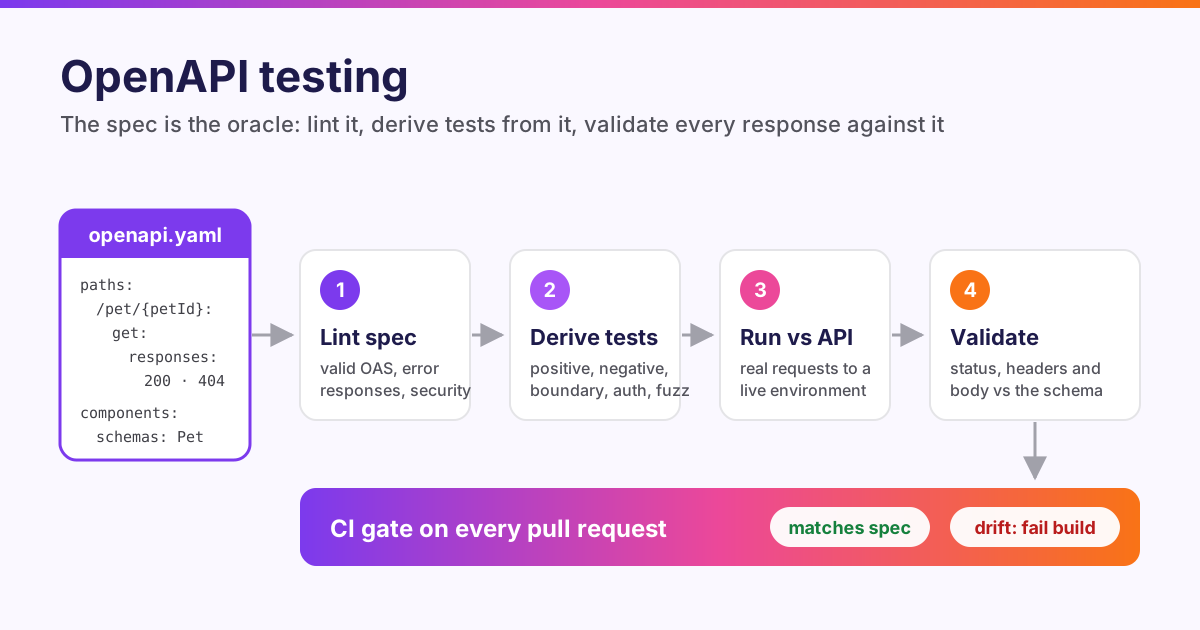
OpenAPI testing is the practice of using an OpenAPI (formerly Swagger) specification as the source of truth for testing an API. The spec says which operations exist, what each accepts and what each returns. A test suite turns those statements into checks. It sends real requests to a running API and fails the build when a status code, header or response body does not match what the spec documents.
This is the pillar guide for our OpenAPI, Contract & Schema Testing hub. It covers what spec-driven testing is, why it catches defects that hand-written tests miss, and how it works step by step. It goes through the six kinds of tests a spec makes possible, then works through an example against the public Swagger Petstore that you can run today. It ends with tools, common mistakes and a checklist. Each section links to a deeper guide where one exists.
In this guide: what OpenAPI testing is · why it matters · how it works · types of OpenAPI tests · worked example · tools · mistakes and checklist · FAQ.
What is OpenAPI testing?
An OpenAPI document is a machine-readable contract. For every path and method it declares the parameters, the request body schema, the possible responses by status code, the response headers and the security requirements. The OpenAPI Specification (OAS) is maintained by the OpenAPI Initiative under the Linux Foundation. Version 3.0 was the long-running workhorse. Version 3.1 aligned its schema language fully with JSON Schema 2020-12, and later 3.x releases keep that alignment. Swagger 2.0 is the older format that many legacy APIs still publish.
OpenAPI testing (people also search for it as "swagger testing" or "swagger api testing") uses that contract in two ways:
- As an oracle. The spec tells the test what a correct response looks like. You don't hand-code
assert body["status"] in ["available", "pending", "sold"]. The test reads theenumfrom the spec. - As a generator. The spec tells the test what to send. Required fields, types,
minLength,maximum,patternandenumconstraints each imply a set of valid and invalid inputs. A tool can enumerate those inputs mechanically.
That second use is what separates OpenAPI testing from simply having a spec. A hand-written suite covers whatever the author remembered to test. A spec-driven suite covers what the spec declares, and it shows you exactly where the spec is silent.
People sometimes mean something smaller by "swagger testing": opening Swagger UI and clicking Try it out. That is a good way to explore an API. It is not testing, because nothing asserts anything, nothing is repeatable and nothing runs in CI.
Why OpenAPI testing matters
Three things make spec-driven testing worth the setup.
Drift is the default. Specs and implementations drift apart unless something forces them back together. A developer renames a field, adds a status code or makes a nullable field non-nullable. The spec doesn't change, and every client generated from that spec is now wrong. Only a test that compares live responses to the spec on every build notices. Our guide to API schema validation and catching drift goes deeper on that failure mode.
Specs are less complete than teams think. When we scored 2,518 public OpenAPI and Swagger specs from the APIs.guru directory for the State of Public OpenAPI Specs 2026 report, 51.2% documented zero error responses. Only 33.9% documented error responses for every operation. A spec that never mentions a 400, 401 or 404 can't tell a test what a correct failure looks like. So the first job of OpenAPI testing is often to expose the gaps in the spec itself.
Coverage becomes measurable. "How much of the API do our tests cover?" has no good answer without a spec. With one, coverage is concrete: operations exercised, documented status codes observed, parameters and constraints exercised. See how to measure API test coverage for the metrics that matter.
OpenAPI testing also fits the shift-left idea neatly. The spec often exists before the implementation does, in design-first teams, so tests can be written or generated before the first line of server code ships.
How OpenAPI testing works, step by step
Whatever tool you use, a mature OpenAPI testing workflow has the same five stages.
1. Validate and lint the spec
First confirm the document is valid OpenAPI: correct structure, resolvable $refs, schema keywords allowed by its version. Then lint it against rules that matter for testing:
- every operation documents at least one 4xx response
- every operation has an
operationId - request and response bodies have schemas, not just examples
- security requirements are declared
- string fields that should be bounded have
maxLength
Spectral's built-in spectral:oas ruleset is a common starting point, and you can add your own rules.
2. Derive test cases from the spec
For each operation, list what the spec implies:
- Positive cases: a minimal valid request (required fields only) and a full valid request (every optional field too).
- Negative cases: a missing required field, the wrong type, a value outside
enum, a string longer thanmaxLength, a number abovemaximum, a pattern violation, and an extra property whenadditionalProperties: false. - Boundary cases: exactly at
minimumandmaximum, and one step past each. - Auth cases: no credentials, invalid credentials and expired credentials, for every operation with a
securityrequirement. - HTTP semantics: an undeclared method, an unsupported
Content-Type, an unknown path.
This step is where spec-driven testing earns its keep. It is mechanical, so a tool can do it, and it is exhaustive in a way people rarely are. Our explainer on how AI generates API tests from OpenAPI walks through the planning in detail.
3. Execute against a running API
Run the cases against a real deployment: a local container, an ephemeral preview environment or a shared staging stack. Point tests at a base URL taken from configuration, never hard-coded, so the same suite runs everywhere.
4. Validate every response against the spec
For each response, check four things:
- the status code is one the operation documents
- required headers are present
- the
Content-Typematches a documented media type - the body validates against the documented schema for that status code
That last check is JSON Schema validation. If you are new to it, read our JSON Schema validation guide first.
5. Gate CI and watch for breaking changes
Run the suite on every pull request and fail the build on any mismatch. Separately, diff the new spec against the last released spec and flag breaking changes: removed operations, new required parameters, changed types, removed enum values. That diff is the core of API versioning and backward-compatibility testing.
Check your spec before you build tests on it. Paste your OpenAPI or Swagger file into the free OpenAPI test-readiness scorer. It runs in your browser and shows which operations are missing error responses, security requirements or request schemas, the gaps that limit every test you derive from the spec.
Types of OpenAPI tests
A spec supports at least six distinct kinds of tests. They answer different questions, so a strong suite uses several.
Contract and schema tests
Does the API return what the spec promises? Each test sends a valid request and validates the status code, headers and body against the documented response. This is schema-first contract testing. Our API contract testing guide compares it with consumer-driven contracts (Pact) and explains when you need both.
Negative and boundary tests
Does the API reject what the spec forbids? Any constraint in the spec implies a test that breaks it: a missing required field, the wrong type, a value out of range or outside an enum. The expected result is a documented 4xx with a useful error body, not a 500 and not a silent 200. In practice negative tests find more real defects than positive ones. Validation code is written last and reviewed least.
Score your OpenAPI spec (free)
Free, runs in your browser, no sign-up needed.
Property-based and fuzz tests
What happens with inputs nobody thought of? Property-based tools generate many requests that conform to the schema (and many that deliberately don't). They then check general properties: no 5xx responses, responses conform to the schema, undocumented status codes never appear. Schemathesis is the best-known open-source tool here; the worked example below uses it.
Coverage tests
What have we not tested? Comparing executed tests to the spec gives a coverage map: operations never called, documented status codes never observed, parameters never varied. It is less a kind of test than a check on your other tests, and it is the fastest way to find blind spots.
Breaking-change and versioning tests
Will this change break existing clients? Diff the proposed spec against the published one and classify each change:
- Breaking: removed endpoints, new required inputs, narrowed types, removed response fields.
- Non-breaking: new optional fields, new endpoints.
Then run the old version's contract tests against the new build to prove that backward compatibility holds in practice, not just on paper.
Security tests derived from the spec
Does the API enforce what the spec says about access? Every security requirement implies a test that removes or corrupts the credential. Every object ID in a path implies a test that requests someone else's object. String fields are natural injection points. These tests don't replace a security programme, but they catch the embarrassing failures early.
| Test type | Question it answers | Typical tooling | When it runs |
|---|---|---|---|
| Contract / schema | Does the response match the spec? | pytest + jsonschema, REST Assured, Ajv | Every PR |
| Negative / boundary | Are invalid inputs rejected correctly? | Generated from spec constraints | Every PR |
| Property-based / fuzz | Do unexpected inputs cause 5xx or schema violations? | Schemathesis | PR (short) and nightly (long) |
| Coverage | Which operations and responses are untested? | Coverage reports against the spec | Every PR |
| Breaking change | Will this break existing clients? | Spec diff tools | Every spec change |
| Spec-derived security | Is auth enforced on every secured operation? | Generated auth and injection cases | Every PR or nightly |
Worked example: testing the Swagger Petstore OpenAPI spec
The Swagger Petstore is the reference OpenAPI 3 sample. It is public and serves its own spec at https://petstore3.swagger.io/api/v3/openapi.json, which makes it a good place to practise. Because anyone can write to it, its data is messy, and that turns out to be instructive. (More practice targets are in our list of free public APIs for testing.)
We'll build three layers: hand-written contract tests that use the spec as the oracle, a property-based fuzzing run, and a CI pipeline that runs both.
Step 1: contract tests in pytest
Install the dependencies:
python -m pip install pytest requests jsonschema
Save this as test_petstore_contract.py:
import os

import pytest
import requests
from jsonschema import Draft202012Validator

BASE_URL = os.environ.get("BASE_URL", "https://petstore3.swagger.io/api/v3")
SPEC_URL = os.environ.get("SPEC_URL", f"{BASE_URL}/openapi.json")


@pytest.fixture(scope="session")
def spec():
    resp = requests.get(SPEC_URL, timeout=10)
    resp.raise_for_status()
    return resp.json()


def response_schema(spec, path, method, status):
    """Return the documented JSON schema for one response, with $refs resolvable."""
    responses = spec["paths"][path][method]["responses"]
    schema = responses[str(status)]["content"]["application/json"]["schema"]
    return {**schema, "components": spec["components"]}


def test_find_by_status_matches_documented_schema(spec):
    resp = requests.get(f"{BASE_URL}/pet/findByStatus",
                        params={"status": "available"}, timeout=10)

    assert resp.status_code == 200
    assert resp.headers["Content-Type"].startswith("application/json")

    validator = Draft202012Validator(
        response_schema(spec, "/pet/findByStatus", "get", 200))
    errors = list(validator.iter_errors(resp.json()))
    assert not errors, "\n".join(
        f"{e.json_path}: {e.message}" for e in errors[:5])


def test_unknown_pet_returns_a_documented_status(spec):
    documented = spec["paths"]["/pet/{petId}"]["get"]["responses"]
    resp = requests.get(f"{BASE_URL}/pet/999999999999", timeout=10)

    assert str(resp.status_code) in documented, (
        f"{resp.status_code} is not documented for GET /pet/{{petId}}")
    assert resp.status_code == 404


def test_invalid_enum_value_is_rejected():
    resp = requests.get(f"{BASE_URL}/pet/findByStatus",
                        params={"status": "not-a-status"}, timeout=10)
    assert resp.status_code == 400
There are three ideas in those 50 lines:
- The schema comes from the spec, not from the test.
response_schemapulls the documented schema for an operation and status code, and it carriescomponentsalong so$ref: '#/components/schemas/Pet'resolves. When the spec changes, the test changes with it. - Status codes are checked against the documented set.
test_unknown_pet_returns_a_documented_statusfails if the API ever returns a code the spec doesn't mention. That catches undocumented 500s as well as spec gaps. - Constraints become negative tests. The
statusparameter has anenum, so a value outside it should be rejected.
Run it with pytest -q. When we ran it in October 2026, the two negative tests passed and the contract test failed:
E   AssertionError: $[68]: 'name' is a required property
E     $[83]: 'name' is a required property
E     $[99]: 'name' is a required property
The Pet schema declares name as required, but several pets in the public store (created by other people's tests) have no name. In a real system this is exactly the defect you want caught: the API returns data its own contract says can't exist, and every client that trusts the contract will break on it. Your run may differ, because the sandbox data changes constantly.
Step 2: property-based fuzzing with Schemathesis
Hand-written tests check what you thought of. A property-based tool checks what you didn't. Install Schemathesis and point it at the spec. Restrict it to GET operations so you don't write junk into a shared public sandbox:
python -m pip install schemathesis
schemathesis run https://petstore3.swagger.io/api/v3/openapi.json \
  --include-method GET \
  --max-examples 10
Schemathesis reads every selected operation, generates valid and invalid inputs from the schemas and runs a battery of checks: server errors, response schema conformance, undocumented status codes, how the API treats undeclared methods, missing authentication. Our October 2026 run selected 8 GET operations and generated 111 test cases. It reported 16 unique failures, among them server errors, a response that violated its schema, a schema-valid request the API rejected, and undeclared HTTP methods answered with an undocumented status. Every failure comes with a curl command that reproduces it.
That is a normal result for a first run against a real API. Most findings are one of three things: a real bug, a spec that is wrong, or a spec that is silent about an error case. All three are worth fixing.
Step 3: run it in CI
Spec linting, contract tests and fuzzing belong in the pipeline, on every pull request, against an environment built from that pull request. A GitHub Actions job:
name: openapi-tests
on: [pull_request]

jobs:
  openapi:
    runs-on: ubuntu-latest
    env:
      BASE_URL: ${{ vars.STAGING_BASE_URL }}
      SPEC_URL: ${{ vars.STAGING_BASE_URL }}/openapi.json
    steps:
      - uses: actions/checkout@v4
      - uses: actions/setup-python@v5
        with:
          python-version: "3.12"
      - run: python -m pip install pytest requests jsonschema schemathesis

      - name: Lint the spec
        run: npx --yes @stoplight/spectral-cli lint openapi.yaml

      - name: Contract tests
        run: pytest -q --junitxml=reports/contract.xml

      - name: Property-based tests
        run: >
          schemathesis run openapi.yaml --url "$BASE_URL"
          --max-examples 25 --report junit --report-dir reports

      - uses: actions/upload-artifact@v4
        if: always()
        with:
          name: openapi-test-reports
          path: reports/
Free PDF + code examples
OpenAPI to Test Generation Template Pack
Go from OpenAPI spec to full test coverage. Includes sample specs, example generated tests, edge case patterns, and CI/CD integration guides.
Download FreeSpectral needs a ruleset; a one-line .spectral.yaml containing extends: ["spectral:oas"] is enough to start. Keep the fuzzing budget small on pull requests (seconds, not minutes) and run a larger budget nightly.
OpenAPI testing tools
The tool landscape splits by job. This is a short orientation. Our OpenAPI testing tools comparison covers each one in depth.
- Spec quality: Spectral (linting), and Swagger Editor or Redocly CLI (validation). These test the spec, not the API.
- Contract and schema validation in code: pytest with jsonschema or openapi-core (Python), REST Assured with a schema validator (Java), Ajv-based checks (JavaScript). They give you full control and are fully hand-written.
- Property-based testing: Schemathesis generates and runs inputs from the spec; Dredd replays the spec's examples against the API.
- Mocking: Prism serves a mock API from the spec, so consumers can test before the provider exists.
- API clients: Postman and Insomnia can turn an OpenAPI file into a request collection, but the tests in those collections are written by hand per request. The trade-offs are covered in Postman vs OpenAPI-driven test automation.
- Spec-driven test platforms: tools that import the spec and generate the whole suite, then run it in CI.
Shift-Left API is an example of the last category. It imports OpenAPI 3.x and Swagger 2.0 (JSON or YAML). A deterministic coverage engine then plans tests from the spec's constraints: 79 scenario classes across 12 test dimensions, including negative, boundary, auth and security cases. That needs no AI key at all; AI, when you configure one, only polishes names and values and adds a bounded number of extra edge cases. When you re-import a changed spec, the platform diffs it, classifies each change as breaking or non-breaking and holds it for your approval. See OpenAPI test automation for how it fits into a pipeline.
Whatever you pick, judge tools on four questions. Does it use the spec's constraints, or only its examples? Does it validate responses against the schema? Does it produce CI-friendly output such as JUnit? And can it tell you what it didn't cover?
Common OpenAPI testing mistakes, and a checklist
Mistakes that weaken OpenAPI testing
- Treating Swagger UI as a test. Clicking Try it out proves an endpoint responds once. It asserts nothing, so it catches nothing next week.
- Testing against examples instead of schemas. An
exampleis one illustration. A schema is the rule. Tests that only replay examples, or mocks that only return them, miss everything the example doesn't show. - Validating only the happy-path status. Most specs document
200carefully and errors barely at all. If your tests only validate 2xx bodies, the error contract (the part clients handle worst) goes untested. - Ignoring
additionalProperties. WithoutadditionalProperties: false(orunevaluatedProperties: falsein 3.1), a response can grow unexpected fields and still pass. Decide deliberately whether extra fields are allowed. - Mixing up 3.0 and 3.1 schema rules. OpenAPI 3.0 uses
nullable: trueand a restricted subset of JSON Schema. 3.1 usestype: ["string", "null"]and full JSON Schema 2020-12. A validator configured for the wrong dialect gives false passes or false failures. - Hard-coding the base URL and test data. Tests that only work against one environment, or that depend on a record someone else can delete, become flaky and get disabled. Read the URL from configuration and create the data each test needs.
- Letting the spec and the suite drift. A spec fixed in a separate repository, weeks after the code changed, is a spec nobody trusts. Version the spec with the code and make the contract tests block merges.
- Fuzzing production or shared data. Property-based tools send a lot of invalid and destructive input. Point them at an isolated environment, and restrict methods when you can't.
OpenAPI testing checklist
- The spec is valid OpenAPI 3.x or Swagger 2.0 and lints clean against your ruleset.
- Every operation documents at least one 4xx response with a schema.
- Every secured operation declares its
securityrequirement. - Contract tests validate status, headers,
Content-Typeand body against the spec for every operation. - Negative tests cover required fields, types, enums, lengths, ranges and patterns.
- Auth tests cover missing, invalid and expired credentials on every secured operation.
- A property-based run executes on every PR (short budget) and nightly (long budget).
- Coverage against the spec is reported: operations, status codes, parameters.
- A spec diff runs on every spec change and blocks unreviewed breaking changes.
- Results are published as JUnit or similar so CI and dashboards can read them.
More from the OpenAPI, Contract & Schema Testing hub
Every guide in this hub, grouped by format. The OpenAPI, Contract & Schema Testing hub page has the full list.
Tools and comparisons
- Contract Testing Tools: Pact, Specmatic & More (2026)
- OpenAPI 3.0 vs 3.1: Every Difference Explained (2026)
- Pact vs Postman for Contract Testing: What Each Can Prove (2026)
How-to tutorials
Guides and concepts
- Schema-First API Development & Testing Strategy (2026)
- Swagger to OpenAPI Migration Guide for Testing Teams (2026)
OpenAPI testing FAQ
What is swagger testing?
Swagger testing means testing an API against its Swagger or OpenAPI specification. At its simplest it is clicking Try it out in Swagger UI to send one request. Done properly it is automated: tests read the spec, send requests to a running API and fail when a status code, header or response body does not match what the spec documents.
Can Swagger be used for API testing?
Swagger UI can send manual requests, which is useful for exploring an API. But it has no assertions, no test data, no history and no CI integration, so it is not a test tool. Use the spec it renders as the input to automated tests: a schema-validating test framework, a property-based fuzzer such as Schemathesis, or a platform that generates tests from the spec.
How do I test an OpenAPI spec itself?
Validate it first (is it valid OpenAPI 3.x or Swagger 2.0?). Then lint it with a ruleset such as Spectral's built-in OAS rules, to catch missing error responses, missing operation IDs, undocumented security and empty schemas. A spec that passes linting is a much better test oracle, because every test you derive from it inherits its gaps.
What is the difference between Postman and Swagger?
Swagger (now OpenAPI) is a specification format for describing an API, plus tools such as Swagger UI and Swagger Editor for viewing and editing that description. Postman is an API client where you build and run request collections and write test scripts. Postman can import an OpenAPI file, but its tests are written by hand per request, whereas spec-driven tools derive tests from the spec itself.
How do you test API responses against an OpenAPI schema?
Extract the response schema for the operation and status code from the spec, and resolve its $ref pointers against components. Then validate the parsed response body with a JSON Schema validator such as Python's jsonschema or JavaScript's Ajv. For OpenAPI 3.1 the schema dialect is JSON Schema 2020-12; for 3.0 it is a close subset with a few differences, such as nullable.
Is OpenAPI testing the same as contract testing?
It is one form of it. Validating a provider against its OpenAPI spec is schema-first (provider-driven) contract testing. Consumer-driven contract testing, usually with Pact, checks the provider against what each consumer actually uses. Many teams run both, plus negative and fuzz tests that go beyond what a contract check covers.
Sources and further reading
- OpenAPI Specification, all versions, OpenAPI Initiative
- OpenAPI Specification v3.1.0, including the Schema Object and its JSON Schema 2020-12 dialect
- OpenAPI Specification v3.0.3, for the
nullablekeyword and 3.0 schema rules - JSON Schema 2020-12 specification, JSON Schema organisation
- RFC 9110: HTTP Semantics, for status code and method semantics
- Schemathesis documentation
- Spectral, the open-source OpenAPI linter and its built-in
spectral:oasruleset - Swagger Petstore (OpenAPI 3)
- APIs.guru OpenAPI directory, the corpus behind our public spec research
- python-jsonschema documentation
Ready to shift left with your API testing?
Import your OpenAPI spec and get a runnable test suite, in our cloud or on your own infrastructure.