
Event-Driven API Testing: Kafka, AsyncAPI & Examples
Quick answer
Test event-driven APIs at three levels: unit tests with an embedded or in-process broker for producer/consumer logic, integration tests with Testcontainers spinning up real Kafka/RabbitMQ for realistic broker behavior (partitioning, consumer groups, offsets), and contract tests against an AsyncAPI specification — the OpenAPI equivalent for event-driven APIs — to validate that published events match their documented schema and channel. The three things synchronous testing doesn't prepare you for: eventual consistency (poll, don't sleep), duplicate delivery (test idempotency explicitly), and out-of-order arrival across partitions (test it, don't assume it away).
Reviewed by Smeet Gohel

Testing event-driven microservices validates that services communicating through asynchronous events produce, consume, and process messages correctly. Unlike synchronous request-response testing, event-driven testing must handle temporal uncertainty — events arrive asynchronously, state converges eventually, and failures manifest as missing or delayed messages rather than error responses.
Event-driven microservices testing covers the complete lifecycle of asynchronous communication: event production (correct schema, routing, ordering), event consumption (idempotent processing, error handling, dead-letter queues), and system-level behavior (eventual consistency, event sourcing correctness, CQRS model synchronization).
An e-commerce team migrates their order processing from synchronous REST calls to an event-driven architecture using Kafka. The order-service publishes OrderCreated events. The payment-service consumes them, processes payment, and publishes PaymentCompleted events. The fulfillment-service consumes PaymentCompleted and starts shipping. In testing, everything works beautifully — events flow through the pipeline, state updates propagate, and orders are fulfilled.
In production, problems surface immediately. A burst of 500 orders arrives during a flash sale. The payment-service falls behind on processing — its consumer group has one partition but the topic has twelve. Meanwhile, 15% of orders fail payment. The payment-service publishes PaymentFailed events, but the fulfillment-service processes a PaymentCompleted event and a PaymentFailed event for the same order because they arrive out of order from different partitions. The fulfillment service ships the order and then tries to cancel it.
None of these issues appeared in testing because the tests used a single event at a time, in-memory brokers, and no concurrency. Event-driven architectures require testing strategies that account for asynchrony, ordering, concurrency, and failure modes that do not exist in synchronous systems.
This guide covers everything needed to test event-driven microservices in 2026. For broader context on testing distributed systems, see our microservices testing complete guide.
In this guide
- What Is Event-Driven Microservices Testing?
- Why Event-Driven Systems Require Specialized Testing
- Key Components of Event-Driven Testing
- Event-Driven Testing Architecture
- Event-Driven Testing Tools Comparison
- Real-World Example: Order Event Pipeline Testing
- Event-driven API testing challenges and how to solve them
- Event-driven API testing best practices
- Event-Driven Testing Checklist
- Event-driven API testing FAQ
What Is Event-Driven Microservices Testing?
Event-driven microservices testing validates the correctness and reliability of systems where services communicate through asynchronous events rather than synchronous request-response calls. This testing covers three distinct layers:
Event production testing validates that a service publishes the correct events in response to commands or state changes. This includes verifying event schema (correct fields, types, required values), event routing (correct topic/queue, correct partition key), event content (accurate data from the source), and event timing (published at the right point in the transaction).
Event consumption testing validates that a service correctly processes incoming events. This includes verifying idempotent processing (handling duplicate events without side effects), error handling (malformed events, deserialization failures), ordering semantics (handling events that arrive out of expected order), and failure recovery (dead-letter queue handling, retry logic).
System-level testing validates end-to-end event flows across multiple services. This includes verifying eventual consistency (read models converge to the correct state within SLA), event chain correctness (multi-step flows produce the right final state), and failure propagation (a failure at one stage does not corrupt downstream stages). Modeling these multi-step flows as chained integration test workflows lets one test trigger a producer endpoint, wait for downstream state, and assert on the eventual read model in a single sequence.
Each layer uses different tools and techniques. Production testing uses unit tests with mock publishers. Consumption testing uses embedded brokers or Testcontainers. System-level testing requires real infrastructure with observability.
For services that speak gRPC rather than HTTP+JSON, the gRPC testing tools roundup covers grpcurl, ghz, the k6 gRPC module and the contract options.
Streaming endpoints need different assertions again — the WebSocket testing tools roundup covers ordering, reconnection and protocol conformance.
Why Event-Driven Systems Require Specialized Testing
Asynchrony Breaks Traditional Test Assertions
In synchronous testing, you call a function and immediately assert the result. In event-driven testing, you publish an event and then wait — the result appears asynchronously in a different service's state. Traditional assertions fail because the state has not converged yet. Tests need polling mechanisms with timeouts, or they need to consume response events from output topics. This fundamental difference requires purpose-built test infrastructure.
Ordering Guarantees Are Weaker Than Expected
Kafka guarantees ordering within a partition, not across partitions. RabbitMQ guarantees ordering within a queue, but not when messages are requeued after failure. Services that assume global ordering — processing OrderCreated before OrderUpdated — break when events arrive out of order due to partitioning, retries, or consumer rebalancing. Testing must validate behavior under non-ideal ordering conditions.
Failure Modes Are Invisible
In synchronous systems, a failure produces an error response. In event-driven systems, a failure produces silence — the consumer crashes, the event sits in the dead-letter queue, and no error is returned to the producer. The only signal is the absence of an expected downstream event. Testing must verify both positive outcomes (correct events produced) and negative outcomes (no orphaned events, no silent data loss).
Schema Evolution Is a Breaking Change Vector
Event schemas evolve over time — fields are added, types change, optional fields become required. Unlike REST APIs where versioning is explicit in URLs, event schemas evolve in place. A producer publishing v2 events while a consumer still expects v1 causes silent deserialization failures. Testing must validate forward and backward compatibility. This connects directly to contract testing practices adapted for messaging.
Key Components of Event-Driven Testing
Event Schema Testing
Event schemas define the contract between producers and consumers. Testing validates:
Schema correctness: Every published event conforms to the registered schema. Use schema registry validation (Confluent Schema Registry, Apicurio) in combination with serialization tests.
// Schema validation test
@Test
void orderCreatedEvent_conformsToSchema() {
    OrderCreatedEvent event = OrderCreatedEvent.builder()
        .orderId("ord-123")
        .customerId("cust-456")
        .items(List.of(new OrderItem("prod-789", 2, 29.99)))
        .totalAmount(59.98)
        .createdAt(Instant.now())
        .build();

    // Serialize and validate against registered schema
    byte[] serialized = avroSerializer.serialize("order-events", event);
    assertThat(serialized).isNotEmpty();

    // Deserialize with consumer's schema version
    OrderCreatedEvent deserialized = avroDeserializer.deserialize("order-events", serialized);
    assertThat(deserialized.getOrderId()).isEqualTo("ord-123");
}
Schema compatibility: New schema versions are backward-compatible (consumers with old schema can read new events) and forward-compatible (consumers with new schema can read old events). Test by serializing with one schema version and deserializing with another.
Schema evolution: When adding, removing, or modifying fields, test that existing consumers handle the change without errors. Default values, optional fields, and union types are the tools for safe evolution.
Idempotency Testing
Events can be delivered more than once — consumer restarts, rebalancing, and network issues cause redelivery. Idempotent processing ensures that processing the same event multiple times produces the same result as processing it once.
# Idempotency test
def test_duplicate_order_created_event_is_idempotent():
    event = create_order_event(order_id="ord-123", amount=59.98)

    # Process the same event three times
    processor.handle(event)
    processor.handle(event)
    processor.handle(event)

    # Verify only one order exists
    orders = order_repository.find_by_id("ord-123")
    assert len(orders) == 1
    assert orders[0].amount == 59.98

    # Verify downstream event published only once
    assert len(event_store.get_events("PaymentRequested")) == 1
Eventual Consistency Testing
Event-driven systems are eventually consistent — the read model lags behind the write model. Testing must account for this temporal gap:
Ready to shift left with your API testing?
Try our no-code API test automation platform free. Generate tests from OpenAPI, run in CI/CD, and scale quality.
// Eventual consistency test with Awaitility
@Test
void orderCreated_eventuallyVisibleInReadModel() {
    // Command: create order
    String orderId = orderCommandService.createOrder(newOrderRequest());

    // Wait for read model to converge
    await().atMost(Duration.ofSeconds(5))
           .pollInterval(Duration.ofMillis(200))
           .untilAsserted(() -> {
               OrderView order = orderQueryService.getOrder(orderId);
               assertThat(order).isNotNull();
               assertThat(order.getStatus()).isEqualTo("CREATED");
           });
}
Dead-Letter Queue Testing
When a consumer cannot process an event (deserialization error, business logic rejection, transient infrastructure failure), the event should route to a dead-letter queue (DLQ) rather than being lost or blocking the main queue.
Test that: (1) malformed events route to the DLQ, (2) the DLQ preserves the original event and failure metadata, (3) events in the DLQ can be replayed after the issue is fixed, and (4) the main consumer continues processing subsequent events without blocking.
AsyncAPI Contract Testing
AsyncAPI is to event-driven APIs what OpenAPI is to REST APIs — a specification format that documents channels, messages, and payload schemas as the source of truth for what a service publishes and consumes:
asyncapi: 3.0.0
info:
  title: Order Events API
  version: 1.0.0
channels:
  orderCreated:
    address: order-events
    messages:
      OrderCreated:
        payload:
          type: object
          required: [orderId, customerId, totalAmount]
          properties:
            orderId: { type: string }
            customerId: { type: string }
            totalAmount: { type: number }
operations:
  publishOrderCreated:
    action: send
    channel:
      $ref: '#/channels/orderCreated'
Testing against the AsyncAPI document works the same way OpenAPI-driven API testing does: validate every published event against the schema for its channel, generate boundary and negative payloads from the schema's constraints, and fail the build when a producer emits an event that doesn't match its documented contract. This closes the same gap for events that contract testing closes for REST — a consumer team can write tests against the AsyncAPI spec without needing a live instance of the producer service. Tools like the AsyncAPI Generator and Microcks can validate messages against the spec directly in CI; combine this with the schema-registry compatibility checks described above for full coverage of both the wire format (Avro/Protobuf) and the documented contract (AsyncAPI).
Event Ordering Testing
For events that require ordered processing (e.g., OrderCreated must be processed before OrderCancelled), test:
- Same-partition ordering: Events with the same partition key are processed in order
- Cross-partition behavior: Events from different partitions may arrive out of order — the consumer handles this correctly
- Reprocessing: After a consumer restart, events are reprocessed in the correct order from the last committed offset
Event-Driven Testing Architecture
Event-driven testing requires infrastructure that provides real messaging semantics. In-memory fakes miss critical behaviors like partitioning, consumer groups, and offset management.
Unit testing with embedded brokers: Use embedded Kafka (via kafka-streams-test-utils), embedded RabbitMQ, or in-process alternatives for testing individual producer and consumer logic. These provide fast feedback but may not replicate all broker behaviors.
Integration testing with Testcontainers: Spin up real Kafka, RabbitMQ, or Redis Streams containers for each test run. This provides realistic broker behavior, proper partitioning, and real serialization/deserialization. Testcontainers clean up automatically after tests.
System testing with real infrastructure: Deplo
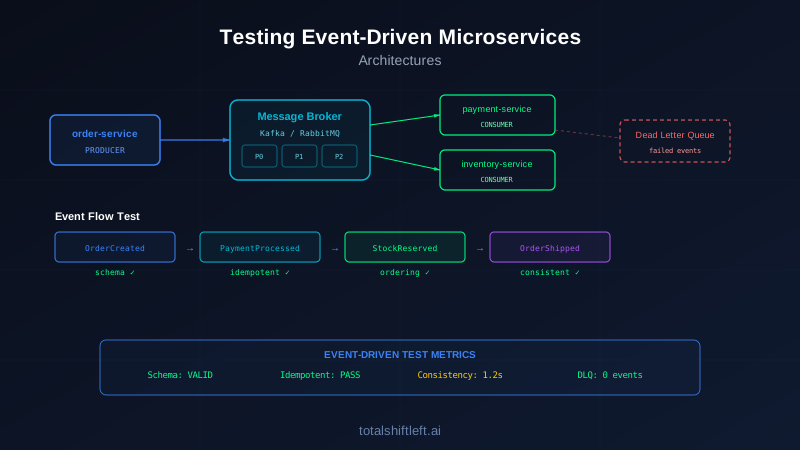
y the full service mesh with real brokers in a staging environment. Use observability tools to verify end-to-end event flows. This is the highest-fidelity test level but the slowest.
┌──────────────────────────────────────────────────────────┐
│           Event-Driven Testing Architecture                │
│                                                           │
│  ┌─────────────┐    ┌─────────────┐    ┌──────────────┐  │
│  │  Producer    │    │   Broker    │    │  Consumer    │  │
│  │  Service     │───▶│  (Kafka/    │───▶│  Service     │  │
│  │             │    │  RabbitMQ)  │    │             │  │
│  └──────┬──────┘    └──────┬──────┘    └──────┬──────┘  │
│         │                  │                  │          │
│  ┌──────▼──────┐    ┌──────▼──────┐    ┌──────▼──────┐  │
│  │  Schema     │    │  DLQ +      │    │  Read Model │  │
│  │  Registry   │    │  Retry      │    │  (DB/Cache) │  │
│  └─────────────┘    └─────────────┘    └─────────────┘  │
│                                                           │
│  Test Infrastructure:                                     │
│  ┌─────────────────────────────────────────────────────┐  │
│  │  Testcontainers: Kafka + Schema Registry + DB       │  │
│  │  Assertions: Awaitility + Consumer polling          │  │
│  │  Monitoring: Consumer lag + DLQ depth               │  │
│  └─────────────────────────────────────────────────────┘  │
└──────────────────────────────────────────────────────────┘
Event-Driven Testing Tools Comparison
| Tool | Purpose | Broker Support | Test Level | CI/CD Speed | Best For |
|---|---|---|---|---|---|
| Testcontainers | Real broker in tests | Kafka, RabbitMQ, Redis, Pulsar | Integration | Medium | Realistic broker testing in CI |
| kafka-streams-test-utils | Stream topology testing | Kafka Streams | Unit | Fast | Kafka Streams processor testing |
| EmbeddedKafka | In-process Kafka | Kafka | Unit / Integration | Fast | Spring Kafka consumer/producer tests |
| Pact (async) | Message contract testing | Any (message-based) | Contract | Fast | Consumer-driven event contracts |
| Schema Registry | Schema validation | Avro, Protobuf, JSON Schema | Unit / Integration | Fast | Event schema compatibility testing |
| Awaitility | Async assertions | N/A (assertion library) | Any | Fast | Eventual consistency assertions |
| WireMock | HTTP trigger simulation | HTTP (triggers events) | Integration | Fast | API-triggered event flow testing |
| Shift-Left API | API endpoint testing | REST (event triggers) | Integration | Fast | Testing REST APIs that produce events |
For most teams, Testcontainers + Awaitility + Schema Registry provides a comprehensive event-driven testing stack. Add Pact for cross-team event contract validation. See our testing tools guide for broader tooling context.
Real-World Example: Order Event Pipeline Testing
An e-commerce platform processes orders through an event pipeline:
order-servicereceives a REST API call, creates an order, publishesOrderCreatedto Kafkapayment-serviceconsumesOrderCreated, processes payment, publishesPaymentProcessedorPaymentFailedinventory-serviceconsumesPaymentProcessed, reserves stock, publishesStockReservedfulfillment-serviceconsumesStockReserved, creates shipping label, publishesOrderShipped
Test 1: End-to-end happy path with Testcontainers
@Testcontainers
class OrderPipelineIntegrationTest {

    @Container
    static KafkaContainer kafka = new KafkaContainer(
        DockerImageName.parse("confluentinc/cp-kafka:7.6.0"));

    @Container
    static PostgreSQLContainer<?> postgres = new PostgreSQLContainer<>("postgres:16");

    @Test
    void orderCreated_flowsThroughPipeline_toShipment() {
        // Submit order via REST API
        OrderResponse order = orderApi.createOrder(newOrderRequest());
        assertThat(order.status()).isEqualTo("CREATED");

        // Verify eventual consistency across the pipeline
        await().atMost(Duration.ofSeconds(15))
               .pollInterval(Duration.ofMillis(500))
               .untilAsserted(() -> {
                   OrderView view = orderQueryApi.getOrder(order.id());
                   assertThat(view.status()).isEqualTo("SHIPPED");
                   assertThat(view.trackingNumber()).isNotNull();
               });
    }
}
Test 2: Payment failure handling
The payment service rejects the payment. Verify the pipeline handles the failure correctly — no stock is reserved, no shipment is created, and the order status reflects the failure.
@Test
void paymentFailed_stopsOrderPipeline() {
    // Configure payment service to reject
    paymentService.setRejectAll(true);

    OrderResponse order = orderApi.createOrder(newOrderRequest());

    await().atMost(Duration.ofSeconds(10))
           .untilAsserted(() -> {
               OrderView view = orderQueryApi.getOrder(order.id());
               assertThat(view.status()).isEqualTo("PAYMENT_FAILED");
           });

    // Verify no downstream events were produced
    List<ConsumerRecord<String, String>> stockEvents =
        kafkaConsumer.poll("stock-events", Duration.ofSeconds(2));
    assertThat(stockEvents).isEmpty();

    // Verify no inventory was reserved
    StockLevel stock = inventoryApi.getStock(testProductId);
    assertThat(stock.reserved()).isZero();
}
Free 1-page checklist
API Testing Checklist for CI/CD Pipelines
A printable 25-point checklist covering authentication, error scenarios, contract validation, performance thresholds, and more.
Download FreeTest 3: Duplicate event idempotency
Simulate Kafka redelivery by manually publishing the same OrderCreated event twice with the same event ID.
Results: The first run of this test revealed that the payment service processed both events, creating two payment attempts for the same order. The idempotency check used the Kafka message offset as the deduplication key — which changes on redelivery. Fix: Changed the deduplication key to the event's business ID (orderId + eventType).
Test 4: Out-of-order event handling
Publish OrderCancelled before OrderCreated (simulating cross-partition arrival).
Results: The fulfillment service threw a NullPointerException because it tried to cancel an order that did not exist in its read model. Fix: Added an event buffer that holds events for entities not yet seen, with a 30-second TTL and fallback to retry from the source topic.
Event-driven API testing challenges and how to solve them
Challenge: Test Execution Time with Real Brokers
Testcontainers spins up real Kafka or RabbitMQ containers, which adds 10-30 seconds of startup time per test class. This slows CI significantly as the test suite grows.
Solution: Use a shared container strategy — start the broker container once per test suite (via @Container with static in JUnit 5) rather than per test class. For unit-level tests, use the kafka-streams-test-utils or embedded broker alternatives. Reserve Testcontainers for integration tests that need realistic broker behavior. Parallelize test classes that use independent topics.
Challenge: Flaky Eventual Consistency Tests
Tests that assert on eventually consistent state are inherently time-dependent. A test that passes with a 5-second timeout on a developer's laptop may fail on a slower CI machine.
Solution: Use generous timeouts (2-3x the expected convergence time) and short poll intervals. Never use Thread.sleep() with a fixed duration — always use polling assertions (Awaitility, eventually{} blocks). If a test is consistently flaky, the convergence SLA may be too aggressive; adjust the system, not the test.
Challenge: Testing Event Schema Evolution
When a producer changes an event schema, existing consumers may break. Testing backward and forward compatibility requires coordinating across teams.
Solution: Use a schema registry with compatibility enforcement. Configure the registry to reject incompatible schema changes. Test schema compatibility in CI before publishing: serialize with the new schema, deserialize with the old schema, and verify no data loss. Use async Pact contracts to formalize cross-team event contracts.
Challenge: Debugging Failed Event Flows
When an end-to-end event flow test fails, identifying which stage failed — and why — is difficult. The failure manifests as a timeout waiting for the final state, with no error message indicating the root cause.
Solution: Add diagnostic assertions at each stage of the pipeline. Instead of only asserting the final state, assert intermediate states with informative failure messages. Log all events consumed and produced during the test. Use correlation IDs (carried through every event) to trace the flow in logs. Consider a test-specific consumer that monitors all topics and logs every event.
Event-driven API testing best practices
- Use real brokers in integration tests — Embedded and in-memory brokers miss critical behaviors (partitioning, consumer groups, offset management, rebalancing); use Testcontainers for realistic testing
- Test idempotent processing explicitly — Publish every event type at least twice in tests and verify the result is the same as processing it once; duplicate delivery is a certainty in production
- Validate event schemas in CI — Register schemas in a test schema registry and validate every published event against the schema; catch schema violations before deployment
- Test out-of-order event delivery — Do not assume events arrive in the order they were produced; explicitly test reversed, interleaved, and duplicated delivery scenarios
- Use polling assertions for eventual consistency — Awaitility (JVM) or retry loops with timeouts; never use fixed-duration sleeps
- Test dead-letter queue behavior — Verify that unprocessable events route to the DLQ, that the DLQ preserves metadata, and that events can be replayed after fixes
- Test consumer lag under load — Run events through the pipeline at production-level throughput and verify consumers keep up; consumer lag is the leading indicator of event-driven system health
- Test partition rebalancing — Simulate consumer group changes (adding/removing consumers) during event processing and verify no events are lost or processed twice
- Implement event tracing — Add correlation IDs to every event and propagate them through the entire pipeline; use these for debugging test failures and production issues
- Combine event testing with API testing — Test the REST APIs that trigger event production and the APIs that query the eventual read models; the API surface is where users and systems interact with the event-driven backend
Event-Driven Testing Checklist
- ✔ Event producer tests verify correct schema, routing, and content for all event types
- ✔ Event consumer tests verify correct processing, state updates, and downstream event production
- ✔ Idempotency tested — duplicate events produce the same result as a single event
- ✔ Out-of-order delivery tested — consumers handle events arriving in non-ideal sequence
- ✔ Dead-letter queue tested — malformed and rejected events route to DLQ with metadata
- ✔ DLQ replay tested — events can be reprocessed from DLQ after fixes
- ✔ Eventual consistency tested with polling assertions and defined SLA timeouts
- ✔ Schema compatibility validated in CI (backward and forward compatibility)
- ✔ Schema registry enforcing compatibility rules for all event topics
- ✔ Consumer lag monitored and tested under production-level throughput
- ✔ Partition rebalancing tested — no event loss during consumer group changes
- ✔ End-to-end pipeline tested with Testcontainers (real broker + real services)
- ✔ Correlation IDs implemented and propagated through all events
- ✔ Fault injection applied to broker connections (latency, partition loss)
- ✔ API triggers and query endpoints validated with Shift-Left API
Event-driven API testing FAQ
What is event-driven microservices testing?
Event-driven microservices testing validates that services communicating through asynchronous events — via message brokers like Kafka, RabbitMQ, or Amazon SNS/SQS — produce, consume, and process events correctly. It covers event schema validation (ensuring events conform to registered schemas), message ordering (handling events that arrive out of expected sequence), idempotent processing (handling duplicate deliveries without side effects), eventual consistency verification (confirming read models converge within SLA), and failure handling for dead-letter queues (routing unprocessable events safely).
How do you test eventual consistency in event-driven systems?
Eventual consistency is tested by performing a write operation (publishing an event or executing a command), then polling the read model with a timeout and assertion interval until the expected state is reached. Use libraries like Awaitility (JVM) or polling assertions with configurable timeouts. The test verifies both that the state eventually converges to the correct value and that it converges within the system's SLA. For example, after publishing an OrderCreated event, poll the order query API every 200ms for up to 5 seconds until the order appears.
What tools support event-driven microservices testing?
Key tools include Testcontainers for spinning up real Kafka, RabbitMQ, or Redis Streams containers in integration tests, the kafka-streams-test-utils library for testing Kafka Streams topologies without a broker, Pact for asynchronous message contract testing between producer and consumer teams, schema registry tools (Confluent, Apicurio) for event schema validation and compatibility enforcement, Awaitility for polling-based eventual consistency assertions, and WireMock for simulating HTTP-triggered event flows. Shift-Left API supports testing the REST APIs that trigger event production and query eventual read models.
How do you test idempotent event processing?
Idempotent processing is tested by publishing the same event multiple times (typically with the same event ID or business key) and verifying that the consumer produces the correct result exactly once. For example, publishing three identical OrderCreated events should result in one order record, not three. The test must verify both the final state (one order exists) and that side effects (database writes, downstream events, external API calls) occurred only once. Use business-level identifiers — not broker-level offsets — as deduplication keys.
What is CQRS testing?
CQRS (Command Query Responsibility Segregation) testing validates that commands (writes) and queries (reads) are handled correctly through separate models. Test that commands produce the expected events, that events update the read model correctly, that the read model eventually reflects all processed events, and that queries against the read model return consistent results. The async gap between command execution and query availability is the primary testing challenge — use polling assertions to bridge this gap while respecting the system's convergence SLA.
How do you handle message ordering in event-driven tests?
Message ordering tests verify that events are processed in the correct sequence when order matters. In Kafka, ordering is guaranteed within a partition — test that events with the same partition key (e.g., order ID) are processed sequentially. For cross-partition scenarios where events may arrive out of order, test that the consumer handles this correctly using techniques like version numbers (reject events with lower version than current state), timestamps (process only events newer than current state), or idempotent operations that produce the same result regardless of order.
Sources and further reading
- AsyncAPI Specification — the event-driven equivalent of OpenAPI.
- Apache Kafka documentation — the broker semantics async tests have to respect.
- Testcontainers — throwaway real dependencies for integration tests.
Key takeaways
- Testing event-driven microservices demands a fundamentally different approach from synchronous service testing.
- Asynchrony, eventual consistency, ordering semantics, and invisible failure modes require purpose-built test infrastructure — real brokers via Testcontainers, polling assertions for eventual consistency, explicit idempotency validation, and dead-letter queue verification.
- The common failures in event-driven systems — duplicate processing, out-of-order events, silent data loss, schema incompatibilities — are all preventable with systematic testing.
- Start with producer and consumer tests using Testcontainers and a schema registry.
- Add idempotency and ordering tests. Build end-to-end pipeline tests. Layer in fault injection and chaos testing to validate resilience under adverse conditions.
Build reliable event-driven systems from day one. Try Shift-Left API free to validate the REST APIs that trigger and query your event-driven pipelines — ensuring your API layer is solid before events flow.
Ready to shift left with your API testing?
Try our no-code API test automation platform free.