
8 Best gRPC Testing Tools in 2026
Quick answer
The best gRPC testing tools split into three categories: manual/GUI clients for exploration (grpcurl, grpcui, Postman and Insomnia's native gRPC support, Evans), load testing (ghz, k6's k6/net/grpc module), and language-native test frameworks (grpc-java's testing utilities, Python's grpcio test channel). gRPC's binary Protobuf format and HTTP/2 transport mean it needs its own tooling rather than a plain HTTP client — most general-purpose API testing platforms treat it as adapter territory rather than a fully generated protocol the way they treat REST or OpenAPI.
Reviewed by Sushant Joshi
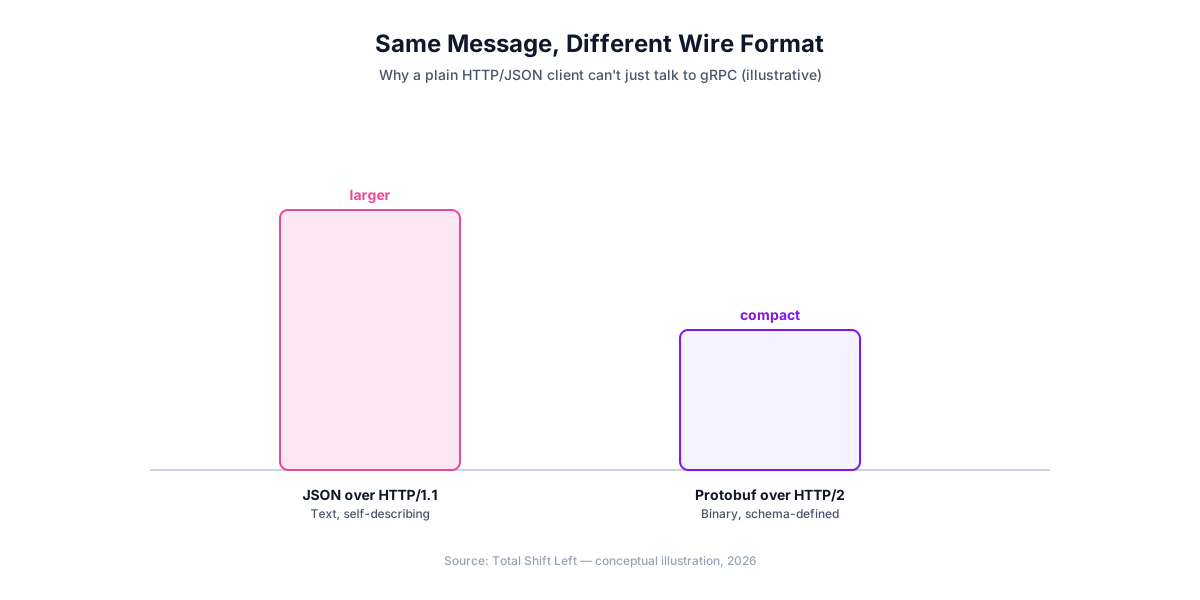
gRPC testing tools exist as their own category because gRPC doesn't speak plain JSON over HTTP/1.1 the way REST does — it uses compact binary Protocol Buffer messages over HTTP/2, which means a standard REST client can't send or read a gRPC call without dedicated support for both. This is a neutral roundup of the tools that actually handle that correctly, across manual exploration, load testing, and language-native test frameworks.
In this guide
- gRPC testing tools compared
- Manual and GUI Clients
- Load Testing Tools
- Language-Native Test Frameworks
- Where General API Testing Platforms Actually Stand with gRPC
- Calling and load-testing a gRPC service
- What makes gRPC testing different
- The four call types and what each test needs
- Deadlines, cancellation and metadata
- Common mistakes when testing gRPC
- Frequently asked questions about gRPC testing
- Contract testing a gRPC service
- Testing streaming methods
gRPC testing tools compared
| Tool | Category | Interface | Best for |
|---|---|---|---|
| grpcurl | Manual client | CLI | Scripted or ad-hoc calls from a terminal |
| grpcui | Manual client | Web UI | Interactive exploration of a service's methods |
| Postman | Manual client | GUI | Teams already using Postman for REST/GraphQL wanting gRPC in the same app |
| Insomnia | Manual client | GUI | Same use case as Postman, for teams standardized on Insomnia |
| Evans | Manual client | Interactive REPL | Terminal-based interactive exploration and scripting |
| ghz | Load testing | CLI | Dedicated gRPC load and benchmark testing |
| k6 (k6/net/grpc) | Load testing | JavaScript | Scripted gRPC load tests alongside existing k6 HTTP suites |
| grpc-java / grpcio test utilities | Language-native | Code (Java/Python) | In-process functional testing without a real network call |
The assertions change when the protocol does — REST vs GraphQL vs gRPC testing covers what transfers and what does not.
Manual and GUI Clients
- grpcurl — the gRPC equivalent of
curl: a command-line tool that calls a gRPC method and prints the response, using either server reflection or a.protofile to understand the service's methods and message types. - grpcui — wraps the same underlying capability as grpcurl in a local web interface, similar to how Swagger UI sits on top of an OpenAPI spec (Swagger vs Postman covers that pairing) — useful for exploring a service interactively rather than constructing CLI flags for each call.
- Postman — added native gRPC request support, including reflection-based method discovery, so teams already using Postman for REST and GraphQL can add gRPC calls in the same app.
- Insomnia — has equivalent first-class gRPC support to Postman's, for teams standardized on Insomnia instead.
- Evans — an interactive REPL client for gRPC, useful for scripting a sequence of calls or exploring a service conversationally from the terminal rather than one grpcurl invocation at a time.
Load Testing Tools
- ghz — a dedicated CLI tool built specifically for gRPC load and benchmark testing, in the same spirit as
heyorwrkfor plain HTTP — point it at a method with a request payload and concurrency setting, and it reports latency percentiles and throughput. For the HTTP side of the same job, see the best API load testing tools. - k6 — supports gRPC natively via its
k6/net/grpcmodule, letting you script gRPC load tests with the samecheck()/thresholdspattern covered in our k6 load testing tutorial, useful for teams wanting gRPC and HTTP load tests in one consistent scripting language.
Language-Native Test Frameworks
For functional (not load) testing of a gRPC service from within its own codebase, both major gRPC language implementations provide testing utilities that avoid a real network call entirely:
- grpc-java — provides in-process test channel utilities that let a JUnit test call a gRPC service directly through an in-memory channel, avoiding real network overhead while still exercising the actual service implementation and Protobuf (de)serialization.
- grpcio (Python) — similarly provides a test channel for calling a gRPC service in-process from a
pytestsuite, the gRPC-specific counterpart to therequests-based tests covered in our pytest tutorial.
Where General API Testing Platforms Actually Stand with gRPC
Worth being direct about, since it's a common point of confusion when evaluating tools: most platforms marketed broadly as "API testing" or "AI API testing" — Total Shift Left included — treat gRPC as adapter or pass-through territory rather than a protocol they fully parse and generate test suites for the way they do with REST/OpenAPI, SOAP/WSDL, or GraphQL schemas. That's a real, structural difference from those three protocols, not a minor feature gap, and it's worth confirming directly with any vendor rather than assuming "API testing platform" implies full gRPC coverage.
That gateway layer, by contrast, is ordinary REST surface — how to generate API tests from an OpenAPI spec applies to it unchanged. For teams whose gRPC services sit behind a REST/JSON gateway (the grpc-gateway pattern many gRPC architectures use at their edge specifically so external clients don't need gRPC-aware tooling), that gateway layer is fully testable with standard REST tools and spec-driven generators. For the internal gRPC layer itself, the dedicated tools in this guide are the more complete fit today.
Ready to shift left with your API testing?
Try our no-code API test automation platform free. Generate tests from OpenAPI, run in CI/CD, and scale quality.
Calling and load-testing a gRPC service
gRPC testing starts with reflection: if the server exposes it, you can list and call every method without a local copy of the proto files:
# discover the surface
grpcurl -plaintext localhost:50051 list
grpcurl -plaintext localhost:50051 describe orders.OrderService

# call a method
grpcurl -plaintext -d '{"sku":"A-1","qty":2}' \
  localhost:50051 orders.OrderService/CreateOrder

# without reflection, point at the proto instead
grpcurl -import-path ./proto -proto orders.proto -plaintext \
  -d '{"id":"42"}' localhost:50051 orders.OrderService/GetOrder
For load, k6 speaks gRPC natively, so the same thresholds you use for HTTP apply to a streaming service:
// load.js — k6 run load.js
import grpc from 'k6/net/grpc';
import { check } from 'k6';

const client = new grpc.Client();
client.load(['./proto'], 'orders.proto');

export const options = {
  vus: 50, duration: '2m',
  thresholds: { grpc_req_duration: ['p(99)<300'], checks: ['rate>0.99'] },
};

export default () => {
  client.connect('localhost:50051', { plaintext: true });
  const r = client.invoke('orders.OrderService/CreateOrder', { sku: 'A-1', qty: 2 });
  check(r, { 'status OK': (x) => x.status === grpc.StatusOK });
  client.close();
};
What makes gRPC testing different
Four properties change what a test has to do, and they explain why general-purpose API tooling struggles here.
The contract is compiled, not described, which changes what contract testing has to do here. A .proto file generates client and server code, so a mismatch between the two sides is usually a build failure rather than a runtime surprise. That removes a whole class of bug REST testing spends effort on — and it means your tests need the same generated stubs the application uses, or a tool that can reflect the service to discover them.
The wire format is binary. You cannot eyeball a request in a proxy log or hand-craft one with curl. Every tool in this space exists partly to solve that visibility problem.
Errors are status codes, not response bodies. gRPC returns a status like INVALID_ARGUMENT, NOT_FOUND or PERMISSION_DENIED, optionally with details. Assertions go against the status code and the details, not against a JSON error envelope — the negative cases in how to write API test cases map across once you swap the status set.
Streaming is first class. Four call types exist, and three of them have no REST equivalent, so they have no established testing pattern to borrow.
The four call types and what each test needs
| Call type | Shape | What the test has to assert |
|---|---|---|
| Unary | One request, one response | Response contents, status code — closest to REST |
| Server streaming | One request, many responses | Message order, count, and that the stream terminates |
| Client streaming | Many requests, one response | That the server aggregates correctly, and handles an early client close |
| Bidirectional | Many both ways | Interleaving, backpressure, and who closes first |
The failure modes that matter live in the last three rows, and they are all about termination rather than content. A stream that never closes hangs a client; a stream that closes early truncates data silently. Both pass a naive test that only checks the first message.
Two rules make streaming tests reliable. Always assert the terminal condition — that the stream ended, and with which status. And always bound the test with a deadline, so a hung stream fails in seconds rather than blocking the suite until CI times out.
Deadlines, cancellation and metadata
Three gRPC concepts have no direct REST analogue and are routinely untested.
Deadlines propagate. A client sets a deadline; it travels with the call and, in a well-built system, is respected by downstream services. Testing this means asserting that a call exceeding its deadline returns DEADLINE_EXCEEDED promptly rather than running to completion server-side. Services that ignore propagated deadlines keep doing expensive work for a client that has already given up.
Cancellation is observable. When a client cancels, a correct server stops work. Verifying that requires instrumenting the server side, and it is worth doing for any expensive operation.
Metadata is where auth lives. gRPC metadata carries the equivalent of headers, including bearer tokens. The authorization tests are the same in spirit as REST — missing token, expired token, valid token with insufficient scope — but they assert UNAUTHENTICATED and PERMISSION_DENIED statuses rather than 401 and 403.
Common mistakes when testing gRPC
Testing through a REST gateway only. Many services expose gRPC and a JSON transcoding gateway. Testing only the gateway leaves the actual gRPC surface — the one other services use — unverified, and the two paths do not always enforce the same rules.
Relying on reflection in production. Server reflection makes CLI tools work without a local .proto, which is excellent in development. Whether it should be enabled in production is a deliberate decision, and tests should assert whichever answer you chose.
Asserting on error message strings. Messages are not part of the contract and change without notice. Assert on the status code, and on typed error details if you use them.
Ignoring message size limits. gRPC applies a default maximum message size. A payload that grows past it fails at the transport layer with an error that looks nothing like a validation failure. Test near the boundary if your messages can grow.
Free Guided worksheet
Build Your Testing Strategy in 30 Minutes
A structured worksheet that walks you through defining your testing strategy in 30 minutes. Cover architecture, tools, layers, and team responsibilities.
Download FreeAssuming a general API platform covers it. As noted above, broad "API testing" tools frequently treat gRPC as adapter territory rather than a protocol they parse and generate suites for. Confirm what a vendor actually does with a .proto file before assuming coverage — the dedicated tools in this guide exist because that gap is real.
Frequently asked questions about gRPC testing
Why can't I just test a gRPC service like a REST API? gRPC uses Protocol Buffers (a compact binary format) over HTTP/2, not plain JSON over HTTP/1.1 — a standard HTTP client and JSON body won't work without a gRPC-aware client that can encode and decode Protobuf messages and speak HTTP/2's framing, which is why gRPC needs its own tooling rather than reusing a REST testing stack directly.
What is the difference between grpcurl and grpcui? grpcurl is a command-line tool — the gRPC equivalent of curl — for scripted or ad-hoc calls from a terminal. grpcui wraps the same underlying capability in a local web interface, similar to how Swagger UI sits on top of an OpenAPI spec, useful for exploring a service's methods interactively rather than via CLI flags.
Can Postman test gRPC APIs? Yes — Postman added native gRPC request support, including reflection-based method discovery similar to grpcurl, so you can build and send gRPC calls from the same app used for REST and GraphQL testing, without switching tools for that part of the workflow.
How do I load test a gRPC service?
ghz is a dedicated CLI tool built specifically for gRPC load testing, similar in spirit to hey or wrk for HTTP. k6 also supports gRPC natively through its k6/net/grpc module, letting you script gRPC load tests the same way as the HTTP examples in our k6 load testing tutorial.
Does Total Shift Left support gRPC testing? Total Shift Left's fully generated, spec-driven test creation targets REST, SOAP, and GraphQL. gRPC support is adapter-based rather than a fully generated protocol the way those three are — for dedicated gRPC test authoring and exploration, the tools in this guide (grpcurl, grpcui, Postman/Insomnia's gRPC support, ghz) are the more complete fit today.
My service uses gRPC internally but exposes REST at the edge — how should I test it? Many gRPC-based architectures expose a REST/JSON gateway (the grpc-gateway pattern) at the edge specifically so external clients and standard REST tooling can integrate without needing gRPC-aware clients. If that gateway is part of your API surface, it can be tested with any standard REST testing tool or a spec-driven generator — the gRPC-specific tools in this guide are for testing the internal gRPC layer directly.
Contract testing a gRPC service
The protobuf schema is the contract, and its compatibility rules are stricter and less forgiving than OpenAPI's — because the wire format identifies fields by number, not by name.
// proto/orders.proto
syntax = "proto3";
package orders;

message Order {
  string id     = 1;
  string sku    = 2;   // renaming this is safe: the number is the contract
  int32  qty    = 3;
  string status = 4;

  reserved 5, 6;                  // retired numbers, never to be reused
  reserved "legacy_total";        // and the retired name, so it cannot come back
}
That means the highest-value gRPC test runs before anything is deployed — a schema-compatibility check in CI:
# .github/workflows/proto-compat.yml
name: Proto compatibility
on: pull_request
jobs:
  breaking:
    runs-on: ubuntu-latest
    steps:
      - uses: actions/checkout@v4
        with: { fetch-depth: 0 }
      - uses: bufbuild/buf-setup-action@v1
      - name: Lint the schema
        run: buf lint
      - name: Fail on breaking changes against main
        run: buf breaking --against ".git#branch=origin/${{ github.base_ref }}"
buf breaking catches the changes that no runtime test will announce: a reused field number, a changed field type, a removed enum value. A gRPC service without this check has no contract gate at all, whatever its test coverage looks like.
Testing streaming methods
Unary calls test like any other request/response API. Streaming is where gRPC needs assertions nothing in a REST suite prepares you for.
# tests/test_streaming.py
import grpc, pytest
from orders_pb2 import WatchRequest, OrderUpdate
from orders_pb2_grpc import OrderServiceStub

def test_server_stream_delivers_in_order_and_terminates(channel, seed_orders):
    stub = OrderServiceStub(channel)
    seen = []
    for update in stub.WatchOrders(WatchRequest(since_seq=0), timeout=10):
        seen.append(update.seq)
        if len(seen) >= 10:
            break
    assert seen == sorted(seen), "updates arrived out of order"
    assert len(set(seen)) == len(seen), "duplicate sequence numbers"

def test_client_stream_is_atomic(channel):
    """A stream that fails midway must not leave half the batch applied."""
    stub = OrderServiceStub(channel)
    def gen():
        yield OrderUpdate(id="1", qty=1)
        yield OrderUpdate(id="2", qty=-1)     # invalid, mid-stream
    with pytest.raises(grpc.RpcError) as e:
        stub.BulkUpdate(gen())
    assert e.value.code() == grpc.StatusCode.INVALID_ARGUMENT
    assert stub.GetOrder(GetOrderRequest(id="1")).qty != 1, "partial batch was applied"

def test_deadline_is_honoured(channel):
    stub = OrderServiceStub(channel)
    with pytest.raises(grpc.RpcError) as e:
        list(stub.WatchOrders(WatchRequest(since_seq=0), timeout=0.5))
    assert e.value.code() == grpc.StatusCode.DEADLINE_EXCEEDED
Three properties to cover on every streaming method: ordering, mid-stream failure semantics, and deadline handling. The second is the one that produces the worst production bugs, because a partially-applied batch is silent until somebody reconciles the data.
Sources and further reading
- gRPC documentation — the protocol, IDL and tooling reference.
- Protocol Buffers language guide — the schema evolution rules gRPC contracts depend on.
- Grafana k6 documentation — scripted load testing with thresholds you can gate on.
Key takeaways
- gRPC needs its own tooling — Protocol Buffers over HTTP/2 isn't something a plain REST client or JSON body can speak.
- grpcurl/grpcui are the closest gRPC equivalents to curl/Swagger UI for manual exploration.
- Postman and Insomnia both added native gRPC support, useful for teams wanting one app across REST, GraphQL, and gRPC.
- ghz and k6's
k6/net/grpcmodule cover gRPC load testing the same way JMeter and k6 itself cover HTTP. - Most general API testing platforms — Total Shift Left included — treat gRPC as adapter territory, not a fully generated protocol like REST or GraphQL. Confirm this directly with any vendor rather than assuming.
- A REST gateway in front of a gRPC service is testable with standard tools even when the internal gRPC layer needs dedicated ones.
Ready to shift left with your API testing?
Try our no-code API test automation platform free.