
Test Data Management Tools: 22 Options by Job (2026)
Quick answer
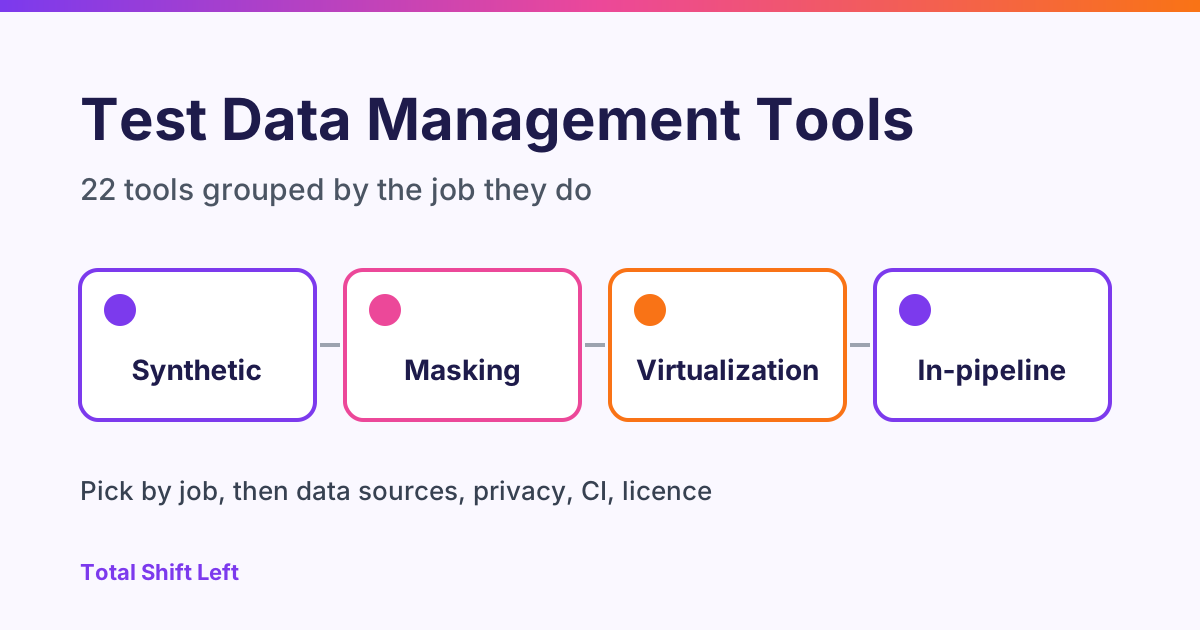
Test data management tools fall into four jobs: synthetic data generation (GenRocket, Mockaroo, Faker), masking and subsetting of production data (Delphix, K2view, Tonic, Broadcom Test Data Manager, IBM Optim), service virtualization (WireMock, Mountebank, Hoverfly) and in-pipeline data (Testcontainers, seed scripts). Pick by job first, then by data sources, privacy needs, CI automation and licence model.
Reviewed by Parveen Kumari
Part of the Test Data & API Mocking hub. Start with the pillar guide: Test data management best practices.
Test data management tools create, protect and deliver the data your tests need. That covers very different jobs: generating synthetic records, masking and subsetting production databases, simulating services you can't call, and seeding a fresh database for every pipeline run. Most "best TDM tools" lists mix these together, which is why they're hard to use. This roundup groups 22 tools by the job they do, with the licence model for each, so you can shortlist in minutes.
If you are still deciding on your approach (synthetic or masked production data, who owns refreshes, how compliance works), start with our test data management best practices and come back here to pick tools.
Test data management tools at a glance
| Tool | Job | Licence and pricing model | Best for |
|---|---|---|---|
| GenRocket | Synthetic generation | Commercial, quote-based | Rule-driven synthetic data at enterprise scale, generated in CI |
| Tonic.ai (Tonic Structural) | Masking, subsetting, synthesis | Commercial, quote-based | De-identifying relational and NoSQL databases for developer and test use |
| Mockaroo | Synthetic generation | Freemium SaaS (free tier with limits; paid plans) | Quick realistic CSV, JSON or SQL datasets without code |
| Faker (Python) | Synthetic generation | Open source (MIT) | Fake values inside Python test code |
Faker.js (@faker-js/faker) | Synthetic generation | Open source (MIT) | Fake values inside JavaScript and TypeScript tests |
| Datafaker | Synthetic generation | Open source (Apache 2.0) | Fake values inside Java and Kotlin tests |
| SDV (Synthetic Data Vault) | Synthetic generation (statistical models) | Source-available (Business Source License) | Synthetic tables that keep the statistical shape of real data |
| Delphix (Perforce) | Masking, virtual copies, provisioning | Commercial, quote-based | Fast, space-efficient database copies with masking, on request |
| K2view | Masking, subsetting, provisioning | Commercial, quote-based | Entity-based data (all data for one customer) across many systems |
| Broadcom Test Data Manager | Masking, subsetting, synthetic generation | Commercial, quote-based | Large enterprises already on Broadcom's testing tools |
| IBM InfoSphere Optim | Subsetting, masking, archiving | Commercial, quote-based | Mainframe and large relational estates |
| Informatica Test Data Management | Masking, subsetting, provisioning | Commercial, quote-based | Teams already using Informatica for data integration |
| PostgreSQL Anonymizer | Masking | Open source (PostgreSQL licence) | Declarative masking rules inside PostgreSQL |
| Greenmask | Masking, dump and restore | Open source (Apache 2.0) | Masked PostgreSQL dumps for test environments |
| Jailer | Subsetting | Open source (Apache 2.0) | Referentially intact slices of relational databases |
| WireMock | Service virtualization (HTTP) | Open source (Apache 2.0); WireMock Cloud is commercial | Stubbing HTTP APIs in Java and as a standalone server |
| Mountebank | Service virtualization (multi-protocol) | Open source (MIT) | HTTP, HTTPS and TCP imposters from any language |
| Hoverfly | Service virtualization (capture and simulate) | Open source (Apache 2.0) | Recording real traffic and replaying it as a simulation |
| Microcks | API mocking and contract testing | Open source (Apache 2.0) | Mocks generated from OpenAPI, AsyncAPI, GraphQL and gRPC definitions |
| Broadcom Service Virtualization | Service virtualization | Commercial, quote-based | Enterprise virtual services across many protocols |
| Parasoft Virtualize | Service virtualization | Commercial, quote-based | Virtual services and test data alongside Parasoft's testing suite |
| Testcontainers | In-pipeline databases and services | Open source (MIT) | Throwaway, real databases per test run in CI |
We list licence models, not prices. Commercial TDM vendors generally quote per deployment, and prices change; check each vendor's site for current terms.
How we evaluated
We built this list from vendor documentation, public repositories and licence files. We also drew on our own experience building test data for API test suites. We did not run a lab benchmark, and nobody paid to be included. For each tool we looked at:
- Job fit. Which of the four jobs it does well, rather than lists on a feature page.
- Data sources. Which databases, file formats and APIs it reads and writes.
- Referential integrity. Whether masked, subset or generated data keeps foreign keys and cross-system links consistent.
- Privacy controls. Masking functions, consistent (deterministic) masking across tables, and support for GDPR or HIPAA-driven policies.
- Automation. A CLI, API or CI integration, so data can be created per pipeline run rather than requested by ticket.
- Deployment. SaaS, self-hosted, or a library inside your test code.
- Licence model. Open source licence, source-available, freemium or commercial.
We left out tools we couldn't verify from public sources, and tools whose main job is something else (general ETL, backup).
Synthetic test data generation tools
Synthetic data is invented, so it contains no real personal data and can be created on demand. It is the default choice for automated API tests. For a deeper comparison of synthetic and production-derived data, see synthetic test data vs production data.
Libraries: Faker, Faker.js and Datafaker
If your tests are code, start here. These libraries generate realistic names, emails, addresses, dates, IDs and more, with locale support and seeds for repeatable output.
from faker import Faker

fake = Faker("en_GB")
Faker.seed(42)            # same data every run

customer = {
    "name": fake.name(),
    "email": fake.unique.email(),
    "postcode": fake.postcode(),
    "createdAt": fake.date_time_this_year().isoformat(),
}
Generate test data variants from your spec (free)
Free, runs in your browser, no sign-up needed.
Use when: each test creates its own data through the API or a factory. Not for: data that must keep real-world distributions or link across many tables.
Mockaroo
A browser-based generator with a large library of field types. You define a schema in the UI and download CSV, JSON, SQL or Excel. You can also call its API to generate data from a saved schema. It suits testers who need a realistic file quickly and don't want to write code. The free tier has limits on rows and API calls.
GenRocket
A commercial platform built around rules and "generators" that produce synthetic data in real time, including complex relationships and edge cases. Data is generated by test cases in the pipeline rather than copied from production. It fits large enterprises that want synthetic data to replace masked copies entirely.
SDV (Synthetic Data Vault)
A Python library from DataCebo that learns statistical models from real tables and samples new rows with similar distributions and correlations. Useful for analytics and ML testing, where the shape of the data matters. Check the licence terms for your use: SDV is source-available under the Business Source License, not a standard open source licence.
Generating from the API schema
For API testing specifically, your OpenAPI schema is already a data generator. Types, formats, enums, patterns and min/max values tell a tool exactly which valid, boundary and invalid values to send. See our test data generation tools for API testing for schema-driven options.
Masking, subsetting and provisioning tools
These tools start from production data and make it safe and small enough for testing. They earn their cost when tests need realistic data with real-world quirks that spans many systems, or when regulators require that test data be traceable to masked production records.
| Tool | What stands out |
|---|---|
| Delphix (now part of Perforce) | Creates virtual database copies that share storage, so a full-size test copy can be provisioned or rewound in minutes. Masking is built in. |
| K2view | Organizes data by business entity (a customer, an order). It pulls each entity's records from many source systems, masks them consistently and delivers them to a test environment. |
| Tonic.ai | Tonic Structural de-identifies databases with consistent masking and can subset or synthesize. Tonic Textual handles unstructured text. Common with developer teams that want production-like data without PII. |
| Broadcom Test Data Manager | Formerly CA Test Data Manager. Combines masking, subsetting and synthetic generation, with a self-service portal. |
| IBM InfoSphere Optim | Long-established subsetting, masking and archiving, with strong support for mainframe (Db2 for z/OS) and large relational estates. |
| Informatica Test Data Management | Masking, subsetting and provisioning that fits into Informatica's data integration platform. |
| PostgreSQL Anonymizer | A PostgreSQL extension. You declare masking rules as security labels on columns, then export a masked dump or apply dynamic masking per role. |
| Greenmask | A PostgreSQL dump-and-restore tool that applies masking transformations during the dump, so masked copies are easy to automate. |
| Jailer | Extracts a referentially intact subset of a relational database (follow the foreign keys from a set of root rows), for smaller, faster test databases. |
Questions to ask any vendor in this group: Is masking deterministic across tables and systems, so the same customer masks to the same value everywhere? How are new columns detected so PII doesn't slip through after a schema change? Can a pipeline request a fresh copy through an API, without a ticket?
Service virtualization and API mocking tools
Sometimes the best test data is no data: when a test depends on a payment provider, a mainframe or a partner API, you simulate it and control exactly what it returns. These tools answer the "virtualization" part of TDM. For the full comparison of mocking tools, see API mocking tools.
| Tool | What stands out |
|---|---|
| WireMock | A widely used HTTP stubbing tool for Java that also runs standalone or in Docker. Request matching, response templating, fault injection and record-and-playback. |
| Mountebank | "Imposters" for HTTP, HTTPS and TCP, configured over a REST API, so it works from any language. |
| Hoverfly | Captures real traffic through a proxy, then simulates it, which makes it quick to build realistic virtual services. |
| Microcks | Generates mocks from OpenAPI, AsyncAPI, GraphQL, gRPC and Postman definitions and runs contract tests against them. A CNCF project. |
| Broadcom Service Virtualization | Enterprise virtual services across HTTP, messaging and legacy protocols, with record-and-replay and data-driven responses. |
| Parasoft Virtualize | Virtual services and test data management alongside Parasoft's functional and performance testing tools. |
Virtualization doesn't replace real test data for the system under test. It removes the need for data in the systems around it.
Free 1-page checklist
API Testing Checklist for CI/CD Pipelines
A printable 25-point checklist covering authentication, error scenarios, contract validation, performance thresholds, and more.
Download FreeIn-pipeline test data: Testcontainers, seeds and data-driven tests
The most reliable API test suites create the data they need at the start of each run and throw it away at the end. That isn't a product category, but it is where most API test data actually comes from.
- Testcontainers starts real databases, message brokers and other services in Docker for each test run, with libraries for Java, .NET, Go, Node.js, Python and more. Combine it with migrations and seed scripts and every run starts from a known state.
- Seed scripts and factories create the minimum data each test needs through your API or ORM. They are fast, readable and easy to review.
- Data-driven tests run the same test against many rows of input and expected output, so one test covers a whole equivalence class.
In Shift-Left API, data sources connect tests to PostgreSQL, MySQL, SQL Server, Oracle, SQLite or MongoDB, as well as CSV, Excel, JSON files and REST APIs. Database connections are read-only, and tests read the source at run time. That lets a masked or seeded database prepared by any of the tools above feed API tests directly. Each test bound to a dataset runs once per row, with its own expected values.
Try data-driven API tests on your own spec. Start a free trial, import an OpenAPI file, and bind a generated test to a CSV or database data source to see one test run per row.
How to choose a test data management tool
Work through these questions in order. Most teams end up with two or three tools, one per job, not one platform for everything.
| Question | If yes | If no |
|---|---|---|
| Do tests need production-like data that spans many systems? | Shortlist masking and provisioning tools (Delphix, K2view, Tonic, Broadcom, IBM, Informatica) | Prefer synthetic generation |
| Is the data subject to GDPR, HIPAA, PCI DSS or similar rules? | Require deterministic masking, PII discovery and audit trails | Synthetic libraries may be enough |
| Do tests run in CI on every pull request? | Require an API or CLI to create data per run; consider Testcontainers plus seeds | A self-service portal may be fine |
| Are dependencies unavailable, slow or costly to call? | Add service virtualization (WireMock, Mountebank, Hoverfly, Microcks) | Call real sandboxes |
| Is the main database PostgreSQL? | Try PostgreSQL Anonymizer or Greenmask before buying | Check vendor support for your databases |
| Do you need mainframe data? | Look at IBM Optim, Broadcom TDM or K2view | Skip mainframe-focused tools |
| Is budget the main constraint? | Combine open source: Faker, Jailer, PostgreSQL Anonymizer, WireMock, Testcontainers | Run a proof of concept with two commercial vendors |
Then run a two-week proof of concept with your real schema, not the vendor's demo database. Measure three things: how long it takes to get a fresh, compliant dataset into a test environment; whether referential integrity holds; and whether your pipeline can request data without a person in the loop. For organization-wide rollout, see our enterprise test data management strategy.
Test data management tools FAQ
What are test data management tools?
Test data management (TDM) tools create, copy, protect and deliver the data that tests need. Depending on the tool, that means generating synthetic records, masking or subsetting production databases, provisioning copies to test environments on demand, or simulating dependent services so tests don't need their data at all.
Are there open source test data management tools?
Yes, for most jobs. Faker, Faker.js and Datafaker generate synthetic values; PostgreSQL Anonymizer and Greenmask mask PostgreSQL data; Jailer subsets relational databases; WireMock, Mountebank, Hoverfly and Microcks virtualize services; Testcontainers starts throwaway databases in CI. What open source rarely gives you is one console that does all of it across many database types.
What is the difference between test data management and test data generation?
Test data generation creates new data, usually synthetic. Test data management is the wider discipline: deciding which data each test needs, where it comes from (synthetic, masked production, or virtualized), how it is kept compliant, how it is refreshed and how it reaches each environment and pipeline run.
Is there a Gartner Magic Quadrant for test data management?
Check Gartner's current research index directly, because report types and coverage change from year to year. Vendors often cite a Gartner report in their marketing; ask them for the exact report title and year, and weigh it alongside a hands-on trial against your own databases.
Which test data management tool is best for API testing?
For API tests that run in CI, the best fit is usually lightweight: synthetic data from a library or the API's own schema, seeded into a throwaway database per run, with mocks for third-party dependencies. Enterprise masking and provisioning tools earn their cost when tests need realistic, referentially intact data drawn from many production systems.
Sources and further reading
- Perforce Delphix: data virtualization and masking.
- K2view Test Data Management: entity-based TDM.
- Tonic.ai documentation: Tonic Structural and Tonic Textual.
- GenRocket: synthetic test data platform.
- Broadcom Test Data Manager documentation.
- Faker, Faker.js, Datafaker and SDV.
- Mockaroo.
- PostgreSQL Anonymizer, Greenmask and Jailer.
- WireMock, Mountebank, Hoverfly and Microcks.
- Testcontainers.
- GDPR Recital 26: why pseudonymised (masked) data can still be personal data.
Ready to shift left with your API testing?
Import your OpenAPI spec and get a runnable test suite, in our cloud or on your own infrastructure.